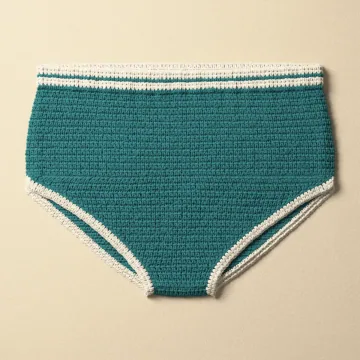
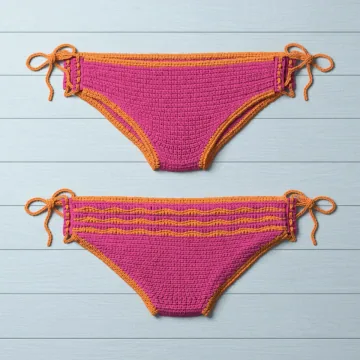
Bandeau bikini with a high waist crochet pattern
Crochet, 33½ in at the top, 2 colors, easy
Size: M, to fit waist 29 in (73.5 cm) Change size
Which size? Size chart for clothes
PDF. Prints on US Letter and A4.
What you need
- Yarn A oliveabout 625 yd (572 m), an estimatemain color
- Yarn B creamabout 275 yd (251 m), an estimatecontrast
- Yarn in all
- About 900 yd (823 m) or 360 g, an estimate
- Weight
- Light weight, 3 on the label (UK DK)
- Hook
- 4.5 mm (US 7), or the size that gives you the gauge
- Also
- Yarn needle, scissors, tape measure, swimsuit lining that stretches both ways and is at least 56 in (142 cm) wide (1 yd (1 m) or 0.95 m for XS to M, 1¼ yd or 1.15 m for L to 3X), pins, elastic ⅜ in (1 cm) wide for the two casings of the top (1½ yd or 1.4 m for XS, 2 yd (2 m) or 1.85 m for S to L, 2½ yd or 2.3 m for 1X to 3X), elastic ¾ in (2 cm) wide for the waist (¾ yd or 0.7 m for XS and S, 1 yd (1 m) or 0.95 m for M and L, 1¼ yd or 1.15 m for 1X to 3X), a safety pin, 4 flat buttons, ⅝ in (1.5 cm) and sewing thread and a sewing needle
- Gauge
- 16 stitches and 18½ rows to 4 in (10 cm) in single crochet (UK double crochet). How to check it
Instructions M, to fit waist 29 in (73.5 cm)
How to read these rows
US terms · Show UK terms
- ch chain, sl st slip stitch, sc single crochet (UK double crochet), dc double crochet (UK treble).
- RS right side, the one that shows.
- ch-2 sp: the gap under two chains; the hook goes in the gap.
- [ ] 3 times: work what is inside 3 times in all.
- (134 sc): the stitches you have when the row is done. How to read a pattern.
- Changing colors. Working in the round.
- The turning chain (ch 1 for single crochet, ch 2 for double crochet) never counts as a stitch. Work the first stitch of every row into the first stitch, at the base of the turning chain.
- The chain at the start of a round never counts as a stitch. Work the first stitch of the round into the stitch at its base, where the round was joined.
Special stitches
- sc2tog single crochet 2 stitches together (UK double crochet 2 together)
- Insert the hook in the next stitch and pull up a loop, insert the hook in the following stitch and pull up a loop (3 loops on the hook); yarn over and pull through all 3 loops.
- fpdc front post double crochet (UK front post treble)
- Yarn over, insert the hook from the front to the back and to the front again around the post of the stitch named, pull up a loop, [yarn over and pull through 2 loops] twice. The front is the side that faces you. A post stitch takes the place of the stitch it is worked around: do not work into the top of that stitch as well.
- bpdc back post double crochet (UK back post treble)
- As fpdc, but insert the hook from the back to the front and to the back again around the post.
Go to: Band · Upper casing · Lower casing · Keeper · Strap · Front panel · Bottom · Edging of the right leg, as worn · Edging of the left leg, as worn · Waist casing · Assembly
Band
Yarn A, olive.
- StartWith yarn A, ch 135.
- Row 1RSSc in 2nd ch from hook and in each ch acrossleaves (134 sc)
- Rows 2 to 26Ch 1, turn; sc in each st acrossleaves (134 sc)Next: row 2 of rows 2 to 26
- EndFasten off. The band comes to about 33½ in (85 cm) wide and 5½ in (14 cm) deep (134 sts, 26 rows). Row 1 is its lower edge. Line the band now (see NOTES), while it is flat. Then the back seam: bring the two short ends together edge to edge, right side outward, and with a new length of yarn A of about 18 in (45 cm) sew the ends of rows 1 to 26 to each other with mattress stitch, row 1 to row 1 and so on (26 row ends to 26). The seam is the middle of the back; the middle of the front lies between sts 67 and 68 of a row.
Upper casing
Yarn B, cream.
- StartHold the band with the right side facing and row 26 uppermost. Join yarn B at the back seam, in the first st to the left of it; ch 1, sc in each of the 134 sts of row 26 (134 sc); join with sl st in first sc. This is rnd 1.
- Rnds 2 to 3Ch 1; sc in each st around; join with sl st in first scleaves (134 sc)Next: round 2 of rounds 2 to 3
- Rnd 4Ch 1; sc in back loop only of each st around; join with sl st in first scleaves (134 sc)
- Rnds 5 to 6Ch 1; sc in each st around; join with sl st in first scleaves (134 sc)Next: round 5 of rounds 5 to 6
- EndFasten off, leaving an end of about 86 in (220 cm) for sewing.
Lower casing
Yarn B, cream.
- StartHold the band with the right side facing and the foundation chain uppermost. Join yarn B at the back seam, in the first ch to the left of it; ch 1, sc in each of the 134 chs of the foundation chain along their free side (134 sc); join with sl st in first sc. This is rnd 1.
- Rnds 2 to 3Ch 1; sc in each st around; join with sl st in first scleaves (134 sc)Next: round 2 of rounds 2 to 3
- Rnd 4Ch 1; sc in back loop only of each st around; join with sl st in first scleaves (134 sc)
- Rnds 5 to 6Ch 1; sc in each st around; join with sl st in first scleaves (134 sc)Next: round 5 of rounds 5 to 6
- EndFasten off, leaving an end of about 86 in (220 cm) for sewing.
Keeper
Yarn B, cream.
- StartWith yarn B, ch 11.
- Row 1RSDc in 3rd ch from hook and in each ch acrossleaves (9 dc)
- Row 2Ch 2, turn; dc in first st, bpdc around next st, repeat: fpdc around next st, bpdc around next st 3 times, dc in last stleaves (2 dc, 4 bpdcs, 3 fpdcs)
- Row 3Ch 2, turn; dc in first st, fpdc around next st, repeat: bpdc around next st, fpdc around next st 3 times, dc in last stleaves (2 dc, 4 fpdcs, 3 bpdcs)
- Rows 4 to 11Repeat Rows 2 and 3, 4 more timesleaves (2 dc, 4 fpdcs, 3 bpdcs)Next: row 4 of rows 4 to 11
- Row 12Ch 2, turn; dc in first st, bpdc around next st, repeat: fpdc around next st, bpdc around next st 3 times, dc in last stleaves (2 dc, 4 bpdcs, 3 fpdcs)
- EndFasten off, leaving an end of about 20 in (50 cm) for sewing. The keeper is about 2¼ in (5.5 cm) wide and 5 in (12.5 cm) long.
Strap make 2
Yarn B, cream.
- StartWith yarn B, ch 7.
- Row 1RSSc in 2nd ch from hook and in each ch acrossleaves (6 sc)
- Rows 2 to 3Ch 1, turn; sc in each st acrossleaves (6 sc)Next: row 2 of rows 2 to 3
- Row 4Ch 1, turn; sc in next 2 sts, ch 2, skip next 2 sts, sc in next 2 stsleaves (4 sc, 1 ch-2 sp)
- Row 5Ch 1, turn; sc in next 2 sts, 2 sc in next ch-2 sp, sc in next 2 stsleaves (6 sc)
- Rows 6 to 69Ch 1, turn; sc in each st acrossleaves (6 sc)Next: row 6 of rows 6 to 69
- Row 70Ch 1, turn; sc in next 2 sts, ch 2, skip next 2 sts, sc in next 2 stsleaves (4 sc, 1 ch-2 sp)
- Row 71Ch 1, turn; sc in next 2 sts, 2 sc in next ch-2 sp, sc in next 2 stsleaves (6 sc)
- Rows 72 to 74Ch 1, turn; sc in each st acrossleaves (6 sc)Next: row 72 of rows 72 to 74
- EndFasten off. The strap is about 16 in (40.5 cm) long, with a buttonhole near each end.
Front panel
Yarn A, olive.
- StartWith yarn A, ch 23.
- Row 1RSDc in 3rd ch from hook and in each ch acrossleaves (21 dc)
- Row 2Ch 2, turn; dc in first st, bpdc around next st, repeat: fpdc around next st, bpdc around next st 9 times, dc in last stleaves (2 dc, 10 bpdcs, 9 fpdcs)
- Row 3Ch 2, turn; dc in first st, fpdc around next st, repeat: bpdc around next st, fpdc around next st 9 times, dc in last stleaves (2 dc, 10 fpdcs, 9 bpdcs)
- Rows 4 to 21Repeat Rows 2 and 3, 9 more timesleaves (2 dc, 10 fpdcs, 9 bpdcs)Next: row 4 of rows 4 to 21
- Row 22Ch 2, turn; dc in first st, bpdc around next st, repeat: fpdc around next st, bpdc around next st 9 times, dc in last stleaves (2 dc, 10 bpdcs, 9 fpdcs)
- EndFasten off. The front panel is about 5¼ in (13.5 cm) wide and 9¼ in (23.5 cm) long; block it to this size.
Bottom
Yarn A, olive.
- StartWith yarn A, ch 74.
- Row 1RSSc in 2nd ch from hook and in each ch acrossleaves (73 sc)
- Rows 2 to 25Ch 1, turn; sc in each st acrossleaves (73 sc)Next: row 2 of rows 2 to 25
- Rows 26 to 30Ch 1, turn; sc2tog twice, sc in each st across to last 4 sts, sc2tog twiceleaves (53 sc)Next: row 26 of rows 26 to 30
- Rows 31 to 50Ch 1, turn; sc2tog, sc in each st across to last 2 sts, sc2togleaves (13 sc)Next: row 31 of rows 31 to 50
- Rows 51 to 64Ch 1, turn; sc in each st acrossleaves (13 sc)Next: row 51 of rows 51 to 64
- Rows 65 to 89Ch 1, turn; 2 sc in first st, sc in each st across to last st, 2 sc in last stleaves (63 sc)Next: row 65 of rows 65 to 89
- Row 90Ch 1, turn; sc in each st acrossleaves (63 sc)
- Rows 91 to 100Repeat Rows 89 and 90, 5 more times (65, 67, 69, 71, 73 sc at the ends of the repeats)leaves (73 sc)Next: row 91 of rows 91 to 100
- Rows 101 to 124Ch 1, turn; sc in each st acrossleaves (73 sc)Next: row 101 of rows 101 to 124
- EndFasten off. The front panel is sewn on now, while the bottom is flat: lay it on the right side of the front, right side up, with its foundation chain along row 1 of the bottom, 26 sts of row 1 free at each side of it, and its two side edges straight down, at right angles to row 1; its last row then lies about along row 43. Pin it, and with a new length of yarn A of about 76 in (195 cm) sew it down all around with whip stitch. Then line the bottom (see NOTES). Then the side seams: fold the bottom at the crotch with the right side outward, so that row 124 lies behind the foundation chain. At each side, with a new length of yarn A of about 16 in (40 cm), sew the ends of rows 1 to 25 to the ends of rows 124 to 100 with mattress stitch, row 1 to row 124, row 2 to row 123 and so on (25 row ends to 25). Rows 26 to 99 stay open for the legs.
Edging of the right leg, as worn
Yarn B, cream.
- StartHold the bottom with the right side facing and the right leg opening, as worn, uppermost. Join yarn B in the end of row 26, the first row of the front past the side seam; ch 1 and go around the opening: along rows 26 to 30, 2 sc in the end of each of the next 5 rows (10 sc); along rows 31 to 50, [sc in the end of each of the next 3 rows, 2 sc in the end of the next row] 5 times (25 sc); along rows 51 to 64, sc in the end of each of the next 3 rows, skip the end of the next row, sc in the end of each of the next 6 rows, skip the end of the next row, sc in the end of each of the next 3 rows (12 sc); along rows 65 to 99, [sc in the end of each of the next 4 rows, 2 sc in the end of the next row] 7 times (42 sc). There are 89 sc in all; join with sl st in first sc. This is rnd 1.
- Rnd 2Ch 1; sc in each st around; join with sl st in first scleaves (89 sc)
- EndFasten off.
Edging of the left leg, as worn
Yarn B, cream.
- StartHold the bottom with the right side facing and the left leg opening, as worn, uppermost. Join yarn B in the end of row 99, the first row of the back past the side seam; ch 1 and go around the opening: along rows 65 to 99, met from the last of them, [2 sc in the end of the next row, sc in the end of each of the next 4 rows] 7 times (42 sc); along rows 51 to 64, met from the last of them, sc in the end of each of the next 3 rows, skip the end of the next row, sc in the end of each of the next 6 rows, skip the end of the next row, sc in the end of each of the next 3 rows (12 sc); along rows 31 to 50, met from the last of them, [2 sc in the end of the next row, sc in the end of each of the next 3 rows] 5 times (25 sc); along rows 26 to 30, met from the last of them, 2 sc in the end of each of the next 5 rows (10 sc). There are 89 sc in all; join with sl st in first sc. This is rnd 1.
- Rnd 2Ch 1; sc in each st around; join with sl st in first scleaves (89 sc)
- EndFasten off.
Waist casing
Yarn B, cream.
- StartHold the bottom with the right side facing and the waist edge uppermost. Join yarn B at the left side seam, as worn, in the first ch of the foundation chain, at the front; ch 1, sc in each of the 73 chs of the foundation chain along their free side, then sc in each of the 73 sts of row 124 (146 sc); join with sl st in first sc. This is rnd 1.
- Rnds 2 to 5Ch 1; sc in each st around; join with sl st in first scleaves (146 sc)Next: round 2 of rounds 2 to 5
- Rnd 6Ch 1; sc in back loop only of each st around; join with sl st in first scleaves (146 sc)
- Rnds 7 to 10Ch 1; sc in each st around; join with sl st in first scleaves (146 sc)Next: round 7 of rounds 7 to 10
- EndFasten off, leaving an end of about 94 in (240 cm) for sewing.
Assembly
- Waist of the bottom: turn rnds 6 to 10 of the casing to the inside along the ridge of rnd 6, and sew the top of rnd 10 to the back of rnd 1, 146 sts to 146 sts, with the end of the casing; leave about 2 in (5 cm) open at the middle of the back. Cut a piece of elastic ¾ in (2 cm) wide and 28 in (71 cm) long, draw it through with a safety pin, lap its two ends 1 in (2.5 cm) and pin them. The elastic is 27 in (68.5 cm) around, 2 in (5 cm) less than the waist. Try the bottom on, take the elastic in or let it out as you like, sew its lapped ends together firmly with sewing thread and sew the rest of the casing shut.
- Casings of the top: turn rnds 4 to 6 of the upper casing to the inside along the ridge of rnd 4, and sew the top of rnd 6 to the back of rnd 1, 134 sts to 134 sts, with the end of the casing; leave about 2 in (5 cm) open at the back seam. Sew the lower casing in the same way, with its own end.
- Elastic of the top: cut a piece of elastic ⅜ in (1 cm) wide and 32 in (81.5 cm) long for the upper casing and a piece 31 in (78.5 cm) long for the lower one. Draw each through its casing with a safety pin, lap its two ends 1 in (2.5 cm) and pin them. The upper elastic is then 31 in (78.5 cm) around and the lower one 30 in (76 cm) around, in casings that are 33½ in (85 cm) around. Try the top on over the bust, take the elastic in or let it out as you like, sew the lapped ends together firmly with sewing thread and sew the casings shut.
- Gather the middle of the front: at the middle, between sts 67 and 68, fold the whole depth of the band, with both casings, into small pleats along its rows, like a fan, until it is about 2¼ in (5.5 cm) high there. Cut about 24 in (60 cm) of yarn A, wind it three times round the pleats, pull it snug and knot its two ends together on the wrong side.
- Keeper: wrap the keeper round the pleats, its right side outside and its ribs running from the top to the bottom of the band, so that the wound yarn lies under the middle of its width. Bring its foundation chain and its last row together on the wrong side of the band and sew them to each other, the 9 chs to the 9 sts, with the end of the keeper. Sew this seam to the pleats behind it with 3 stitches, so that the keeper cannot turn.
- Buttons: sew 4 flat buttons to the outside of the upper casing, at rnd 2, with sewing thread and through the outer layer alone, so that the elastic stays free: two on the front, each at the 15th st out from the middle of the front, and two on the back, each at the 12th st out from the back seam. To wear the straps, button one end of each to a front button and the other end to the back button of the same side; or cross the straps at the back. A strap is made longer or shorter by moving its back button. Without the straps the top is a plain bandeau.
Finishing
- Weave in all the ends. Wash as the yarn label says and lay flat to the measurements to dry.
About
An olive bandeau gathered under a cream ribbed keeper, with cream edges and straps that button on, and a high olive bottom with a ribbed panel at the front. How it is built: a tube of one flat band with a back seam and two elastic casings, gathered under a keeper, with straps that button; a bottom in one flat piece with side seams and a ribbed panel sewn to its front.