Bat applique crochet pattern
Easy · 4 colors
PDF · US Letter · 4 pages · Change paper
For your own stitching, gifts and handmade pieces you sell. Do not resell or share this PDF. What you may do, in full
- Size
- About 5¾ in (15 cm) wide and about 4 in (10 cm) tall
- Skill
- EasyWorked in rows and rounds, with 5 pieces, color changes and 1 special stitch.
Paper for the PDF
Go to the instructions Round counter
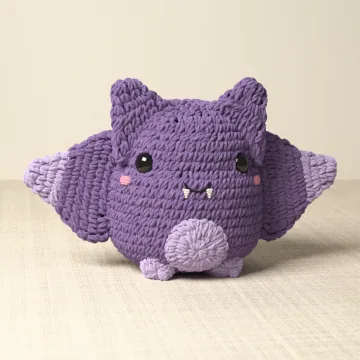
A bat with wide plum wings scalloped along the lower edge, pointed ears, orange eyes and a smile with two little fangs.
Gauge
14 stitches and 15 rows to 4 in (10 cm) in single crochet.
Work a piece a little more than 4 in (10 cm) square, lay it flat and count. If you count more stitches than this, use a larger hook; if fewer, a smaller one.
How to measure it
Before you start
- Rounds are worked with the right side facing; do not turn.
- Where a line says turn, turn the piece over and work back along the stitches just made.
- The wing is a part of a circle, worked back and forth in rows from a ring; do not join the ends of a row.
- Magic ring: wrap the yarn round two fingers, work the first round or row into the loop, then pull the tail until the ring is closed. Four chains joined into a ring with a slip stitch may be used instead.
- A chain that counts as a stitch is marked so in its line and is included in the count.
- A chain 1 at the start of a round or a row does not count as a stitch.
- Working along the other side of the chain: turn the piece round, not over, and work into the unused loops of the foundation chain, beginning in the chain next to the one just used.
- At the start of a round, same st is the stitch the round before was joined in.
- The figures in brackets at the end of a line count its stitches; slip stitches are not counted.
- In Rows 2 to 4 of the wing the turning chain stands on the first stitch of the row, the one you turned from, and same st is that stitch. The last stitch or group of each row goes into the top of the chain that began the row before.
- The distances under FINISHING are for the yarn and gauge above; in another yarn make them larger or smaller in the same proportion as the size.
- Backstitch (sewn): thread the yarn needle and bring it up from the back one stitch length (about ¼ in, 0.6 cm, and half that round a small curve, unless the line names another) along the line. Put it down at the start of the line and bring it up again one stitch length ahead of where it last came up; keep going down at the end of the stitch before and up one length ahead.
- French knot (sewn): bring the yarn needle up from the back, wrap the yarn twice round the needle close to the surface, hold the wraps and put the needle down beside the place where it came up. For a large knot use the yarn double and wrap it three times.
- Straight stitch (sewn): bring the yarn needle up from the back at one end of the stitch and put it down at the other end.
- The same words in another yarn make another size, measured the longest way: fine yarn (2) and a 3.25 mm hook, about 3¾ in (10 cm); light yarn (3) and a 4 mm hook, about 4½ in (11 cm); bulky yarn (5) and a 6.5 mm hook, about 7¼ in (18 cm).
Instructions
- “[ ]” is a repeat.
- “( )” goes into one place.
- The count at the end is what the round leaves.
- Tick a round when it is done. Your place is kept in this browser.
How to read these rounds
Square brackets “[ ]” hold a repeat: work what is inside as many times as it says. Round brackets “( )” inside a line hold stitches that all go into one place. In UK terms sl st is slip stitch, sc is double crochet, hdc is half treble, dc is treble and tr is double treble.
Body
Yarn A, charcoal.
- FoundationWith A, ch 4.
- Rnd 1Sc in 2nd ch from hook, sc in next ch, 3 sc in next ch, working along the other side of the chain, sc in next ch, 2 sc in next ch, sl st in first sc to joinleaves (8 sc)
- Rnd 2Ch 1, 2 sc in same st, sc in next st, 2 sc in each of next 3 sts, sc in next st, 2 sc in each of next 2 sts, sl st in first sc to joinleaves (14 sc)
- Rnd 3Ch 1, sc in same st, 2 sc in next st, sc in next st, repeat: sc in next st, 2 sc in next st 3 times, sc in next st, repeat: sc in next st, 2 sc in next st 2 times, sl st in first sc to joinleaves (20 sc)
- Rnd 4Ch 1, sc in same st, sc in next st, 2 sc in next st, sc in next st, repeat: sc in next 2 sts, 2 sc in next st 3 times, sc in next st, repeat: sc in next 2 sts, 2 sc in next st 2 times, sl st in first sc to joinleaves (26 sc)
- EndFasten off, leaving a 25 in (64 cm) tail, for sewing this piece down at the end.
Ear make 2
Yarn A, charcoal.
- FoundationWith A, ch 5.
- Row 1Sc in 2nd ch from hook, sc in next 3 chsleaves (4 sc)
- Row 2Ch 1, turn, sc in each st acrossleaves (4 sc)
- Row 3Ch 1, turn, repeat: sc2tog in next 2 sts 2 timesleaves (2 sc2tog)
- Row 4Ch 1, turn, sc2tog in next 2 stsleaves (1 sc2tog)
- EndFasten off, leaving a 10 in (25 cm) tail for sewing.
Wing make 2
Yarn B, plum.
- FoundationWith B, make a magic ring.
- Row 1Ch 3 (counts as dc), 3 dc in ringleaves (4 dc)
- Row 2Turn, ch 3 (counts as dc), dc in same st, 2 dc in each of next 3 stsleaves (8 dc)
- Row 3Turn, ch 3 (counts as dc), dc in same st, repeat: dc in next st, 2 dc in next st 3 times, 2 dc in next stleaves (13 dc)
- Row 4Turn, ch 4 (counts as tr), hdc in same st, sc in next st, sl st in next st, sc in next st, repeat: (hdc, tr, hdc) in next st, sc in next st, sl st in next st, sc in next st 2 times, (hdc, tr) in next stleaves (4 tr, 6 hdc, 6 sc)
- EndFasten off, leaving a 10 in (25 cm) tail for sewing.
Finishing
- Block: pin the pieces to shape on a flat surface, spray them with water and let them dry.
- The body is an oval worked round a chain: hold it with the long way up and down. Either end may be the top, and its middle is the middle of the foundation chain. Sew the ears behind the top of the body, their points up and leaning outward: the straight edge of each is hidden, its inner corner on the middle line of the body, ⅜ in (1 cm) below the top edge, and its outer corner lower, just inside the side edge.
- A wing has three edges: two straight ones, which are the ends of the rows, and the scalloped one, which is Row 4. The straight edges meet at the ring. Lay the ring end behind the body, ½ in (1.3 cm) from its middle line and ¼ in (0.6 cm) above its middle, so that one straight edge slants up and outward, past the side of the body, and the other runs nearly straight down behind the body and shows below it. The wing is the same from both sides: lay the second wing the same way on the other side. Sew them to the back of the body.
- With C and the yarn double, work two large French knots for the eyes, ⅜ in (1 cm) above the middle of the body and ⅞ in (2.2 cm) apart.
- With D, work the mouth in backstitch: a curve ⅞ in (2.2 cm) wide that dips ¼ in (0.6 cm) in its middle, its ends ⅛ in (0.3 cm) below the middle of the body. With D, work a straight stitch for each fang, ¼ in (0.6 cm) long, straight down from the mouth, the two ⅜ in (1 cm) apart.
- To sew the bat to your project, pin it where it is to go and sew round its edge with the long tail, under the outermost strands of the stitches; where a part is of another color, use a length of that color.
- Weave in all the ends that are left with the yarn needle.
In all: 5 pieces; 18 ends to weave in.