Bulky single stitch throw crochet pattern
Beginner, throw to king, 4 colors
PDF, for US Letter and A4. Throw. Another size
What you need
- Yarn
- Bulky weight, 5 on the label (UK chunky), an estimate: about 2,285 yd (2,089 m) in all or 1,750 g. Using a different yarn?
- A navy975 yd (892 m), 750 g
- B oatmeal525 yd (480 m), 400 g
- C clay675 yd (617 m), 520 g
- D cream110 yd (101 m), 85 g
- Hook
- 8 mm (US L-11)
- Gauge
- 10 stitches and 11½ rows to 4 in (10 cm) in single crochet (UK double crochet). Test square
- Also
- Yarn needle, scissors and tape measure
New to this? How to crochet, A first blanket
Choose a size
| Size | Finished size | Yarn (ydm) |
|---|---|---|
| Lap | 38 × 45¾ in (97 × 116 cm) | 1,3601,244 |
| Throw, chosen | 50 × 59¾ in (127 × 152 cm) | 2,2852,089 |
| King | 108 × 100 in (274 × 254 cm) | 8,1257,430 |
Press a size: the instructions and the PDF follow. Take the size nearest your own measure. Blanket size chart
Before you start
Gauge
Work a test square first (18 rows)
A test piece to measure and pull out. It is not the start of the pattern.
The test piece is about 6 in (15 cm) wide and 6¼ in (16 cm) tall, so that you can count over 4 in (10 cm) in the middle of it.
- StartWith A, ch 16.
- 1Sc in 2nd ch from hook and in each ch across15 sc
- 2–18Ch 1, turn; sc in each st across15 sc
Key
- sc
- single crochet UK dc
- ch
- chain
- sl st
- slip stitch
- sk
- skip
- st
- stitch
3 sc in first st: all three in that one stitch.
The ch 1 is not a stitch. Work in the very first stitch.
122 sc: the row now has 122; a check, not a step. Not 122? Pull it back.
US terms. Show UK terms
Left-handed? Hook in the left hand; work the rows from left to right. No count changes.
Instructions
Throw. Change
Press a row’s number when it is done. Key
 A slip knot, snug on the hook
 Chain: catch the yarn and draw it through the loop
 Row 1: the hook goes into the 2nd chain
 Single crochet: draw up a loop, then draw the yarn through both loops
Blanket
- StartWith A, make a slip knot and ch 123.
- 1Sc in 2nd ch from hook and in each ch across122 sc
- 23456789Ch 1, turn; sc in each st across122 sc
Stop and measure now, after row 9. Width, across the middle of the rows and not along the chain edge: about 48¾ in (124 cm). If it is wider, start again with a smaller hook; if it is narrower, with a larger one. If only the chain edge is tight, make the chain with a larger hook.
- 10–72Ch 1, turn; sc in each st across122 sc
- 73With D, ch 1, turn; sc in each st across122 sc
- 74Ch 1, turn; sc in each st across122 sc
- 75With B, ch 1, turn; sc in each st across122 sc
- 76–114Ch 1, turn; sc in each st across122 sc
- 115With D, ch 1, turn; sc in each st across122 sc
- 116Ch 1, turn; sc in each st across122 sc
- 117With C, ch 1, turn; sc in each st across122 sc
- 118–168Ch 1, turn; sc in each st across122 sc
- Fasten off, leaving a 6 in (15 cm) tail.
Border
- StartRight side facing and row 168 at the top, join D with sl st in the stitch that ends row 168, at the top right corner.
- 1Ch 1, 3 sc in first st, sc in next 120 sts, 3 sc in last st, repeat: sc in end of each of next 5 rows, sk next row end 28 times, 3 sc in first ch of foundation edge, sc in next 120 chs, 3 sc in last ch of foundation edge, repeat: sc in end of each of next 5 rows, sk next row end 28 times, sl st in first sc to join532 sc
- 2With A, ch 1, sc in next st, 3 sc in next st, sc in next 122 sts, 3 sc in next st, sc in next 142 sts, 3 sc in next st, sc in next 122 sts, 3 sc in next st, sc in next 141 sts, sl st in first sc to join540 sc
- Fasten off, leaving a 6 in (15 cm) tail.
Finishing
- Weave in the ends.
- Lay the piece flat, pull it gently to its size, dampen it and let it dry.
More single crochet blankets
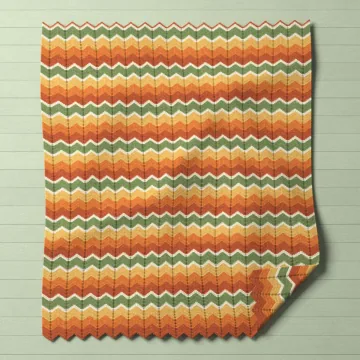
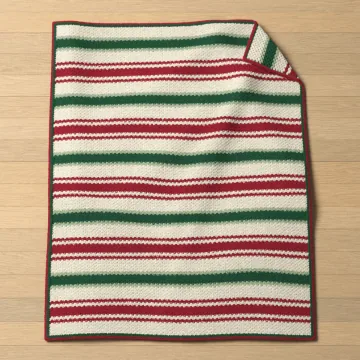
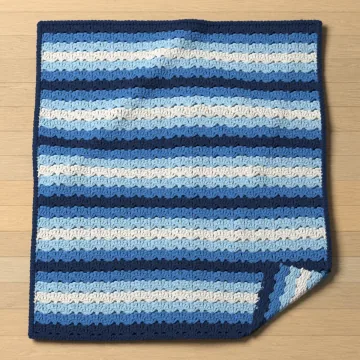
About this pattern
Plain single crochet (UK double crochet) in bulky yarn, one stitch from the first row to the last. Three fields of unequal height, navy, oatmeal and clay, are parted by two thin lines of cream, and a border of one cream round and one navy round goes all the way around.
Gauge
10 stitches and 11½ rows to 4 in (10 cm) in single crochet.
Use any hook that gives you this. If you count more stitches than this in 4 in (10 cm), change to a larger hook; if you count fewer, to a smaller one.
Along a row, count every stitch and every chain between stitches as one.
To count your gauge in the middle of the test piece: there are no chains between the stitches here, so count the stitches alone: 10 stitches side by side are about 4 in (10 cm) wide, and 12 rows are about 4¼ in (10.5 cm) tall.
Larger or smaller
For another width, make the chain longer or shorter: each chain is one more stitch, and the number to chain is the stitches you want plus 1. Measure your own gauge first: the width before the border, in inches, times your stitches to 1 in (2.5 cm) is the number of stitches. For a king bed, whose mattress top is about 76 × 80 in (193 × 203 cm), the king size is about 108 in (274 cm) wide, so that about 16 in (41 cm) hangs at each side: choose it under Size; it begins with 268 chains in A. For another length, work more or fewer rows in the three fields, an even number in each, and leave the lines of D at 2 rows. The border is worked into whatever the edge has: count your own stitches and row ends for its first round.
Notes
- The ch 1 at the start of a row does not count as a stitch: the first stitch of the row goes into the first st of the row below.
- Row 1 is the right side.
- Several of one stitch named together ("3 sc in first st") are all worked into that one place.
- Change yarn in the last yarn over of the last stitch of the row before.
- Cut a yarn when its stripe is done, leaving a tail of about 6 in (15 cm), and work over the tails as you go or weave them in at the end. The estimates include the tails; if you measure your own, add them.
- Leave a tail of about 6 in (15 cm) when you begin, and weave it in at the end with the others. Join a new ball at the end of a row, with the same tails: each join adds two ends.
- The border is worked in rounds with the right side facing. Round 1 begins in the st just joined, which it calls "first st", goes along the last row to the other end, which it calls "last st", then down the left side, along the foundation edge and up the right side.
- Along the foundation edge the ch skipped at the start of row 1 is not counted: the last ch is the one under the first stitch of row 1.
- The chain at the start of a round does not count as a stitch. After round 1, the first stitch of a round goes into the stitch that the slip stitch joined: that stitch is the first of the next stitches.
- Where a round names a new yarn, change to it in the slip stitch that joins the round before, and cut the old yarn, leaving a tail of about 6 in (15 cm).
- Buy whole balls from one dye lot.
- Of the 168 rows, A has 72, B 40, C 52 and D 4: 2 in each line.
Yarn
To find how many balls: divide by the length on your yarn's label and round up. Buy them from one dye lot.
The estimate is from the stitches and chains of this size at this gauge, with 30 percent added.
To measure your own: work the swatch in A and measure it, mark the yarn where the swatch begins and ends, pull the swatch out and measure the yarn it took; divide by the area of the swatch and multiply by the area of the blanket without its border. That is the yarn of all the rows: divide it among the yarns by the number of rows each one has, which the notes give. For the border add the yarn of 5 rows to D and of 5 rows to A, and 2 yd (2 m) to every yarn for the tails.
For an estimate from a swatch of your own: the yarn calculator.
Abbreviations
Written in US terms. Where the UK name differs it is given beside the US one.
- sl st
- slip stitch (UK: ss, slip stitch)
- sc
- single crochet (UK: dc, double crochet)
- RS
- right side
- sk
- skip (UK: miss)
- st
- stitch
Details
- Size
- About 50 × 59¾ in (127 × 152 cm)With its border. The panel alone: about 48¾ × 58½ in (124 × 149 cm)
- In all
- 21,568 stitches (20,496 in the blanket, 1,072 in the border); 14 ends to weave in
- Skill
- BeginnerOne stitch, three fields of color, a border
You may sell what you make from it by hand, in small quantities. The PDF itself is not to be sold or shared. Selling, classes and kits: the rules