Basketweave structured handbag crochet pattern
Intermediate · 2 colors · 5,750 stitches in 8 pieces
PDF · US Letter · 5 pages · Change paper
Go to the instructions Row counter
- Size
- About 11½ in (29 cm) wide, 8¾ in (22 cm) tall and 3½ in (9 cm) deep, the panel edges counted and the handles not
- Skill
- IntermediateThe front and back are in front and back post stitches worked in rows, and the bag is sewn together from panels.
- Yarn
- Medium (4), about 525 yd (480 m), an estimate
- Hook
- 4 mm (US G-6)
Paper for the PDF
For your own crochet, gifts and handmade pieces you sell. Do not resell or share this PDF or copies of it. Selling, classes and kits: the rules
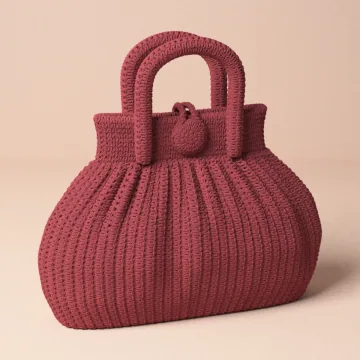
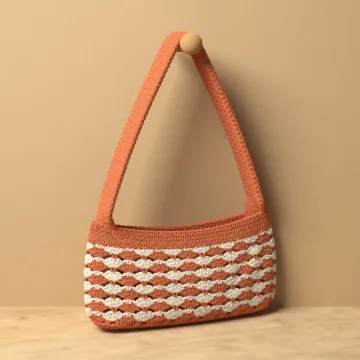
A structured handbag with camel basketweave panels in post stitch, espresso ends and base, two firm top handles and a buttoned tab. The front and the back are woven looking panels of front and back post double crochet (UK treble). One long strip in single crochet (UK double crochet) makes both ends and the base, so the bag stands by itself, and the handles are folded double so that they hold their shape. A firm gauge keeps the corners square.
Gauge
16 stitches and 18 rows to 4 in (10 cm) in single crochet.
16 stitches and 11 rows to 4 in (10 cm) in double crochet. The panel is a little firmer than plain double crochet: at this gauge 11 of its rows are 4 in (10 cm) too, measured over the post stitches.
How to measure it
Along a row, count every stitch and every chain between stitches as one.
Work a test square first (27 rows)
A test piece to measure and pull out. It is not the start of the pattern.
Lay it flat and count the stitches and rows over 4 in (10 cm) in its middle.
There should be 16 stitches and 18 rows. If you count more stitches than that, change to a larger hook; if you count fewer, change to a smaller hook. The swatch can be pulled out and its yarn used again.
- Swatch foundationCh 25.
- Swatch row 1 (RS)Sc in 2nd ch from hook and in each ch across(24 sc)
- Swatch rows 2 to 27Ch 1, turn; sc in each st across(24 sc)
Before you start
How it is worked: Post stitches · Changing colors · Joining and seaming pieces
Read the 8 notes
- The 2 chains skipped at the start of row 1 of the panel, the chain of 2 at the start of its other rows, and the chain of 1 at the start of a row of sc, do not count as stitches.
- A post stitch is worked round the upright of the stitch below, from the front (FP) or from the back (BP), not into its top. FP and BP are named from the side that faces you: on a right side row FP is a raised block, and on a wrong side row BP is. At both ends of a row the post stitch goes round the first or the last stitch in the same way.
- Each band of the weave is 3 rows. After 3 rows the raised and the sunk blocks change places.
- To change color, draw the new yarn through as the last yarn over of the stitch before, here the last stitch of the row before. Cut the old yarn at the change, leaving a tail of 6 in (15 cm).
- Whip stitch: put the needle through both edges from back to front, one stitch for each stitch or row, and draw the yarn snug.
- Backstitch: bring the needle up one stitch length ahead, put it down where the stitch before ended, and go on so in a line without gaps.
- For a bag that keeps its shape even when it is empty, line it with a firm fabric, or lay a piece of plastic canvas on the base.
- Colors. The panels, row by row. Rows 1 to 22: A. Rows 23 to 24: B. All the other pieces: B.
Instructions
- “[ ]” is a repeat.
- The count at the end is what the row leaves.
- Tick a row when it is done. Your place is kept in this browser.
How to read these rows
Square brackets “[ ]” hold a repeat: work what is inside as many times as it says. In UK terms sl st is slip stitch, sc is double crochet, dc is treble, sc2tog is dc2tog, FPdc is front post treble, BPdc is back post treble and sk is miss.
Panel make 2
Yarns in order of use: A, camel; B, espresso.
- FoundationCh 46.
- Row 1RSDc in 3rd ch from hook and in each ch acrossleaves (44 dc)
- Row 2Ch 2, turn; repeat: BPdc around next 4 sts, FPdc around next 4 sts 5 times, BPdc around next 4 stsleaves (24 BPdc, 20 FPdc)
- Row 3Ch 2, turn; repeat: FPdc around next 4 sts, BPdc around next 4 sts 5 times, FPdc around next 4 stsleaves (24 FPdc, 20 BPdc)
- Rows 4 to 5Ch 2, turn; repeat: BPdc around next 4 sts, FPdc around next 4 sts 5 times, BPdc around next 4 stsleaves (24 BPdc, 20 FPdc)Next: row 4 of 5
- Row 6Ch 2, turn; repeat: FPdc around next 4 sts, BPdc around next 4 sts 5 times, FPdc around next 4 stsleaves (24 FPdc, 20 BPdc)
- Rows 7 to 8Ch 2, turn; repeat: BPdc around next 4 sts, FPdc around next 4 sts 5 times, BPdc around next 4 stsleaves (24 BPdc, 20 FPdc)Next: row 7 of 8
- Row 9Ch 2, turn; repeat: FPdc around next 4 sts, BPdc around next 4 sts 5 times, FPdc around next 4 stsleaves (24 FPdc, 20 BPdc)
- Rows 10 to 11Ch 2, turn; repeat: BPdc around next 4 sts, FPdc around next 4 sts 5 times, BPdc around next 4 stsleaves (24 BPdc, 20 FPdc)Next: row 10 of 11
- Row 12Ch 2, turn; repeat: FPdc around next 4 sts, BPdc around next 4 sts 5 times, FPdc around next 4 stsleaves (24 FPdc, 20 BPdc)
- Rows 13 to 14Ch 2, turn; repeat: BPdc around next 4 sts, FPdc around next 4 sts 5 times, BPdc around next 4 stsleaves (24 BPdc, 20 FPdc)Next: row 13 of 14
- Row 15Ch 2, turn; repeat: FPdc around next 4 sts, BPdc around next 4 sts 5 times, FPdc around next 4 stsleaves (24 FPdc, 20 BPdc)
- Rows 16 to 17Ch 2, turn; repeat: BPdc around next 4 sts, FPdc around next 4 sts 5 times, BPdc around next 4 stsleaves (24 BPdc, 20 FPdc)Next: row 16 of 17
- Row 18Ch 2, turn; repeat: FPdc around next 4 sts, BPdc around next 4 sts 5 times, FPdc around next 4 stsleaves (24 FPdc, 20 BPdc)
- Rows 19 to 20Ch 2, turn; repeat: BPdc around next 4 sts, FPdc around next 4 sts 5 times, BPdc around next 4 stsleaves (24 BPdc, 20 FPdc)Next: row 19 of 20
- Row 21Ch 2, turn; repeat: FPdc around next 4 sts, BPdc around next 4 sts 5 times, FPdc around next 4 stsleaves (24 FPdc, 20 BPdc)
- Row 22Ch 2, turn; repeat: BPdc around next 4 sts, FPdc around next 4 sts 5 times, BPdc around next 4 stsleaves (24 BPdc, 20 FPdc)
- Row 23With B, ch 1, turn; sc in each st acrossleaves (44 sc)
- Row 24Ch 1, turn; sc in each st acrossleaves (44 sc)
- EndFasten off, leaving a tail of 6 in (15 cm).
Panel edge make 2
Yarn B, espresso.
- FoundationThe two sides and the lower edge of a panel, RS facing: 92 places, the ends of rows 24 to 1 down the left side, the 44 chains of the foundation edge, and the ends of rows 1 to 24 up the right side.
- Row 1RSJoin B with sl st in first st, ch 1, sc in same st, sc in next st, repeat: 2 sc in next st, sc in next st 11 times, 2 sc in next st, sc in next 42 sts, 2 sc in next st, repeat: sc in next st, 2 sc in next st 11 times, sc in next 2 stsleaves (116 sc)
- EndFasten off, leaving a tail of 6 in (15 cm).
Gusset and base
Yarn B, espresso.
- FoundationCh 117.
- Row 1RSSc in 2nd ch from hook and in each ch acrossleaves (116 sc)
- Rows 2 to 16Ch 1, turn; sc in each st acrossleaves (116 sc)Next: row 2 of 16
- EndFasten off, leaving a tail of 6 in (15 cm).
Handle make 2
Yarn B, espresso.
- FoundationCh 73.
- Row 1RSSc in 2nd ch from hook and in each ch acrossleaves (72 sc)
- Rows 2 to 8Ch 1, turn; sc in each st acrossleaves (72 sc)Next: row 2 of 8
- EndFasten off, leaving a tail of 64 in (162.5 cm) to close the handle.
Tab
Yarn B, espresso.
- FoundationCh 13.
- Row 1RSSc in 2nd ch from hook and in each ch acrossleaves (12 sc)
- Rows 2 to 30Ch 1, turn; sc in each st acrossleaves (12 sc)Next: row 2 of 30
- Row 31Ch 1, turn; sc in next 4 sts, ch 4, sk next 4 sts, sc in next 4 stsleaves (8 sc, 1 ch-4 sp)
- Row 32Ch 1, turn; sc in next 4 sts, 4 sc in next ch-4 sp, sc in next 4 stsleaves (12 sc)
- Row 33Ch 1, turn; sc2tog, sc in next 8 sts, sc2togleaves (10 sc)
- Row 34Ch 1, turn; sc2tog, sc in next 6 sts, sc2togleaves (8 sc)
- EndFasten off, leaving a tail of 6 in (15 cm).
Assembly
- Work a panel edge round three sides of each panel. Weave in all the tails but the long tails of the handles. The panels are alike: one is the front and one is the back. Each shows 11 blocks across; in the top band, rows 20 to 22, counted from one side edge to the other, the 1st, 3rd, 5th, 7th, 9th and 11th block are raised, so there is a raised block at both ends, and the five between them are sunk.
- The handles. Fold a handle in half lengthwise, the wrong side inside, so that its last row lies on its foundation edge, and with its long tail whip stitch these two edges together, stitch to stitch, 72 stitches. It is now a flat double band, 4 rows wide, about 1 in (2.5 cm), and 18 in (45.5 cm) long. Close the other in the same way.
- Lay the front right side up. One end of a handle covers the 3rd block from the left edge and the other end the 3rd block from the right edge: each block is 4 stitches wide, as wide as the handle. Pin the ends straight down over the two dark rows of the top and over rows 22 to 17, so that each end reaches about 2⅝ in (6.5 cm) below the top edge of the panel, the end of the handle on row 17. The sewn edge of the handle faces the middle of the bag at both ends. For each end cut a length of B about 44 in (112 cm) long, fasten it on the wrong side of the panel with 3 small stitches, and backstitch the end down close to its outline, through both layers of the handle and the panel: down one edge, across the end and up the other edge, and across along the top edge of the panel. Fasten off on the wrong side. The free part between is about 12¾ in (32.5 cm) long. Sew the other handle to the back in the same way.
- The tab. On the back, find the middle 12 stitches of the top edge, the 17th to the 28th. Lay row 1 of the tab and the 4 rows after it, 5 rows in all, on the inside of the back, below these 12 stitches, the right side of the tab against the wrong side of the back, the foundation edge down and row 5 level with the top edge. With a length of B, 36 in (91.5 cm) long, whip stitch the foundation edge and the two row end sides of these 5 rows to the back, and backstitch across along the top edge. The rest of the tab, with the buttonhole at its far end, goes over the top to the front, its right side up.
- The gusset. Its 116 stitches are 35 for one end of the bag, 46 for the base and 35 for the other end. Put a marker at both long edges after stitch 35 and after stitch 81, counted from one short end. With the wrong sides together pin the last row of the gusset to the edge of the front, the right sides of both outside, the markers at the two lower corners of the panel: one before the first of the 46 stitches along the foundation edge and one after the last of them. Cut a length of B about 96 in (244 cm) long, begin at one top corner with a tail of 6 in (15 cm), and whip stitch the two edges together, stitch to stitch, 116 stitches, with 3 stitches in the same place at both top corners, and fasten off inside. Sew the foundation edge of the gusset to the edge of the back in the same way, with another length of B, 96 in (244 cm) long.
- The button. Bring the tab over to the front and lay it flat down the middle of it. Put a pin through the middle of the buttonhole into the front: it comes in the 6th block, the middle one. Sew the button there with sewing thread.
Finishing
- Weave every tail that is left in on the inside. Press the corners of the gusset square with your fingers.
In all: 6 pieces; 5,750 stitches (1,056 in each panel, 116 in each panel edge, 1,856 in the gusset and base, 576 in each handle, 398 in the tab).