Daisy chain afghan crochet pattern
Crochet, 30 in wide, 4 colors, intermediate
PDF. Prints on US Letter and A4.
What you need
Each amount is an estimate.
- Yarn A sunny yellowabout 95 yd (87 m)round 1
- Yarn B whiteabout 360 yd (329 m)round 2
- Yarn C leaf greenabout 480 yd (439 m)the sewn details
- Yarn D creamabout 370 yd (338 m)the sewn details
- Yarn in all
- About 1,305 yd (1,193 m) or 520 g
- Weight
- Light weight, 3 on the label (UK DK)
- Hook
- 4 mm (US G-6), or the size that gives you the gauge
- Ends
- 362 to weave in
- Also
- A yarn needle, scissors, pins for blocking and a spray bottle
- Gauge
- 18 stitches and 19 rows to 4 in (10 cm) in single crochet (UK double crochet). How to check it
Instructions
How to read these rounds
US terms · Show UK terms
- ch chain, sl st slip stitch, sc single crochet (UK double crochet), dc double crochet (UK treble), tr treble crochet (UK double treble).
- RS right side, the one that shows.
- [ ] 7 times: work what is inside 7 times in all. ( ): all of it goes into the one place.
- (8 sc): the stitches you have when the round is done. How to read a pattern.
- Working in the round. Joining squares. Changing colors.
- A chain 1 at the start of a round does not count as a stitch.
- The ch 3 at the start of Rnd 2 only lifts the yarn to the height of the first petal; every tr cluster is a petal, and the round is joined in the top of the first one.
Special stitches
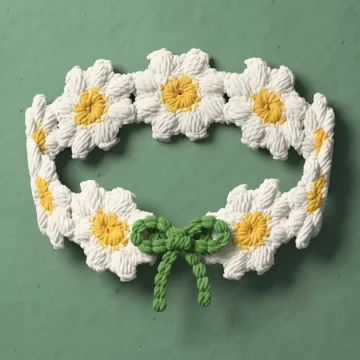
Daisy make 80
Yarns in order of use: A, sunny yellow; B, white.
- StartWith A, make a magic ring.
- Rnd 1RSCh 1, 8 sc in ring, pull the tail to close the ring, sl st in first sc to joinleaves (8 sc)
Fasten off A.
- Rnd 2Join B with sl st in any st, ch 3 (does not count as a st), (tr cluster, ch 2) in same st, repeat: (tr cluster, ch 2) in next st 7 times, sl st in first tr cluster to joinleaves (8 tr cluster, 8 ch-2 sps)
- EndFasten off, leaving a 6 in (15 cm) tail.
Finishing
- Nothing is blocked until the afghan is joined.
- Weave in the ends of a daisy before you join the next one to it.
- Strips: make 4 strips of 20 daisies each. The petals of a daisy are numbered in the order they are worked, 1 to 8. The first daisy of a strip is worked just as it is written. Each of the remaining 19 daisies of the strip is worked as it is written too, all 8 petals of it, but two of its petals, 1 and 2, are joined to the daisy before it, both daisies with their right sides up: when petal 1 is closed, slip stitch in the top of petal 6 of the daisy before, then ch 2 and go on; when petal 2 is closed, slip stitch in the top of petal 5 of the daisy before, then ch 2 and go on.
- How a strip lies: lay it from left to right, right side up, the first daisy at the left. Every daisy then has petals 3 and 4 at the lower edge and petals 7 and 8 at the upper edge, 7 to the right of 8.
- Upper edge, Row 1: with C and the right side facing, join with a slip stitch in the top of petal 7 of the last daisy, at the right end, ch 1, sc in the same place, ch 2, sc in the top of petal 8, [ch 4, sc in petal 7 of the next daisy, ch 2, sc in petal 8] 19 times (40 sc, 20 ch-2 spaces, 19 ch-4 spaces).
- Upper edge, Row 2: ch 3 (counts as dc), turn, skip the first sc, [2 dc in the next ch-2 space, dc in the next sc, 4 dc in the next ch-4 space, dc in the next sc] 19 times, 2 dc in the last ch-2 space, dc in the last sc (156 dc).
- Upper edge, Rows 3 and 4: ch 3 (counts as dc), turn, skip the first dc, dc in each of the next 154 dc, dc in the top of the ch 3 (156 dc). Fasten off.
- Lower edge: turn the strip round, not over, so that the other edge is at the top, and work Rows 1 to 4 in the same way, with petal 3 in place of petal 7, petal 4 in place of petal 8 and the first daisy, now at the right end, in place of the last.
- Cream bands: lay the 4 strips one above the other, right sides up, the first daisies all at the left; they are strips 1 to 4 from the bottom up. On the upper edge of each strip but strip 4 work 5 rows with D: with the right side facing, join with a slip stitch in the last dc of Row 4, at the right end, ch 3 (counts as dc), dc in each of the other 155 dc (156 dc); then 4 rows like Row 3. Fasten off. On the upper edge of strip 4 and on the lower edge of strip 1 work 4 rows with D in the same way, the lower edge with the strip turned round.
- Join the last row of every band of 5 rows to the lower edge of the strip above it: hold them with right sides together and the ends even, and with D work a slip stitch seam, 1 slip stitch through both in each of the 156 dc, under both top loops on both pieces. Fasten off.
- Border, round 1: turn the afghan so that one short end is at the top. With C and the right side facing, join with a slip stitch in the end of the outermost row at the right and ch 1, which does not count as a stitch. Along this short end work 2 sc in the end of every dc row, 1 sc in the end of every edge Row 1 and 1 sc in the end of every seam, and over the end of every strip of daisies, between its two edge rows, work ch 2, sc in the top of the nearer end petal, ch 2, sc in the top of the other end petal, ch 2: a strip with its 2 edges makes 16 sc and 3 ch-2 spaces, a band 10 sc, a seam 1 sc and an outer band 8 sc, in all 113 sc and 12 ch-2 spaces. Ch 2 for the corner. Along the long edge work 2 sc in the first dc and 1 sc in each of the other 155 dc, counting the ch 3 of the row as one dc (157 sc); ch 2 for the corner. Work the other short end and the other long edge in the same way, each with its corner; slip stitch in the first sc to join (540 sc, 4 corner spaces and 24 other ch-2 spaces in all). The end petals are petals 1 and 2 at the one short end and 5 and 6 at the other.
- Border, round 2: ch 1, which does not count as a stitch; beginning in the first sc, work 1 sc in each sc, 3 sc in each of the 4 corner spaces and, at every strip of daisies, 2 sc in the middle one of its 3 ch-2 spaces and 1 sc in each of the two others; slip stitch in the first sc to join. Between the 3 sc of the corners there are 129 sc on each short edge and 157 sc on each long edge (584 sc in all). Fasten off.
- Border, round 3 (shells): join B with a slip stitch in the 2nd of the 3 sc at the corner where a short edge begins, going on to the left along that short edge, and ch 1, which does not count as a stitch; sc in the same sc, * [sk the next sc, 5 dc in the next sc, sk the next sc, sc in the next sc] 32 times on a short edge or 39 times on a long edge, sk the next sc, 5 dc in the next sc, sk the next sc, sc in the 2nd of the 3 sc at the corner; repeat from * for the other three edges, leaving out the last sc; slip stitch in the first sc to join (33 shells on each short edge and 40 on each long edge, 146 sc). Fasten off.
- Weave in all the ends that are left with the yarn needle.
- Block the afghan: pin it out with its edges straight and every daisy round, spray it with water and let it dry.
About
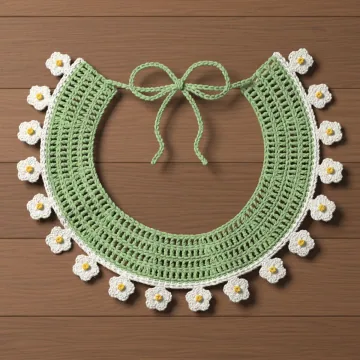
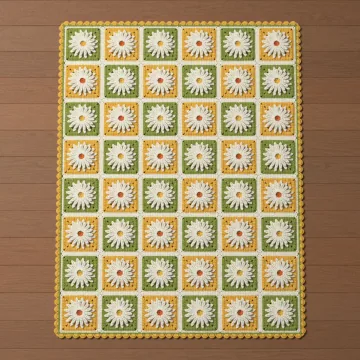
Daisy chains: small white daisies with yellow centers, joined petal to petal into four long strips. Wide bands of leaf green and cream double crochet lie between them, and a border of green and of white shells goes all round.