Marching elephant border crochet pattern
Intermediate · 4 colors · 3 sizes
Size: Baby blanket Change size
PDF · US Letter · 6 pages · Change paper
Go to the instructions Round counter
- Size
- About 34 × 34 in (86 × 86 cm)With its border. The panel alone: about 34 × 34 in (86 × 86 cm)
- Skill
- IntermediateShaping in stitches of four heights, work round the edge of a small piece, pieces pinned and sewn on
- Yarn
- Medium (4), about 835 yd (764 m), an estimate
- Hook
- 5.5 mm (US I-9)
Size 3 choices · Baby blanket is pictured
Paper for the PDF
For your own crochet, gifts and handmade pieces you sell. Do not resell or share this PDF or copies of it. Selling, classes and kits: the rules
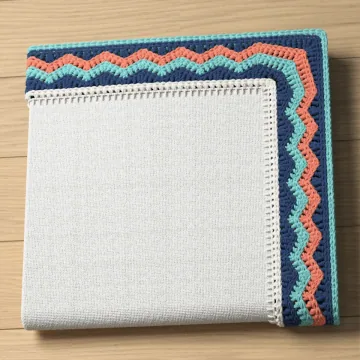
The border is eleven plain rounds, eight of them double crochet (UK treble). Each elephant is one small piece in five rows: the head and the trunk are in the last row, the legs and the tail are worked round its edge. It has an ear of pink half double crochet (UK half treble) with a dark rim. All of them stand the same way up and look the same way.
Sizes
| Size | Finished size, about | Yarn, an estimate |
|---|---|---|
| Lovey | 20½ × 20½ in (52 × 52 cm) | about 460 yd (421 m) |
| Baby blanket | 34 × 34 in (86 × 86 cm) | about 835 yd (764 m) |
| Crib blanket | 47¾ × 47¾ in (121 × 121 cm) | about 1,220 yd (1,116 m) |
Gauge
13 stitches and 15 rows to 4 in (10 cm) in single crochet.
How to measure it
Check your gauge on the piece. Begin the pattern and measure the piece itself as you go.
After round 1 a side, measured between two corner stitches, is about 23.7 in (60.2 cm). If the edge ruffles, use a smaller hook; if it pulls the cloth in, use a larger one.
In a thinner or a thicker yarn: how many stitches you need, and how large it comes out.
To make it larger or smaller
Any number of loops works, as long as both long sides have the same number and both short sides have the same number, with one loop at each corner. Call the loops of a side N (75 here). Round 1 then has "sc in next N sts" on that side, and the number for that side becomes, round by round: round 2, N + 2; round 3, N + 6; then 4 more in each round as far as round 9, which has N + 30; round 10, N + 34; round 11, N + 36. The corners do not change. If the cloth is longer than it is wide, work each side with the number of that side: the lines are written as one side and then, in the outer brackets, a corner and the next side, worked 3 times. For the elephants, measure each side along the top of round 5 from one corner ch-2 space to the next and divide by 4.8 in (12.2 cm); the nearest whole number is how many spaces there are between elephants on that side, and one elephant more than that stands on it, the two at its corners counted.
Before you start
How it is worked: Working in the round · Joining squares · Changing colors
Read the 17 notes
- Round 1 is worked into the loops of the blanket stitch, one after another. Its first st is the loop that lies across any one of the corners.
- Blanket stitch: thread a sharp embroidery needle with a large eye with yarn A, a length of about 40 in (101.6 cm) at a time, and hold the cloth with its right side up and the edge you are working on toward you. Fasten the yarn on the wrong side, at the edge. * Put the needle in from the front about 0.3 in (0.8 cm) inside the edge and about 0.3 in (0.8 cm) farther along, bring its point out under the edge and over the yarn that lies there, and draw up until the yarn lies snugly along the edge without puckering it. Repeat from * all round. The yarn that lies along the edge between two stitches is one loop. At a corner, make one slanting stitch on either side of the point, so that one loop lies across the corner. When a length runs out, end it and begin the next on the wrong side, in the same hole. At the end, join the last loop to the first stitch and fasten off.
- Stitches in round brackets with a place after them, or several of one stitch with one place after them, are all worked into that one place. The brackets at the end of a round hold its count.
- What is in square brackets is worked as many times as the number after them says, in all.
- Corner stitch of round 1: the middle one of the 3 sc in a corner. The first corner of round 1 is begun with 2 sc and completed with the 1 sc at the end of the round, all worked into the first st; its corner stitch is the first sc of the round. In a round after the first, "first st" means the first st of the round below; for round 2 that is this same first sc, which is also where round 1 was joined.
- When the place named is a chain space, the stitch goes into the open space under the chain, not into a chain stitch.
- The edging is worked in rounds with the right side facing; do not turn. In an elephant and in an ear, turn where the row says so: rows 1, 3 and 5 of an elephant have the right side facing, rows 2 and 4 the wrong side.
- The ch 3 at the start of rounds 2 to 9 counts as a dc and is worked into, at its top, like any other st. The ch 2 at the start of an ear counts as a hdc. A ch 1 at the start of a row or round does not count as a stitch.
- Ears: yarn A takes over in the last hdc of row 1. At the last step of that hdc, with three loops on the hook, draw yarn A through instead of yarn D, then cut yarn D, leaving an end of about 6 in (15.2 cm). Row 1 is not joined: the ear is a half round, and its straight side is made of the ring and the ends of the two rows. In row 2 the "turning ch" is the ch 2 of row 1.
- The elephants look to the left as you face their right side (to the right if you are left handed).
- On a crocheted or knitted blanket no blanket stitch is needed. Leave it out and work round 1 into the edge of the blanket itself: 3 sc in each corner and, along each side between two corners, as many sc as keep the edge flat, the same number on each side if the blanket is square. Where a line of round 1 says "first st", that is a corner stitch of the blanket. Round 2 and all the rounds after it are then as printed, with the numbers of your own side (see ANOTHER SIZE).
- When the next round begins with "Join", fasten off the yarn you have at the end of the round (cut it, leaving a tail of about 6 in (15.2 cm), and draw the tail through the last loop). Then join the yarn named with a slip stitch in the place named.
- "Any corner" means any one of the four corner spaces: the four sides are alike, so the round comes out the same from each of them. Begin in that space and work along the side to its left, the way you always go (to its right if you are left handed).
- Rounds 3 to 9 go on in the same yarn and begin with "Sl st in next ch-2 sp". The round before was joined in the top of its ch 3, and one dc stands between that and the corner space: make a sl st in that dc, and then the sl st in the space. The top of that ch 3 and that dc are not yet worked. They are the last two sts of the last side, and the last 2 dc of the round go into them, the first into the top of the ch 3 and the second into the dc, over the sl st that lies there. At the start of a round the first dc of the first side goes into the first of the 2 dc that stand just past the corner space.
- Begin with a hemmed flannel blanket about 23.4 in (59.4 cm) square; with the edging it is about 34.1 in (86.6 cm) square.
- Round 1 leaves 77 stitches between two corner stitches on every side.
- There are 7 elephants on each side, the two at its corners counted, 24 in all; so make 24 elephants and 24 ears. An elephant is about 4 in (10.2 cm) wide from the trunk to the little tail and about 2.7 in (6.9 cm) tall; the eight rounds of double crochet, rounds 2 to 9, are about 4.6 in (11.7 cm) deep.
Instructions
Size: Baby blanket Change sizeUS termsUK terms
First read the 17 notes just above.
- “[ ]” is a repeat.
- “( )” goes into one place.
- The count at the end is what the round leaves.
- Tick a round when it is done. Your place is kept in this browser.
- Left-handed? Work everything as it is written, the other way: rows from left to right, rounds clockwise. Left-handed crochet
How to read these rounds
Square brackets “[ ]” hold a repeat: work what is inside as many times as it says. Round brackets “( )” inside a line hold stitches that all go into one place. In UK terms sl st is slip stitch, sc is double crochet, hdc is half treble, dc is treble and tr is double treble.
Edging
Yarns in order of use: A, dark slate blue; B, ivory; D, rose pink.
- FoundationA hemmed flannel blanket with a blanket stitch edge of 75 loops on each side and one at each corner, with the right side facing you.
- Rnd 1Join A with sl st in first st, ch 1, 2 sc in first st, sc in next 75 sts, repeat: 3 sc in next st, sc in next 75 sts 3 times, sc in first st, sl st in first sc to joinleaves (312 sc)
- Rnd 2Join B with sl st in first st, ch 3 (counts as dc), (dc, ch 2, 2 dc) in same st, dc in next 77 sts, repeat: (2 dc, ch 2, 2 dc) in next st, dc in next 77 sts 3 times, sl st in top of ch-3 to joinleaves (324 dc, 4 ch-2 sps)
- Rnd 3Sl st in next ch-2 sp, ch 3 (counts as dc), (dc, ch 2, 2 dc) in same sp, dc in next 81 sts, repeat: (2 dc, ch 2, 2 dc) in next ch-2 sp, dc in next 81 sts 3 times, sl st in top of ch-3 to joinleaves (340 dc, 4 ch-2 sps)
- Rnd 4Sl st in next ch-2 sp, ch 3 (counts as dc), (dc, ch 2, 2 dc) in same sp, dc in next 85 sts, repeat: (2 dc, ch 2, 2 dc) in next ch-2 sp, dc in next 85 sts 3 times, sl st in top of ch-3 to joinleaves (356 dc, 4 ch-2 sps)
- Rnd 5Sl st in next ch-2 sp, ch 3 (counts as dc), (dc, ch 2, 2 dc) in same sp, dc in next 89 sts, repeat: (2 dc, ch 2, 2 dc) in next ch-2 sp, dc in next 89 sts 3 times, sl st in top of ch-3 to joinleaves (372 dc, 4 ch-2 sps)
- Rnd 6Sl st in next ch-2 sp, ch 3 (counts as dc), (dc, ch 2, 2 dc) in same sp, dc in next 93 sts, repeat: (2 dc, ch 2, 2 dc) in next ch-2 sp, dc in next 93 sts 3 times, sl st in top of ch-3 to joinleaves (388 dc, 4 ch-2 sps)
- Rnd 7Sl st in next ch-2 sp, ch 3 (counts as dc), (dc, ch 2, 2 dc) in same sp, dc in next 97 sts, repeat: (2 dc, ch 2, 2 dc) in next ch-2 sp, dc in next 97 sts 3 times, sl st in top of ch-3 to joinleaves (404 dc, 4 ch-2 sps)
- Rnd 8Sl st in next ch-2 sp, ch 3 (counts as dc), (dc, ch 2, 2 dc) in same sp, dc in next 101 sts, repeat: (2 dc, ch 2, 2 dc) in next ch-2 sp, dc in next 101 sts 3 times, sl st in top of ch-3 to joinleaves (420 dc, 4 ch-2 sps)
- Rnd 9Sl st in next ch-2 sp, ch 3 (counts as dc), (dc, ch 2, 2 dc) in same sp, dc in next 105 sts, repeat: (2 dc, ch 2, 2 dc) in next ch-2 sp, dc in next 105 sts 3 times, sl st in top of ch-3 to joinleaves (436 dc, 4 ch-2 sps)
- Rnd 10Join D with sl st in any corner ch-2 sp, ch 1, (sc, ch 2, sc) in same sp, sc in next 109 sts, repeat: (sc, ch 2, sc) in next ch-2 sp, sc in next 109 sts 3 times, sl st in first sc to joinleaves (444 sc, 4 ch-2 sps)
- Rnd 11Join A with sl st in any corner ch-2 sp, ch 1, (sc, ch 2, sc) in same sp, sc in next 111 sts, repeat: (sc, ch 2, sc) in next ch-2 sp, sc in next 111 sts 3 times, sl st in first sc to joinleaves (452 sc, 4 ch-2 sps)
- EndFasten off.
Elephant make 24
Yarn C, elephant gray.
- FoundationCh 9.
- Row 1RSSc in 2nd ch from hook and in each ch acrossleaves (8 sc)
- Rows 2 to 4Ch 1, turn; sc in first st, sc in next 7 stsleaves (8 sc)Next: row 2 of rows 2 to 4
- Row 5RSCh 1, turn; sc in first st, hdc in next st, dc in next 2 sts, hdc in next st, sc in next st, sk next st, head in last stleaves (2 sc, 2 hdc, 2 dc, 1 head)
- EndDo not turn and do not fasten off: go on round the edge of the elephant with the right side facing. Front edge (below the head): 1 sl st in the end of each of rows 4, 3, 2 and 1, going down. Lower edge: work along the foundation chain, into the side of it that is away from row 1. It has 8 chs, one under each sc of row 1; take them one after another, beginning with the ch under the last sc of row 1. Front leg, over the first 3 chs: sl st in the 1st of them, ch 3, dc in that same 1st ch, dc in the 2nd, dc in the 3rd, ch 3, sl st in that same 3rd ch (3 dc with a ch 3 at either side). Belly: sl st in each of the next 2 chs. Hind leg, over the last 3 chs: as the front leg. Back edge: 1 sl st in the end of each of rows 1, 2, 3 and 4, going up, then 1 sl st in the first sc of row 5. The little tail: ch 5, sl st in the 2nd ch from the hook and in each of the next 3 chs, sl st in that same first sc of row 5. Fasten off, leaving an end of about 30 in (76.2 cm) to sew with.
Ear make 24
Yarns in order of use: D, rose pink; A, dark slate blue.
- FoundationCh 4, sl st in first ch to form a ring.
- Row 1RSCh 2 (counts as hdc), 6 hdc in ringleaves (7 hdc)
- Row 2WSYarn A. Ch 1, turn; sc in first st, repeat: 2 sc in next st, sc in next st 2 times, 2 sc in next st, sc in top of turning chleaves (10 sc)
- EndFasten off, leaving an end of about 12 in (30.5 cm) to sew with.
Assembly
- Work in this order: ears and eyes first, then the elephants on the border.
- Ears: sew one ear to the right side of every elephant with its own long end. The ear has the right side of its row 1 up. Its straight side stands upright and its round side points to the little tail. The middle of the straight side (the ring the ear began with) lies over the st of row 4 that was skipped in row 5, close behind the head; half of the straight side is above that place, along the back of the head, and half is below it. Sew the straight side down with running stitch (the needle goes down and up through both layers in small even stitches) and leave the round side free.
- Eyes: with yarn A, about 6 in (15.2 cm) for each, make a French knot on every head: bring the needle up in the middle of the head, halfway between the foot of its 7 tr and their tops, wind the yarn twice round the needle, put the needle down close beside the place it came up, and draw the knot close. Knot the two ends together on the wrong side.
- Placing the elephants: lay the blanket flat, right side up, and choose one side to be its lower edge. Every elephant goes on the border right side up, with its legs toward that lower edge, so that all of them stand the same way up and look the same way. Their middles lie along the top of round 5, which is halfway across the rounds of double crochet. The middle of an elephant is the middle of its whole width and height, trunk and legs counted. Pin one on each corner, its middle over the corner ch-2 space of round 5. Then, along each side, pin 5 more between the two corner ones, all with the same distance from middle to middle, about 4.7 in (11.9 cm). Pin each trunk so that it goes forward from the head and then bends up, with its tip higher than the head.
- Sewing the elephants: with its own long end sew each one down with running stitch close to its edge, all the way round: round the head, up one side of the trunk and down the other, round the legs and along the back. Leave the ear free, and the little tail hanging. Fasten off on the wrong side.
- Ends: each elephant, ear and eye brings ends with it (2 for an elephant, 4 for an ear, 2 for an eye). They are in the count below. Where an end lies behind an elephant, run it under a few stitches there and cut it.
Finishing
- Weave in the ends.
In all: 49 pieces.