Flower pendant necklace crochet pattern
Crochet, 20½ in long, 4 colors, intermediate
PDF. Prints on US Letter and A4.
What you need
Each amount is an estimate.
- Yarn A dusty roseabout 15 yd (14 m)rounds 1, 6 and 7 of the flower and round 1 of the blossoms
- Yarn B pale roseabout 6 yd (5 m)rounds 4 and 5 of the flower
- Yarn C creamabout 25 yd (23 m)rounds 2 and 3 of the flower and round 2 of the blossoms
- Yarn D sageabout 15 yd (14 m)the leaves and the cord
- Yarn in all
- About 61 yd (56 m) or 15 g
- Weight
- Fine weight, 2 on the label
- Hook
- 3.25 mm (US D-3), or the size that gives you the gauge
- Also
- A yarn needle, scissors, a ½ in (1.2 cm) wooden button, pins, a spray bottle, sewing thread and a needle for the button
- Gauge
- 21 stitches and 22 rows to 4 in (10 cm) in single crochet (UK double crochet). How to check it
Instructions
How to read these rounds
US terms · Show UK terms
- ch chain, sl st slip stitch, sc single crochet (UK double crochet), hdc half double crochet (UK half treble), dc double crochet (UK treble), tr treble crochet (UK double treble).
- sk skip, RS right side, the one that shows.
- ch-3 sp: the gap under three chains; the hook goes in the gap.
- [ ] 5 times: work what is inside 5 times in all. ( ): all of it goes into the one place.
- (12 sc): the stitches you have when the round is done. How to read a pattern.
- Working in the round. Post stitches. Joining squares. Changing colors.
- A chain 1 at the start of a round or a row does not count as a stitch.
Special stitches
- BPsc Back post single crochet (UK: BPdc)
- Insert the hook from back to front to back round the post of the stitch named, yarn over and pull up a loop, yarn over and pull through 2 loops.
Go to: Flower · Blossom · Leaf · Cord
Flower
Yarns in order of use: A, dusty rose; C, cream; B, pale rose.
- StartWith A, make a magic ring.
- Rnd 1RSCh 1, 12 sc in ring, pull the tail to close the ring, sl st in first sc to joinleaves (12 sc)
Fasten off A.
- Rnd 2Join C with sl st in any st, ch 1, sc in same st, repeat: ch 3, sk next st, sc in next st 5 times, ch 3, sk next st, sl st in first sc to joinleaves (6 sc, 6 ch-3 sps)
- Rnd 3Ch 1, repeat: (sc, hdc, 3 dc, hdc, sc) in next ch-3 sp 6 times, sl st in first sc to joinleaves (12 sc, 12 hdc, 18 dc)
Fasten off C.
- Rnd 4Join B with sl st around the post of first sc of Rnd 2, working behind Rnd 3, ch 1, BPsc around same st, ch 5, repeat: BPsc around next sc of Rnd 2, ch 5 5 times, sl st in first BPsc to joinleaves (6 BPsc, 6 ch-5 sps)
- Rnd 5Ch 1, repeat: (sc, hdc, 5 dc, hdc, sc) in next ch-5 sp 6 times, sl st in first sc to joinleaves (12 sc, 12 hdc, 30 dc)
Fasten off B.
- Rnd 6Join A with sl st around the post of first BPsc of Rnd 4, working behind Rnd 5, ch 1, BPsc around same st, ch 7, repeat: BPsc around next BPsc of Rnd 4, ch 7 5 times, sl st in first BPsc to joinleaves (6 BPsc, 6 ch-7 sps)
- Rnd 7Ch 1, repeat: (sc, hdc, 2 dc, 3 tr, 2 dc, hdc, sc) in next ch-7 sp 6 times, sl st in first sc to joinleaves (12 sc, 12 hdc, 24 dc, 18 tr)
- EndFasten off, leaving a 14 in (36 cm) tail for sewing.
Blossom make 6
Yarns in order of use: A, dusty rose; C, cream.
- StartWith A, make a magic ring.
- Rnd 1RSCh 1, 10 sc in ring, pull the tail to close the ring, sl st in first sc to joinleaves (10 sc)
Fasten off A.
- Rnd 2Join C with sl st in any st, (ch 2, 2 dc) in same st, (2 dc, ch 2, sl st) in next st, repeat: (sl st, ch 2, 2 dc) in next st, (2 dc, ch 2, sl st) in next st 4 times, sl st in first sl st to joinleaves (20 dc)
- EndFasten off, leaving a 10 in (25 cm) tail for sewing.
Leaf make 3
Yarn D, sage.
- StartWith D, ch 10.
- Rnd 1Sc in 2nd ch from hook, hdc in next ch, dc in next 3 chs, hdc in next 2 chs, sc in next ch, (sc, hdc, sc) in next ch, working along the other side of the chain, sc in next ch, hdc in next 2 chs, dc in next 3 chs, hdc in next ch, sc in next ch, sl st in first sc to joinleaves (6 sc, 7 hdc, 6 dc)
- EndFasten off, leaving a 10 in (25 cm) tail for sewing.
Cord
Yarn D, sage.
- StartWith D, ch 109.
- Row 1Sc in 2nd ch from hook, sc in each rem ch acrossleaves (108 sc)
- EndFasten off, leaving a 6 in (15 cm) tail.
Finishing
- Block: pin the flower, the blossoms and the leaves to shape, with every petal round and flat, pin the cord straight, spray them with water and let them dry.
- Leaves: turn the flower so that a dip between two petals of Rnd 7 is straight down, and lay it wrong side up. Pin the three leaves on it wrong side up. Each leaf points straight away from the magic ring, its base ¾ in (1.9 cm) from the middle of the ring. The first points straight down. The second and the third lie to the left and to the right of it, the base of each ⅝ in (1.6 cm) from the base of the first; their tips fan out. With its tail, sew each leaf to the back of the petals under it, with small stitches that do not show in front. Where the leaves meet, the middle one lies in front of the other two.
- Cord: lay the cord right side up, with the tops of the stitches along its lower edge, and mark its middle, between the 54th and the 55th stitch. Place the flower on it, right side up, its magic ring over the middle of the cord and the middle leaf straight down. With its tail, sew the back of the flower to the cord round the ring of Rnd 1 and once more at ⅝ in (1.6 cm) on each side of it.
- Blossoms: count from the middle of the cord along each side. The magic ring of the first blossom lies on the 12th stitch, that of the second on the 20th and that of the third on the 28th; the blossoms are right side up, each turned so that one petal points straight down across the lower edge of the cord. Sew each down with its tail round its Rnd 1.
- With sewing thread, sew the button to the right side of one end of the cord, its middle ¼ in (0.6 cm) from the short edge.
- Button loop: at the other short edge, join D with a slip stitch in one corner, ch 8, work a slip stitch in the other corner and fasten off. The loop is about ⅝ in (1.6 cm) long when it is pulled flat. Pull it over the button to see that it holds; work a chain more or less if it does not.
- Weave in all the ends that are left with the yarn needle.
About
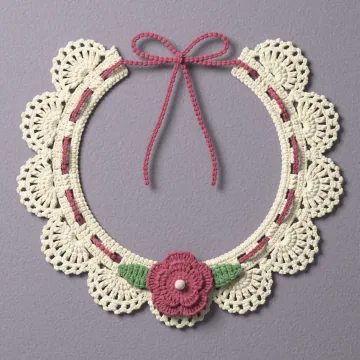
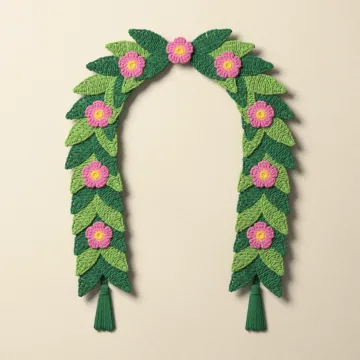
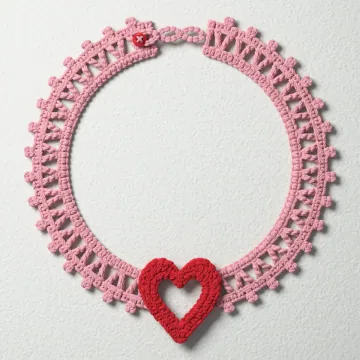
A large flower of three layers, each of six petals worked behind the layer before it, hangs at the middle of a sage cord with three leaves below it. Three small cream blossoms climb the cord on each side. One button closes it.