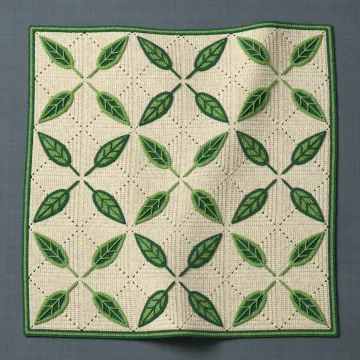
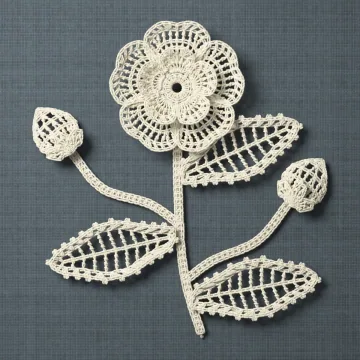
Ginkgo leaf crochet pattern
Crochet, 4½ in wide, 1 color, intermediate
PDF. Prints on US Letter and A4.
What you need
- Yarn Golden yellowabout 15 yd (14 m) or 5 g, an estimate
- Weight
- Light weight, 3 on the label (UK DK)
- Hook
- 4 mm (US G-6), or the size that gives you the gauge
- Also
- A yarn needle, scissors, pins for blocking and a spray bottle
- Gauge
- 18 stitches and 19 rows to 4 in (10 cm) in single crochet (UK double crochet). How to check it
Instructions
How to read these rows
US terms · Show UK terms
- A chain 1 at the start of a row does not count as a stitch.
- StartCh 11.
- Row 1Hdc in 3rd ch from hook, dc in next 3 chs, hdc in next ch, sc in next 4 chsleaves (2 hdc, 3 dc, 4 sc)
- Row 2Ch 1, turn, working in back loops only, sc in next 4 sts, hdc in next st, dc in next 3 sts, hdc in next stleaves (4 sc, 2 hdc, 3 dc)
- Row 3Ch 2 (does not count as a st), turn, working in back loops only, hdc in next st, dc in next 3 sts, hdc in next st, sc in next 4 stsleaves (2 hdc, 3 dc, 4 sc)
- Row 4Ch 1, turn, working in back loops only, sc in next 4 sts, hdc in next st, dc in next 3 sts, hdc in next stleaves (4 sc, 2 hdc, 3 dc)
- Row 5Ch 2 (does not count as a st), turn, working in back loops only, hdc in next st, dc in next 3 sts, hdc in next st, sc in next 4 stsleaves (2 hdc, 3 dc, 4 sc)
- Row 6Ch 1, turn, working in back loops only, sc in next 4 sts, hdc in next st, dc in next 3 sts, hdc in next stleaves (4 sc, 2 hdc, 3 dc)
- Row 7Ch 2 (does not count as a st), turn, working in back loops only, hdc in next st, dc in next 3 sts, hdc in next st, sc in next 4 stsleaves (2 hdc, 3 dc, 4 sc)
- Row 8Ch 1, turn, working in back loops only, sc in next 4 sts, leave the remaining 5 sts unworkedleaves (4 sc)
- Row 9Ch 7, turn, hdc in 3rd ch from hook, dc in next 3 chs, hdc in next ch, working in back loops only, sc in next 4 stsleaves (2 hdc, 3 dc, 4 sc)
- Row 10Ch 1, turn, working in back loops only, sc in next 4 sts, hdc in next st, dc in next 3 sts, hdc in next stleaves (4 sc, 2 hdc, 3 dc)
- Row 11Ch 2 (does not count as a st), turn, working in back loops only, hdc in next st, dc in next 3 sts, hdc in next st, sc in next 4 stsleaves (2 hdc, 3 dc, 4 sc)
- Row 12Ch 1, turn, working in back loops only, sc in next 4 sts, hdc in next st, dc in next 3 sts, hdc in next stleaves (4 sc, 2 hdc, 3 dc)
- Row 13Ch 2 (does not count as a st), turn, working in back loops only, hdc in next st, dc in next 3 sts, hdc in next st, sc in next 4 stsleaves (2 hdc, 3 dc, 4 sc)
- Row 14Ch 1, turn, working in back loops only, sc in next 4 sts, hdc in next st, dc in next 3 sts, hdc in next stleaves (4 sc, 2 hdc, 3 dc)
- Row 15Ch 2 (does not count as a st), turn, working in back loops only, hdc in next st, dc in next 3 sts, hdc in next st, sc in next 4 sts, ch 13, sl st in 2nd ch from hook, sl st in next 11 chsleaves (2 hdc, 3 dc, 4 sc)
- EndFasten off, leaving a 6 in (15 cm) tail.
Finishing
- Edging: hold the fan with its right side facing you and its curved edge at the top; Row 1 is now at the right. The end of a row is the side of its outer hdc. Join the yarn with a slip stitch in the end of Row 1 and ch 1, which is not counted. Work 2 sc in the end of Row 1, the first of them in the same place as the slip stitch, (sc, hdc) in the end of Row 2, 2 dc in that of Row 3, (hdc, sc) in that of Row 4, (sc, hdc) in that of Row 5, 2 dc in that of Row 6 and (hdc, sc) in that of Row 7. Go down into the notch with 1 sc in each of the 5 unworked stitches of Row 7, under both loops, the outer one first. Slip stitch in the end of Row 8. Come up again with 1 sc in each of the 5 chains that Row 9 was begun in, along their unused side, the inner one first. Then work (sc, hdc) in the end of Row 9, 2 dc in that of Row 10, (hdc, sc) in that of Row 11, (sc, hdc) in that of Row 12, 2 dc in that of Row 13, (hdc, sc) in that of Row 14 and 2 sc in that of Row 15. Fasten off, leaving a 6 in (15 cm) tail. The edging has 22 sc, 8 hdc and 8 dc.
- Gather: thread the beginning tail in the yarn needle. Run it through the narrow end of each of the 15 rows in turn, from Row 1 to Row 15, pull it up until the ends of the rows lie in a tight half circle ¼ in (0.6 cm) across the straight way, and fasten it on the wrong side with two small stitches; do not cut it yet.
- Stem: turn the stem so that it runs straight away from the notch, lay its upper ¼ in (0.6 cm) behind the narrow ends of Rows 7, 8 and 9, and fasten it there to the back of Row 8 with two stitches of the same tail.
- Block: pin the ginkgo leaf to shape on a flat surface, the two ends of the edging 4½ in (11.5 cm) apart. Pin the curved edge in two waves on each side of the notch: its dc 2½ in (6.4 cm) from the middle of the half circle and the dip between the two waves and the ends of the edging 2⅜ in (6 cm) from it. Pin the stem in a soft curve; it reaches 2⅛ in (5.4 cm) below the middle of the half circle. Spray it with water and let it dry.
- Weave in all the ends that are left with the yarn needle.
About
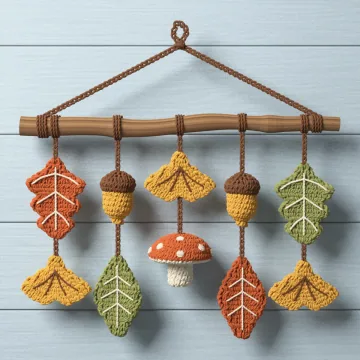
A golden ginkgo leaf with a wavy edge: a ribbed fan with a notch in the middle of its curved edge and a long slim stem, worked sideways in rows that run between the edge and the stem.