Leaf blanket crochet pattern
Easy · 3 colors · 14,040 stitches in 72 pieces
PDF · US Letter · 4 pages · Change paper
Go to the instructions Round counter
- Size
- About 41½ in (105 cm) across
- Squares
- 36, in 6 rows of 6, each about 6⅝ in (17 cm)
- Skill
- EasyWorked in rounds, with 72 pieces and color changes.
- Yarn
- Medium (4), about 2,155 yd (1,971 m), an estimate
- Hook
- 5 mm (US H-8)
Paper for the PDF
For your own crochet, gifts and handmade pieces you sell. Do not resell or share this PDF or copies of it. Selling, classes and kits: the rules
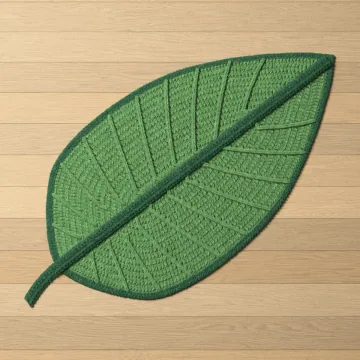
Thirty-six oat squares, each with one long leaf sewn across it from corner to corner. Forest green leaves with fern green edges and fern green leaves with forest green edges meet in fours, stem to stem, and make nine great pinwheels.
Gauge
14 stitches and 15 rows to 4 in (10 cm) in single crochet.
Use any hook that gives you this. If you count more stitches than this in 4 in (10 cm), change to a larger hook; if you count fewer, to a smaller one.
How to measure it
Check your gauge on the piece. Begin the pattern and measure the piece itself as you go.
After round 2 the square measures about 2½ in (6 cm) across.
In a thinner or a thicker yarn: how many stitches you need, and how large it comes out.
Before you start
How it is worked: Magic ring · Working in the round · Corner to corner · Joining squares · Changing colors
Read the 14 notes
- Rounds are worked with the right side facing; do not turn.
- Magic ring: wrap the yarn round two fingers, work the first round or row into the loop, then pull the tail until the ring is closed. Four chains joined into a ring with a slip stitch may be used instead.
- A chain that counts as a stitch is marked so in its line and is included in the count.
- A chain 1 at the start of a round does not count as a stitch.
- Fasten off the old color, then join the new one with a slip stitch in the place named; the first stitch or chain of the line is worked in that same place.
- A slip stitch at the start of a round only carries the yarn to the place named; the first stitch of the round is worked in that same place. If stitches lie between the joining and that place, slip stitch across them first.
- Working along the other side of the chain: turn the piece round, not over, and work into the unused loops of the foundation chain, beginning in the chain next to the one just used.
- The figures in brackets at the end of a line count its stitches and the chain spaces between them; slip stitches, and chains that are not named there, are not counted.
- The blanket is 36 squares, 6 rows of 6, in nine blocks of two squares by two. To make it larger add whole blocks, two rows or two columns of squares at a time: each block takes four more squares and four more leaves. Go on with the colors like a checkerboard, so that a block whose leaves were begun with B always lies beside blocks whose leaves were begun with C. Two more rows or columns add 100 sc to the border. Allow yarn in proportion.
- Leaf: the slip knot of the foundation chain is at the tip. Rnd 1 goes up one side of the chain, round the tip and down the other side, and both rounds begin and end at the base. The last sc of Rnd 1 is worked in the chain that holds its first sc. In Rnd 2 the (hdc, dc, hdc) is worked in the hdc at the tip.
- The leaf stem is the last chain of Rnd 2: slip stitch back along it, then slip stitch in the first hdc of the round to join.
- The distances under FINISHING are for the yarn and gauge above; in another yarn make them larger or smaller in the same proportion as the size.
- Backstitch (sewn): thread the yarn needle and bring it up from the back one stitch length (about ¼ in, 0.6 cm, and half that round a small curve, unless the line names another) along the line. Put it down at the start of the line and bring it up again one stitch length ahead of where it last came up; keep going down at the end of the stitch before and up one length ahead.
- The same words in another yarn make another size, measured straight across: fine yarn (2) and a 3.25 mm hook, about 27¾ in (70 cm); light yarn (3) and a 4 mm hook, about 32¼ in (82 cm); bulky yarn (5) and a 6.5 mm hook, about 53 in (135 cm).
Instructions
First read the 14 notes just above.
- “[ ]” is a repeat.
- “( )” goes into one place.
- The count at the end is what the round leaves.
- Tick a round when it is done. Your place is kept in this browser.
- Left-handed? Work everything as it is written, the other way: rows from left to right, rounds clockwise. Left-handed crochet
How to read these rounds
Square brackets “[ ]” hold a repeat: work what is inside as many times as it says. Round brackets “( )” inside a line hold stitches that all go into one place. In UK terms sl st is slip stitch, sc is double crochet, hdc is half treble, dc is treble and tr is double treble.
Square make 36
Yarn A, oat.
- FoundationWith A, make a magic ring.
- Rnd 1RSCh 3 (counts as dc), 2 dc in ring, ch 2, repeat: 3 dc in ring, ch 2 3 times, sl st in top of ch-3 to joinleaves (12 dc, 4 ch-2 sps)
- Rnd 2Sl st in next ch-2 sp, ch 3 (counts as dc), (dc, ch 2, 2 dc) in same sp, dc in next 3 sts, repeat: (2 dc, ch 2, 2 dc) in next ch-2 sp, dc in next 3 sts 3 times, sl st in top of ch-3 to joinleaves (28 dc, 4 ch-2 sps)
- Rnd 3Sl st in next ch-2 sp, ch 3 (counts as dc), (dc, ch 2, 2 dc) in same sp, dc in next 7 sts, repeat: (2 dc, ch 2, 2 dc) in next ch-2 sp, dc in next 7 sts 3 times, sl st in top of ch-3 to joinleaves (44 dc, 4 ch-2 sps)
- Rnd 4Sl st in next ch-2 sp, ch 3 (counts as dc), (dc, ch 2, 2 dc) in same sp, dc in next 11 sts, repeat: (2 dc, ch 2, 2 dc) in next ch-2 sp, dc in next 11 sts 3 times, sl st in top of ch-3 to joinleaves (60 dc, 4 ch-2 sps)
- Rnd 5Sl st in next ch-2 sp, ch 3 (counts as dc), (dc, ch 2, 2 dc) in same sp, dc in next 15 sts, repeat: (2 dc, ch 2, 2 dc) in next ch-2 sp, dc in next 15 sts 3 times, sl st in top of ch-3 to joinleaves (76 dc, 4 ch-2 sps)
- Rnd 6Sl st in next ch-2 sp, ch 3 (counts as dc), (dc, ch 2, 2 dc) in same sp, dc in next 19 sts, repeat: (2 dc, ch 2, 2 dc) in next ch-2 sp, dc in next 19 sts 3 times, sl st in top of ch-3 to joinleaves (92 dc, 4 ch-2 sps)
- EndFasten off, leaving a 6 in (15 cm) tail.
Leaf make 36
Yarns in order of use: B, forest green; C, fern green.
- Make 20 as the lines say, B first and C for the edge, and 16 the other way round: C first and B for the edge.
- FoundationWith B, ch 18.
- Rnd 1Sc in 2nd ch from hook, hdc in next ch, dc in next 2 chs, tr in next 5 chs, dc in next 3 chs, hdc in next 2 chs, sc in next 2 chs, (sc, hdc, sc) in last ch, working along the other side of the chain, sc in next 2 chs, hdc in next 2 chs, dc in next 3 chs, tr in next 5 chs, dc in next 2 chs, hdc in next ch, sc in next ch, sl st in first sc to joinleaves (8 sc, 7 hdc, 10 dc, 10 tr)
Fasten off B.
- Rnd 2Join C with sl st in first sc, ch 1, 2 hdc in same st, hdc in next 3 sts, 2 hdc in next st, hdc in next 3 sts, 2 hdc in next st, hdc in next 8 sts, (hdc, dc, hdc) in next st, hdc in next 8 sts, 2 hdc in next st, hdc in next 3 sts, 2 hdc in next st, hdc in next 3 sts, 2 hdc in next st, ch 10, sl st in 2nd ch from hook, sl st in next 8 chs, sl st in first hdc to joinleaves (42 hdc, 1 dc)
- EndFasten off, leaving a 40 in (102 cm) tail for sewing.
Assembly
- Block every square to the same size, about 6⅝ in (17 cm) across: pin it out on a flat surface, spray it with water and let it dry.
- Block every leaf too: pin it out flat, right side up, 2⅝ in (6.7 cm) across at its widest and 6⅛ in (15.5 cm) long without its leaf stem, the tip drawn to a point, and the leaf stem straight, 2⅛ in (5.4 cm) long.
- Weave in all the ends of every leaf, but not its long sewing tail, on its wrong side. Then sew one leaf and its veins to every square, before you join any of the squares. The base of a leaf is the end with the leaf stem, where its rounds are joined; its tip is the dc of Rnd 2. Lay a square right side up and a leaf on it, right side up, along the straight line from one corner of the square to the corner opposite. Measure along that line from the outermost point of each corner (the outer edge of its ch-2): the end of the leaf stem lies ¼ in (0.6 cm) from the outermost point of the one corner and the tip of the leaf about ⅞ in (2.2 cm) from that of the other. If your leaf stem is a little longer or shorter, let the difference be at the tip. Leave the two chains of the corner free for the seam. Pin the leaf down.
- With its tail sew the leaf to the square all the way round, along both edges of the leaf stem too, with one small whip stitch in every stitch of the edge (whip stitch: up through the square beside the edge, down through the outermost strand of the edge). Do not pull the stitches tight: the leaf stays raised on the square.
- Veins: sew them through the leaf and the square, with C on a leaf that was begun with B and with B on a leaf that was begun with C. The middle vein is a straight line of backstitch along the foundation chain, from the base of Rnd 1 to its tip. The four side veins are lines of 3 backstitches of about ⅜ in (1 cm) each, two on each side of the middle vein. The lower two begin on the middle vein 1⅜ in (3.5 cm) from the base edge of the leaf and the upper two 2⅝ in (6.7 cm) from it; each slants toward the tip and ends at the inner edge of Rnd 2, ⅞ in (2.2 cm) nearer the tip than where it began.
- On the wrong side of every square, weave in its own ends, the rest of the sewing tail of its leaf and the ends of the veins with the yarn needle.
- Lay the 36 squares out in 6 rows of 6, right sides up, the leaves in blocks of two squares by two, so that in every block the four leaf stems meet in the middle and the four tips point to the corners of the block. The nine blocks lie three by three: the leaves of the four corner blocks and of the middle block were begun with B, those of the other four with C.
- Join with a slip stitch seam in A: hold two squares that lie side by side with right sides together. Begin with 1 slip stitch in the corner space of both, work 1 slip stitch through both in every stitch along the side (23 slip stitches), and end with 1 slip stitch in the next corner space of both; work under both top loops of the stitch on both squares. Join the squares of each row first, then join the rows to each other with one long seam each, going straight on from one pair of squares to the next. Fasten off at the end of each seam.
- Border: with B and the right side facing, join with a slip stitch in any corner space of the blanket and ch 1, which does not count as a stitch; work 3 sc in each of the four corner spaces of the blanket, 1 sc in every stitch along the edges and 1 sc in each of the two corner spaces that meet at a seam; slip stitch in the first sc to join (604 sc). Fasten off. Second round of the border: with C and the right side facing, join with a slip stitch in any sc that is not the middle one of the 3 sc of a corner, ch 1, 1 sc in the same st, then 1 sc in every sc and 3 sc in the middle one of the 3 sc at every corner; slip stitch in the first sc to join (612 sc). Fasten off. Third round: the same with B (620 sc). Fasten off.
Finishing
- Weave in all the ends of the seams and the border with the yarn needle.
In all: 72 pieces; 14,040 stitches (312 in each square, 78 in each leaf); 296 ends to weave in.