Hen egg basket crochet pattern
Intermediate · 5 colors · 2,548 stitches in 19 pieces · 2 sizes
Size: Dozen Change size
PDF · US Letter · 7 pages · Change paper
Go to the instructions Round counter
- Size
- About 9¾ in (25 cm) long, 6¾ in (17 cm) wide and 4 in (10 cm) tall, the head and the tail not counted
- Skill
- IntermediateThe basket is plain oval rounds; the head is stuffed, and the feathers and wings are small pieces sewn on.
- Yarn
- Medium (4), about 550 yd (503 m), an estimate
- Hook
- 5.5 mm (US I-9)
Size 2 choices · Dozen is pictured
Paper for the PDF
For your own crochet, gifts and handmade pieces you sell. Do not resell or share this PDF or copies of it. Selling, classes and kits: the rules
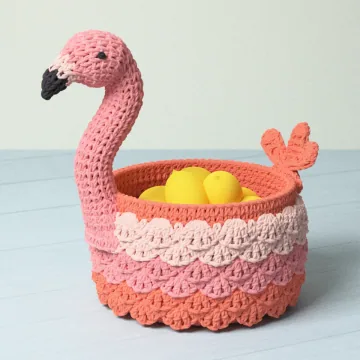
A hen egg basket: a low oval nest in speckled black and cream single crochet (UK double crochet), with a stuffed head, red comb, tail fan and pocket wings. The nest is worked in one piece from an oval base up, with the yarn held double so that it stands. The head and neck are one stuffed tube, the tail is a fan of seven feathers, and each wing is an oval sewn on along its lower edge, so that it is a pocket. The dozen size has room for about twelve large eggs in one layer. For tweed without tweed yarn hold one strand of black and one of cream together.
Sizes
Gauge
12 stitches and 13 rounds to 4 in (10 cm) in single crochet.
How to measure it
Check your gauge on the piece. Begin the pattern and measure the piece itself as you go.
The gauge is checked on the piece itself: after round 11 the base should measure about 9¾ in (25 cm) long, laid flat and not stretched.
A range that is near enough is printed after that round. If the piece measures more than that, begin again with a smaller hook; if it measures less, with a larger hook.
In a thinner or a thicker yarn: how many stitches you need, and how large it comes out.
Before you start
How it is worked: Magic ring · Continuous rounds · Back loop and front loop · Changing colors
Read the 8 notes
- Begin with a magic ring: wind the yarn once round two fingers, put the hook through the ring, draw up a loop and chain 1 to hold it, which does not count as a stitch. Work round 1 into the ring, then pull the tail to draw the ring closed.
- The rounds of the basket, the head, the beak, the lobes, the eyes and the wings are not joined: work in a spiral, and move a marker up to the first stitch of each round. The feathers are one round, joined with a slip stitch.
- The basket and the wings are ovals. Round 1 is worked along both sides of the foundation chain: along one side, 3 stitches in the last chain, then back along the other side.
- Two strands are held together throughout, for the sewing too, where nothing else is said. Every part is worked with its right side, the outside, facing you.
- Where the pattern says BLO, put the hook under the back loop only; the front loop stays free on the outside as a ridge.
- To change color, draw the new yarn through as the last yarn over of the stitch before. Cut the old yarn at each change, leaving a tail of 6 in (15 cm).
- Whip stitch: put the needle through both edges from back to front, one stitch for each stitch or row, and draw the yarn snug.
- Colors. Basket. Rounds 1 to 23: A. Round 24: D. The head is A, the beak C, the lobes B, the eyes E and the wings D.
Instructions
Size: Dozen Change sizeUS termsUK terms
First read the 8 notes just above.
Go to: Basket · Head and neck · Beak · Comb and wattle lobe · Eye · Charcoal feather · Tweed feather · Wing · Assembly
- “[ ]” is a repeat.
- The count at the end is what the round leaves.
- Tick a round when it is done. Your place is kept in this browser.
- Left-handed? Work everything as it is written, the other way: rows from left to right, rounds clockwise. Left-handed crochet
How to read these rounds
Square brackets “[ ]” hold a repeat: work what is inside as many times as it says. In UK terms sl st is slip stitch, sc is double crochet, hdc is half treble and dc is treble.
Basket
Yarns in order of use: A, black and cream tweed; D, charcoal.
- FoundationCh 11.
- Rnd 1RSSc in 2nd ch from hook, sc in next 8 chs, 3 sc in last ch, working along the other side of the foundation ch, sc in next 8 chs, 2 sc in last chleaves (22 sc)
- Rnd 22 sc in next st, sc in next 8 sts, 2 sc in each of next 3 sts, sc in next 8 sts, 2 sc in each of next 2 stsleaves (28 sc)
- Rnd 32 sc in next st, sc in next st, sc in next 8 sts, repeat: 2 sc in next st, sc in next st 3 times, sc in next 8 sts, repeat: 2 sc in next st, sc in next st 2 timesleaves (34 sc)
- Rnd 4Sc in next 2 sts, 2 sc in next st, sc in next 8 sts, repeat: sc in next 2 sts, 2 sc in next st 3 times, sc in next 8 sts, repeat: sc in next 2 sts, 2 sc in next st 2 timesleaves (40 sc)
- Rnd 52 sc in next st, sc in next 3 sts, sc in next 8 sts, repeat: 2 sc in next st, sc in next 3 sts 3 times, sc in next 8 sts, repeat: 2 sc in next st, sc in next 3 sts 2 timesleaves (46 sc)
- Rnd 6Sc in next 4 sts, 2 sc in next st, sc in next 8 sts, repeat: sc in next 4 sts, 2 sc in next st 3 times, sc in next 8 sts, repeat: sc in next 4 sts, 2 sc in next st 2 timesleaves (52 sc)
- Rnd 72 sc in next st, sc in next 5 sts, sc in next 8 sts, repeat: 2 sc in next st, sc in next 5 sts 3 times, sc in next 8 sts, repeat: 2 sc in next st, sc in next 5 sts 2 timesleaves (58 sc)
- Rnd 8Sc in next 6 sts, 2 sc in next st, sc in next 8 sts, repeat: sc in next 6 sts, 2 sc in next st 3 times, sc in next 8 sts, repeat: sc in next 6 sts, 2 sc in next st 2 timesleaves (64 sc)
- Rnd 92 sc in next st, sc in next 7 sts, sc in next 8 sts, repeat: 2 sc in next st, sc in next 7 sts 3 times, sc in next 8 sts, repeat: 2 sc in next st, sc in next 7 sts 2 timesleaves (70 sc)
- Rnd 10Sc in next 8 sts, 2 sc in next st, sc in next 8 sts, repeat: sc in next 8 sts, 2 sc in next st 3 times, sc in next 8 sts, repeat: sc in next 8 sts, 2 sc in next st 2 timesleaves (76 sc)
- Rnd 112 sc in next st, sc in next 9 sts, sc in next 8 sts, repeat: 2 sc in next st, sc in next 9 sts 3 times, sc in next 8 sts, repeat: 2 sc in next st, sc in next 9 sts 2 timesleaves (82 sc)
- Stop and measure now, after round 11.The base should measure about 9¾ in (25 cm) long and 6¾ in (17 cm) wide. Half an inch (1.5 cm) more or less is near enough; it must lie flat.
Sides
- Rnd 12Sc in BLO of each st aroundleaves (82 sc)
- Rnds 13 to 23Sc in each st aroundleaves (82 sc)Next: round 13 of rounds 13 to 23
- Rnd 24With D, sc in each st aroundleaves (82 sc)
- EndSlip stitch in the next stitch to level the edge. Fasten off, leaving a tail of 6 in (15 cm).
Head and neck
Yarn A, black and cream tweed.
- Begin at the top of the head. Stuff the head firmly and the neck softly when the last round is done.
- FoundationMake a magic ring.
- Rnd 1RS6 sc in MRleaves (6 sc)
- Rnd 22 sc in each st aroundleaves (12 sc)
- Rnd 3repeat: Sc in next st, 2 sc in next st 6 timesleaves (18 sc)
- Rnds 4 to 7Sc in each st aroundleaves (18 sc)Next: round 4 of rounds 4 to 7
Neck
- Rnd 8repeat: Sc in next 5 sts, 2 sc in next st 3 timesleaves (21 sc)
- Rnd 9Sc in each st aroundleaves (21 sc)
- Rnd 10repeat: Sc in next 6 sts, 2 sc in next st 3 timesleaves (24 sc)
- Rnd 11Sc in each st aroundleaves (24 sc)
- Rnd 12repeat: Sc in next 7 sts, 2 sc in next st 3 timesleaves (27 sc)
- Rnd 13Sc in each st aroundleaves (27 sc)
- Rnd 14repeat: Sc in next 8 sts, 2 sc in next st 3 timesleaves (30 sc)
- Rnd 15Sc in each st aroundleaves (30 sc)
- Rnd 16repeat: Sc in next 9 sts, 2 sc in next st 3 timesleaves (33 sc)
- Rnd 17Sc in each st aroundleaves (33 sc)
- EndSlip stitch in the next stitch. Fasten off, leaving a tail of 48 in (122 cm) for sewing.
Beak
Yarn C, golden orange.
- Begin at the point. Push a little stuffing in after round 4.
- FoundationMake a magic ring.
- Rnd 1RS4 sc in MRleaves (4 sc)
- Rnd 2repeat: Sc in next st, 2 sc in next st 2 timesleaves (6 sc)
- Rnd 3Sc in each st aroundleaves (6 sc)
- Rnd 4repeat: Sc in next st, 2 sc in next st 3 timesleaves (9 sc)
- EndSlip stitch in the next stitch. Fasten off, leaving a tail of 16 in (40.5 cm) for sewing.
Comb and wattle lobe make 5
Yarn B, barn red.
- Do not stuff the lobes. Three are the comb and two the wattles.
- FoundationMake a magic ring.
- Rnd 1RS6 sc in MRleaves (6 sc)
- Rnds 2 to 3Sc in each st aroundleaves (6 sc)Next: round 2 of rounds 2 to 3
- EndSlip stitch in the next stitch. Fasten off, leaving a tail of 14 in (35.5 cm) for sewing.
Eye make 2
Yarn E, cream.
- FoundationMake a magic ring.
- Rnd 1RS6 sc in MRleaves (6 sc)
- EndSlip stitch in the next stitch. Fasten off, leaving a tail of 14 in (35.5 cm) for sewing.
Charcoal feather make 4
Yarn D, charcoal.
- The feather is one round along both sides of its chain. The joined end is its foot, and the 5 hdc in one chain make its round tip.
- FoundationCh 13.
- Rnd 1RSSc in 2nd ch from hook, sc in next 3 chs, hdc in next 2 chs, dc in next 4 chs, hdc in next ch, 5 hdc in last ch, working along the other side of the foundation ch, hdc in next ch, dc in next 4 chs, hdc in next 2 chs, sc in next 4 chs, sl st in first sc to joinleaves (8 sc, 11 hdc, 8 dc)
- EndFasten off, leaving a tail of 22 in (56 cm) for sewing.
Tweed feather make 3
Yarn A, black and cream tweed.
- The feather is one round along both sides of its chain. The joined end is its foot, and the 5 hdc in one chain make its round tip.
- FoundationCh 13.
- Rnd 1RSSc in 2nd ch from hook, sc in next 3 chs, hdc in next 2 chs, dc in next 4 chs, hdc in next ch, 5 hdc in last ch, working along the other side of the foundation ch, hdc in next ch, dc in next 4 chs, hdc in next 2 chs, sc in next 4 chs, sl st in first sc to joinleaves (8 sc, 11 hdc, 8 dc)
- EndFasten off, leaving a tail of 22 in (56 cm) for sewing.
Wing make 2
Yarn D, charcoal.
- FoundationCh 9.
- Rnd 1RSSc in 2nd ch from hook, sc in next 6 chs, 3 sc in last ch, working along the other side of the foundation ch, sc in next 6 chs, 2 sc in last chleaves (18 sc)
- Rnd 22 sc in next st, sc in next 6 sts, 2 sc in each of next 3 sts, sc in next 6 sts, 2 sc in each of next 2 stsleaves (24 sc)
- Rnd 32 sc in next st, sc in next st, sc in next 6 sts, repeat: 2 sc in next st, sc in next st 3 times, sc in next 6 sts, repeat: 2 sc in next st, sc in next st 2 timesleaves (30 sc)
- Rnd 4Sc in next 2 sts, 2 sc in next st, sc in next 6 sts, repeat: sc in next 2 sts, 2 sc in next st 3 times, sc in next 6 sts, repeat: sc in next 2 sts, 2 sc in next st 2 timesleaves (36 sc)
- EndSlip stitch in the next stitch. Fasten off, leaving a tail of 32 in (81.5 cm) for sewing.
Assembly
- Weave in the tails of the basket on the inside. Weave in the starting tails of the wings, the eyes and the feathers on their wrong sides. The starting tails of the head, the beak and the lobes stay inside them.
- The ends. Lay the basket flat with its base folded along its middle the long way, so that each end of the base is at a fold. Put a marker in the rim at each fold: one is the head end, the other, 41 stitches away, the tail end. Open the basket again. The rounds of the sides are counted from 1, the round in BLO, to 13, the rim.
- The face. The last stitch of the neck marks the middle of the back of the head; turn the head so that it is away from you, and the line straight in front of you is the middle of the front. With both strands of D, about 12 in (30.5 cm) long for each eye, make a French knot in the middle of the eye, on its right side. French knot: bring the needle up, wind the yarn twice round it close to the fabric, and put it down again beside the place where it came up, holding the yarn taut. Fasten off at the back. Lay an eye on each side of the head, right side out, its middle on round 5, 4 stitches from the middle of the front. Sew it down with its own tail: bring the needle up through the eye under the top of a stitch and down through the head just outside the edge, 6 stitches. Draw the end inside. Every flat part below is sewn down in this way.
- The beak. Set its open edge on the middle of the front, over rounds 6 to 8 of the head and neck, so that its upper edge is just below round 5, the point outward and a little down. With its tail whip stitch its 9 stitches to the head in a circle. Draw the end inside.
- The comb. Press the lobes flat. Set three of them in a line along the top of the head, from the front to the back, each with its flat open edge on the head and its closed end up: each about 1 in (2.5 cm) wide. Begin at the front: the front end of the first lobe is on round 4, at the middle of the front, so that round 5 is free between it and the beak. The second lobe begins where the first ends and lies over the magic ring, and the third begins where the second ends and reaches to about round 6 at the back. They touch and do not overlap. With its own tail sew each open edge to the head, 3 stitches on one side and 3 on the other. The wattles. Press the other two flat too and set them just below the beak, next to each other, with their open edges up and their closed ends hanging down, and sew each in the same way along its open edge. Draw all the ends inside.
- The head goes on at the head end, its beak away from the basket. Lay the front part of the neck's open edge on the outside of the basket, so that its middle is below the marker on round 9 of the sides; bring the two sides of the edge up over the rim, 7 stitches from the marker on each side, and the back part down on the inside, its middle on round 12. Pin it. The back part is 15 of the 33 stitches: the last stitch of the neck, in the middle of the inside, and the 7 stitches on each side of it. The front part is the other 18, outside the rim. With its long tail whip stitch the edge down all round, one stitch for each of its stitches, through the wall; before the last few stitches add stuffing, so that the neck stands firmly. Fasten off inside the basket.
- The tail. The seven feathers lie on the outside of the tail end, right sides out, and spread like a fan; their feet are close together 1¼ in (3 cm) below the rim, straight below the marker. Pin them in this order, each one over the edge of the one before. Think of the face of a clock, with the marker straight above its middle. First the outermost two, which are charcoal: one points to 10, the other to 2. Next two tweed feathers, one on each side, a third of the way from these to 12; then two charcoal ones, two thirds of the way; last the third tweed feather, in the middle, pointing to 12. With its own tail sew each one to the wall along both its edges from the foot to the rim, with a small stitch for each of its stitches; then sew its edge to the next feather for 1 in (2.5 cm) above the rim, so that the fan stands. Fasten off inside.
- The marks of the wings. With one strand of E, about 24 in (61 cm) long for each, sew three V shapes in a row along the middle line of each wing, on the right side, 1 in (2.5 cm) apart. Each V is two straight stitches, each about ½ in (1.5 cm) long, which meet at its point; the points look toward the same end of the wing, the tip. Straight stitch: bring the needle up at one end of the line and down at the other. Fasten off at the back.
- The wings. Pin one to the middle of each long side, right side out, its long way level and its tip toward the tail, its lower edge on round 2 of the sides. With its long tail sew it down along the lower edge and both ends, 24 of its 36 stitches, and leave the 12 stitches in the middle of the upper edge open: the wing is a pocket. Make 3 stitches in one place at each end of the opening. Fasten off inside.
Finishing
- Weave all the tails that are left in on the inside.
In all: 19 pieces; 2,548 stitches (1,638 in the basket, 378 in the head and neck, 25 in the beak, 18 in each comb and wattle lobe, 6 in each eye, 27 in each charcoal feather, 27 in each tweed feather, 108 in each wing).