Rounds are worked with the right side facing; do not turn.
Magic ring: wrap the yarn round two fingers, work the first round or row into the loop, then pull the tail until the ring is closed. Four chains joined into a ring with a slip stitch may be used instead.
Fasten off the old color, then join the new one with a slip stitch in the place named; the first stitch or chain of the line is worked in that same place.
A slip stitch at the start of a round only carries the yarn to the place named; the first stitch of the round is worked in that same place. If stitches lie between the joining and that place, slip stitch across them first.
Front loop: the strand of the top of a stitch nearest you; back loop: the strand farther from you. Working into one leaves the other free for a later round.
Where a line names an earlier round, fold what has been worked since toward you and work into the stitches of that round behind it.
In a round of petals or points the last slip stitch falls in the stitch the first petal or point began in.
The figures in brackets at the end of a line count its stitches, its picots and the chain spaces between them; slip stitches are not counted.
The picot of every bract and leaf stands on its tallest stitch, the dtr, and makes the tip.
Rnds 2 and 5 are worked in front loops; Rnds 4 and 7 in back loops, the sl st that joins the new color too. Wherever a round is worked in one loop of a round, the other loop of every stitch, and both loops of every stitch that is skipped, stay free behind the bracts.
Rnd 4 goes into the back loops of all 12 sc of Rnd 1, the last 2 sc into the first sc of Rnd 1. The 2nd sc of Rnd 1 is the first one that Rnd 2 skipped, so each of the six single sc of Rnd 4 stands behind the middle of a front bract, and the six ch-5 sps of Rnd 5 lie behind the gaps between them.
Rnd 7 goes into the back loops of Rnd 4: the first sc into the first of a pair worked in one stitch, the second into its other one, and the skipped sc is the single one between two pairs; the last one skipped is the first sc of Rnd 4. So each ch-6 sp lies behind the middle of a front bract.
At the start of Rnd 8, sl st in the 2nd sc of Rnd 7 and then in the ch-6 sp.
The distances under FINISHING are for the yarn and gauge above; in another yarn make them larger or smaller in the same proportion as the size.
French knot (sewn): bring the yarn needle up from the back, wrap the yarn twice round the needle close to the surface, hold the wraps and put the needle down beside the place where it came up. For a large knot use the yarn double and wrap it three times.
The same words in another yarn make another size, measured the longest way: fine yarn (2) and a 3.25 mm hook, about 4 in (10 cm); light yarn (3) and a 4 mm hook, about 4¾ in (12 cm); bulky yarn (5) and a 6.5 mm hook, about 7¾ in (20 cm).
Left-handed. Work everything as it is written, the other way: rows from left to right, rounds clockwise. Left-handed crochet
Abbreviations
Written in US terms. Where the UK name differs it is given beside the US one.
A chain 1 at the start of a round does not count as a stitch.
Rnds 3 and 6 begin with the ch-sp that follows the first sc, and every sl st between two bracts goes into the sc between their two ch-sps, both loops of it. The last sl st of the round goes into the first sc; the round is not joined again.
Rnd 1RSCh 1,12 sc in ring,pull the tail to close the ring,sl st in first sc to joinleaves (12 sc)
Rnd 2Working in front loops only,ch 1,sc in same st,ch 4,sk next st,[repeat: sc in next st,ch 4,sk next st]5 times,sl st in first sc to joinleaves (6 sc, 6 ch-4 sps)
Rnd 3Ch 1,[repeat: (sc, hdc, dc, tr, dtr, picot, tr, dc, hdc, sc) in next ch-4 sp,sl st in next sc]6 timesleaves (12 sc, 12 hdc, 12 dc, 12 tr, 6 dtr, 6 picots)
Rnd 4Join B with sl st in 2nd sc of Rnd 1,working in back loops only,ch 1,sc in same st,2 sc in next sc of Rnd 1,[repeat: sc in next sc of Rnd 1,2 sc in next sc of Rnd 1]5 times,sl st in first sc to joinleaves (18 sc)
Rnd 5Working in front loops only,ch 1,sc in same st,ch 5,sk next 2 sts,[repeat: sc in next st,ch 5,sk next 2 sts]5 times,sl st in first sc to joinleaves (6 sc, 6 ch-5 sps)
Rnd 6Ch 1,[repeat: (sc, hdc, dc, 2 tr, dtr, picot, 2 tr, dc, hdc, sc) in next ch-5 sp,sl st in next sc]6 timesleaves (12 sc, 12 hdc, 12 dc, 24 tr, 6 dtr, 6 picots)
Fasten off B.
Rnd 7Join C with sl st in 2nd sc of Rnd 4,working in back loops only,ch 1,sc in same st,sc in next sc of Rnd 4,ch 6,sk next sc of Rnd 4,[repeat: sc in next 2 sc of Rnd 4,ch 6,sk next sc of Rnd 4]5 times,sl st in first sc to joinleaves (12 sc, 6 ch-6 sps)
Rnd 8Sl st in next ch-6 sp,ch 1,(sc, hdc, dc, 2 tr, dtr, picot, 2 tr, dc, hdc, sc) in same sp,[repeat: (sc, hdc, dc, 2 tr, dtr, picot, 2 tr, dc, hdc, sc) in next ch-6 sp]5 times,sl st in first sc to joinleaves (12 sc, 12 hdc, 12 dc, 24 tr, 6 dtr, 6 picots)
EndFasten off, leaving a 6 in (15 cm) tail.
Finishing
Block: pin the tips of the six leaves and the six deep red bracts out on a flat surface, right side up, the leaves first; spray the flower with water, lift the tips of the red bracts with your fingers so that they stand up, and let it dry.
With D used double, work seven large French knots for the center, each wrapped three times: one over the magic ring and six evenly round it, ¼ in (0.6 cm) from its middle.
Weave in all the ends that are left with the yarn needle.
About
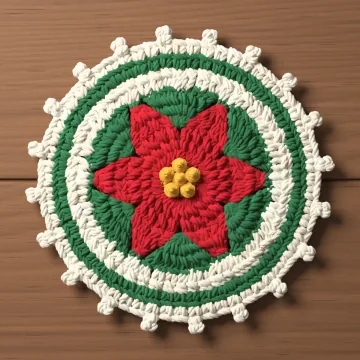
A full poinsettia of two tiers of six pointed bracts, Christmas red over deep red, and a tier of six green leaves behind them. Every bract and leaf is one graded shell with a picot at its tip, and the center is a cluster of gold French knots.