Receiving blanket crochet pattern
Easy · 2 colors · 7,779 stitches in 2 pieces · 2 sizes
Size: Standard Change size
PDF · US Letter · 4 pages · Change paper
Go to the instructions Row counter
- Size
- About 30½ × 30 in (77 × 76 cm)With its border. The panel alone: about 28½ × 28 in (72 × 71 cm)
- Skill
- EasyChain spaces, groups in one place, shells in the border
- Yarn
- Fine (2), about 795 yd (727 m), an estimate
- Hook
- 4 mm (US G-6)
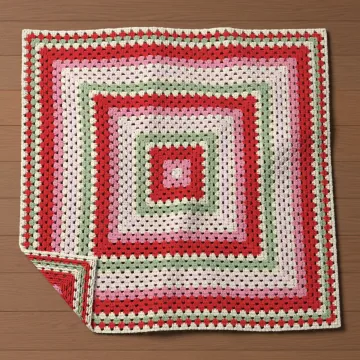
Size 2 choices · Standard is pictured
Which size? Baby blanket size chart
Paper for the PDF
For your own crochet, gifts and handmade pieces you sell. Do not resell or share this PDF or copies of it. Selling, classes and kits: the rules
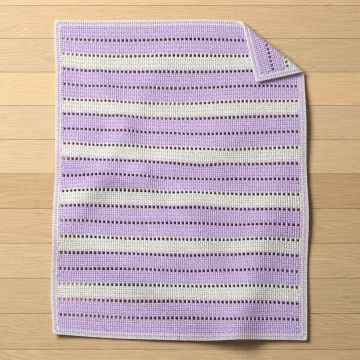
V-stitch is a double crochet (UK treble), a chain and a double crochet in every chain space, so that small Vs stand one above another in columns, with two double crochets at each side for a firm edge. It is light and it folds small. The Vs are close together, with no long loops to catch. The border is three rounds of single crochet (UK double crochet) and a round of shells, all the way around in ivory.
Sizes
Gauge
17 stitches and 10 rows to 4 in (10 cm) in V-stitch.
Use any hook that gives you this. If you count more stitches than this in 4 in (10 cm), change to a larger hook; if you count fewer, to a smaller one.
How to measure it
Along a row, count every stitch and every chain between stitches as one.
To count your gauge in the middle of the test piece: 18 stitches and chains side by side are about 4.2 in (10.8 cm) wide, and 10 rows are about 4 in (10 cm) tall.
The pattern also stops you to measure after row 8.
Work a test square first (15 rows)
A test piece to measure and pull out. It is not the start of the pattern.
The test piece is about 6½ in (17 cm) wide and 6 in (15 cm) tall, so that you can count over 4 in (10 cm) in the middle of it.
- Swatch foundationWith A, ch 30.
- Swatch row 1 (RS)Dc in 4th ch from hook (skipped chs count as dc), sk next ch, (dc, ch 1, dc) in next ch, repeat: sk next 2 chs, (dc, ch 1, dc) in next ch 7 times, sk next ch, dc in next 2 chs(20 dc, 8 ch-1 sps)
- Swatch rows 2 to 15Ch 3 (counts as dc), turn; dc in next st, repeat: (dc, ch 1, dc) in next ch-1 sp 8 times, sk next st, dc in next st, dc in top of turning ch(20 dc, 8 ch-1 sps)
In a thinner or a thicker yarn: how many stitches you need, and how large it comes out.
To make it larger or smaller
For another width, add or take away 6 chains at a time: 6 chains add two more repeats of the bracketed group. Measure your own gauge first. The top and the bottom of the border then still come out even; on the sides, count anew when you add rows: before the last round every side must have a multiple of 6 plus 5 stitches between one corner stitch and the next.
The starting chain calculator opens on this pattern's multiple and gauge: type the width you want.
Before you start
How it is worked: Changing colors · Working in the round
Read the 12 notes
- The ch 3 at the start of a row counts as a dc. It stands on the first st of the row below; the next st is the second. The last stitch of the next row is worked into the top of it. In row 2 that is the top of the skipped chs: the last ch you made of the foundation.
- The ch 1 at the start of a row does not count as a stitch: the first stitch of the row goes into the first st of the row below.
- Row 1 is the right side.
- A stitch worked into a chain space passes over any stitches that lie before the space; they are left unworked.
- Stitches in parentheses, or several of one stitch, are all worked into the one place named after them.
- Choose a smooth cotton blend that can be washed in the machine.
- For a baby it is a blanket for awake and watched hours: on a lap, in the arms, on the floor.
- Leave a tail of about 6 in (15 cm) when you begin, and weave it in at the end with the others. Join a new ball at the end of a row, with the same tails: each join adds two ends.
- The border is worked in rounds with the right side facing. Rnd 1 begins in the st just joined, which it calls "first st", goes along the last row to the other end, which it calls "last st", then down the left side, along the foundation edge and up the right side.
- Along the foundation edge every ch counts, skipped or not; the last one is the lowest of the 3 chs that stand as the first dc of row 1.
- The chain at the start of a round does not count as a stitch. After rnd 1, the first stitch of a round goes into the stitch that the slip stitch joined: that stitch is the first of the next stitches.
- Rnd 4 is the round of shells. Its first sc goes into the stitch that the slip stitch joined, and a shell of 7 dc goes into each corner stitch, the middle one of the 3 stitches that rnd 3 has in one place at the corner. Every sc between two shells goes into the 3rd stitch after the stitch that holds the shell before it.
Instructions
Size: Standard Change sizeUS termsUK terms
First read the 12 notes just above.
- “[ ]” is a repeat.
- “( )” goes into one place.
- The count at the end is what the row leaves.
- Tick a row when it is done. Your place is kept in this browser.
- Left-handed? Work everything as it is written, the other way: rows from left to right, rounds clockwise. Left-handed crochet
How to read these rows
Square brackets “[ ]” hold a repeat: work what is inside as many times as it says. Round brackets “( )” inside a line hold stitches that all go into one place. In UK terms sl st is slip stitch, sc is double crochet and dc is treble.
Baby blanket, row 70 in full words: Chain 1, turn; single crochet in next 2 stitches, [single crochet in next stitch, single crochet in next chain-1 space, single crochet in next stitch] 39 times, single crochet in next stitch, single crochet in top of turning chain.
Baby blanket
Yarn A, mint.
- FoundationWith A, ch 123.
- Row 1RSDc in 4th ch from hook (skipped chs count as dc), sk next ch, (dc, ch 1, dc) in next ch, repeat: sk next 2 chs, (dc, ch 1, dc) in next ch 38 times, sk next ch, dc in next 2 chsleaves (82 dc, 39 ch-1 sps)
- Rows 2 to 8Ch 3 (counts as dc), turn; dc in next st, repeat: (dc, ch 1, dc) in next ch-1 sp 39 times, sk next st, dc in next st, dc in top of turning chleaves (82 dc, 39 ch-1 sps)Next: row 2 of rows 2 to 8
- Stop and measure now, after row 8.Width, across the middle of the rows and not along the chain edge: about 28½ in (72 cm). If it is wider, start again with a smaller hook; if it is narrower, with a larger one. If only the chain edge is tight, make the chain with a larger hook.
- Rows 9 to 69Ch 3 (counts as dc), turn; dc in next st, repeat: (dc, ch 1, dc) in next ch-1 sp 39 times, sk next st, dc in next st, dc in top of turning chleaves (82 dc, 39 ch-1 sps)Next: row 9 of rows 9 to 69
- Row 70Ch 1, turn; sc in next 2 sts, repeat: sc in next st, sc in next ch-1 sp, sc in next st 39 times, sc in next st, sc in top of turning chleaves (121 sc)
- EndFasten off, leaving a 6 in (15 cm) tail.
Border
Yarn B, ivory.
- FoundationRight side facing and row 70 at the top, join B with sl st in the stitch that ends row 70, at the top right corner.
- Rnd 1RSCh 1, 3 sc in first st, sc in next 119 sts, 3 sc in last st, repeat: 2 sc in end of each of next 2 rows, sc in end of next row 21 times, 2 sc in end of each of next 7 rows, 3 sc in first ch of foundation edge, sc in next 119 chs, 3 sc in last ch of foundation edge, repeat: 2 sc in end of each of next 2 rows, sc in end of next row 21 times, 2 sc in end of each of next 7 rows, sl st in first sc to joinleaves (488 sc)
- Rnd 2RSCh 1, sc in next st, 3 sc in next st, sc in next 121 sts, 3 sc in next st, sc in next 121 sts, 3 sc in next st, sc in next 121 sts, 3 sc in next st, sc in next 120 sts, sl st in first sc to joinleaves (496 sc)
- Rnd 3RSCh 1, sc in next 2 sts, 3 sc in next st, sc in next 123 sts, 3 sc in next st, sc in next 123 sts, 3 sc in next st, sc in next 123 sts, 3 sc in next st, sc in next 121 sts, sl st in first sc to joinleaves (504 sc)
- Rnd 4RSCh 1, sc in next st, sk next 2 sts, 7 dc in next st, repeat: sk next 2 sts, sc in next st, sk next 2 sts, 5 dc in next st 20 times, sk next 2 sts, sc in next st, sk next 2 sts, 7 dc in next st, repeat: sk next 2 sts, sc in next st, sk next 2 sts, 5 dc in next st 20 times, sk next 2 sts, sc in next st, sk next 2 sts, 7 dc in next st, repeat: sk next 2 sts, sc in next st, sk next 2 sts, 5 dc in next st 20 times, sk next 2 sts, sc in next st, sk next 2 sts, 7 dc in next st, repeat: sk next 2 sts, sc in next st, sk next 2 sts, 5 dc in next st 20 times, sk next 2 sts, sl st in first sc to joinleaves (84 sc, 428 dc)
- EndFasten off, leaving a 6 in (15 cm) tail.
Finishing
- Weave in the ends.
- Lay the piece flat, pull it gently to its size, dampen it and let it dry.
In all: 7,779 stitches (5,779 in the baby blanket, 2,000 in the border); 4 ends to weave in.