Scalloped dishcloth border crochet pattern
Easy, dishcloth to washcloth, 2 colors
PDF, for US Letter and A4. Dishcloth. Another size
What you need
- Yarn
- Medium weight, 4 on the label (UK aran), cotton, an estimate: about 55 yd (50 m) in all or 30 g. Using a different yarn?
- A mustard cotton40 yd (37 m), 20 gcloth and round 1
- B slate cotton15 yd (14 m), 10 gscallops and hanging loop
- Hook
- 5.5 mm (US I-9)
- Gauge
- 13 stitches and 15 rows to 4 in (10 cm) in single crochet (UK double crochet). You measure after round 1.
- Also
- Yarn needle, scissors and tape measure
New to this? How to crochet, Simple edgings
Choose a size
| Size | Finished size | Yarn (ydm) |
|---|---|---|
| Small scrub cloth | 6¼ × 6¼ in (16 × 16 cm) | 4037 |
| Dishcloth, chosen | 8 × 8¼ in (20 × 21 cm) | 5550 |
| Washcloth | 10 × 10½ in (25 × 27 cm) | 8578 |
Press a size: the instructions and the PDF follow.
Key
- sc
- single crochet UK dc
- ch
- chain
- sl st
- slip stitch
- dc
- double crochet UK tr
- sk
- skip
- st
- stitch
2 sc in first st: both in one stitch. Sc in next 19 sts: one in each. ch-1 sp: the hole under the chain. The hook goes in the hole, never into a chain.
The ch 1 is not a stitch. Work in the very first stitch.
[ ] 10 times: 10 times in all. 11 sc, 10 ch-1 sps: the row now has that many; a check, not a step.
US terms. Show UK terms
Left-handed? Hook in the left hand; work the rows from left to right. No count changes.
Instructions
Dishcloth. Change
Press a row’s number when it is done. Key
Cloth
Yarn A, mustard cotton.
- StartMake a slip knot. Ch 22.
- 1RS Sc in 2nd ch from hook, repeat: ch 1, sk next ch, sc in next ch 10 times11 sc, 10 ch-1 sps
Stop and measure now, after round 1. The top edge, measured between its two corner stitches and not counting them, is about 6½ in (16.5 cm). If the edge ruffles, work the round again with a smaller hook; if it pulls in, with a larger one; keep the number of stitches.
- 2WS Ch 1, turn; sc in first st, sc in next ch-1 sp, repeat: ch 1, sc in next ch-1 sp 9 times, sc in last st12 sc, 9 ch-1 sps
- 3Ch 1, turn; sc in first st, ch 1, sk next st, repeat: sc in next ch-1 sp, ch 1 9 times, sk next st, sc in last st11 sc, 10 ch-1 sps
- 4Ch 1, turn; sc in first st, sc in next ch-1 sp, repeat: ch 1, sc in next ch-1 sp 9 times, sc in last st12 sc, 9 ch-1 sps
- 5Ch 1, turn; sc in first st, ch 1, sk next st, repeat: sc in next ch-1 sp, ch 1 9 times, sk next st, sc in last st11 sc, 10 ch-1 sps
- 6Ch 1, turn; sc in first st, sc in next ch-1 sp, repeat: ch 1, sc in next ch-1 sp 9 times, sc in last st12 sc, 9 ch-1 sps
- 7Ch 1, turn; sc in first st, ch 1, sk next st, repeat: sc in next ch-1 sp, ch 1 9 times, sk next st, sc in last st11 sc, 10 ch-1 sps
- 8Ch 1, turn; sc in first st, sc in next ch-1 sp, repeat: ch 1, sc in next ch-1 sp 9 times, sc in last st12 sc, 9 ch-1 sps
- 9Ch 1, turn; sc in first st, ch 1, sk next st, repeat: sc in next ch-1 sp, ch 1 9 times, sk next st, sc in last st11 sc, 10 ch-1 sps
- 10Ch 1, turn; sc in first st, sc in next ch-1 sp, repeat: ch 1, sc in next ch-1 sp 9 times, sc in last st12 sc, 9 ch-1 sps
- 11Ch 1, turn; sc in first st, ch 1, sk next st, repeat: sc in next ch-1 sp, ch 1 9 times, sk next st, sc in last st11 sc, 10 ch-1 sps
- 12Ch 1, turn; sc in first st, sc in next ch-1 sp, repeat: ch 1, sc in next ch-1 sp 9 times, sc in last st12 sc, 9 ch-1 sps
- 13Ch 1, turn; sc in first st, ch 1, sk next st, repeat: sc in next ch-1 sp, ch 1 9 times, sk next st, sc in last st11 sc, 10 ch-1 sps
- 14Ch 1, turn; sc in first st, sc in next ch-1 sp, repeat: ch 1, sc in next ch-1 sp 9 times, sc in last st12 sc, 9 ch-1 sps
- 15Ch 1, turn; sc in first st, ch 1, sk next st, repeat: sc in next ch-1 sp, ch 1 9 times, sk next st, sc in last st11 sc, 10 ch-1 sps
- 16Ch 1, turn; sc in first st, sc in next ch-1 sp, repeat: ch 1, sc in next ch-1 sp 9 times, sc in last st12 sc, 9 ch-1 sps
- 17Ch 1, turn; sc in first st, ch 1, sk next st, repeat: sc in next ch-1 sp, ch 1 9 times, sk next st, sc in last st11 sc, 10 ch-1 sps
- 18Ch 1, turn; sc in first st, sc in next ch-1 sp, repeat: ch 1, sc in next ch-1 sp 9 times, sc in last st12 sc, 9 ch-1 sps
- 19Ch 1, turn; sc in first st, ch 1, sk next st, repeat: sc in next ch-1 sp, ch 1 9 times, sk next st, sc in last st11 sc, 10 ch-1 sps
- 20Ch 1, turn; sc in first st, sc in next ch-1 sp, repeat: ch 1, sc in next ch-1 sp 9 times, sc in last st12 sc, 9 ch-1 sps
- 21Ch 1, turn; sc in first st, ch 1, sk next st, repeat: sc in next ch-1 sp, ch 1 9 times, sk next st, sc in last st11 sc, 10 ch-1 sps
- 22Ch 1, turn; sc in first st, sc in next ch-1 sp, repeat: ch 1, sc in next ch-1 sp 9 times, sc in last st12 sc, 9 ch-1 sps
- 23Ch 1, turn; sc in first st, ch 1, sk next st, repeat: sc in next ch-1 sp, ch 1 9 times, sk next st, sc in last st11 sc, 10 ch-1 sps
- 24Ch 1, turn; sc in first st, sc in next ch-1 sp, repeat: ch 1, sc in next ch-1 sp 9 times, sc in last st12 sc, 9 ch-1 sps
- 25Ch 1, turn; sc in first st, sc in next st, repeat: sc in next ch-1 sp, sc in next st 9 times, sc in last st21 sc
- Fasten off.
Border
- StartA finished piece of 21 sts by 25 rows, RS facing.
- 1Join A with sl st in first st, ch 1, 2 sc in first st, sc in next 19 sts, 3 sc in last st, repeat: sc in end of each of next 3 rows, sk next row end 6 times, sc in end of next row, 3 sc in first ch of foundation edge, sc in next 19 chs, 3 sc in last ch of foundation edge, repeat: sc in end of each of next 3 rows, sk next row end 6 times, sc in end of next row, sc in first st, sl st in first sc to join88 sc
- 2Join B with sl st in first st, ch 3 (counts as dc), 3 dc in same st, sk next st, sc in next st, repeat: sk next 2 sts, 5 dc in next st, sk next 2 sts, sc in next st 3 times, sk next st, repeat: 7 dc in next st, sk next st, sc in next st, repeat: sk next 2 sts, 5 dc in next st, sk next 2 sts, sc in next st 3 times, sk next st 3 times, 3 dc in first st, sl st in top of ch-3 to join88 dc, 16 sc
- Do not fasten off yet: ch 12, then sl st in the same top of the ch 3 the round was joined in. The 12 chs are the hanging loop, at the tip of one corner. Fasten off.
Finishing
- Weave in the ends.
More scalloped edgings
About this pattern
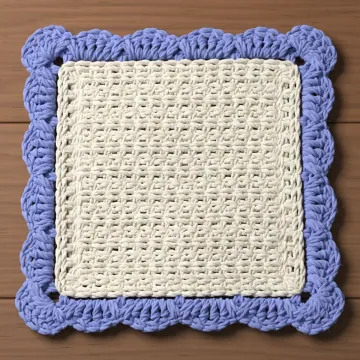
A round of single crochet (UK double crochet) makes the edge even, and one round of shells, 7 double crochet (UK treble) in a corner and 5 along the sides, does the rest. Twelve chains at one corner make a loop for the hook by the sink.
Gauge
13 stitches and 15 rows to 4 in (10 cm) in single crochet.
Check your gauge on the piece. Begin the pattern and measure the piece itself as you go.
After round 1 the top edge, measured between its two corner stitches and not counting them, is about 6½ in (16.5 cm). If the edge ruffles, work the round again with a smaller hook; if it pulls in, with a larger one; keep the number of stitches.
Larger or smaller
For any cloth, plain or patterned, with straight sides: work round 1 so that the stitches between two corner stitches are a multiple of 6 plus 3 (9, 15, 21, 27 and so on) on every side; work 2 single crochet in one stitch to gain a stitch or skip one to lose it, spread along the side. Take 3 from that number and divide by 6: that is n (here 21 less 3, divided by 6, so n is 3). Then, in round 2, the repeat along each side, here worked 3 times, is worked n times (the outer brackets are still worked 3 times). On an oblong cloth the longer sides have an n of their own: work each side by its own n and write the four sides one after another, without the outer brackets. For a larger moss stitch cloth to begin with, work 6 × n + 3 stitches and 8 × n + 1 rows: for n = 5 that is ch 34 for 33 stitches, and 41 rows. The two kinds of row go on in turn to the last row but one, and the last row is the plain one; for n = 5 the repeat in brackets is worked 16 times in row 1 and 15 times in every other row, the last one too, and in round 1 the repeat along the row ends is worked 10 times, with sc in next 31 sts or chs along the other two sides.
Notes
- Corner stitch: the middle one of the 3 single crochet in a corner. A round that begins with 2 sc and ends with 1 sc in the same first stitch makes its first corner of those 3 sc, and its corner stitch is the first sc of the round. In round 2, "first st" means that first corner stitch.
- Along the row ends, round 1 takes 3 stitches to every 4 rows and one more at the end.
- The foundation edge is the underside of the starting chain. Work into each of its chains, those skipped in row 1 too, but not into the one chain at its end that was the turning chain of row 1.
- Both rounds of the border are worked with the right side facing; do not turn.
- A ch 1 at the start of a row or a round does not count as a stitch. The ch 3 at the start of round 2 counts as a dc.
- A corner of 7 dc: its corner stitch is the middle one. The first corner of that round is begun with the ch 3 and 3 dc and completed with the last 3 dc, worked into the same first stitch; its corner stitch is the top of the ch 3, which is the first st of the round.
- Moss stitch: between the two edge stitches a sc stands over every ch 1 of the row below and a ch 1 over every sc. Every even row begins and ends with 2 sc side by side; every odd row except the last begins with a sc and a ch 1 and ends with a ch 1 and a sc. The last row is plain: a sc in every sc and in every ch-1 sp of the row below it, so that round 1 of the border has a sc to go into all along the top.
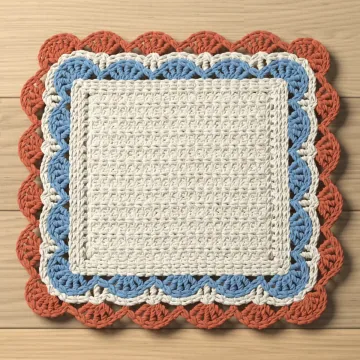
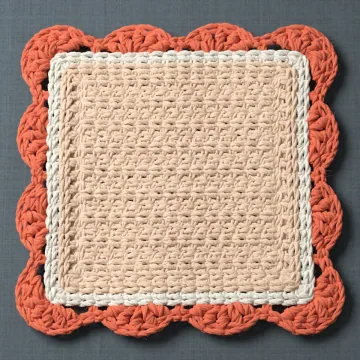
- For a set of three, like the one shown, use two of three colors in each: mustard with white scallops, white with slate scallops, and slate with mustard scallops. Each cloth takes the amounts printed for yarn A and yarn B.
- A stitch worked into a chain space goes into the open space under the chain, not into a chain stitch. Where a chain space is the next place named, pass over any stitches that stand before it and leave them unworked.
- Where several stitches have one place after them, as in "3 dc in same st", they are all worked into that one place.
- What is in square brackets is worked as many times as the number after them says, in all.
- When the next round begins with "Join", fasten off the yarn you have at the end of the round (cut it, leaving a tail of about 6 in (15 cm), and draw the tail through the last loop). Then join the yarn named with a slip stitch in the place named.
- The cloth is 21 stitches by 25 rows, about 6½ in (16.5 cm) by 6¾ in (17 cm); with the border it is about 8⅛ in (20.5 cm) by 8¼ in (21 cm), the hanging loop left out. The loop stands out about 1¼ in (3.5 cm) from its corner.
- The cloth is worked first and turned at the end of every row; then the border goes round it. Fasten off the cloth when its last row is done.
- With the right side facing you and the last row at the top, the first st is the one at the right-hand end of the last row (the left-hand end if you are left handed). Round 1 goes along the top, down the row ends of the next side, along the foundation edge and up the row ends of the last side.
- Round 1 leaves 21 stitches between two corner stitches on every side.
Yarn
To find how many balls: divide by the length on your yarn's label and round up. Buy them from one dye lot.
The estimate is from the stitches and chains of this size at this gauge, with 30 percent added.
For another length of edge, the yarn for a side is in proportion to its length.
For an estimate from a swatch of your own: the yarn calculator.
Abbreviations
Written in US terms. Where the UK name differs it is given beside the US one.
- sl st
- slip stitch (UK: ss, slip stitch)
- sc
- single crochet (UK: dc, double crochet)
- dc
- double crochet (UK: tr, treble)
- RS
- right side
- WS
- wrong side
- sk
- skip (UK: miss)
- sp
- space
- st
- stitch
Details
- Size
- About 8 × 8¼ in (20 × 21 cm)
- In all
- 489 stitches (297 in the cloth, 192 in the border)
- Skill
- EasyMoss stitch, shells, a round worked along row ends
You may sell what you make from it by hand, in small quantities. The PDF itself is not to be sold or shared. Selling, classes and kits: the rules