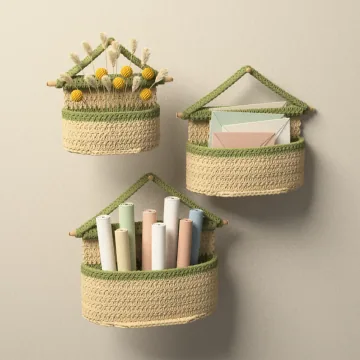
Hanging wall pocket organizer crochet pattern
Crochet, 15½ × 28½ in, 7 colors, intermediate
PDF. Prints on US Letter and A4.
What you need
Each amount is an estimate.
- Yarn A oatabout 525 yd (480 m)the panel
- Yarn B terracottaabout 40 yd (37 m)the waffle pocket
- Yarn C ochreabout 65 yd (59 m)the bobble pocket
- Yarn D oliveabout 75 yd (69 m)the moss stitch pocket
- Yarn E clay pinkabout 35 yd (32 m)the ribbed pocket
- Yarn F rustabout 50 yd (46 m)the shell pocket
- Yarn G brownabout 80 yd (73 m)the edges and the hanging cord
- Yarn in all
- About 870 yd (796 m) or 430 g
- Weight
- Medium weight, 4 on the label (UK aran), cotton
- Hook
- 4.5 mm (US 7), or the size that gives you the gauge
- Also
- A wooden dowel 18 in (45.5 cm) long and about ½ in (1.5 cm) thick, a hook or a nail for the wall, pins, a yarn needle and scissors
- Gauge
- 16 stitches and 18 rows to 4 in (10 cm) in single crochet (UK double crochet). How to check it
Instructions
How to read these rows
US terms · Show UK terms
- ch chain, sl st slip stitch, sc single crochet (UK double crochet), dc double crochet (UK treble).
- FPdc round the stitch below, from the front, BPdc round the stitch below, from the back, yo yarn over the hook, sk skip, RS right side, the one that shows, WS wrong side, the back.
- 3 sc in next st: all in one stitch. sc in next 58 sts: one in each. ch-1 sp: the gap under the one chain; the hook goes in the gap.
- [ ] 9 times: work what is inside 9 times in all.
- (60 sc): the stitches you have when the row is done. How to read a pattern.
- Post stitches. Changing colors. Working in the round.
- The chain of 1 at the start of a row of single crochet, bobbles or moss stitch, and the chain of 2 at the start of a row of the waffle and the ribs, do not count as a stitch. In the shells the chain of 3 counts as a double crochet (UK treble) and stands on the first stitch, which is the one called same st; the last single crochet of the next row goes into its top.
Special stitches
- bo Bobble
- [yo, insert hook in the place named, yo, pull up a loop, yo, pull through 2 loops] 5 times, yo, pull through all 6 loops on hook. Push it out to the right side.
Go to: Panel · Edge of the panel · Waffle pocket · Bobble pocket · Moss stitch pocket · Ribbed pocket · Shell pocket · Edge of the waffle pocket · Edge of the bobble pocket · Edge of the moss stitch pocket · Edge of the ribbed pocket · Edge of the shell pocket · Assembly
Panel
Yarn A, oat.
- StartCh 61.
- Row 1RSSc in 2nd ch from hook and in each ch acrossleaves (60 sc)
- Rows 2 to 132Ch 1, turn; sc in each st acrossleaves (60 sc)Next: row 2 of rows 2 to 132
- EndFasten off, leaving a tail of 60 in (152.5 cm) for the sleeve.
Edge of the panel
Yarn G, brown.
- Hold the panel with the right side facing you and its left side at the top, so that the foundation chain is at your left. The last 10 rows, rows 123 to 132, are the sleeve and get no edge. Begin at your right, in the end of row 122, and work down the side to row 1, one single crochet in the end of each row (122); along the foundation chain, one under each chain (60); and up the other side from row 1 to row 122 (122). The first and the last chain of the foundation are the corners and take 3 single crochet.
- StartThree sides of the panel, RS facing: 304 places.
- Row 1RSJoin G with sl st in first st, ch 1, sc in same st, sc in next 121 sts, 3 sc in next st, sc in next 58 sts, 3 sc in next st, sc in next 122 stsleaves (308 sc)
- EndFasten off, leaving a tail of 6 in (15 cm).
Waffle pocket
Yarn B, terracotta.
- StartCh 30.
- Row 1WSDc in 3rd ch from hook and in each ch acrossleaves (28 dc)
- Row 2RSCh 2, turn; repeat: FPdc around next st, dc in next 2 sts 9 times, FPdc around next stleaves (10 FPdc, 18 dc)
- Row 3Ch 2, turn; repeat: BPdc around next st, FPdc around next 2 sts 9 times, BPdc around next stleaves (10 BPdc, 18 FPdc)
- Rows 4 to 10Repeat rows 2 and 3 in turn: every even-numbered row is worked as row 2, every odd-numbered row as row 3.Row 2: Ch 2, turn; [FPdc around next st, dc in next 2 sts] 9 times, FPdc around next stRow 3: Ch 2, turn; [BPdc around next st, FPdc around next 2 sts] 9 times, BPdc around next stNext: row 4 of rows 4 to 10, worked as row 2
- EndFasten off, leaving a tail of 6 in (15 cm).
Bobble pocket
Yarn C, ochre.
- StartCh 28.
- Row 1RSSc in 2nd ch from hook and in each ch acrossleaves (27 sc)
- Row 2WSCh 1, turn; sc in next 3 sts, repeat: bo in next st, sc in next 3 sts 6 timesleaves (21 sc, 6 bo)
- Row 3Ch 1, turn; sc in each st acrossleaves (27 sc)
- Row 4Ch 1, turn; sc in next st, repeat: bo in next st, sc in next 3 sts 6 times, bo in next st, sc in next stleaves (20 sc, 7 bo)
- Row 5Ch 1, turn; sc in each st acrossleaves (27 sc)
- Rows 6 to 23Repeat rows 2 to 5 in order, over and over. The last row, row 23, is worked as row 3.Next: row 6 of rows 6 to 23, worked as row 2
- EndFasten off, leaving a tail of 6 in (15 cm).
Moss stitch pocket
Yarn D, olive.
- StartCh 58.
- Row 1RSSc in 2nd ch from hook and in each ch acrossleaves (57 sc)
- Row 2Ch 1, turn; sc in next st, repeat: ch 1, sk next st, sc in next st 28 timesleaves (29 sc, 28 ch-1 sps)
- Row 3Ch 1, turn; sc in next st, repeat: sc in next ch-1 sp, ch 1, sk next st 27 times, sc in next ch-1 sp, sc in next stleaves (30 sc, 27 ch-1 sps)
- Row 4Ch 1, turn; sc in next st, ch 1, sk next st, repeat: sc in next ch-1 sp, ch 1, sk next st 27 times, sc in next stleaves (29 sc, 28 ch-1 sps)
- Row 5Ch 1, turn; sc in next st, repeat: sc in next ch-1 sp, ch 1, sk next st 27 times, sc in next ch-1 sp, sc in next stleaves (30 sc, 27 ch-1 sps)
- Row 6Ch 1, turn; sc in next st, ch 1, sk next st, repeat: sc in next ch-1 sp, ch 1, sk next st 27 times, sc in next stleaves (29 sc, 28 ch-1 sps)
- Row 7Ch 1, turn; sc in next st, repeat: sc in next ch-1 sp, ch 1, sk next st 27 times, sc in next ch-1 sp, sc in next stleaves (30 sc, 27 ch-1 sps)
- Row 8Ch 1, turn; sc in next st, ch 1, sk next st, repeat: sc in next ch-1 sp, ch 1, sk next st 27 times, sc in next stleaves (29 sc, 28 ch-1 sps)
- Row 9Ch 1, turn; sc in next st, repeat: sc in next ch-1 sp, ch 1, sk next st 27 times, sc in next ch-1 sp, sc in next stleaves (30 sc, 27 ch-1 sps)
- Row 10Ch 1, turn; sc in next st, ch 1, sk next st, repeat: sc in next ch-1 sp, ch 1, sk next st 27 times, sc in next stleaves (29 sc, 28 ch-1 sps)
- Row 11Ch 1, turn; sc in next st, repeat: sc in next ch-1 sp, ch 1, sk next st 27 times, sc in next ch-1 sp, sc in next stleaves (30 sc, 27 ch-1 sps)
- Row 12Ch 1, turn; sc in next st, ch 1, sk next st, repeat: sc in next ch-1 sp, ch 1, sk next st 27 times, sc in next stleaves (29 sc, 28 ch-1 sps)
- Row 13Ch 1, turn; sc in next st, repeat: sc in next ch-1 sp, ch 1, sk next st 27 times, sc in next ch-1 sp, sc in next stleaves (30 sc, 27 ch-1 sps)
- Row 14Ch 1, turn; sc in next st, ch 1, sk next st, repeat: sc in next ch-1 sp, ch 1, sk next st 27 times, sc in next stleaves (29 sc, 28 ch-1 sps)
- Row 15Ch 1, turn; sc in next st, repeat: sc in next ch-1 sp, ch 1, sk next st 27 times, sc in next ch-1 sp, sc in next stleaves (30 sc, 27 ch-1 sps)
- Row 16Ch 1, turn; sc in next st, ch 1, sk next st, repeat: sc in next ch-1 sp, ch 1, sk next st 27 times, sc in next stleaves (29 sc, 28 ch-1 sps)
- Row 17Ch 1, turn; sc in next st, repeat: sc in next ch-1 sp, ch 1, sk next st 27 times, sc in next ch-1 sp, sc in next stleaves (30 sc, 27 ch-1 sps)
- Row 18Ch 1, turn; sc in next st, ch 1, sk next st, repeat: sc in next ch-1 sp, ch 1, sk next st 27 times, sc in next stleaves (29 sc, 28 ch-1 sps)
- Row 19Ch 1, turn; sc in next st, repeat: sc in next ch-1 sp, ch 1, sk next st 27 times, sc in next ch-1 sp, sc in next stleaves (30 sc, 27 ch-1 sps)
- Row 20Ch 1, turn; sc in next st, ch 1, sk next st, repeat: sc in next ch-1 sp, ch 1, sk next st 27 times, sc in next stleaves (29 sc, 28 ch-1 sps)
- Row 21Ch 1, turn; sc in next st, repeat: sc in next ch-1 sp, ch 1, sk next st 27 times, sc in next ch-1 sp, sc in next stleaves (30 sc, 27 ch-1 sps)
- Row 22Ch 1, turn; sc in next st, ch 1, sk next st, repeat: sc in next ch-1 sp, ch 1, sk next st 27 times, sc in next stleaves (29 sc, 28 ch-1 sps)
- Row 23Ch 1, turn; sc in next st, repeat: sc in next ch-1 sp, ch 1, sk next st 27 times, sc in next ch-1 sp, sc in next stleaves (30 sc, 27 ch-1 sps)
- Row 24Ch 1, turn; sc in next st, ch 1, sk next st, repeat: sc in next ch-1 sp, ch 1, sk next st 27 times, sc in next stleaves (29 sc, 28 ch-1 sps)
- Row 25Ch 1, turn; sc in next st, repeat: sc in next ch-1 sp, ch 1, sk next st 27 times, sc in next ch-1 sp, sc in next stleaves (30 sc, 27 ch-1 sps)
- Row 26Ch 1, turn; sc in next st, ch 1, sk next st, repeat: sc in next ch-1 sp, ch 1, sk next st 27 times, sc in next stleaves (29 sc, 28 ch-1 sps)
- Row 27Ch 1, turn; sc in next st, repeat: sc in next ch-1 sp, sc in next st 28 timesleaves (57 sc)
- EndFasten off, leaving a tail of 6 in (15 cm).
Ribbed pocket
Yarn E, clay pink.
- StartCh 20.
- Row 1WSDc in 3rd ch from hook and in each ch acrossleaves (18 dc)
- Row 2RSCh 2, turn; repeat: FPdc around next 2 sts, BPdc around next 2 sts 4 times, FPdc around next 2 stsleaves (10 FPdc, 8 BPdc)
- Row 3Ch 2, turn; repeat: BPdc around next 2 sts, FPdc around next 2 sts 4 times, BPdc around next 2 stsleaves (10 BPdc, 8 FPdc)
- Rows 4 to 13Repeat rows 2 and 3 in turn: every even-numbered row is worked as row 2, every odd-numbered row as row 3.Row 2: Ch 2, turn; [FPdc around next 2 sts, BPdc around next 2 sts] 4 times, FPdc around next 2 stsRow 3: Ch 2, turn; [BPdc around next 2 sts, FPdc around next 2 sts] 4 times, BPdc around next 2 stsNext: row 4 of rows 4 to 13, worked as row 2
- EndFasten off, leaving a tail of 6 in (15 cm).
Shell pocket
Yarn F, rust.
- StartCh 38.
- Row 1RSSc in 2nd ch from hook and in each ch acrossleaves (37 sc)
- Row 2Ch 1, turn; sc in first st, repeat: sk next 2 sts, 5 dc in next st, sk next 2 sts, sc in next st 6 timesleaves (7 sc, 30 dc)
- Row 3Ch 3 (counts as dc), turn; 2 dc in same st, repeat: sk next 2 sts, sc in next st, sk next 2 sts, 5 dc in next st 5 times, sk next 2 sts, sc in next st, sk next 2 sts, 3 dc in last stleaves (31 dc, 6 sc)
- Row 4Ch 1, turn; sc in first st, repeat: sk next 2 sts, 5 dc in next st, sk next 2 sts, sc in next st 6 timesleaves (7 sc, 30 dc)
- Row 5Ch 3 (counts as dc), turn; 2 dc in same st, repeat: sk next 2 sts, sc in next st, sk next 2 sts, 5 dc in next st 5 times, sk next 2 sts, sc in next st, sk next 2 sts, 3 dc in last stleaves (31 dc, 6 sc)
- Row 6Ch 1, turn; sc in first st, repeat: sk next 2 sts, 5 dc in next st, sk next 2 sts, sc in next st 6 timesleaves (7 sc, 30 dc)
- Row 7Ch 3 (counts as dc), turn; 2 dc in same st, repeat: sk next 2 sts, sc in next st, sk next 2 sts, 5 dc in next st 5 times, sk next 2 sts, sc in next st, sk next 2 sts, 3 dc in last stleaves (31 dc, 6 sc)
- Row 8Ch 1, turn; sc in first st, repeat: sk next 2 sts, 5 dc in next st, sk next 2 sts, sc in next st 6 timesleaves (7 sc, 30 dc)
- Row 9Ch 3 (counts as dc), turn; 2 dc in same st, repeat: sk next 2 sts, sc in next st, sk next 2 sts, 5 dc in next st 5 times, sk next 2 sts, sc in next st, sk next 2 sts, 3 dc in last stleaves (31 dc, 6 sc)
- Row 10Ch 1, turn; sc in first st, repeat: sk next 2 sts, 5 dc in next st, sk next 2 sts, sc in next st 6 timesleaves (7 sc, 30 dc)
- Row 11Ch 3 (counts as dc), turn; 2 dc in same st, repeat: sk next 2 sts, sc in next st, sk next 2 sts, 5 dc in next st 5 times, sk next 2 sts, sc in next st, sk next 2 sts, 3 dc in last stleaves (31 dc, 6 sc)
- Row 12Ch 1, turn; sc in first st, repeat: sk next 2 sts, 5 dc in next st, sk next 2 sts, sc in next st 6 timesleaves (7 sc, 30 dc)
- Row 13Ch 1, turn; sc in each st acrossleaves (37 sc)
- EndFasten off, leaving a tail of 6 in (15 cm).
Edge of the waffle pocket
Yarn G, brown.
- StartThe waffle pocket just worked, 28 stitches and 10 rows; turn it so that its last row is at the top with the right side facing you.
- Rnd 1RSJoin G with sl st in first st, ch 1, 3 sc in same st, sc in next 26 sts, 3 sc in next st, 2 sc in end of each of next 10 rows, 3 sc in next ch, sc in next 26 chs, 3 sc in next ch, 2 sc in end of each of next 10 rows, sl st in first sc to joinleaves (104 sc)
- EndFasten off, leaving a tail of 62 in (157.5 cm) for sewing.
Edge of the bobble pocket
Yarn G, brown.
- StartThe bobble pocket just worked, 27 stitches and 23 rows; turn it so that its last row is at the top with the right side facing you.
- Rnd 1RSJoin G with sl st in first st, ch 1, 3 sc in same st, sc in next 25 sts, 3 sc in next st, sc in end of each of next 23 rows, 3 sc in next ch, sc in next 25 chs, 3 sc in next ch, sc in end of each of next 23 rows, sl st in first sc to joinleaves (108 sc)
- EndFasten off, leaving a tail of 62 in (157.5 cm) for sewing.
Edge of the moss stitch pocket
Yarn G, brown.
- StartThe moss stitch pocket just worked, 57 stitches and 27 rows; turn it so that its last row is at the top with the right side facing you.
- Rnd 1RSJoin G with sl st in first st, ch 1, 3 sc in same st, sc in next 55 sts, 3 sc in next st, sc in end of each of next 27 rows, 3 sc in next ch, sc in next 55 chs, 3 sc in next ch, sc in end of each of next 27 rows, sl st in first sc to joinleaves (176 sc)
- EndFasten off, leaving a tail of 88 in (223.5 cm) for sewing.
Edge of the ribbed pocket
Yarn G, brown.
- StartThe ribbed pocket just worked, 18 stitches and 13 rows; turn it so that its last row is at the top with the right side facing you.
- Rnd 1RSJoin G with sl st in first st, ch 1, 3 sc in same st, sc in next 16 sts, 3 sc in next st, 2 sc in end of each of next 13 rows, 3 sc in next ch, sc in next 16 chs, 3 sc in next ch, 2 sc in end of each of next 13 rows, sl st in first sc to joinleaves (96 sc)
- EndFasten off, leaving a tail of 64 in (162.5 cm) for sewing.
Edge of the shell pocket
Yarn G, brown.
- StartThe shell pocket just worked, 37 stitches and 13 rows; turn it so that its last row is at the top with the right side facing you.
- Rnd 1RSJoin G with sl st in first st, ch 1, 3 sc in same st, sc in next 35 sts, 3 sc in next st, sc in end of next row, 2 sc in end of each of next 11 rows, sc in end of next row, 3 sc in next ch, sc in next 35 chs, 3 sc in next ch, sc in end of next row, 2 sc in end of each of next 11 rows, sc in end of next row, sl st in first sc to joinleaves (130 sc)
- EndFasten off, leaving a tail of 72 in (183 cm) for sewing.
Assembly
- Weave in all the tails on the wrong side of each part, but leave the tail of 60 in (152.5 cm) on the panel and the long tail on the edge of each pocket.
- The sleeve. Lay the panel with its wrong side up and row 132 away from you. Fold the last 5 rows, rows 128 to 132, toward you, with the fold along the top of row 127. They lie on the 5 rows before them, rows 123 to 127, and the top of row 132 lies at the top of row 122. The folded part is on the wrong side. With the tail of 60 in (152.5 cm), which hangs at one end of row 132, sew that edge down: bring the needle up through a stitch of row 132 and down through a stitch of row 122, taking only the back of it so that nothing shows on the right side, 60 stitches from one side to the other. The two ends of the sleeve stay open. Fasten off and draw the end inside the sleeve.
- Place the pockets. Lay the panel with its right side up and the foundation chain toward you; stitch 1 is at your left. Every pocket lies right side up with its last row at the top. The waffle pocket (top left): its left edge just after stitch 3 of the panel, its right edge just after stitch 29, its bottom edge on row 88, its top corners on row 112. The bobble pocket (top right): its left edge just after stitch 31 of the panel, its right edge just after stitch 57, its bottom edge on row 88, its top corners on row 112. The moss stitch pocket (middle, across the width): its left edge just after stitch 3 of the panel, its right edge just after stitch 57, its bottom edge on row 47, its top corners on row 75. The ribbed pocket (bottom left): its left edge just after stitch 3 of the panel, its right edge just after stitch 21, its bottom edge on row 4, its top corners on row 34. The shell pocket (bottom right): its left edge just after stitch 23 of the panel, its right edge just after stitch 57, its bottom edge on row 4, its top corners on row 31. Pin the four corners of every pocket.
- Each pocket is a little wider than its place, so that it stands out and holds more. How its bottom edge lies on the panel, counted as it is sewn, from its right corner to its left: Waffle pocket: 30 stitches along the bottom on 26 of the panel; [5 stitches one to one, then 2 stitches of the pocket on 1 of the panel] 4 times, then 2 one to one. Bobble pocket: 29 stitches along the bottom on 26 of the panel; [7 stitches one to one, then 2 stitches of the pocket on 1 of the panel] 3 times, then 2 one to one. Moss stitch pocket: 59 stitches along the bottom on 54 of the panel; [9 stitches one to one, then 2 stitches of the pocket on 1 of the panel] 5 times, then 4 one to one. Ribbed pocket: 20 stitches along the bottom on 18 of the panel; [8 stitches one to one, then 2 stitches of the pocket on 1 of the panel] 2 times. Shell pocket: 39 stitches along the bottom on 34 of the panel; [5 stitches one to one, then 2 stitches of the pocket on 1 of the panel] 5 times, then 4 one to one. The middle stitch of the 3 at a corner is the end of the bottom edge.
- Sew each pocket with the long tail of its edge, which hangs at the top right corner. Begin there with two small stitches in one place. Bring the needle up through the edge of the pocket and down through the panel beneath, close beside the edge, one stitch for each stitch of the edge: down the right side, along the bottom from right to left, up the left side. The top stays open. End with two small stitches in one place at the top left corner, fasten off on the wrong side of the panel and weave in the end there.
- With G, ch 120 for the hanging cord, about 24 in (61 cm) long, and fasten off with a tail of 6 in (15 cm) at each end. Push the dowel through the sleeve, so that it stands out about 1½ in (4 cm) at each side. Lay the last 3 in (7.5 cm) of the cord, the chain itself, round one end of the dowel, close to the panel, and tie it to the cord with a double knot; tie the other end of the cord round the other end of the dowel in the same way. About 18 in (45.5 cm) of cord is left between the two knots. Weave the tails back along the cord. Hang it by the middle of the cord.
Finishing
- Press the panel lightly under a damp cloth before the pockets are filled.
About
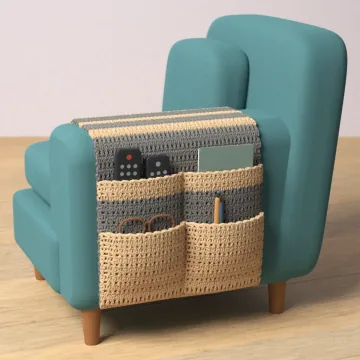
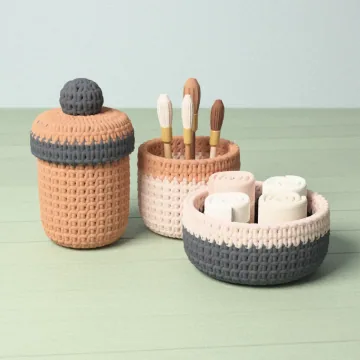
Two pockets of the same size at the top, one across the whole width, and a narrow and a wide one below hold rolled towels, brushes and combs in the bathroom, or diapers and cloths in a nursery. The panel is oat and the pockets are in earth tones with brown edges. It hangs from a wooden dowel in a sleeve at the top.