Tulip crochet pattern
Beginner, 3 in wide, 3 colors
PDF, for US Letter and A4.
What you need
- Size
- About 3 in (8 cm) wide and about 6 in (15 cm) tall.
- Yarn
- Medium weight, 4 on the label (UK aran), an estimate: about 17 yd (16 m) in all or 10 g. Using a different yarn?
- A tulip pink6 yd (5 m), 5 gsome of the petals
- B deep pink3 yd (3 m), 5 gsome of the petals
- C green8 yd (7 m), 5 gthe leaves
- Hook
- 5 mm (US H-8), or the size that gives you the gauge
- Gauge
- 14 stitches and 15 rows to 4 in (10 cm) in single crochet (UK double crochet)
- Also
- A yarn needle, scissors, pins for blocking and a spray bottle
New to this? How to crochet, A first flower
Before you start
The first rows
The top of a petal is its ch-1 space; the round end, where the round is joined, is its foot. A leaf has a rounded end (3 sc) and a pointed end, where it begins and ends.
Key
- sc
- single crochet UK dc
- ch
- chain
- hdc
- half double crochet UK htr
- dc
- double crochet UK tr
- sl st
- slip stitch
- st
- stitch
( ) in one place: all of it there. 5 sc, 4 hdc, 6 dc, 1 ch-1 sp: the round now has that many; a check, not a step.
US terms. Show UK terms
Left-handed? Hook in the left hand; work the rounds clockwise. No count changes.
Rounds
Press a round’s number when it is done. Key
Petal: make 3
- Make 2 in A and 1 in B. The lines say A; for the petal in B, read B in its place.
- StartWith A, make a slip knot and ch 8.
- 1Sc in 2nd ch from hook, hdc in next ch, dc in next 3 chs, hdc in next ch, (sc, ch 1, sc) in next ch, working along the other side of the chain, hdc in next ch, dc in next 3 chs, hdc in next ch, 2 sc in next ch, sl st in first sc to join5 sc, 4 hdc, 6 dc, 1 ch-1 sp
- Fasten off, leaving a 15 in (38 cm) tail for sewing.
Leaf: make 2
Yarn C, green.
Finishing
- Block: pin the pieces to shape on a flat surface, right side up, spray them with water and let them dry.
- Lay the two A petals side by side, right side up and tops up, leaning apart: 1⅜ in (3.5 cm) from one top to the other, and overlapping by ⅛ in (0.5 cm) where they are widest, either one on top. Lay the B petal upright over the middle of them, right side up, its foot ⅛ in (0.5 cm) lower than theirs. Pin the three and turn them over. From the back, run the tail of one A petal through the backs of its stitches to where the A petals overlap, and sew them to each other there. Then, with the tail of the B petal, sew both of its sides to the A petals where they lie on them, from its foot up, through the back strands only.
- For the stem, with C, ch 15, or as many as measure 4¼ in (11 cm), and fasten off, leaving a 6 in (15 cm) tail at each end. Lay it, either side up, straight down from the middle of the B petal, its upper end behind the foot of that petal, ½ in (1.5 cm) of it hidden. Sew that end to the back of the B petal with its tail.
- Lay a leaf beside the stem on each side, right side up and not bent, its pointed end level with the lower end of the stem and its edge touching the edge of the stem for the lowest 1 in (2.5 cm). The leaf leans outward, so that the middle of its rounded end is 1⅛ in (3 cm) straight out from the center line of the stem. Sew the touching edges together from the back with the tail of the leaf.
- Weave in all the ends of the tulip on the back with the yarn needle, before it is sewn to anything.
- To sew the tulip to your project, pin it where it is to go and sew round its edges with lengths of A, B and C, each part in its own color, under the outermost strands of the stitches. Weave in the ends of these lengths.
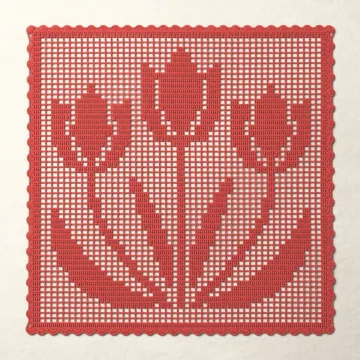
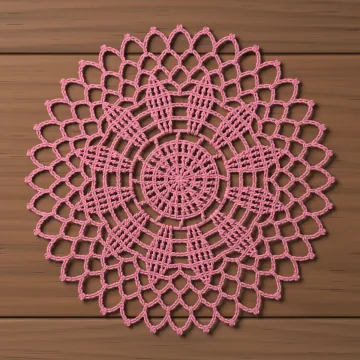
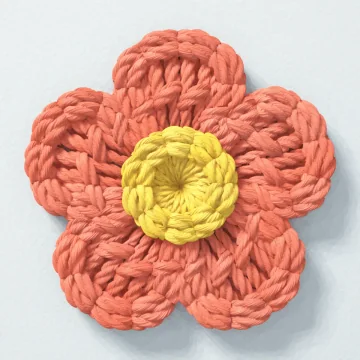
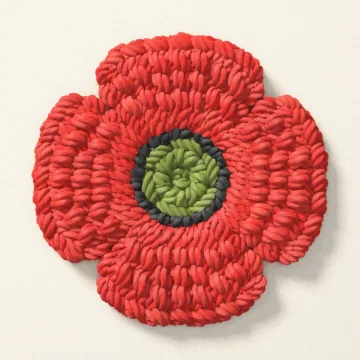
More tulips
About this pattern
A tulip in side view: three overlapping petals on a green stem with two long leaves.
Gauge
14 stitches and 15 rows to 4 in (10 cm) in single crochet.
A petal measures about 2¼ in (6 cm) from its foot to its top, and a leaf about 3½ in (9 cm) from end to end.
Use any hook that gives you this. If you count more stitches than this in 4 in (10 cm), change to a larger hook; if you count fewer, to a smaller one.
Notes
- Rounds are worked with the right side facing; do not turn.
- Working along the other side of the chain: turn the piece round, not over, and work into the unused loops of the foundation chain, beginning in the chain next to the one just used.
- The figures in brackets at the end of a line count its stitches and the chain spaces between them; slip stitches are not counted.
- The distances under FINISHING are for the yarn and gauge above; in another yarn make them larger or smaller in the same proportion as the size.
- The same words in another yarn make another size, measured the longest way: fine yarn (2) and a 3.25 mm hook, about 4 in (10 cm); light yarn (3) and a 4 mm hook, about 4¾ in (12 cm); bulky yarn (5) and a 6.5 mm hook, about 7¾ in (20 cm).
Yarn
To find how many balls: divide by the length on your yarn's label and round up. Buy them from one dye lot.
The estimate is from the stitches and chains of this size at this gauge, with 30 percent added.
For an estimate from a swatch of your own: the yarn calculator.
Abbreviations
Written in US terms. Where the UK name differs it is given beside the US one.
- sl st
- slip stitch (UK: ss, slip stitch)
- sc
- single crochet (UK: dc, double crochet)
- hdc
- half double crochet (UK: htr, half treble)
- dc
- double crochet (UK: tr, treble)
- st
- stitch
- sp
- space
Details
- In all
- 5 pieces; 91 stitches (15 in each petal, 23 in each leaf)
- Skill
- BeginnerWorked in rounds, with 5 pieces and color changes.
You may sell what you make from it by hand, in small quantities. The PDF itself is not to be sold or shared. Selling, classes and kits: the rules