Cross stitch guide
Cross stitch patterns for other crafts
A cross stitch chart is a grid in which every square is one color. Any craft built from square units can follow it as it stands: one fuse bead, one crochet stitch or block, or one latch hook knot for each square. Knitting can follow it too, but a knitted stitch is not square, so the picture changes shape.
On this page 7 parts
Why a cross stitch chart carries over
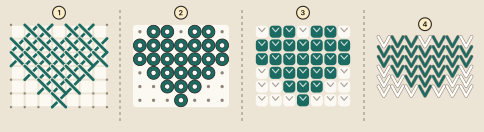
A counted chart is a picture built from small colored units, one to a square. Cross stitch fills each square with an X of thread (1 in the picture). Other crafts fill a square with something else and can read the same grid:
| Craft | One square of the chart becomes |
|---|---|
| Fuse beads (2) | One bead on one peg |
| Crochet in rows (3) | One single crochet |
| Corner-to-corner crochet | One small block of stitches |
| Latch hook | One knot of yarn on the canvas |
| Knitting (4) | One knit stitch |
Three things to know before you start:
- Only whole squares carry over. A bead, a block or a knot fills a whole square, so backstitch lines, French knots and part stitches have nowhere to go. A chart in whole crosses, like the patterns on this site, converts as it is.
- Fewer colors are easier. Every symbol in the key is another bead color or ball of yarn. The Easy patterns here use four colors or fewer.
- The key gives thread numbers. Those are no help with beads or yarn. Match each symbol to the nearest color you have.
Fuse beads
Fuse beads are small plastic tubes. You set them on the pegs of a board, then melt them together with an iron through a sheet of paper. Most boards are a square grid of pegs, so a chart is copied peg for peg (2).
The beads decide the size. The most used bead is 5 mm across, so every square of the chart is 5 mm. A design 30 squares wide comes to 15 cm, about 6 inches. Count the pegs on your board before you choose a chart: the design has to fit on it.
Crochet
Crochet has two common ways of working a color chart, and both read one square as one unit.
- Rows of single crochet (double crochet in United Kingdom terms). One square is one stitch. The rows are worked back and forth from the bottom of the chart.
- Corner to corner. One square is one small block of stitches, and the piece is worked on the diagonal from one corner.
The size depends on your yarn, your hook and your tension. Work a swatch, count how many squares fit into 4 inches (10 cm), and divide. At 4 squares to the inch (2.54 cm), a chart 60 squares wide is 15 inches (38.1 cm) wide. Blocks are larger than single stitches, so the same chart worked corner to corner is a good deal bigger.
The crochet part of this site explains how to read a crochet graph, corner to corner and gauge.
Latch hook
In latch hook, short lengths of yarn are knotted onto a coarse, open rug canvas. The design is either printed on the canvas or counted from a chart, the way a needlepoint chart is. One square of the chart is one knot.
Rug canvas is coarse: about 3.3 to 5 holes to the inch (2.54 cm). On canvas with 5 holes to the inch, 50 squares cover 10 inches (25.4 cm). On canvas with 3.3 holes to the inch, the same 50 squares cover about 15 inches (38.5 cm). Some rug canvas has a colored line every ten holes, which matches the heavier lines of a chart.
Knitting
A knitting color chart is also one square to a stitch. But a knitted stitch is usually a rectangle, wider than it is tall, where a chart square is as tall as it is wide. Knit a cross stitch chart square for square and the picture comes out flattened (4).
Measure a swatch both ways: stitches to the inch and rows to the inch. Say it comes to 5 stitches and 7 rows to the inch (2.54 cm). A chart 35 squares each way is then 7 inches (17.8 cm) wide and only 5 inches (12.7 cm) tall. To keep the proportions, the design needs more rows than a square grid gives it. A charting program that lets you set the gauge shows the stretched squares as they will knit.
A small motif can also be added afterward. Duplicate stitch embroiders a charted design over finished stocking stitch, one stitch for each square.
More surfaces, on their own pages
- Diamond painting: one drill for each square.
- Plastic canvas and perforated paper: stiff grids you stitch on with a needle.
- Cross stitch on crochet and knitting: the other way round, crosses stitched onto a finished piece.
Where to go next
Pick a small chart in few colors to try a new craft: the Easy patterns are a good place to look. How to resize a cross stitch pattern explains the arithmetic of squares and size.