Cross stitch guide
Cross stitch on evenweave and linen
On evenweave and linen each cross is worked over two threads of the cloth in each direction. Bring the needle up, count two threads across and two up, and go down. Stitched this way, 28 count cloth gives 14 stitches to the inch, the same as 14 count Aida.
On this page 10 parts
What evenweave is
Evenweave is cloth woven in single threads, with the same number of threads to the inch across as down. Aida has its threads bundled into blocks. Evenweave does not, so it looks like fine plain cloth with a small hole between every two threads.
On a shop label, evenweave usually means a smooth cloth whose threads are all one thickness, often a blend of cotton and rayon. Linen is woven the same way from flax, and its threads are less even. Both are stitched the same way. The common counts are 28 and 32, and 25 count is widely sold too.
What over two means
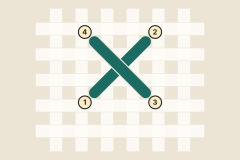
Over two means each leg of the cross passes over two threads of the cloth, across and up. One cross covers a square of two threads by two.
- Bring the needle up from the back (1).
- Count two threads to the right and two threads up, and take the needle down there (2). You have skipped one hole on the way.
- Bring the needle up two threads straight below (3).
- Take it down two threads above where you started (4).
It helps to see the stitch as a square of nine holes, three by three. The cross uses the four corner holes. The middle hole and the four at the sides stay empty. If the middle hole of a stitch is filled, you have gone over one thread, not two.
For a row, work the first legs all the way along, then come back crossing them, as on Aida. How to cross stitch teaches that from the first stitch.
Why 28 count over two is the size of 14 count Aida
The count of evenweave or linen is its threads to one inch (2.54 cm). A cross over two uses up two threads, so the stitches to the inch are half the count. 28 threads make 14 stitches.
So to use evenweave or linen where a pattern names Aida, double the count. The design comes out the same size.
Evenweave counts over two, and the Aida each matches
| Fabric | Stitches to the inch | 100 stitches measure | Tapestry needle | Strands |
|---|---|---|---|---|
| 25 count evenweave or linen, over two | 12.5 | 8 in (20.3 cm) | Size 24 | 2 |
| 28 count evenweave or linen, over two | 14 | 7 1/8 in (18.1 cm) | Size 24 | 2 |
| 32 count evenweave or linen, over two | 16 | 6 1/4 in (15.9 cm) | Size 26 | 2 |
Reading the table
The stitches to the inch are the Aida count each cloth matches: 28 count matches 14 count Aida and 32 count matches 16. 25 count falls between 11 and 14 count Aida. The needle and strands are the usual choices, and published charts do not all agree: some give three strands for 25 count over two. How many strands and needle sizes list where charts differ. Each count has its own guide: 25 count, 28 count and 32 count.
Where to place the first stitch on linen
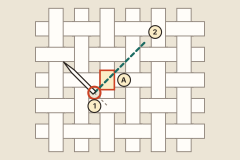
The threads of linen and evenweave go over and under each other in turn. That matters for the first stitch only.
Look at the hole where the needle will come up (1), and at the upright thread on its right. Follow that thread up to the next crossing (A). At A the upright thread should lie on top of the level one. If it dips under, move one thread along and start there.
Starting here, the first leg leans against an upright thread, which holds it in place, and the stitches sit more neatly.
You only do this once. Every later stitch is a whole number of twos away from the first, and the weave repeats every two threads, so each stitch lands in the same kind of place.
Keeping count
- Count threads, not holes. Say "one, two" for every stitch.
- Check the middle holes. An empty hole in the middle of each cross means you are still over two.
- Hold the cloth taut. A hoop or frame makes the threads easier to see. Do not pull so hard that the weave is dragged out of line.
- Use good light. A magnifier helps on the finer counts.
- Grid a big design. Lines of running stitch every ten stitches save recounting: see gridding.
- Bind the edges. Evenweave and linen fray more than Aida.
How to count has more ways to keep your place.
Stitching over one thread
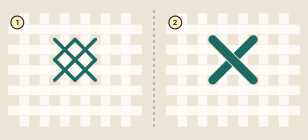
Over one means each cross covers a single thread each way. On 28 count that is 28 stitches to the inch (2.54 cm), so a design is half as wide and half as high as it is over two. It is used for very fine detail.
Two things change over one. Use fewer strands: often a single strand. And take care with the order of working, because over one thread a stitch can slide under the threads of the cloth. Working a row of half stitches and crossing them on the way back is often advised against here. Finishing each cross before you start the next is the safer way.
Questions people ask
Can I stitch over two on Aida? Yes. Skip a hole each way. The stitches come out twice as big, so the design is twice as wide and twice as high.
Is evenweave harder than Aida? A little slower at first, because the grid is less obvious. The stitch itself is the same.
Which needle and how many strands? The same as for the Aida it matches: the table above gives both.
Work out your size
The fabric calculator, opened on 100 by 100 stitches on 28 count worked over two, gives the stitched size and the piece to cut. Change the count to compare.