Cross stitch guide
Cross stitch fabric
Cross stitch is worked on cloth woven with the same number of squares or threads to the inch in both directions, so every stitch comes out square. Most people start on 14 count Aida. Evenweave and linen are finer cloths, usually stitched over two threads.
On this page 8 parts
What count means
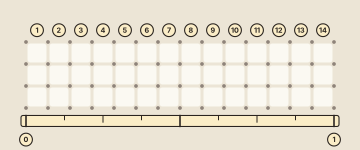
The count of a cloth is how many squares or threads it has in one inch (2.54 cm). 14 count Aida has 14 squares to the inch, and each square takes one cross, so it gives 14 stitches to the inch.
A higher count is a finer cloth. The stitches are smaller, and the same design comes out smaller. A lower count has bigger squares that are easier to see.
The count also tells you how big a design will be. Divide the stitches by the count: a design 140 stitches wide is 10 inches (25.4 cm) wide on 14 count.
Aida, evenweave or linen: which
There are three cloths to know.
- Aida is woven in small square blocks with a clear hole at each corner. One cross covers one block. It is the easiest cloth to see and to count, and the one most people learn on. Aida cloth has its own guide.
- Evenweave is woven in single threads that are all the same thickness. Each cross is usually worked over two threads each way. It is most often sold in 28 and 32 count, and in 25 count too, and is often a blend of cotton and rayon.
- Linen is woven from flax, also in single threads. Its threads vary a little in thickness, which gives it an older, softer look. It is stitched the way evenweave is. Linen for cross stitch covers its counts and kinds.
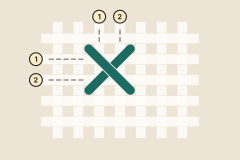
On evenweave and linen the count is the number of threads to the inch. Because a cross covers two threads, 28 count gives 14 stitches to the inch, the same as 14 count Aida, and 32 count matches 16 count Aida. How to cross stitch on evenweave and linen shows where the needle goes.
Choose Aida for a first project, and for any design in full crosses. Every cross stitch pattern on this site is charted in full crosses only, so all of them work on Aida. Choose evenweave or linen when a chart has quarter and three-quarter stitches, which need the hole that sits in the middle of each cross on those cloths, or when you want a finer, smoother background.
14 count, 16 count or 18 count compared
| Fabric | Stitches to the inch | 100 stitches measure | Tapestry needle | Strands |
|---|---|---|---|---|
| 14 count Aida | 14 | 7 1/8 in (18.1 cm) | Size 24 | 2 |
| 16 count Aida | 16 | 6 1/4 in (15.9 cm) | Size 26 | 2 |
| 18 count Aida | 18 | 5 1/2 in (14.1 cm) | Size 26 | 1 or 2 |
How to pick a count
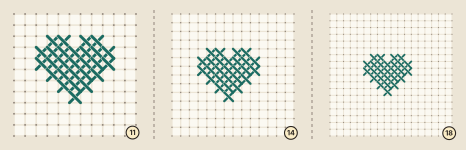
- 14 count is the usual first choice. It is the most common count and easy to find.
- 16 count makes the same design a little smaller and a little finer.
- 18 count gives small, close stitches. It asks for good light and good eyesight.
- 11 count and lower have large squares, which helps children and anyone who finds 14 count hard to see.
Each count has a guide with a size chart: 14 count Aida, 16 count Aida, 18 count Aida and 11 count Aida. The less common fabric counts share one page.
The needle and the strands in the table are the usual choices. Published charts differ by one needle size or one strand at some counts: needle sizes and how many strands say where.
How to tell what count a cloth is
Lay a ruler on the cloth and count what lies in one inch (2.54 cm). On Aida, count the squares. On evenweave or linen, count the threads. Fourteen squares means 14 count. Twenty-eight threads means 28 count.
How to use a stitch gauge or a ruler
A ruler is all you need for the count above. A stitch gauge is a ruler made for cross stitch. It is a flat strip printed with a separate scale for each common fabric count, from 11 count up to 36 or 40. It does two jobs:
- It finds a count. Hold the gauge against the cloth and try the scales one by one. The scale whose marks fall in step with the holes of the cloth is the count.
- It measures in stitches. Each scale is marked in stitches of that count. Find your design's width in stitches on the scale for your fabric, and the gauge shows how long that is on the cloth.
The count and the gauge are not the same thing. The count is a number that belongs to the cloth. The gauge is a tool that reads it.
With no gauge to hand, the fabric calculator does the second job from two numbers, the stitches and the count.
What cross stitch fabric is called
Shops and patterns use a handful of names for the same few cloths.
- Counted cross stitch fabric means any cloth you count stitches on: Aida, evenweave or linen.
- Aida cloth, Aida fabric and Aida are the same thing.
- Evenweave on a label nearly always means a smooth cloth of even single threads, as against linen.
- Hardanger fabric is a 22 count cotton with a blocked look. It is counted the way Aida is.
- Stamped cloth has the design printed on it, so there is nothing to count.
Mills also give their cloths names of their own. The page on what you can stitch on besides Aida explains the ones you are likely to meet.
Questions people ask
Can I use a different cloth from the one my pattern names? Yes. A chart works on any count. Only the size changes, so work it out before you cut.
Can I swap Aida for linen? Yes. Double the count: 28 count linen worked over two is the size of 14 count Aida.
How much cloth do I need? The size of the design plus a margin on every side for finishing. The fabric sizes guide has the common cuts.
Work out your size
The fabric calculator, opened on a design of 140 by 140 stitches on 14 count, gives the stitched size and the piece to cut, with 3 inches (7.5 cm) on every side for framing. Change the numbers to your own design and count.