Cross stitch guide
Temperature cross stitch projects
A temperature cross stitch records a year of weather in thread. Each day gets one square or one small motif, stitched in the color that stands for that day's temperature. You choose the ranges and the colors before you start, and by the end of the year the cloth shows the seasons.
On this page 11 parts
- What a temperature cross stitch is
- Choose which reading to record
- Set the ranges
- Choose the colors
- How big a year comes out on 14 count
- The layouts in that table
- The same layouts in centimeters, count by count
- How much thread, as an estimate
- How to keep up
- Rain, snow and other things to record
- Where to go next
What a temperature cross stitch is
It is a record of the weather, kept one day at a time. Before you start, you divide the temperatures of your year into ranges and give each range a thread color. Then every day gets its own place on the cloth, and you stitch that place in the color of the day's temperature.
Knitters and crocheters keep the same record as a blanket, worked a row a day. In cross stitch a day is a single stitch, a block of stitches, or a small motif repeated in a new color.
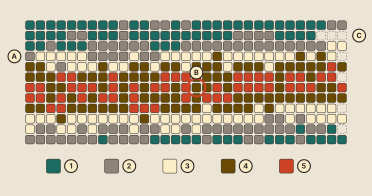
The picture shows the plainest layout: a square a day and a row a month (A). One square is one day (B). Months shorter than 31 days leave empty squares at the end of their row (C). The key under the chart gives the color of each range, from the coldest (1) to the hottest (5).
Choose which reading to record
Pick one reading and keep to it all year:
- the daily high,
- the daily low, or
- the daily average.
Use readings for one place, from one source. A weather app shows today's figures, and national weather services publish daily records that can be looked up later.
Set the ranges
- Find your year's span. Look up last year's coldest and hottest readings for your place. That is the span your key has to cover.
- Choose how many colors. Projects use anything from about six colors to ten or more. Fewer is simpler to shop for and to stitch.
- Divide the span by the number of colors. A span of 30 degrees and six colors gives ranges of 5 degrees each.
- Narrow the ranges for a mild climate. Where the temperature hardly moves for months, wide ranges give long stretches of one color. Smaller steps bring out the changes.
- Write the key down. Note each range with its color and thread number, and keep it with the project.
Choose the colors
The usual scheme runs from cool colors for cold days to warm colors for hot days: blues, through greens and yellows, to reds. Some stitchers use a full rainbow like that. Others use a run of shades of one or two colors, which is quieter.
Strong contrast between the ends of the key makes unusual days stand out. Close shades blend into each other. Lay the skeins side by side in order before you start, to see that every step can be told from the next.
How big a year comes out on 14 count
| Design, in stitches | Stitched size, inches | Stitched size, centimeters | Fabric to cut, inches | Fabric to cut, centimeters |
|---|---|---|---|---|
| 31 × 12 | 2 1/4 × 7/8 in | 5.6 × 2.2 cm | 9 × 7 in | 21 × 18 cm |
| 62 × 24 | 4 3/8 × 1 3/4 in | 11.2 × 4.4 cm | 11 × 8 in | 27 × 20 cm |
| 93 × 36 | 6 5/8 × 2 5/8 in | 16.9 × 6.5 cm | 13 × 9 in | 32 × 22 cm |
| 155 × 60 | 11 1/8 × 4 1/4 in | 28.1 × 10.9 cm | 18 × 11 in | 44 × 26 cm |
The fabric to cut leaves 3 inches (7.5 cm) on every side for framing, rounded up to a whole inch or centimeter. For a design of another size, open the fabric calculator on 155 × 60 stitches at this count and change the numbers.
The layouts in that table
A year laid out with a row for each month is 31 days wide and 12 months high. The four lines of the table are that layout at four sizes:
- 31 × 12 stitches: one stitch a day, 365 stitches in the year.
- 62 × 24: each day a block of two stitches by two, 1,460 stitches.
- 93 × 36: each day a block of three by three, 3,285 stitches.
- 155 × 60: each day a block of five by five, 9,125 stitches.
A leap year has 366 days. The layout is the same, with one more day in February's row.
The layout can be turned so that each month is a column. A year can also run as one long band, or each day can be a small motif with a gap round it. Draw your layout on a grid first: the pattern maker or a sheet of graph paper will do. Then you know its size in stitches before you cut the cloth.
The same layouts in centimeters, count by count
| Stitches | 11 count Aida | 14 count Aida | 16 count Aida | 18 count Aida | 28 count evenweave or linen, over two | 32 count evenweave or linen, over two |
|---|---|---|---|---|---|---|
| 12 | 2.8 cm | 2.2 cm | 1.9 cm | 1.7 cm | 2.2 cm | 1.9 cm |
| 24 | 5.5 cm | 4.4 cm | 3.8 cm | 3.4 cm | 4.4 cm | 3.8 cm |
| 31 | 7.2 cm | 5.6 cm | 4.9 cm | 4.4 cm | 5.6 cm | 4.9 cm |
| 36 | 8.3 cm | 6.5 cm | 5.7 cm | 5.1 cm | 6.5 cm | 5.7 cm |
| 60 | 13.9 cm | 10.9 cm | 9.5 cm | 8.5 cm | 10.9 cm | 9.5 cm |
| 62 | 14.3 cm | 11.2 cm | 9.8 cm | 8.7 cm | 11.2 cm | 9.8 cm |
| 93 | 21.5 cm | 16.9 cm | 14.8 cm | 13.1 cm | 16.9 cm | 14.8 cm |
| 155 | 35.8 cm | 28.1 cm | 24.6 cm | 21.9 cm | 28.1 cm | 24.6 cm |
How much thread, as an estimate
A year is not many stitches, so a temperature project uses little thread. As an estimate, one skein of stranded cotton makes about 2,000 whole crosses on 14 count with two strands. That estimate takes each cross to use five and a half times its own width in thread and adds a fifth for the ends. How much floss you need explains the method.
By that estimate:
- at one stitch a day, the whole year takes less than a fifth of one skein, shared between all the colors;
- at nine stitches a day, the whole year takes an estimated 1.6 skeins in all, so one skein of each color is plenty;
- at 25 stitches a day, an estimated 4.6 skeins in all. A color that comes up on more than 80 days would pass the estimate for one skein, so the colors you expect to see most may need two.
You cannot know in advance how many days each color will get. Buy every color of the key at the start, and keep the numbers written on the key so that any of them can be bought again.
How to keep up
- Write the reading down every day, even when you do not stitch. A line on a sheet of paper or in a notes app is enough.
- Stitch in batches. Once a week is a good habit. A week is seven stitches at the smallest size.
- If you fall behind, look the missing days up. Past readings for a place can be found for a whole year.
- Start when you like. A year from January to December is usual, but a project can begin on any date and run for twelve months from there, to mark a year that matters to you.
- Mark the cloth. Gridding the fabric, or at least marking where each month starts, saves counting from the edge every time.
- Keep the key and the sheet together. A project journal is a good home for both.
Rain, snow and other things to record
Some stitchers record more than one thing: the high and the low side by side, or rain and snow as well as the temperature. If each day is a block of several stitches, one stitch of the block can take a second color. Every extra reading is more to look up and more to keep up with, so add one only if you are sure you will still want it in November.
The same plan works for anything you can note once a day, such as the color of the sky or your mood. Give each answer a color, and stitch the day.
Where to go next
For the stitching itself, a long project a few stitches at a time, see how to manage a large project. To work out cloth for a layout of your own, see cross stitch fabric sizes. For finished designs with clouds, rain and lightning, see the weather patterns.