Stitches · Intermediate
French knot
A French knot is a small raised dot of thread. Bring the thread up, wrap it round the needle twice, and take the needle back down right beside the hole it came up through, never through the same hole, holding the thread taut until the knot sits on the cloth.
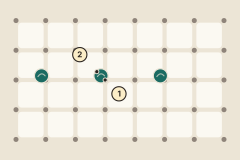
How to work it
Come up where the knot belongs
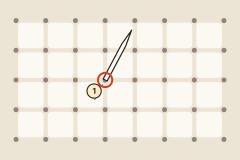
Bring the needle up from the back of the cloth through the hole where the chart puts the knot (1). Pull the thread all the way through.
Wrap the thread round the needle
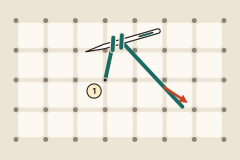
Hold the needle over the cloth in one hand. With the other hand, take hold of the thread a little way from the cloth and wind it round the needle twice. Keep hold of the thread and keep it taut, so that the wraps sit snug on the needle without squeezing it.
Go back down beside the hole
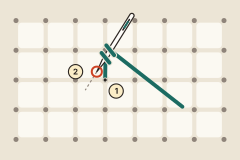
Put the point of the needle into the cloth right beside the hole the thread came up through (2). On Aida, pierce the block right next to the hole. On evenweave or linen, go down one thread of the cloth away. Never go down through the same hole.
Slide the wraps down and pull through
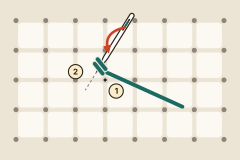
Still holding the thread taut, slide the wraps down the needle until they rest on the cloth. Push the needle through to the back and draw the rest of the thread through the wraps. Let go of the thread only when the knot has formed.
At a glance
- Used for
- eyes; flower centers; woolly or curly texture; single raised dots among finished crosses
- On the chart
- Most often a small dot or circle. The key says how many strands to use and how many times to wrap.
- Wraps
- One or two is usual, and three at most. If the key does not say, use two.
French knots turn up in a great many counted charts: an eye, the middle of a flower, a woolly coat or curly hair, a few raised dots set among the crosses. A chart shows each one as a small dot or circle, and its key gives the number of strands and the number of wraps.
Two things decide how big the knot is: how thick the thread is and how many times it goes round the needle. One wrap gives a small knot and two a fuller one. Past three wraps the loops come out loose and uneven, so for a bigger knot add a strand instead of another wrap.
Every cross stitch pattern on Floss Field is charted in full crosses only, with no knots. This page is for charts from elsewhere that ask for them, and for adding an eye or a dot of your own.
Tips
- Use the same number of strands and the same number of wraps for every knot in a piece, so that they all come out one size.
- Many stitchers put the cloth in a hoop for knots. A knot takes two hands, one for the needle and one for the thread, and the hoop keeps the cloth taut under them.
- Try three or four knots on a spare corner of the cloth before the first one that counts.
When it goes wrong
- The knot pulls through to the back
- The needle went back down through the hole it came up through. Go down right beside that hole, so that a little cloth lies under the knot.
- The knot sits loose or floppy
- The thread was let go too early. Keep it taut with the other hand until the wraps are down on the cloth and the needle has gone through them.
- The knot is too small to see
- Add a strand, or wrap twice instead of once.
- The needle sticks in the wraps
- The eye of a needle is usually a little wider than its shaft, and it catches as it goes through. A milliner's needle, which is one thickness from point to eye, passes through the wraps more easily.
Left-handed
Hold the needle in your left hand and keep the thread taut with your right. The knot comes out the same whichever way the thread goes round the needle.
Variations
- A colonial knot in its place. A colonial knot is wound round the needle in a figure of eight, and comes out a little larger and rounder. Stitchers who cannot get on with French knots often find it easier, and it can stand in wherever a chart asks for a French knot.
- A seed bead in its place. Some stitchers sew on a small seed bead where the chart shows a knot. It gives a raised dot with less trouble, but a bead does not have the texture of a knot, so the look changes.
- French knot in hand embroidery. The same knot in hand embroidery, where there are no holes to count and the knot can sit anywhere on the fabric.
Questions
- How many times do I wrap the thread for a French knot?
- As many as the chart's key says. If it does not say, wrap twice. One wrap makes a smaller knot, and more than three makes a loose, uneven one.
- Why does my French knot disappear to the back?
- The needle went down through the same hole it came up through, so there was nothing under the knot to hold it. Go down right beside the hole instead.
- Do the cross stitch patterns on Floss Field have French knots?
- No. Every cross stitch pattern here is charted in full crosses only.