Working methods · Intermediate
Railroading
Railroading is a way of making a stitch lie flat. The needle goes down between the two strands of the thread, so that they finish side by side like the two rails of a track and not twisted round each other.
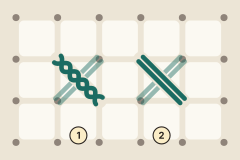
How to work it
Go down between the strands
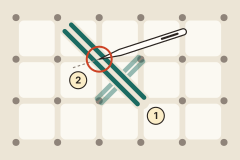
Put the point of the needle between the two strands, without piercing either, and take it down through the hole (2). As the thread is pulled through, one strand settles on each side of the needle and the two lie side by side.
Or hold the strands with a laying tool
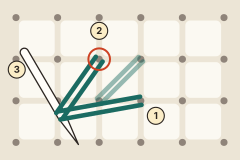
A laying tool does the same job from outside the stitch. Bring the thread up (1) and stroke its strands flat against the cloth with the tool (3). Take the needle down (2), and as the thread is drawn through, keep the loop stretched over the tool so that the strands stay side by side. Slip the tool out as the stitch settles on the cloth.
At a glance
- Also called
- railroad stitch, laying tool, thread tension
- Used for
- flat, even stitches with two strands or more; fuller cover of the cloth
- Works with
- Two strands or more. A single strand has nothing to lie beside.
- Which legs
- The top leg at least, since it is the one that shows most. Both legs for the fullest cover.
- What it costs
- A little time on every stitch, and less with practice.
Thread twists as you stitch. The needle turns a little in the fingers with every stitch, and after a while the strands are wound round each other. Twisted strands make an uneven stitch that covers less of the cloth. Flat strands make a fuller stitch.
The first cure is the simplest: every few stitches, let the needle hang from the cloth until the thread stops turning. Some stitchers do only that and find it enough. Railroading is the next step up. It is a refinement and not a rule, and it earns its time where full cover matters most.
A laying tool is a smooth rod for stroking strands flat and holding them taut while a stitch is made. There are tools made for the purpose, and a trolley needle is one worn on a finger, but a large tapestry needle does the same work. Using one takes a hand, so the cloth has to be held for you, in a frame on a stand.
Tension is how hard you pull each stitch. Pull until the stitch lies flat against the cloth, and stop. A stitch pulled too tight drags the holes open and puckers the cloth. A stitch left too loose stands away from the cloth and loses its shape. Stitching with the cloth slack in the hand tends to leave stitches loose, and a hoop or a frame, used every time, keeps them even.
Tips
- Try it on one row and leave the next row plain, then look at the two side by side. It is the quickest way to see whether the difference is worth the time to you.
- If you railroad only one leg, make it the top one.
When it goes wrong
- The thread keeps twisting
- Let the needle hang from the cloth every few stitches until the thread unwinds, whether or not you railroad.
- The cloth puckers round the stitches
- The stitches are pulled too tight. Pull only until the thread lies flat against the cloth.
- The stitches stand up in loose loops
- They are not pulled far enough, or the cloth was slack while you stitched. Hold the cloth taut in a hoop or a frame.
Questions
- What is railroading in cross stitch?
- Taking the needle down between the two strands of the thread, so that they lie side by side on the cloth and do not twist over each other.
- Do I have to railroad every stitch?
- No. It is optional. Some stitchers find that letting the needle hang to untwist the thread is enough, and some railroad only the top leg, or only the parts of a piece where cover matters.
- What is a laying tool?
- A smooth rod, or a large needle used as one, that strokes the strands of a thread flat and holds them taut while the stitch is pulled through.
- How tight should cross stitches be?
- Snug and no more. A stitch should lie flat against the cloth without pulling the holes open or puckering the cloth, and without standing off it in a loop.