American Saddlebred horse trotting hand embroidery pattern
Advanced · 16 colors · 5 × 4.3 in · 6 kinds of stitch
Download free PDFPDFPrints on US Letter and A4You may sell what you make from it by hand, in small quantities. The PDF itself is not to be sold or shared. Selling, classes and kits: the rules
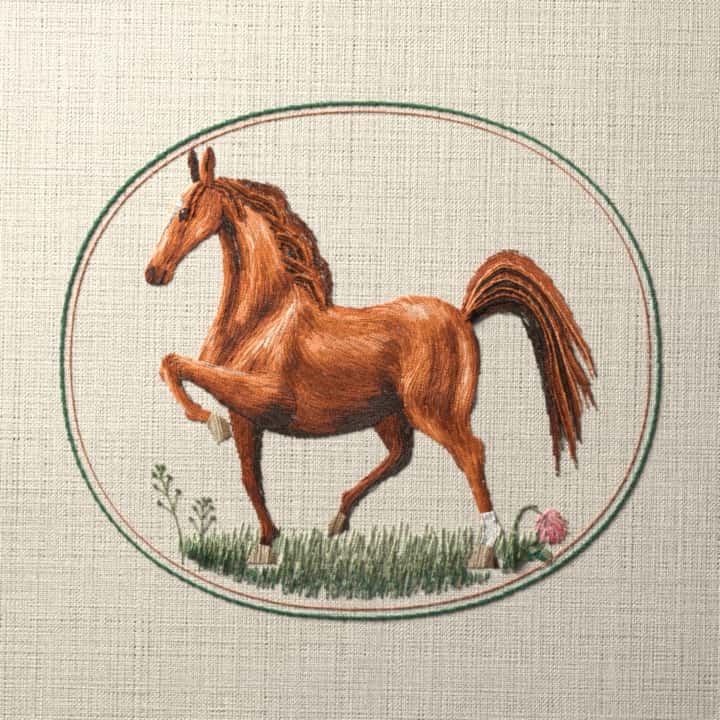
A liver chestnut American Saddlebred trots to the left, one foreleg and the opposite hind leg folded while the other pair meets the ground.
Size and details
Advanced. Uses long and short stitch over much of the design, 16 colors and a great deal of stitching.
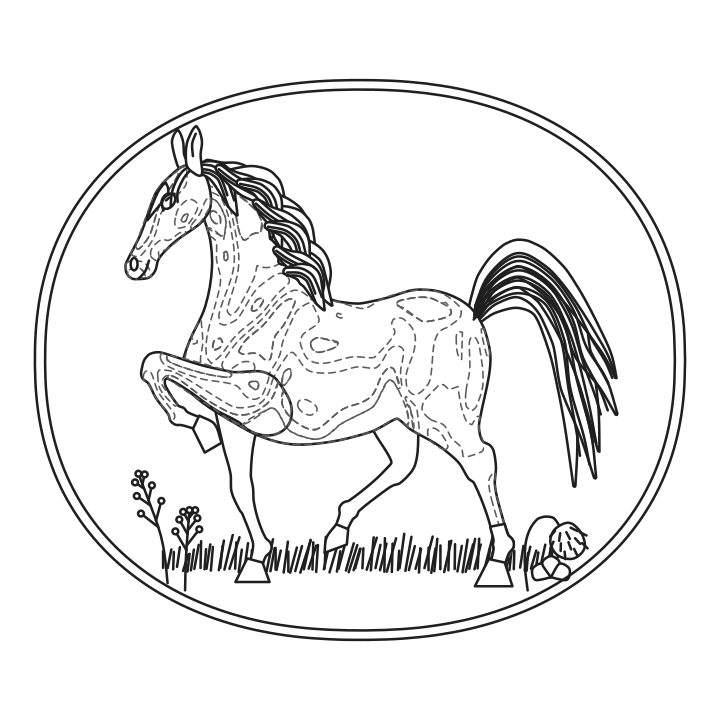
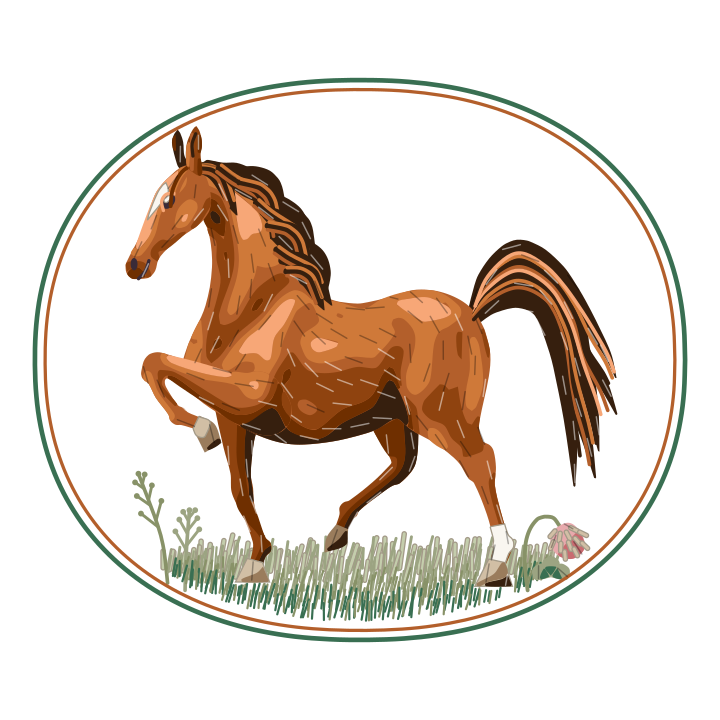
The coat is long and short stitch in one strand, combed along each muscle from mahogany through copper to apricot, and the far legs stay a shade darker. Stem stitch strands run through the mane and the tail. The bluegrass is straight stitch, with French knots on its seed heads, and a pink clover head bends over just behind the hoof. A stem stitch oval with a fine split stitch line inside it frames the horse. In the picture of where the colors go, the fine lines show which way the stitches lie.
| Hoop | Inches | Centimeters | Satin stitch up to |
|---|---|---|---|
| 3 in (8 cm) | 2 × 1.7 in | 5.1 × 4.3 cm | 1/8 in (3 mm) |
| 4 in (10 cm) | 3 × 2.6 in | 7.6 × 6.6 cm | 3/16 in (5 mm) |
| 5 in (13 cm) | 4 × 3.4 in | 10.2 × 8.6 cm | 3/16 in (5 mm) |
| 6 in (15 cm) | 5 × 4.3 in | 12.7 × 10.9 cm | 1/4 in (6 mm) |
| 8 in (20 cm) | 7 × 6 in | 17.8 × 15.2 cm | 3/8 in (10 mm) |
- In a 3, 4 or 5 inch hoop the French knots are drawn smaller than about 2 mm (a little over 1/16 in). Use one strand of floss for them there, or choose a larger hoop.
What you need
- Fabric
- Plain cotton or linen, cut 9 in (23 cm) square.
- Needle
- Embroidery needle, size 9 for 1 strand, size 7 for 2 or 3 (a lower number is a thicker needle).
- Floss
- 16 colors of six-strand cotton, listed below. DMC is a brand: another brand in a like color will do.
- Marker
- A pen or a sheet that suits the fabric: how to transfer a pattern says which.
Floss
- 1DMC 524 Very Light Fern GreenBluegrass (lightest)
- 2DMC 3053 Green GrayBluegrass (light), bluegrass seed heads and clover leaves (lighter)
- 3DMC 3052 Medium Green GrayBluegrass (dark), bluegrass seed heads (darker), clover stem
- 4DMC 938 Ultra Dark Coffee BrownTail, coat, far legs, near legs and ears (darkest), mane and hooves (dark)
- 5DMC 400 Dark MahoganyFar legs (light), coat and near legs (middle dark), head (dark), ears (middle)
- 6DMC 300 Very Dark MahoganyFar legs, coat, near legs and ears (dark), forelock (darker), head (darkest)
- 7DMC 301 Medium MahoganyCoat and near legs (middle light), oval (lighter), head (middle) and 5 more parts
- 8DMC 842 Very Light Beige BrownHooves and clover head (light)
- 9DMC 840 Medium Beige BrownHooves (middle)
- 10DMC 3776 Light MahoganyCoat, tail, mane, near legs and head (light), ears (lightest)
- 11DMC 402 Very Light MahoganyCoat, tail, head and near legs (lightest), eyelid
- 12DMC 3865 Winter WhiteSock, star and eye light
- 13DMC 3371 Black BrownEye, mouth and nostril
- 14DMC 501 Dark Blue GreenOval and clover leaves (darker), bluegrass (darkest)
- 15DMC 3688 Medium MauveClover head (middle)
- 16DMC 3687 MauveClover head (dark)
Skeins: one of each color is enough. An estimate for the 6 inch hoop, from the length of each line and the area of each filled shape, with a fifth added for tails.
How to stitch it
- New to hand embroidery? Start here.
- Print at 100%, trace the pattern onto the fabric, and put it in the hoop: inner ring under, drawing up, tight as a drum.
- Floss is six strands. Cut 18 inches (45 cm), pull out the number given one at a time, and lay them together.
- Inside a filled shape start with two or three tiny stitches, which the filling covers. Start a line with a small knot on the back. End each thread by running the needle under the backs of a few stitches.
- Each small ring is one French knot. A fine broken line inside a shape is where two shades meet: trace it, do not stitch it.
- A number under “Where colors go” is a color of the list. The fine lines on the colors show which way the stitches lie.
Stitch in this order
Filled parts from the back of the picture forward, then lines and knots. Where a stitch page names another number of strands, use the number here.
- Long and short stitch 1 strandTail, far legs, coat, sock, near legs, ears, head, mane, clover head
- Satin stitch 2 strandsHooves, star, eye, nostril, clover leaves
- Straight stitch 1 strandBluegrass, bluegrass seed heads, eye light, clover head
- Stem stitch3 strands: oval2 strands: forelock, clover stem1 strand: bluegrass seed heads, mane, tail
- Split stitch 1 strandEyelid, mouth, ears, oval
- French knot 1 strand, two wrapsBluegrass seed heads
When it is done, take off any lines that still show and finish the hoop. A guide to this kind of work: Stitches for fur, hair and feathers.
More patterns like this
Advanced prints 3–14 in · 18 colors
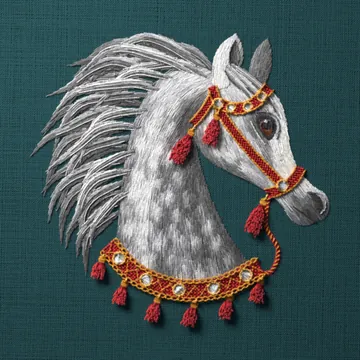
Arabian horse head with tassels
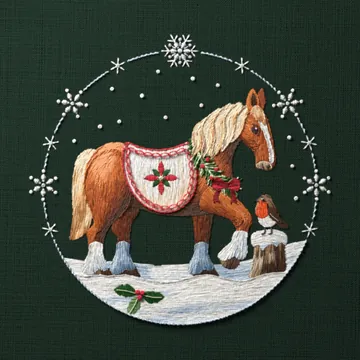
Advanced prints 3–14 in · 22 colors
Christmas horse in the snow
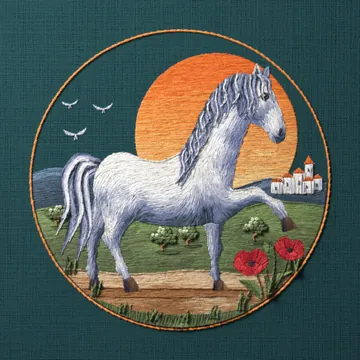
Advanced prints 3–14 in · 24 colors
Andalusian horse in the Spanish walk
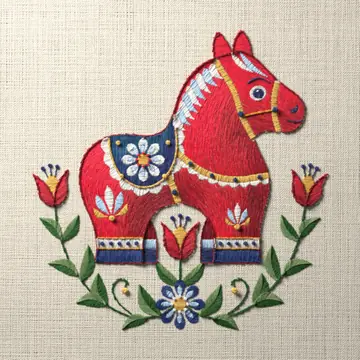
Advanced prints 3–14 in · 13 colors
Red Dala horse
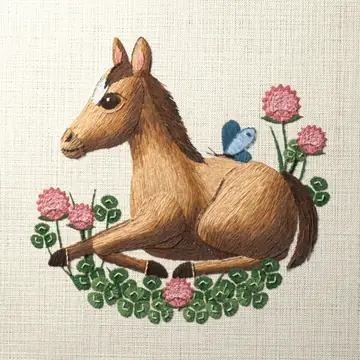
Advanced 3–8 in hoop · 20 colors
Young colt resting in clover
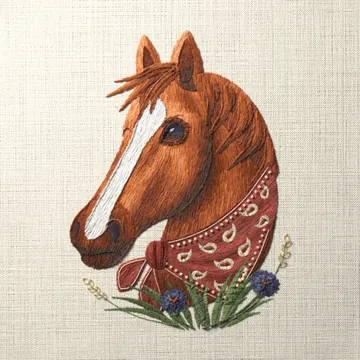
Advanced 3–8 in hoop · 23 colors
Horse in a paisley bandana
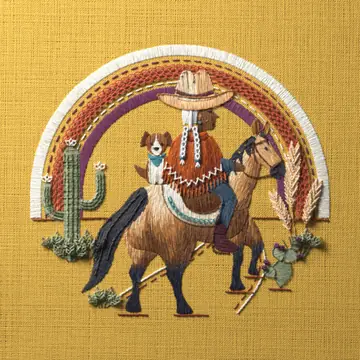
Advanced 3–8 in hoop · 24 colors
Western horse and rider
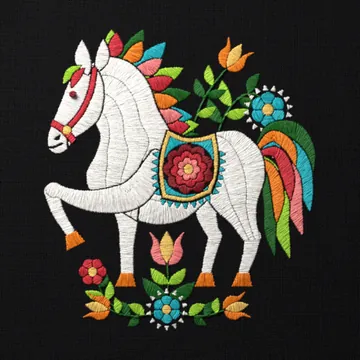
Advanced 3–8 in hoop · 9 colors
Polish folk art horse
New to hand embroidery? Starting hand embroidery, step by step