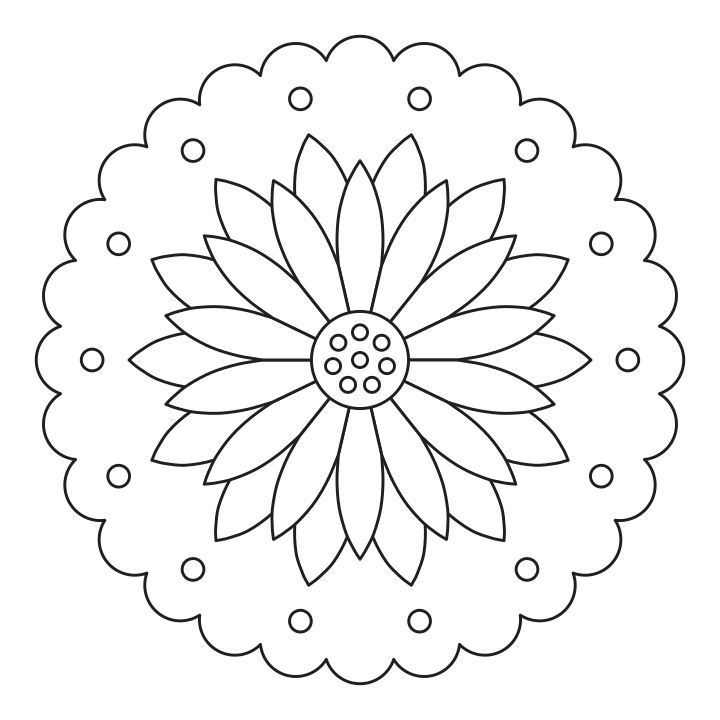
Aster coaster hand embroidery pattern
Intermediate · 5 colors · 4.3 × 4.3 in · 4 kinds of stitch · one of a set of 6
Download free PDFPDFYou may sell what you make from it by hand, in small quantities. The PDF itself is not to be sold or shared. Selling, classes and kits: the rules
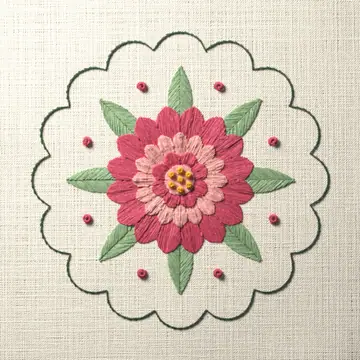
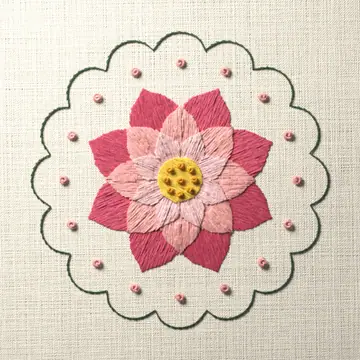
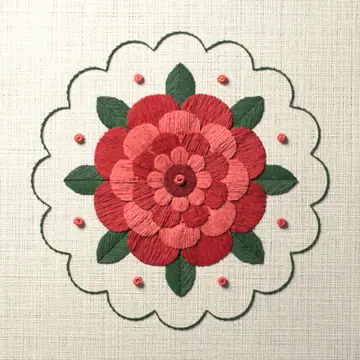
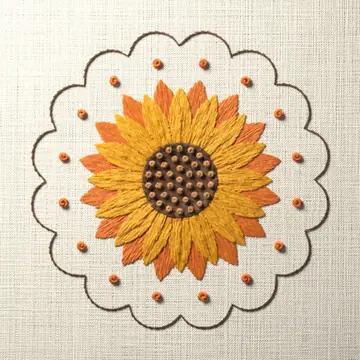
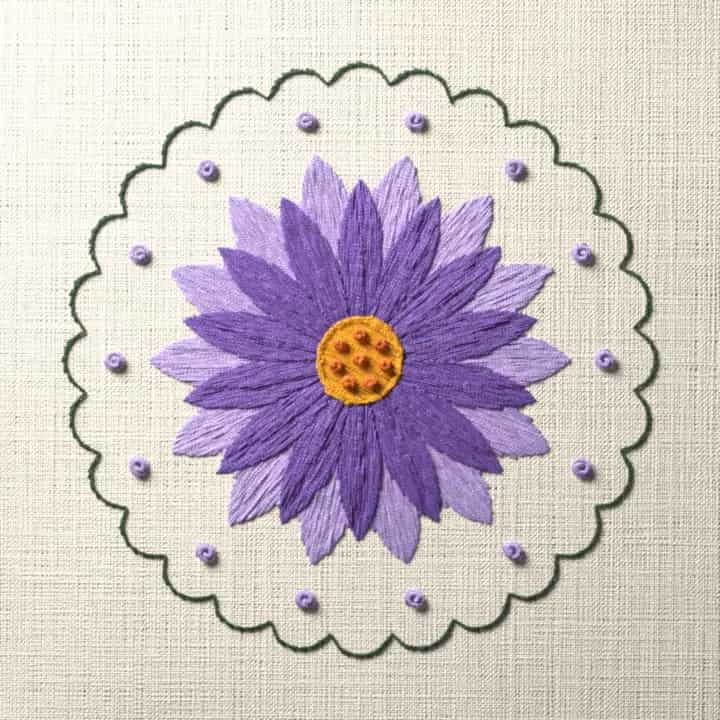
A round design for a coaster shows one aster seen face on inside a scalloped edge.
Choose a size
| Hoop | Inches | Centimeters | Satin stitch up to |
|---|---|---|---|
| 3 in (8 cm) | 1.7 × 1.7 in | 4.3 × 4.3 cm | 1/4 in (6 mm) |
| 4 in (10 cm) | 2.6 × 2.6 in | 6.6 × 6.6 cm | 3/8 in (10 mm) |
| 5 in (13 cm) | 3.5 × 3.5 in | 8.9 × 8.9 cm | 1/2 in (13 mm) |
| 6 in (15 cm) | 4.3 × 4.3 in | 10.9 × 10.9 cm | 5/8 in (16 mm) |
| 8 in (20 cm) | 6.1 × 6.1 in | 15.5 × 15.5 cm | 7/8 in (22 mm) |
- In a 5, 6 or 8 inch hoop the widest satin stitch shape is 1/2 in (13 mm) or more across. Satin stitches longer than about 12 mm (just under 1/2 in) tend to work loose: divide the shape into sections, or work it in long and short stitch.
- In a 3 or 4 inch hoop the French knots are drawn smaller than about 2 mm (a little over 1/16 in). Use one strand of floss for them there, or choose a larger hoop.
Before you start
- New to this? How to read a pattern.
- Print at actual size (100%, not “fit”), trace the black lines, and put the fabric in the hoop, tight as a drum.
- Print at actual size (100%, not “fit”), tape the sheets and trace all of it. Hoop one part, stitch it, then move the hoop; raised parts and knots last.
- Floss has six strands: cut 18 inches (45 cm), pull out the number named one at a time, and lay them together.
- The back is seen: no knots. Start with tiny stitches; end around the backs of four or five stitches.
- On the drawing a ring is one French knot.
On linens. Pillowcase: middle of the hem band; napkin: one corner, on the diagonal. How to embroider pillowcases and napkins
What you need
- Hoop
- 6 in (15 cm), 4.3 × 4.3 in stitched. Another size
- Fabric
- Plain cotton or linen in a light color, cut 9 in (23 cm) square.
- Needle
- Embroidery needle, size 9.
- Floss
- 5 colors of six-strand cotton. Skeins: one of each color is enough, an estimate for the 6 inch hoop from the drawing’s lines and shapes.
- Also
- Water-soluble pen or sharp pencil, small scissors.
DMC is a brand, the number its color: another brand in a like color will do.
Threads and stitches
- 1DMC 210 Medium Lavender
- 2DMC 208 Very Dark Lavender
- 3DMC 3852 Very Dark Straw
- 4DMC 922 Light Copper
- 5DMC 986 Very Dark Forest Green
Stitch in this order
Where a stitch page says otherwise, follow this list.
- Long and short stitch 1 or 2 strandsAster back rays, aster front rays
- Satin stitch 2 strandsAster eye
- Stem stitch 2 or 3 strandsScalloped edge
- French knot 2 strands, two wrapsAster eye knots, ring of knots
Take out lines that still show, press face down, finish the hoop.
About this pattern
Intermediate. Uses long and short stitch; from a 4 inch hoop up the widest satin stitches are long.
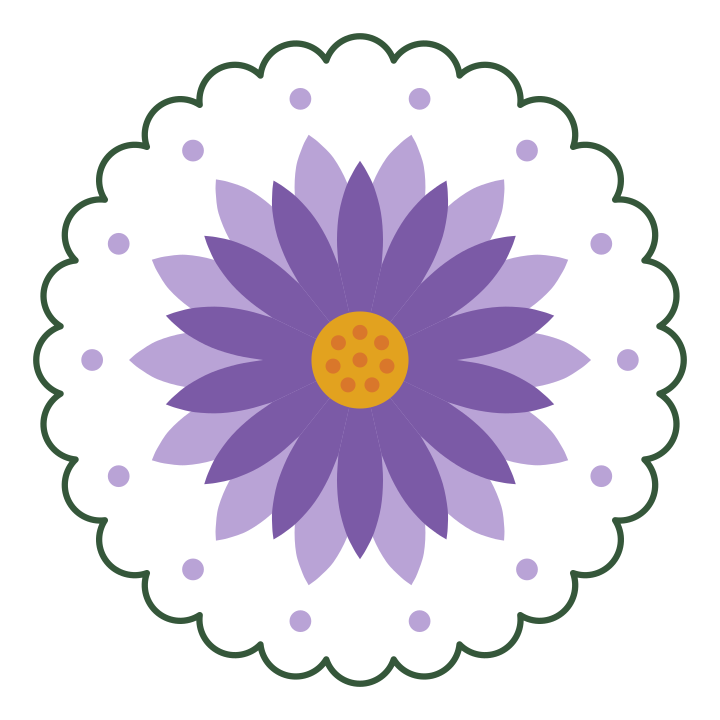
Fourteen dark purple front rays, slender and pointed, lie over fourteen longer light purple back rays that show between them; both sets are long and short stitch. The aster eye is a gold disc of satin stitch carrying orange French knots, seven about one knot in the middle. Round the flower runs a ring of fourteen light purple French knots, and outside it the scalloped edge in green stem stitch, with twenty-eight scallops, two to each knot of the ring.
1 DMC 210: aster back rays and ring of knots. 2 DMC 208: aster front rays. 3 DMC 3852: aster eye. 4 DMC 922: aster eye knots. 5 DMC 986: scalloped edge.
A guide to this kind of work: Stitches for flowers.