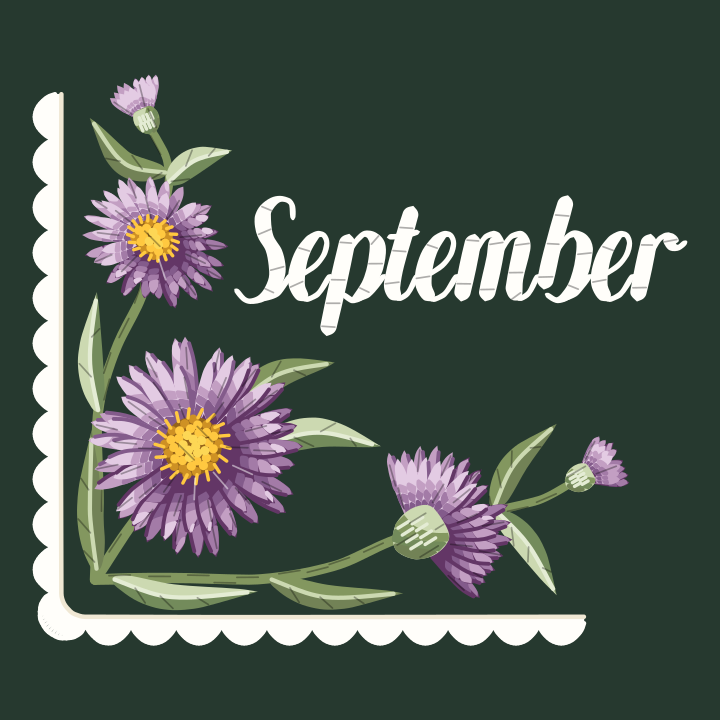
September birth flower, aster hand embroidery pattern
Advanced · 16 colors · 4.3 × 3.7 in · 8 kinds of stitch · one of a set of 12
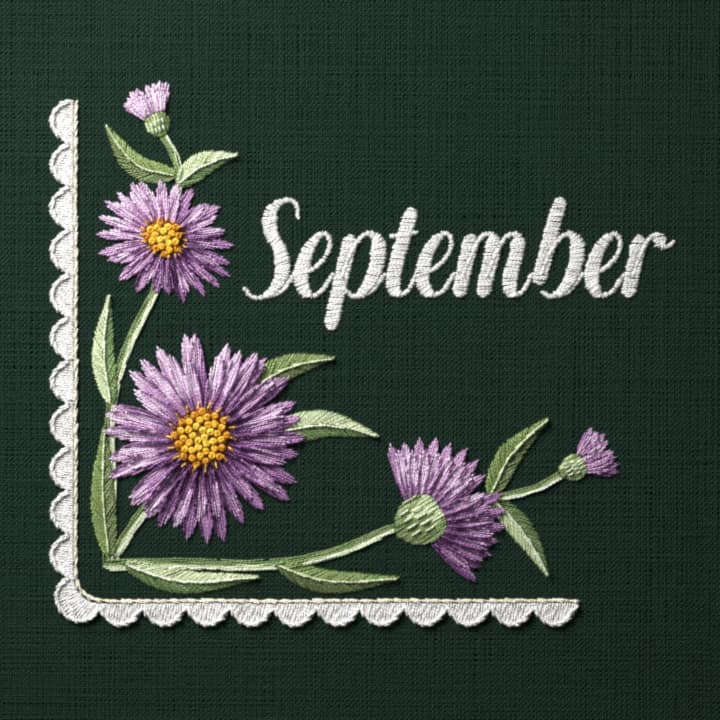
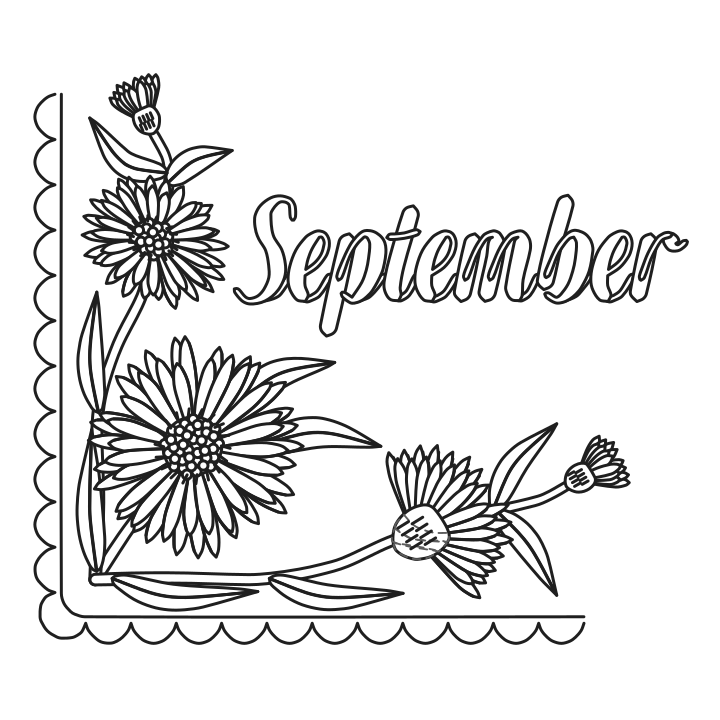
A number is a color of the list. Fine lines show which way the stitches lie: do not stitch them.
Download free PDFPDFYou may sell what you make from it by hand, in small quantities. The PDF itself is not to be sold or shared. Selling, classes and kits: the rules
The many narrow petals are long and short stitch from plum to lavender, some edged in split stitch.
Choose a size
| Hoop | Inches | Centimeters | Satin stitch up to |
|---|---|---|---|
| 3 in (8 cm) | 1.7 × 1.5 in | 4.3 × 3.8 cm | 1/8 in (3 mm) |
| 4 in (10 cm) | 2.6 × 2.2 in | 6.6 × 5.6 cm | 1/4 in (6 mm) |
| 5 in (13 cm) | 3.4 × 3 in | 8.6 × 7.6 cm | 5/16 in (8 mm) |
| 6 in (15 cm) | 4.3 × 3.7 in | 10.9 × 9.4 cm | 3/8 in (10 mm) |
| 8 in (20 cm) | 6 × 5.2 in | 15.2 × 13.2 cm | 1/2 in (13 mm) |
- In an 8 inch hoop the widest satin stitch shape is 1/2 in (13 mm) across. Satin stitches longer than about 12 mm (just under 1/2 in) tend to work loose: divide the shape into sections, or work it in long and short stitch.
- In a 3 or 4 inch hoop the French knots are drawn smaller than about 2 mm (a little over 1/16 in). Use one strand of floss for them there, or choose a larger hoop.
Before you start
- New to this? Try an easy pattern first, or see how to read one.
- Print at actual size (100%, not “fit”). Dark fabric: trace with a white pencil over a bright light, or use a wash-away sheet. Then put it in the hoop, tight as a drum.
- Print at actual size (100%, not “fit”), tape the sheets and trace all of it. Hoop one part, stitch it, then move the hoop; raised parts and knots last.
- Floss has six strands: cut 18 inches (45 cm), pull out the number named one at a time, and lay them together.
- The back is seen: no knots. Start with tiny stitches; end around the backs of four or five stitches.
- On the drawing a ring is one French knot; a broken line inside a shape is where two shades meet: trace it, do not stitch it.
On linens. Pillowcase: middle of the hem band; napkin: one corner, on the diagonal. How to embroider pillowcases and napkins
What you need
- Hoop
- 6 in (15 cm), 4.3 × 3.7 in stitched. Another size
- Fabric
- Plain cotton or linen in dark green or another dark color, cut 9 in (23 cm) square.
- Needle
- Embroidery needle, size 9.
- Floss
- 16 colors of six-strand cotton. Skeins: one of each color is enough, an estimate for the 6 inch hoop from the drawing’s lines and shapes.
- Also
- White pencil, small scissors.
DMC is a brand, the number its color: another brand in a like color will do.
Threads and stitches
- 1DMC BLANC White
- 2DMC ECRU Ecru
- 3DMC 3364 Pine Green
- 4DMC 3363 Medium Pine Green
- 5DMC 3348 Light Yellow Green
- 6DMC 988 Medium Forest Green
- 7DMC 772 Very Light Yellow Green
- 8DMC 327 Dark Violet
- 9DMC 208 Very Dark Lavender
- 10DMC 209 Dark Lavender
- 11DMC 210 Medium Lavender
- 12DMC 211 Light Lavender
- 13DMC 780 Ultra Very Dark Topaz
- 14DMC 783 Medium Topaz
- 15DMC 725 Medium Light Topaz
- 16DMC 726 Light Topaz
Stitch in this order
Where a stitch page says otherwise, follow this list.
- Long and short stitch 1 strandStems, petals, flower cups
- Fishbone stitch 2 strandsLeaves
- Satin stitch 2 strandsEyes, month
- Buttonhole stitch 2 strandsScalloped edge
- Stem stitch2 strands: edge cord1 strand: leaf veins
- Split stitch 1 strandPetal edges
- Straight stitch 1 strandEye tips, cup scales
- French knot 1 strand, two wrapsKnots of the eyes
Take out lines that still show, press face down, finish the hoop.
About this pattern
Advanced. Uses long and short stitch, dozens of French knots, 16 colors and a great deal of stitching; from a 6 inch hoop up the widest satin stitches are long.
The gold centers are French knots over satin stitch with straight stitch tips. The leaves are fishbone stitch with a stem stitch vein. The scalloped edge is close buttonhole stitch in white with an ecru cord of stem stitch inside it, and the name of the month is satin stitch. Every month in the set of twelve has the same edge, lettering, and places for its flowers, so they match side by side.
1 DMC BLANC: scalloped edge and month. 2 DMC ECRU: edge cord. 3 DMC 3364: stems, leaves and flower cups (light). 4 DMC 3363: leaves and flower cups (darkest). 5 DMC 3348: leaves and flower cups (lightest), leaf veins (darker). 6 DMC 988: leaves and flower cups (dark). 7 DMC 772: leaf veins (lighter), cup scales. 8 DMC 327: petals (darkest), petal edges (darker). 9 DMC 208: petals (dark), petal edges (lighter). 10 DMC 209: petals (middle). 11 DMC 210: petals (light). 12 DMC 211: petals (lightest). 13 DMC 780: eyes (darkest). 14 DMC 783: eyes (dark). 15 DMC 725: eyes (light), eye tips. 16 DMC 726: eyes (lightest).
A guide to this kind of work: Stitches for flowers.
The rest of this set
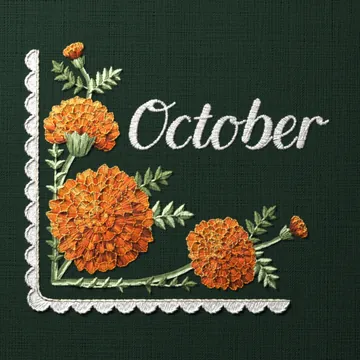
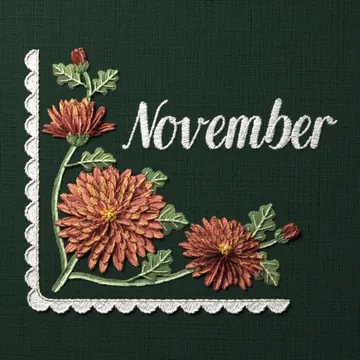
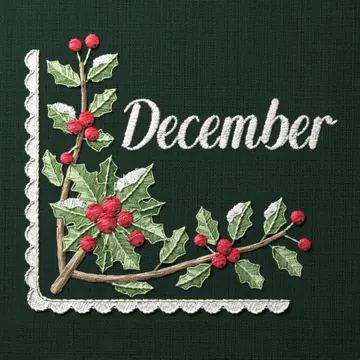
More subjects and crafts
Patterns
- February birth flower, violet
- March birth flower, daffodil
- April birth flower, daisy
- May birth flower, lily of the valley
- June birth flower, rose
- July birth flower, water lily
- August birth flower, poppy
- Aster coaster
- Goldenrod, aster and calendula bunch
- Monarch butterfly hoop with fall asters
- Aster vine heart
- Aster mandala