Bald eagle and American flag hand embroidery pattern
Advanced · 24 colors · 7 kinds of stitch
Download free PDFPDF, US Letter · 128 KBFor your own stitching, gifts and handmade pieces you sell. Do not resell or share this PDF. What you may do, in full
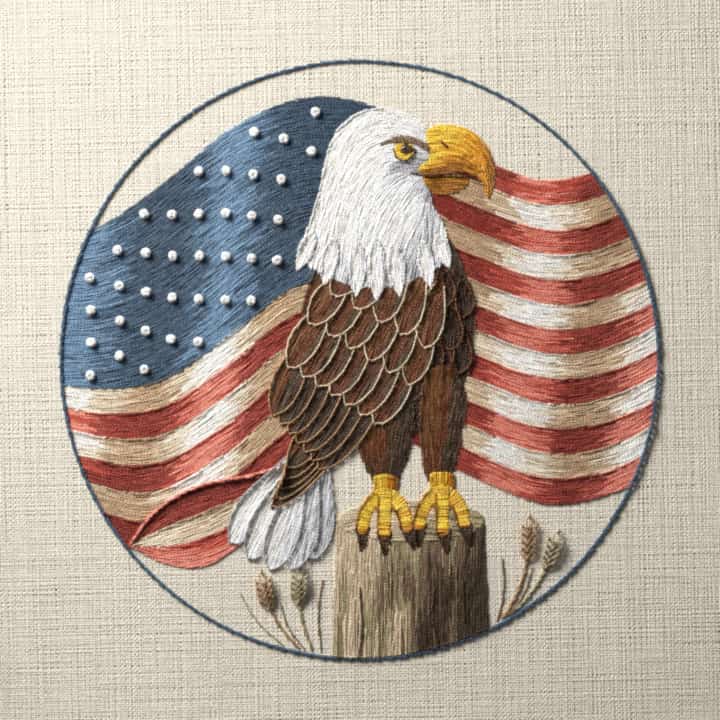
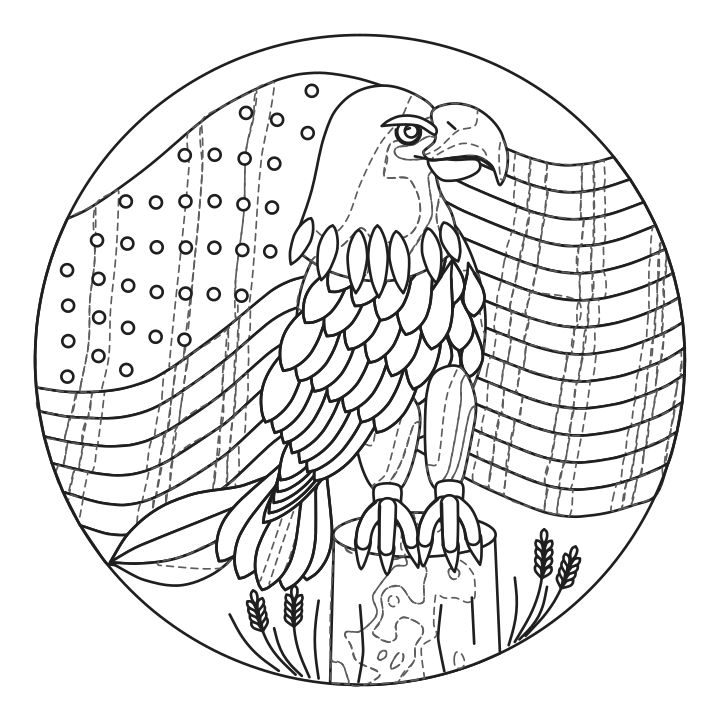
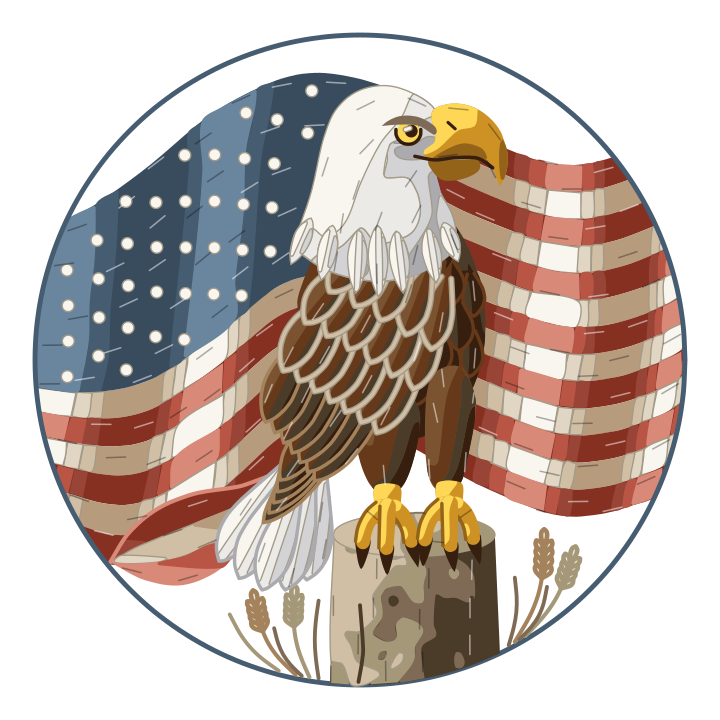
A bald eagle stands on a weathered fence post with its wings folded in layers, looking to the right. Behind it a faded flag ripples through the whole ring, and one fold of the hem lifts just behind the tail. The flag, the feathers and the post are shaded in long and short stitch, with each wing feather edged in split stitch. The stars are French knots, the talons and brow are satin stitch, and the ring is stem stitch. Dry grass with lazy daisy seed heads stands on both sides of the post. In the picture of where the colors go, the fine lines show which way the stitches lie.
Size and details
Advanced. Uses long and short stitch over much of the design, dozens of French knots, 24 colors and a great deal of stitching.
24 colors of floss and 7 kinds of stitch:
- Long and short stitch
- French knot
- Stem stitch
- Lazy daisy stitch
- Split stitch
- Satin stitch
- Straight stitch
- Which stitch goes where
| Hoop | Inches | Centimeters | Satin stitch up to |
|---|---|---|---|
| 3 in (8 cm) | 1.9 × 1.9 in | 4.8 × 4.8 cm | 1/16 in (1.6 mm) |
| 4 in (10 cm) | 2.8 × 2.8 in | 7.1 × 7.1 cm | 1/8 in (3 mm) |
| 5 in (13 cm) | 3.8 × 3.8 in | 9.7 × 9.7 cm | 3/16 in (5 mm) |
| 6 in (15 cm) | 4.7 × 4.7 in | 11.9 × 11.9 cm | 3/16 in (5 mm) |
| 8 in (20 cm) | 6.6 × 6.6 in | 16.8 × 16.8 cm | 5/16 in (8 mm) |
- In a 3, 4 or 5 inch hoop the French knots are drawn smaller than about 2 mm (a little over 1/16 in). Use one strand of floss for them there, or choose a larger hoop.
- In a 3 or 4 inch hoop the shortest lazy daisy loops are drawn smaller than about 2 mm (a little over 1/16 in). Use one strand of floss for them there, or choose a larger hoop.
The pattern is drawn inside a circle about half an inch (1.3 cm) smaller all around than the hoop.
What you need
- DMC 3777 Very Dark Terra CottaRed stripes (darkest), lifted fold (shade 1 of 7)
- DMC 355 Dark Terra CottaRed stripes (dark), lifted fold (shade 2 of 7)
- DMC 3830 Terra CottaRed stripes (light), lifted fold (shade 3 of 7)
- DMC 3778 Light Terra CottaRed stripes (lightest), lifted fold (shade 4 of 7), fold edge
- DMC 841 Light Beige BrownCream stripes (darkest), lifted fold (shade 5 of 7)
- DMC 842 Very Light Beige BrownFeather edges and fence post (lightest), cream stripes (dark) and 2 more parts
- DMC 3033 Very Light Mocha BrownCream stripes (light), lifted fold (shade 7 of 7)
- DMC 3865 Winter WhiteHead, cream stripes and tail (lightest), stars and eye light
- DMC 3750 Very Dark Antique BlueBlue canton (dark)
- DMC 930 Dark Antique BlueBlue canton (middle), ring
- DMC 931 Medium Antique BlueBlue canton (light)
- DMC 3031 Very Dark Mocha BrownBreast (middle), fence post (darkest), long wing feathers (dark) and 4 more parts
- DMC 3790 Ultra Dark Beige GrayFence post and dry grass (dark), brow
- DMC 642 Dark Beige GrayFence post and dry grass (light), fence post top (darker), grass heads (lighter)
- DMC 3863 Medium Mocha BeigeFeather edges (dark), grass heads (darker), dry grass (middle), shoulder (lightest)
- DMC 3024 Very Light Brown GrayTail and head (light)
- DMC 318 Light Steel GrayFeather edges (light), head and tail (darkest)
- DMC 415 Pearl GrayHead and tail (dark)
- DMC 938 Ultra Dark Coffee BrownBreast (dark), long wing feathers and leg feathers (darkest), talons and 4 more parts
- DMC 801 Dark Coffee BrownWing coverts (middle), long wing feathers (light), shoulder (dark) and 3 more parts
- DMC 433 Medium BrownWing coverts and shoulder (light), leg feathers and long wing feathers (lightest)
- DMC 783 Medium TopazFeet and bill (middle)
- DMC 780 Ultra Very Dark TopazBill and feet (dark), toe edges
- DMC 726 Light TopazFeet and bill (light), eye
Skeins: one of each color is enough. An estimate for the largest size, the 8 inch hoop: the length of each line and the area of each filled shape, a fifth added for tails and ends, a tenth of every 8 m (8.7 yd) skein kept spare.
The floss is six-strand cotton; the stitch guide says how many strands to use. You also need a hoop, an embroidery needle (a size 7 to 9 suits two or three strands) and plain cotton or linen fabric. To frame the piece in its hoop, cut a square 3 inches (8 cm) wider than the hoop: a 9 inch (23 cm) square for a 6 inch hoop.
When it is stitched, how to finish a hoop shows how to back it for the wall.
Stitch guide
- Put the pattern on the fabric (how to transfer a pattern) and the fabric in the hoop.
- Stitch the filled parts first, what lies behind before what lies in front of it.
- Then stitch the lines: stems, veins and outlines over the edges of the filled parts.
- Keep the knots for the end, so that the hoop and your hand do not flatten them.
Start each thread with a small knot on the back or one of the knotless starts, and end it by running the needle under the backs of a few stitches (starting and ending a thread). Use the strands this list gives, also where a page about a stitch names another number.
- Long and short stitch 1 strandRed stripes, cream stripes, blue canton, lifted fold, fence post, fence post top, tail, breast, leg feathers, long wing feathers, and 5 more
- French knot 2 strands, two wrapsStars
- Stem stitch 1 to 3 strandsFold edge, ring, wood cracks, dry grass
- Lazy daisy stitch 1 strandGrass heads
- Split stitch 1 strandFeather edges, toe edges, mouth line, eye ring
- Satin stitch 2 strandsTalons, feet, eye, pupil, brow
- Straight stitch 1 to 2 strandsNostril, eye light
Getting it onto your fabric
The PDF holds the pattern twice at actual size: once as drawn, and once mirrored for an iron-on transfer pen. Print it at 100% with scaling off and check the one-inch square (25.4 mm) with a ruler before you trace. How to transfer a pattern explains tracing, carbon paper and the other ways. The files are under Downloads.
Downloads
- Download free PDF PDF, US Letter, 3 pages, for a 6 inch (15 cm) hoop
- Download free PDF, A4 PDF, A4, 3 pages, for a 6 inch (15 cm) hoop
More patterns like this
Advanced 3–8 in hoop · 24 colors
Half-round stars and stripes bunting
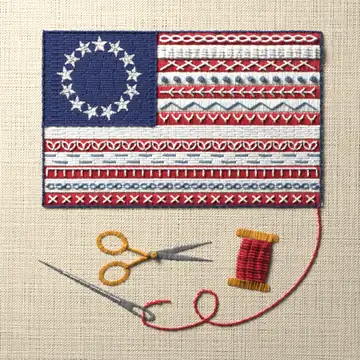
Easy 3–8 in hoop · 7 colors
Betsy Ross flag stitch sampler, easy
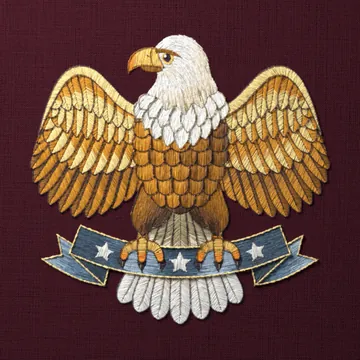
Advanced 3–8 in hoop · 16 colors
Eagle holding a banner
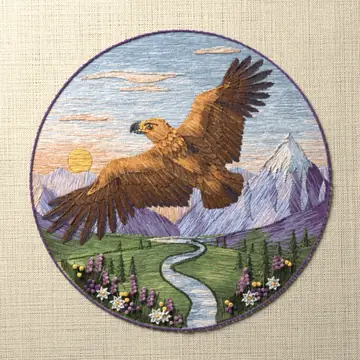
Advanced 3–8 in hoop · 24 colors
Golden eagle over the mountains
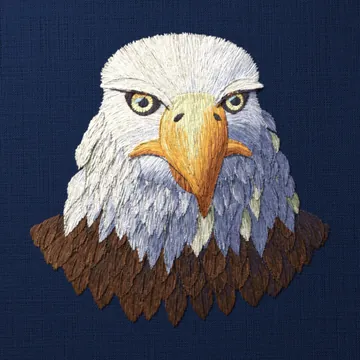
Advanced 3–8 in hoop · 22 colors
Bald eagle head portrait
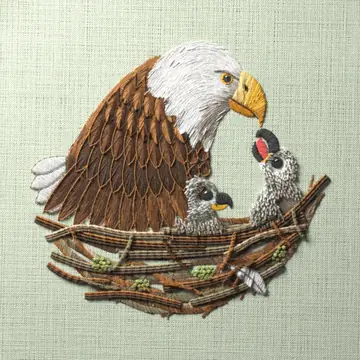
Advanced 3–8 in hoop · 23 colors
Mother eagle and eaglets in the nest
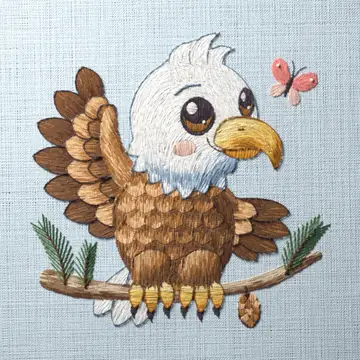
Advanced 3–8 in hoop · 20 colors
Cute baby eagle
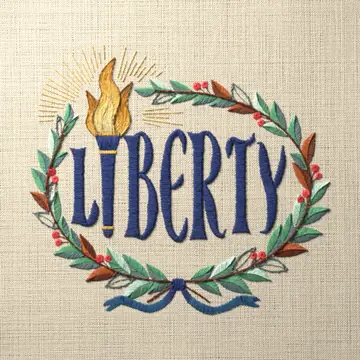
Advanced 3–8 in hoop · 16 colors
Liberty in laurel
New to hand embroidery? Starting hand embroidery, step by step