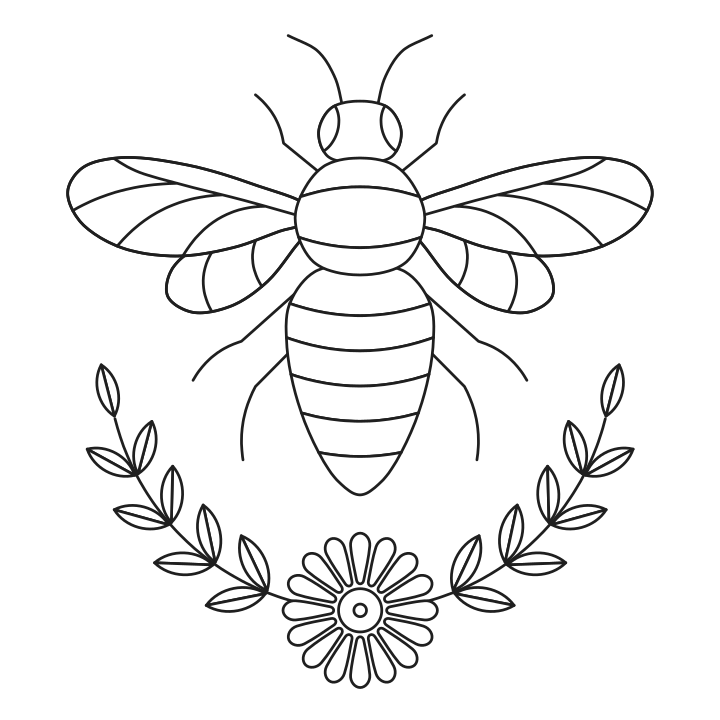
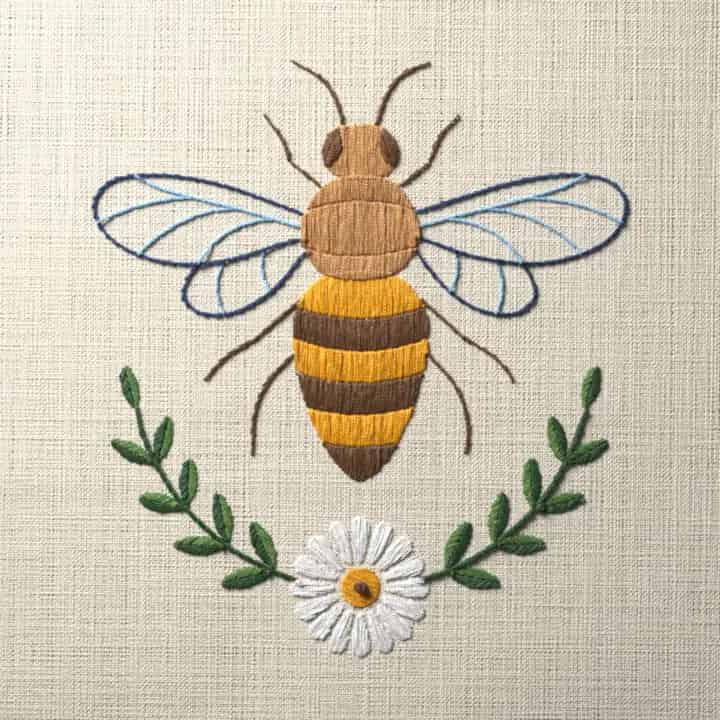
Bee over daisy crescent hand embroidery pattern
Intermediate · 8 colors · 4.2 × 4.6 in · 4 kinds of stitch
Download free PDFPDFYou may sell what you make from it by hand, in small quantities. The PDF itself is not to be sold or shared. Selling, classes and kits: the rules
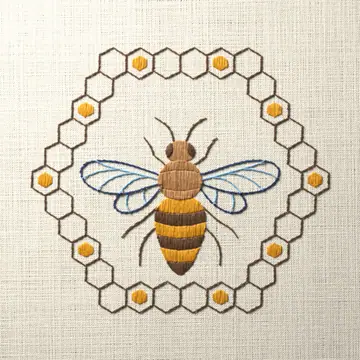
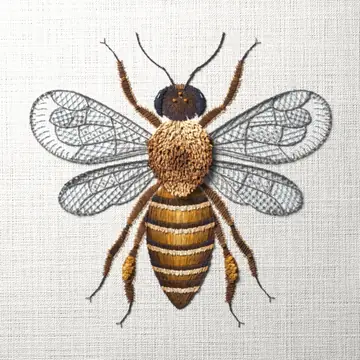
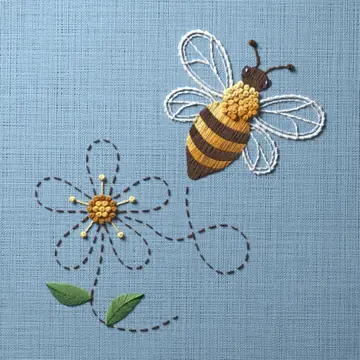
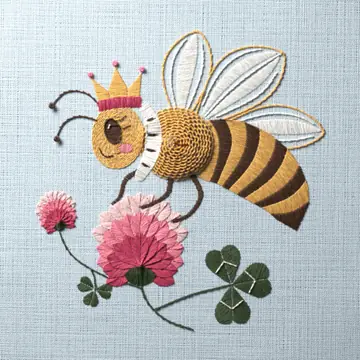
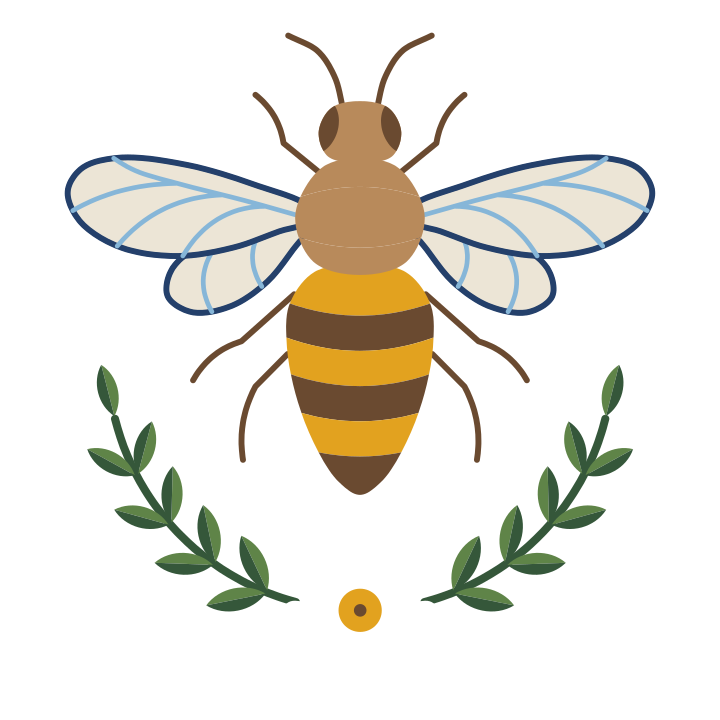
A honey bee spreads its four wings over a crescent of leaves: from a daisy at the foot a branch rises to each side, with four pairs of satin stitch leaves and one leaf at its end.
Choose a size
| Hoop | Inches | Centimeters | Satin stitch up to |
|---|---|---|---|
| 3 in (8 cm) | 1.7 × 1.8 in | 4.3 × 4.6 cm | 3/16 in (5 mm) |
| 4 in (10 cm) | 2.5 × 2.8 in | 6.4 × 7.1 cm | 1/4 in (6 mm) |
| 5 in (13 cm) | 3.3 × 3.7 in | 8.4 × 9.4 cm | 3/8 in (10 mm) |
| 6 in (15 cm) | 4.2 × 4.6 in | 10.7 × 11.7 cm | 7/16 in (11 mm) |
| 8 in (20 cm) | 5.8 × 6.5 in | 14.7 × 16.5 cm | 5/8 in (16 mm) |
- In an 8 inch hoop the widest satin stitch shape is 5/8 in (16 mm) across. Satin stitches longer than about 12 mm (just under 1/2 in) tend to work loose: divide the shape into sections, or work it in long and short stitch.
- In a 3, 4 or 5 inch hoop the French knot is drawn smaller than about 2 mm (a little over 1/16 in). Use one strand of floss for it there, or choose a larger hoop.
Before you start
- New to this? How to read a pattern.
- Print at actual size (100%, not “fit”), trace the black lines, and put the fabric in the hoop, tight as a drum.
- Print at actual size (100%, not “fit”), tape the sheets and trace all of it. Hoop one part, stitch it, then move the hoop; raised parts and knots last.
- Floss has six strands: cut 18 inches (45 cm), pull out the number named one at a time, and lay them together.
- Start a filling with tiny stitches, a line with a small knot; end under stitches on the back.
- On the drawing a ring is one French knot.
What you need
- Hoop
- 6 in (15 cm), 4.2 × 4.6 in stitched. Another size
- Fabric
- Plain cotton or linen in a light color, cut 9 in (23 cm) square.
- Needle
- Embroidery needle, size 7.
- Floss
- 8 colors of six-strand cotton. Skeins: one of each color is enough, an estimate for the 6 inch hoop from the drawing’s lines and shapes.
- Also
- Water-soluble pen or sharp pencil, small scissors.
DMC is a brand, the number its color: another brand in a like color will do.
Threads and stitches
- 1DMC 986 Very Dark Forest Green
- 2DMC 320 Medium Pistachio Green
- 3DMC B5200 Snow White
- 4DMC 3852 Very Dark Straw
- 5DMC 3781 Dark Mocha Brown
- 6DMC 336 Navy Blue
- 7DMC 3755 Baby Blue
- 8DMC 3828 Hazelnut Brown
Stitch in this order
Where a stitch page says otherwise, follow this list.
- Satin stitch 2 strandsLeaves (each half slanted to the center vein, in its own color), daisy petals, daisy center, head, eyes, bands of the abdomen, thorax
- Stem stitch 2 or 3 strandsBranches, feelers, legs, outlines of the hind wings, outlines of the fore wings
- Back stitch 2 strandsHind wing veins, fore wing veins
- French knot 2 strands, two wrapsDaisy center knot
Take out lines that still show, press face down, finish the hoop.
About this pattern
Intermediate. Eight colors; from a 5 inch hoop up the widest satin stitches are long.
The daisy is satin stitch petals round a satin stitch center with a French knot in it. The head, the eyes, the three parts of the thorax (the middle of the body) and six bands across the abdomen of the bee are satin stitch; the wings are outlined in stem stitch with veins of back stitch, and the feelers and six jointed legs are stem stitch.
1 DMC 986: branches and darker half of each leaf. 2 DMC 320: lighter half of each leaf. 3 DMC B5200: daisy petals. 4 DMC 3852: daisy center and gold bands of the abdomen. 5 DMC 3781: daisy center knot, feelers, legs, eyes and brown bands of the abdomen. 6 DMC 336: outlines of the hind wings and outlines of the fore wings. 7 DMC 3755: hind wing veins and fore wing veins. 8 DMC 3828: head and thorax.