Cat skull hand embroidery pattern
Advanced · 16 colors · 4.7 × 4.4 in · 6 kinds of stitch
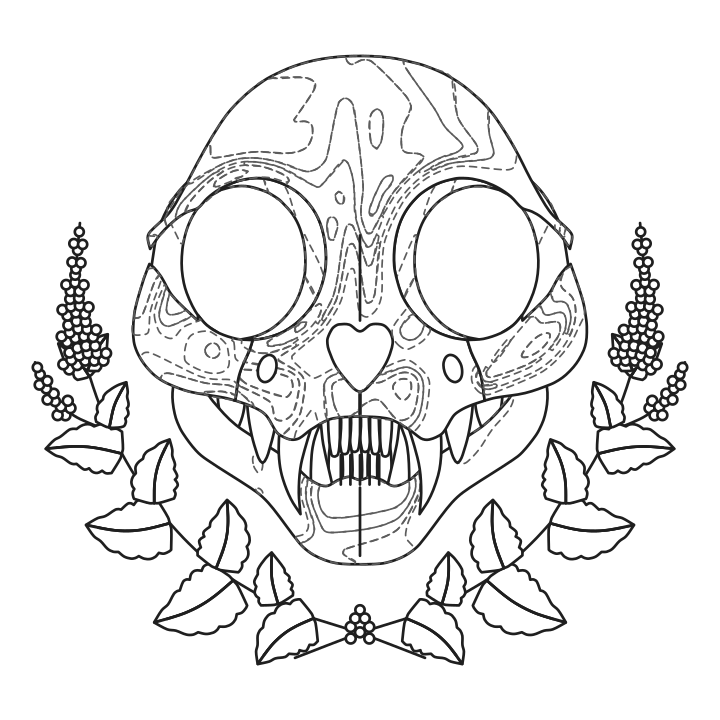
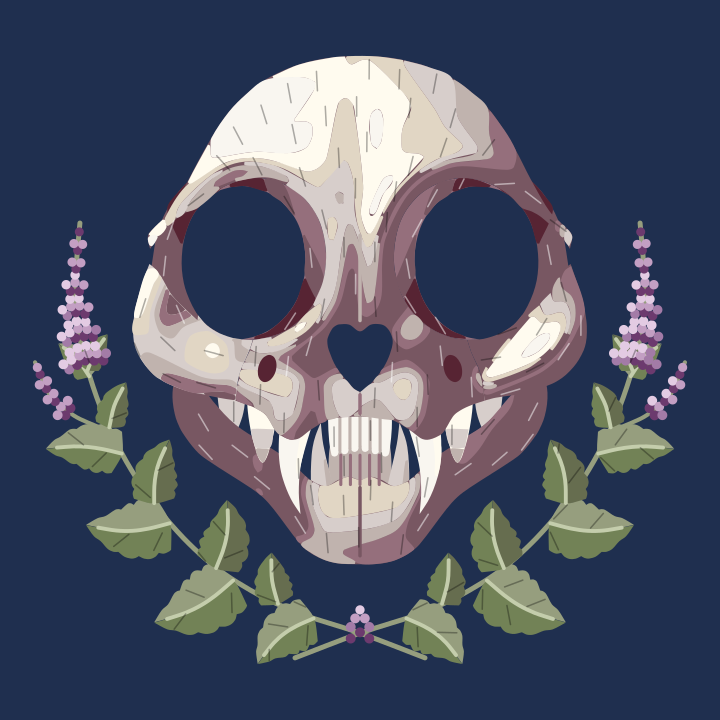
A number is a color of the list. Fine lines show which way the stitches lie: do not stitch them.
Download free PDFPDFPrints on US Letter and A4You may sell what you make from it by hand, in small quantities. The PDF itself is not to be sold or shared. Selling, classes and kits: the rules
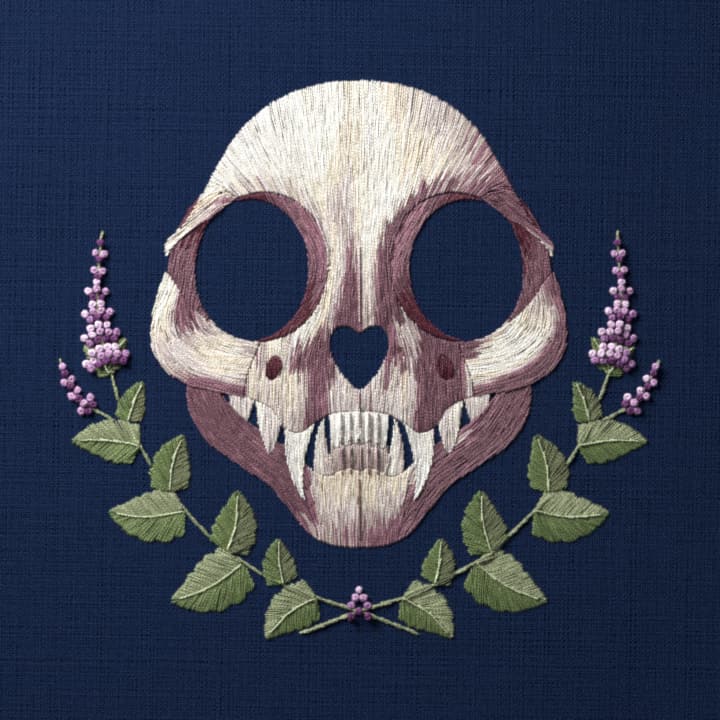
A cat’s skull looks straight out with huge round eye sockets, a heart-shaped nose opening and broad cheek arches, its lower jaw closed behind four curved canines.
Choose a size
| Hoop | Inches | Centimeters | Satin stitch up to |
|---|---|---|---|
| 3 in (8 cm) | 1.9 × 1.7 in | 4.8 × 4.3 cm | 1/8 in (3 mm) |
| 4 in (10 cm) | 2.8 × 2.6 in | 7.1 × 6.6 cm | 1/4 in (6 mm) |
| 5 in (13 cm) | 3.8 × 3.5 in | 9.7 × 8.9 cm | 5/16 in (8 mm) |
| 6 in (15 cm) | 4.7 × 4.4 in | 11.9 × 11.2 cm | 3/8 in (10 mm) |
| 8 in (20 cm) | 6.6 × 6.1 in | 16.8 × 15.5 cm | 1/2 in (13 mm) |
- In an 8 inch hoop the widest satin stitch shape is 1/2 in (13 mm) across. Satin stitches longer than about 12 mm (just under 1/2 in) tend to work loose: divide the shape into sections, or work it in long and short stitch.
- In a 3, 4 or 5 inch hoop the French knots are drawn smaller than about 2 mm (a little over 1/16 in). Use one strand of floss for them there, or choose a larger hoop.
Before you start
- New to this? Try an easy pattern first, or see how to read one.
- Print at actual size (100%, not “fit”). Dark fabric: trace with a white pencil over a bright light, or use a wash-away sheet. Then put it in the hoop, tight as a drum.
- Print at actual size (100%, not “fit”), tape the sheets and trace all of it. Hoop one part, stitch it, then move the hoop; raised parts and knots last.
- Floss has six strands: cut 18 inches (45 cm), pull out the number named one at a time, and lay them together.
- Start a filling with tiny stitches, a line with a small knot; end under stitches on the back.
- On the drawing a ring is one French knot; a broken line inside a shape is where two shades meet: trace it, do not stitch it.
What you need
- Hoop
- 6 in (15 cm), 4.7 × 4.4 in stitched. Another size
- Fabric
- Plain cotton or linen in indigo or another dark color, cut 9 in (23 cm) square.
- Needle
- Embroidery needle, size 9.
- Floss
- 16 colors of six-strand cotton. Skeins: one of each color is enough, an estimate for the 6 inch hoop from the drawing’s lines and shapes.
- Also
- White pencil, small scissors.
DMC is a brand, the number its color: another brand in a like color will do.
Threads and stitches
- 1DMC 522 Fern Green
- 2DMC 3363 Medium Pine Green
- 3DMC 524 Very Light Fern Green
- 4DMC 520 Dark Fern Green
- 5DMC 3837 Ultra Dark Lavender
- 6DMC 211 Light Lavender
- 7DMC 210 Medium Lavender
- 8DMC 209 Dark Lavender
- 9DMC 3740 Dark Antique Violet
- 10DMC 154 Very Dark Grape
- 11DMC 452 Medium Shell Gray
- 12DMC 453 Light Shell Gray
- 13DMC 3041 Medium Antique Violet
- 14DMC 3033 Very Light Mocha Brown
- 15DMC 712 Cream
- 16DMC 3865 Winter White
Stitch in this order
Where a stitch page says otherwise, follow this list.
- Stem stitch 3 strandsCatnip stems
- Satin stitch 2 strandsLeaves, small teeth, cheek teeth, small openings
- Long and short stitch 1 strandTemples, canine teeth, lower jaw, eye sockets, skull, cheekbones
- Stem stitch 1 strandLeaf veins
- Straight stitch 1 strandLines of the small teeth
- Split stitch 1 strandSeams
- French knot 2 strands, two wrapsCatnip flowers
Take out lines that still show, press face down, finish the hoop.
About this pattern
Advanced. Uses long and short stitch over much of the design, more than a hundred French knots, 16 colors and a great deal of stitching; from a 6 inch hoop up the widest satin stitches are long.
The bone and canines are worked in long and short stitch, shaded from cream through warm gray to mauve, with fine split stitch seams. The small front teeth and the notched catnip leaves are satin stitch, the stems and leaf veins are stem stitch, and the lilac flowers are French knots. The sockets and the nose are left as bare indigo cloth.
1 DMC 522: leaves (light), catnip stems. 2 DMC 3363: leaves (middle). 3 DMC 524: leaf veins. 4 DMC 520: leaves (dark). 5 DMC 3837: catnip flowers (darkest). 6 DMC 211: catnip flowers (lightest). 7 DMC 210: catnip flowers (light). 8 DMC 209: catnip flowers (dark). 9 DMC 3740: skull and cheekbones (shade 1 of 7), lower jaw (darkest), temples (lighter), eye sockets (middle), seams (dark). 10 DMC 154: temples (darker), eye sockets (dark), small openings. 11 DMC 452: skull and cheekbones (shade 3 of 7), small teeth and lower jaw (middle), canine teeth (darkest), seams (light), cheek teeth (dark). 12 DMC 453: skull and cheekbones (shade 4 of 7), canine teeth (dark), cheek teeth (middle), lower jaw (light). 13 DMC 3041: eye sockets (light), skull and cheekbones (shade 2 of 7), lower jaw and small teeth (dark), seams (middle). 14 DMC 3033: skull and cheekbones (shade 5 of 7), lower jaw (lightest). 15 DMC 712: skull and cheekbones (shade 7 of 7), cheek teeth (light), canine teeth (lightest). 16 DMC 3865: skull and cheekbones (shade 6 of 7), canine teeth and small teeth (light).
A guide to this kind of work: Stitches for fur, hair and feathers.
More patterns like this
Skull with amethyst eyes
Advanced 3 to 8 in hoop 23 colors
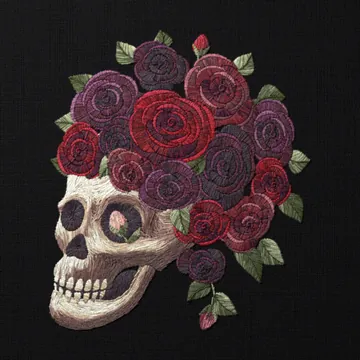
Gothic skull with dark roses
Advanced 3 to 8 in hoop 23 colors
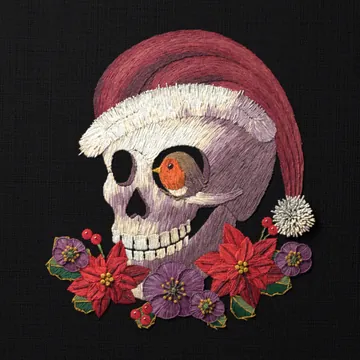
Skull with Santa hat and poinsettias
Advanced 3 to 8 in hoop 20 colors
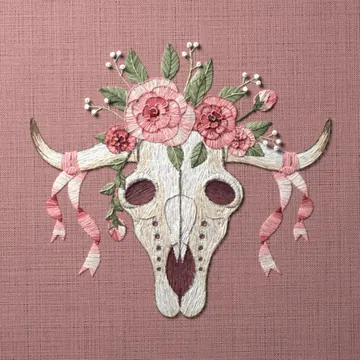
White longhorn skull with ribbon roses
Advanced 3 to 8 in hoop 17 colors
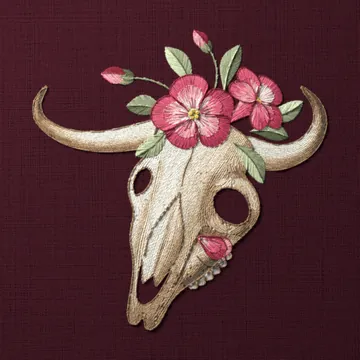
Cow skull with desert roses
Advanced 3 to 14 in 15 colors
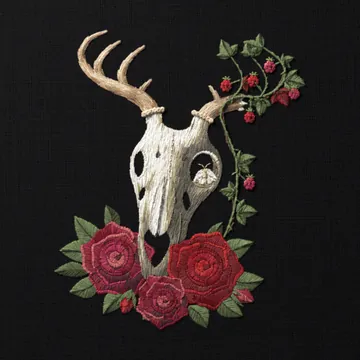
Deer skull and roses
Advanced 3 to 8 in hoop 22 colors
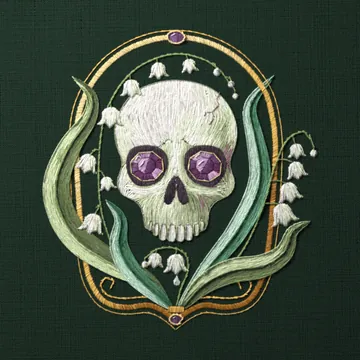
Lily of the valley skull, amethyst eyes
Advanced 3 to 14 in 22 colors
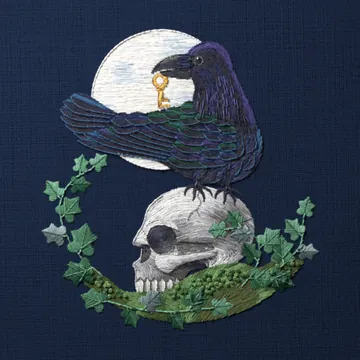
Crow on a skull in moonlight
Advanced 3 to 8 in hoop 24 colors
New to hand embroidery? Starting hand embroidery, step by step