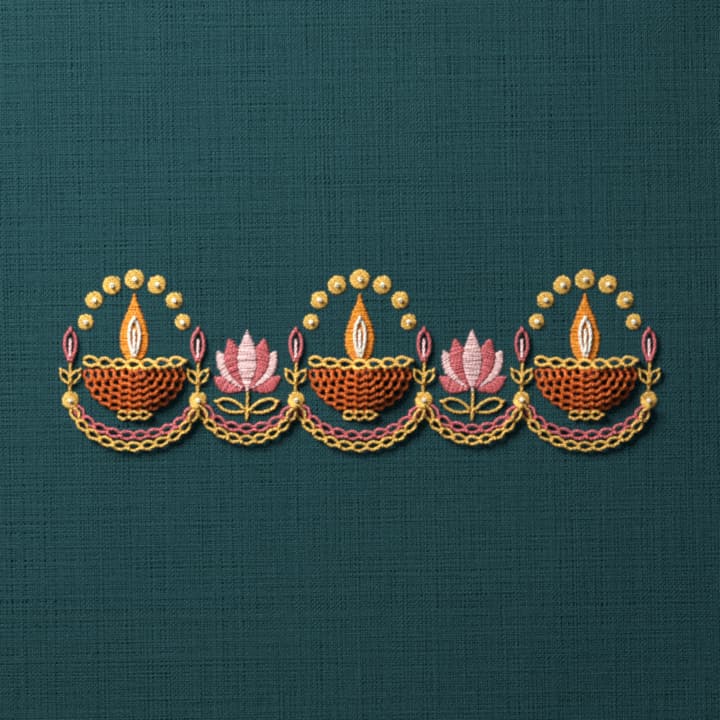
Diwali diya border with sequins on teal hand embroidery pattern
Easy · 6 colors · 4.7 × 1.4 in · 6 kinds of stitch
Download free PDFPDFPrints on US Letter and A4You may sell what you make from it by hand, in small quantities. The PDF itself is not to be sold or shared. Selling, classes and kits: the rulesNew to it? Next: how to start
Three lit clay lamps hang in deep scallops, with an open lotus in each shallow scallop between and a pink bud at every point.
Size and details
Easy. Line stitches and loops and French knots, with some short satin stitches.
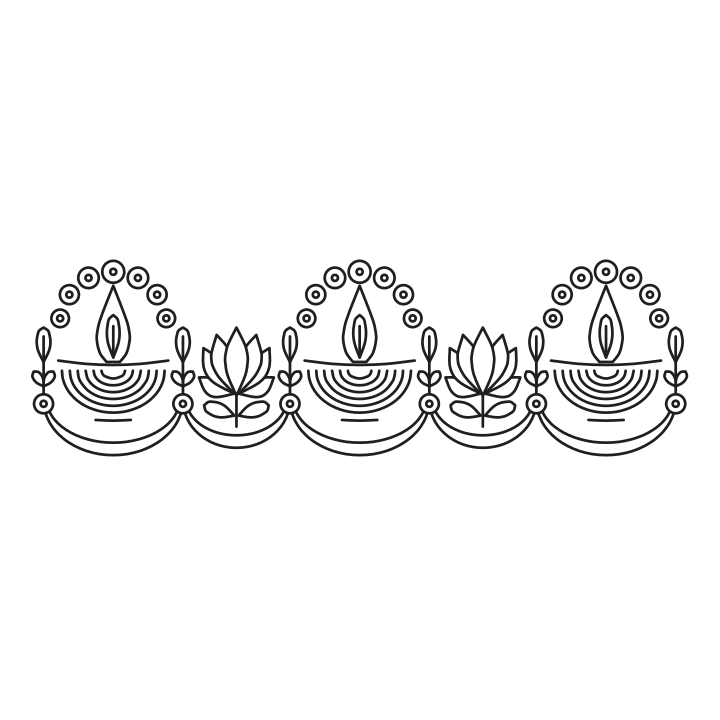
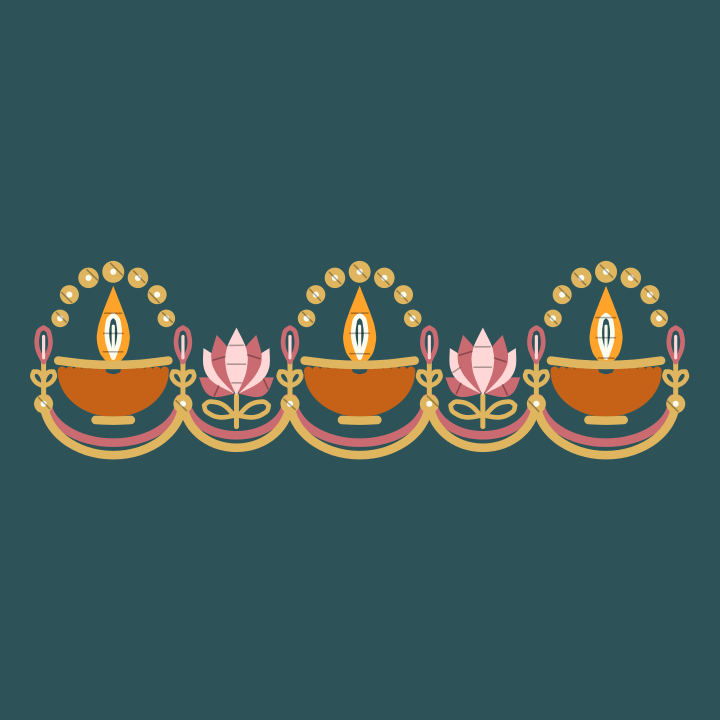
The bowls, their gold rims and the double scalloped edge are rows of chain stitch; the flames are satin stitch with an ivory lazy daisy stitch at the heart. Lotus petals are satin stitch in two pinks, buds and leaves are lazy daisy stitch, and stems are stem stitch. Each gold sequin is drawn as a flat satin stitch spot with an ivory French knot in the middle: work it in thread, or sew on a real sequin held by a small bead, or make a single large knot. To carry the band on, lay the first lamp of the next length over the last lamp of this one and the scallops run on without a break. It is drawn for teal linen. In the picture of where the colors go, the fine lines show which way the stitches lie.
| Hoop | Inches | Centimeters | Satin stitch up to |
|---|---|---|---|
| 3 in (8 cm) | 1.9 × 0.6 in | 4.8 × 1.5 cm | 1/16 in (1.6 mm) |
| 4 in (10 cm) | 2.8 × 0.9 in | 7.1 × 2.3 cm | 1/8 in (3 mm) |
| 5 in (13 cm) | 3.7 × 1.1 in | 9.4 × 2.8 cm | 3/16 in (5 mm) |
| 6 in (15 cm) | 4.7 × 1.4 in | 11.9 × 3.6 cm | 1/4 in (6 mm) |
| 8 in (20 cm) | 6.5 × 2 in | 16.5 × 5.1 cm | 5/16 in (8 mm) |
- In a 3, 4 or 5 inch hoop the French knots are drawn smaller than about 2 mm (a little over 1/16 in). Use one strand of floss for them there, or choose a larger hoop.
- In a 3 inch hoop the shortest lazy daisy loops are drawn smaller than about 2 mm (a little over 1/16 in). Use one strand of floss for them there, or choose a larger hoop.
On a towel. Wash and dry the towel first. To start with, put the bottom of the design 2 to 3 inches (5 to 7.5 cm) above the hem, in the middle or in a lower corner. Keep the stitches low, and press from the back. How to embroider a towel has every step, and the placement chart has the figures for other towels.
On linens. Wash and press the piece first. A pillowcase takes its design in the middle of the hem band; a napkin or a handkerchief in one corner, set on the diagonal. Keep the stitches short and low, and press face down on soft cloth. How to embroider pillowcases and napkins has the sizes and the places.
What you need
- Fabric
- Plain cotton or linen in teal, cut 9 in (23 cm) square. On white cloth its palest threads do not show: choose other colors under Options. A pencil line does not show on it: see how to transfer a pattern to dark fabric.
- Needle
- Embroidery needle, size 9 for 1 strand, size 7 for 2 or 3, size 5 for 4 (a lower number is a thicker needle).
- Floss
- 6 colors of six-strand cotton, listed below. DMC is a brand: another brand in a like color will do.
- Marker
- A pen or a sheet that suits the fabric: how to transfer a pattern says which.
Floss
- 1DMC 3687 MauveLotus petals, scalloped edge and buds (darker)
- 2DMC 3820 Dark StrawSequins, lamp rims, stems and bud leaves, scalloped edge (lighter) and 2 more parts
- 3DMC 963 Ultra Very Light Dusty RoseLotus petals and buds (lighter)
- 4DMC 741 Medium TangerineFlames
- 5DMC 746 Off WhiteFlame hearts and sequin centers
- 6DMC 921 CopperLamp bowls
Skeins: one of each color is enough. An estimate for the 6 inch hoop, from the length of each line and the area of each filled shape, with a fifth added for tails.
How to stitch it
- New to hand embroidery? Start here.
- Print at 100%, trace the pattern onto the fabric, and put it in the hoop: inner ring under, drawing up, tight as a drum.
- Floss is six strands. Cut 18 inches (45 cm), pull out the number given one at a time, and lay them together.
- Begin with no knot on the back where it is seen and washed, as on a towel, a napkin or clothes; for a piece in a hoop a small knot is fine. End each thread by whipping it around the backs of four or five stitches, with one small hitch.
- Each small ring is one French knot. Each small loop is one lazy daisy: come up at its point.
- A number under “Where colors go” is a color of the list. The fine lines on the colors show which way the stitches lie.
Stitch in this order
Filled parts from the back of the picture forward, then lines, loops and knots. Where a stitch page names another number of strands, use the number here.
- Satin stitch2 strands: lotus petals, flames1 strand: sequins
- Chain stitch4 strands: lamp bowls, lamp rims3 strands: scalloped edge, lamp feet
- Stem stitch 3 strandsStems
- Straight stitch 3 strandsFlame hearts, buds
- Lazy daisy stitch4 strands: flame hearts, buds3 strands: lotus leaves2 strands: bud leaves
- French knot 1 strand, two wrapsSequin centers
When it is done, take off any lines that still show and finish the hoop. A guide to this kind of work: How to embroider a saree.
More patterns like this
Easy prints 3–14 in · 6 colors
Small Diwali rangoli with diya lamps
Easy 3–8 in hoop · 7 colors
Folk candle bookmark in red and black
Easy 3–8 in hoop · 5 colors
Light bulb with a daisy filament
Easy 3–8 in hoop · 7 colors
Dark academia bookmark
Easy prints 3–14 in · 5 colors
Easy gold butta motif
Easy 3–8 in hoop · 6 colors
Kasuti style saree border with parrots
Intermediate 3–8 in hoop · 8 colors
Paisley cutwork border for a saree
Intermediate prints 3–14 in · 5 colors
Phulkari square for a Punjabi suit
New to hand embroidery? Starting hand embroidery, step by step