Dream catcher with natural feathers hand embroidery pattern
Intermediate · 20 colors · 5 kinds of stitch
Download free PDFPDF, US Letter · 43 KBFor your own stitching, gifts and handmade pieces you sell. Do not resell or share this PDF or copies of it. Selling, classes and kits: the rules
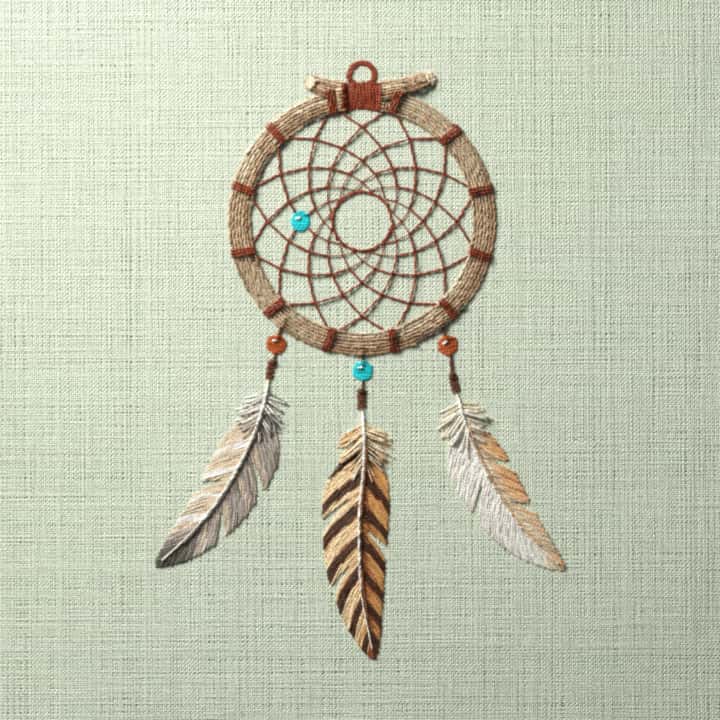
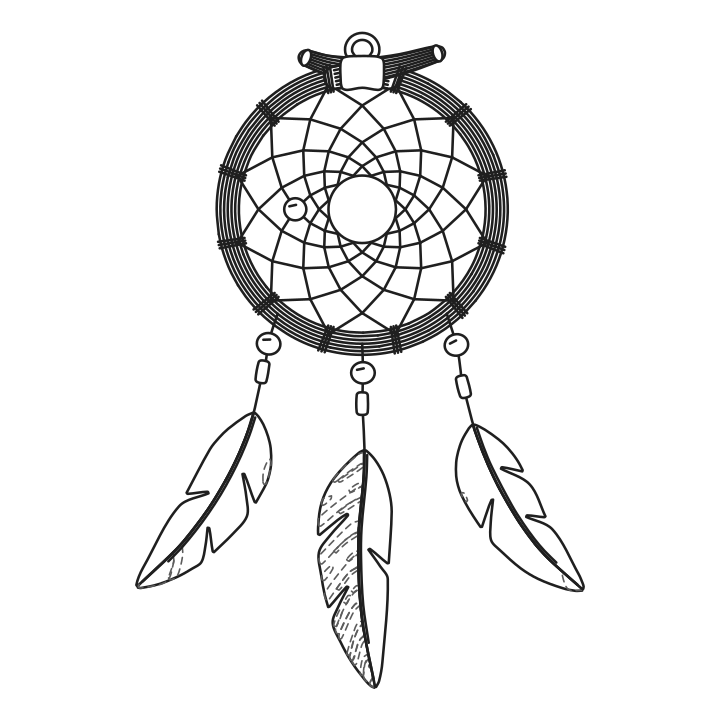
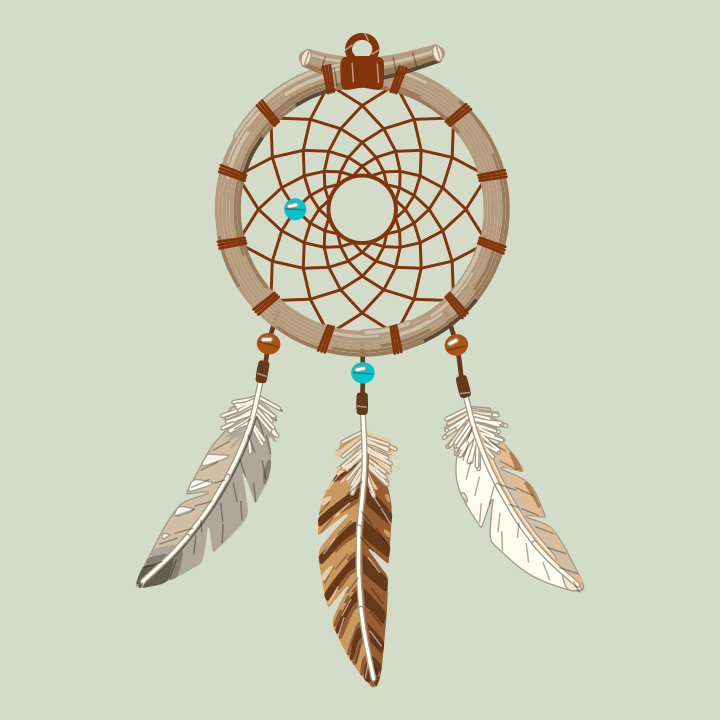
The dream catcher began with the Ojibwe people, and this one is drawn plainly. A willow rod is bent round in close rows of stem and split stitch, and its two crossed ends are bound at the top with satin stitch. The russet net is straight stitch, narrowing inward to a small open ring, with one turquoise bead caught in it. Three feathers in long and short stitch hang fanned below: dove gray to the left, barred brown in the middle, warm cream to the right. Split stitch makes each pale shaft, and short straight stitches splay into soft down at the quill. It is drawn for sage green linen. In the picture of where the colors go, the fine lines show which way the stitches lie.
Size and details
Intermediate. Uses long and short stitch and 20 colors.
20 colors of floss and 5 kinds of stitch:
| Hoop | Inches | Centimeters | Satin stitch up to |
|---|---|---|---|
| 3 in (8 cm) | 1.3 × 2 in | 3.3 × 5.1 cm | 1/8 in (3 mm) |
| 4 in (10 cm) | 2 × 3 in | 5.1 × 7.6 cm | 1/8 in (3 mm) |
| 5 in (13 cm) | 2.7 × 3.9 in | 6.9 × 9.9 cm | 3/16 in (5 mm) |
| 6 in (15 cm) | 3.4 × 4.9 in | 8.6 × 12.4 cm | 1/4 in (6 mm) |
| 8 in (20 cm) | 4.7 × 6.9 in | 11.9 × 17.5 cm | 3/8 in (10 mm) |
The pattern is drawn inside a circle about half an inch (1.3 cm) smaller all around than the hoop.
What you need
- 1DMC 801 Dark Coffee BrownBarred feather (dark), thongs and thong wraps
- 2DMC 918 Dark Red CopperNet, twine wraps, binding and hanging loop
- 3DMC 841 Light Beige BrownHoop and hoop ends (light)
- 4DMC 840 Medium Beige BrownHoop and hoop ends (dark)
- 5DMC 838 Very Dark Beige BrownHoop and hoop ends (darkest)
- 6DMC 842 Very Light Beige BrownGray feather (light), cream feather (dark), hoop (lightest) and 2 more parts
All it stitches
Gray feather (light), cream feather and cream feather down (dark), hoop and hoop ends (lightest) - 7DMC 739 Ultra Very Light TanBarred feather down and cream feather (light), cream feather down (middle), cut ends
- 8DMC 646 Dark Beaver GrayGray feather down and gray feather (dark)
- 9DMC 647 Medium Beaver GrayGray feather and gray feather down (middle)
- 10DMC 3865 Winter WhiteGray feather down (light), gray feather (lightest), bead lights
- 11DMC 3787 Dark Brown GrayGray feather shaft (darker), gray feather (darkest)
- 12DMC 712 CreamCream feather (lightest), cream feather down (light) and 3 more parts
All it stitches
Cream feather (lightest), cream feather down (light), barred feather shaft, gray feather shaft and cream feather shaft (lighter) - 13DMC 436 TanBarred feather (light), barred feather down (dark)
- 14DMC 738 Very Light TanBarred feather down (middle), barred feather (lightest)
- 15DMC 434 Light BrownBarred feather (middle), barred feather shaft (darker)
- 16DMC 898 Very Dark Coffee BrownBarred feather (darkest)
- 17DMC 435 Very Light BrownCream feather (darkest)
- 18DMC 437 Light TanCream feather (middle), cream feather shaft (darker)
- 19DMC 3845 Medium Bright TurquoiseBeads (lighter)
- 20DMC 920 Medium CopperBeads (darker)
Skeins: one of each color is enough. An estimate for the 8 inch hoop, from the length of each line and the area of each filled shape, with a fifth added for tails.
The floss is six-strand cotton; the stitch guide says how many strands to use. You also need a hoop, an embroidery needle (a size 9 or 10 for one strand, 7 to 9 for two or three) and plain cotton or linen fabric, in sage green, the color it is drawn for. To frame the piece in its hoop, cut a square 3 inches (8 cm) wider than the hoop: a 9 inch (23 cm) square for a 6 inch hoop.
When it is stitched, how to finish a hoop shows how to back it for the wall.
Stitch guide
- Put the pattern on the fabric (how to transfer a pattern) and the fabric in the hoop.
- Stitch the filled parts first, what lies behind before what lies in front of it.
- Then stitch the lines: stems, veins and outlines over the edges of the filled parts.
Inside a filled shape start with two or three tiny stitches, which the filling covers: a knot shows as a bump. A line may start with a small knot on the back or one of the knotless starts. End each thread by running the needle under the backs of a few stitches. (Starting and ending a thread shows how.) Use the strands this list gives, and begin as it says, also where a page about a stitch names another number or begins with a knot.
- Stem stitch 1 to 3 strands3 strands: thongs2 strands: net, hoop, hoop ends1 strand: gray feather shaft, barred feather shaft, cream feather shaft
- Straight stitch 1 to 2 strands2 strands: twine wraps, bead lights1 or 2 strands: net1 strand: gray feather down, barred feather down, cream feather down
- Split stitch 1 to 3 strands1 to 3 strands: gray feather shaft, barred feather shaft, cream feather shaft2 strands: hoop, hoop ends
- Satin stitch 2 strandsHoop ends, cut ends, hanging loop, binding, thong wraps, beads
- Long and short stitch 1 strandGray feather, barred feather, cream feather
Getting it onto your fabric
The PDF holds the pattern twice at actual size: once as drawn, and once mirrored for an iron-on transfer pen. Print it at 100% with scaling off and check the one-inch square (25.4 mm) with a ruler before you trace. How to transfer a pattern explains tracing, carbon paper, the sticky wash-away sheet for knits, denim and dark cloth, and the other ways. The files are under Downloads.
Downloads
- Download free PDF PDF, US Letter, 3 pages, for a 6 inch (15 cm) hoop
- Download free PDF, A4 PDF, A4, 3 pages, for a 6 inch (15 cm) hoop
More patterns like this
Intermediate prints 3–14 in · 14 colors
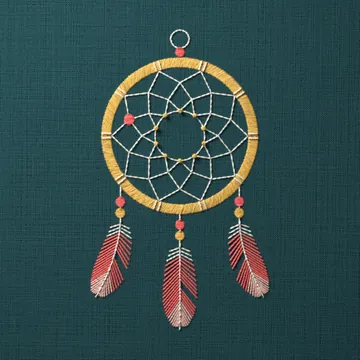
Boho dreamcatcher for a jacket
Easy 3–8 in hoop · 4 colors
Small easy dreamcatcher for cards
Advanced prints 3–14 in · 18 colors
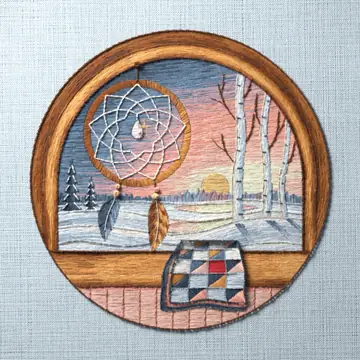
Dreamcatcher in a snowy window
Advanced 3–8 in hoop · 20 colors
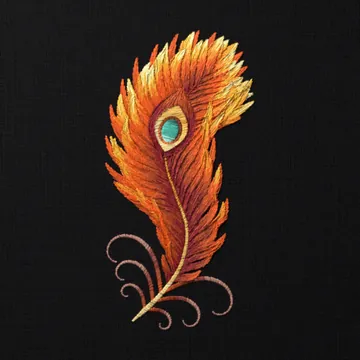
Orange and gold eye feather
Advanced 3–8 in hoop · 21 colors
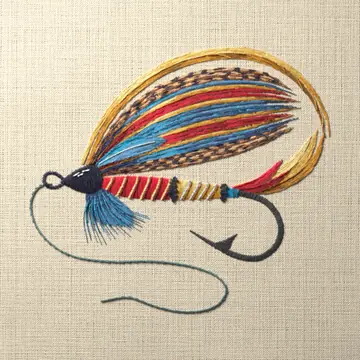
Feather wing salmon fly
Advanced 3–8 in hoop · 22 colors
Scroll banner with quill and ink
Intermediate prints 3–14 in · 11 colors
Peacock feathers in a curling sweep
Advanced 3–8 in hoop · 23 colors
Arrow with three hanging feathers
New to hand embroidery? Starting hand embroidery, step by step