Easy buffalo head with a meadowlark hand embroidery pattern
Easy · 7 colors · 5 kinds of stitch
Download free PDFPDF, US Letter · 79 KBFor your own stitching, gifts and handmade pieces you sell. Do not resell or share this PDF or copies of it. Selling, classes and kits: the rules
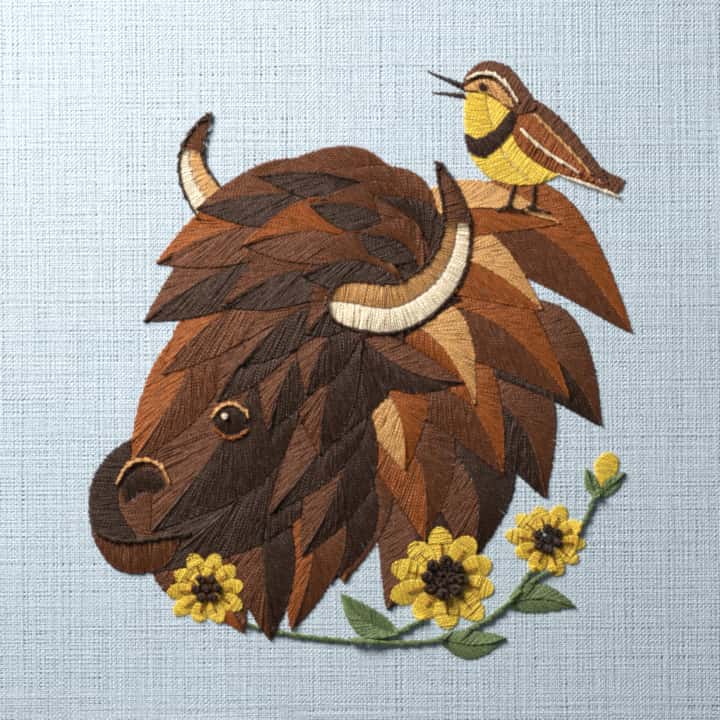
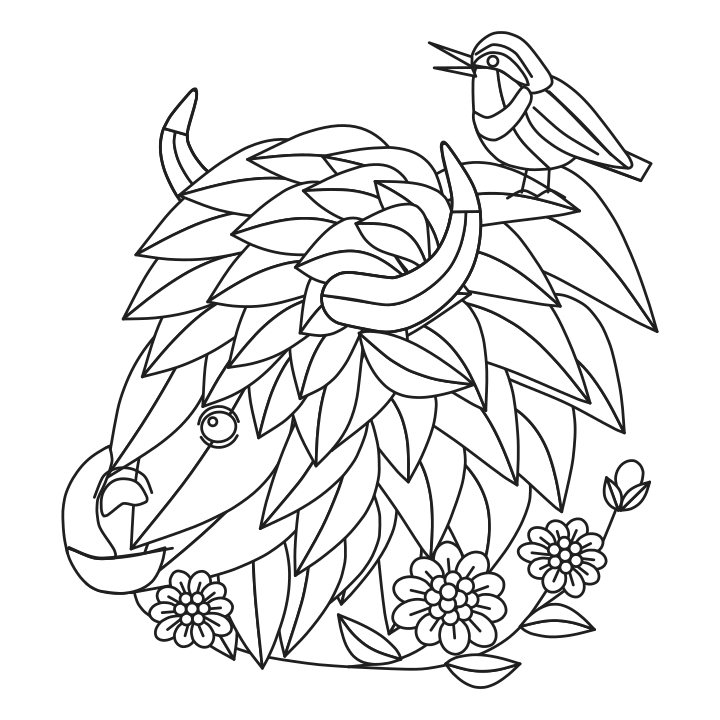
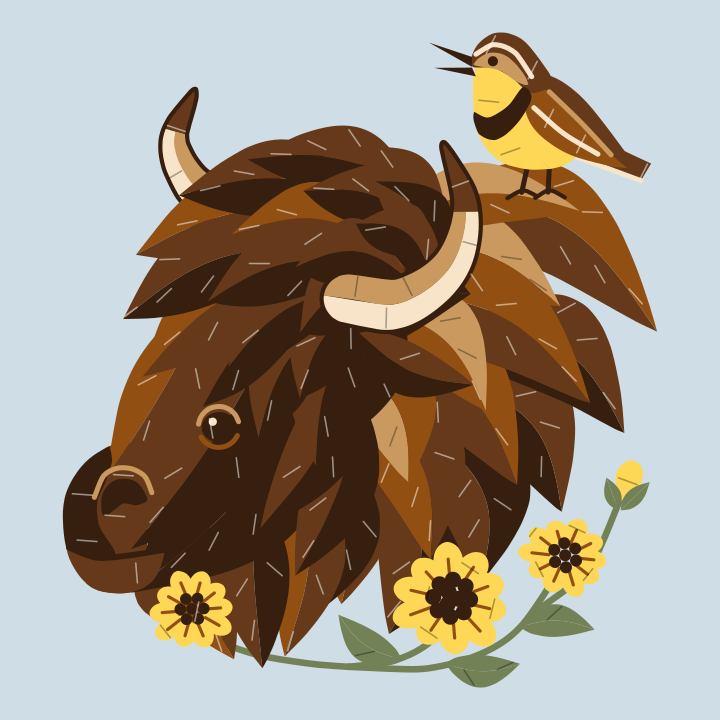
A calm buffalo stands side on against the sky while a meadowlark sings from its hump. The crown, face, beard and cape are large locks of fishbone stitch, each with a lighter half and a darker half, so the shaggy coat takes shape one lock at a time. The horns, nose, bird and petals are short satin stitch, with stem stitch for the stalks, eyelids and horn edges, French knots in the flower hearts and the eyes, and a straight stitch in each petal. It suits a tote bag, a pouch or a hoop. It is drawn for pale blue linen. In the picture of where the colors go, the fine lines show which way the stitches lie.
Size and details
Easy. In a hoop of 6 inches or less: short satin stitches, no shading; in a larger hoop the widest satin stitches are long.
7 colors of floss and 5 kinds of stitch:
| Hoop | Inches | Centimeters | Satin stitch up to |
|---|---|---|---|
| 3 in (8 cm) | 1.7 × 1.8 in | 4.3 × 4.6 cm | 1/8 in (3 mm) |
| 4 in (10 cm) | 2.5 × 2.8 in | 6.4 × 7.1 cm | 3/16 in (5 mm) |
| 5 in (13 cm) | 3.3 × 3.7 in | 8.4 × 9.4 cm | 1/4 in (6 mm) |
| 6 in (15 cm) | 4.2 × 4.6 in | 10.7 × 11.7 cm | 5/16 in (8 mm) |
| 8 in (20 cm) | 5.8 × 6.4 in | 14.7 × 16.3 cm | 7/16 in (11 mm) |
- In a 3, 4 or 5 inch hoop the French knots are drawn smaller than about 2 mm (a little over 1/16 in). Use one strand of floss for them there, or choose a larger hoop.
The pattern is drawn inside a circle about half an inch (1.3 cm) smaller all around than the hoop.
What you need
- DMC 3363 Medium Pine GreenLeaves and stems
- DMC 801 Dark Coffee BrownBonnet, face and beard (middle), cape (dark), cheek wool (lighter) and 7 more parts
- DMC 938 Ultra Dark Coffee BrownBonnet, face and beard (dark), cape (darkest), cheek wool (darker) and 10 more parts
- DMC 975 Dark Golden BrownCape, bonnet, beard and face (light), wing and petal folds, eyelids (darker)
- DMC 436 TanCape (lightest), horns and wing bars (darker), cheek and nostril rim, eyelids (lighter)
- DMC 739 Ultra Very Light TanHorns and wing bars (lighter), tail edge, eyebrow and eye light
- DMC 726 Light TopazFlower petals, breast and bud
Skeins: 3 for bonnet, face and beard (middle), cape (dark), cheek wool (lighter) and 7 more parts and 2 for bonnet, face and beard (dark), cape (darkest), cheek wool (darker) and 10 more parts; one of each other color. An estimate for the largest size, the 8 inch hoop: the length of each line and the area of each filled shape, a fifth added for tails and ends, a tenth of every 8 m (8.7 yd) skein kept spare.
The floss is six-strand cotton; the stitch guide says how many strands to use. You also need a hoop, an embroidery needle (a size 9 or 10 for one strand, 7 to 9 for two or three, and 3 to 5 for four or more) and plain cotton or linen fabric. To frame the piece in its hoop, cut a square 3 inches (8 cm) wider than the hoop: a 9 inch (23 cm) square for a 6 inch hoop.
When it is stitched, how to finish a hoop shows how to back it for the wall.
Stitch guide
- Put the pattern on the fabric (how to transfer a pattern) and the fabric in the hoop.
- Stitch the filled parts first, what lies behind before what lies in front of it.
- Then stitch the lines: stems, veins and outlines over the edges of the filled parts.
- Keep the knots for the end, so that the hoop and your hand do not flatten them.
Inside a filled shape start with two or three tiny stitches, which the filling covers: a knot shows as a bump. A line may start with a small knot on the back or one of the knotless starts. End each thread by running the needle under the backs of a few stitches. (Starting and ending a thread shows how.) Use the strands this list gives, and begin as it says, also where a page about a stitch names another number or begins with a knot.
- Stem stitch 2 to 5 strandsStems, horn edges, eyelids, nostril rim, mouth, legs, tail edge, wing bars, eyebrow
- Fishbone stitch 3 to 4 strandsCape, beard, face, cheek wool, bonnet, ear, leaves
- Satin stitch 3 strandsHorns, horn tips, muzzle, lower lip, nose, eye, nostril, tail, breast, back, wing, head, cheek, bib, bill, flower petals, bud
- French knot 1 to 3 strands, two wrapsEye light, eye, flower hearts
- Straight stitch 1 strandPetal folds
Getting it onto your fabric
The PDF holds the pattern twice at actual size: once as drawn, and once mirrored for an iron-on transfer pen. Print it at 100% with scaling off and check the one-inch square (25.4 mm) with a ruler before you trace. How to transfer a pattern explains tracing, carbon paper, the sticky wash-away sheet for knits, denim and dark cloth, and the other ways. The files are under Downloads.
Downloads
- Download free PDF PDF, US Letter, 3 pages, for a 6 inch (15 cm) hoop
- Download free PDF, A4 PDF, A4, 3 pages, for a 6 inch (15 cm) hoop
More patterns like this
Advanced 3–8 in hoop · 18 colors
Buffalo in the snow
Advanced prints 3–14 in · 18 colors
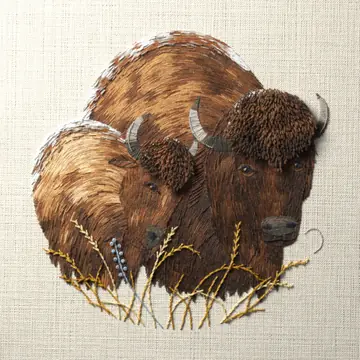
Buffalo couple in winter grass
Advanced 3–8 in hoop · 15 colors
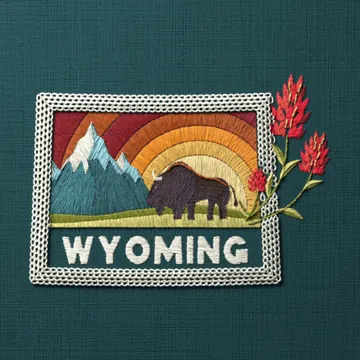
Wyoming outline with its name
Easy prints 3–14 in · 7 colors
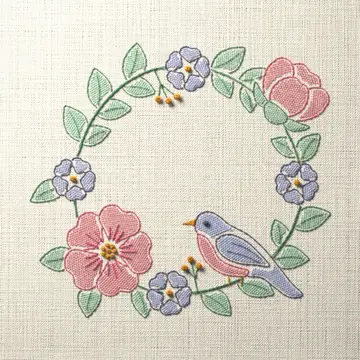
Easy pastel shadow work look wreath
Easy 3–8 in hoop · 7 colors
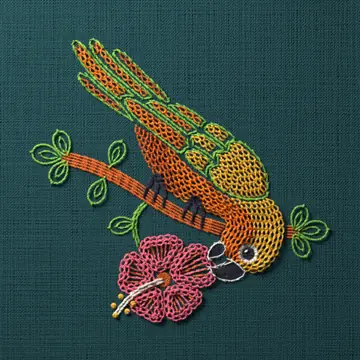
Easy sun conure parrot with a hibiscus
Intermediate 3–8 in hoop · 6 colors
Mexican folk animals and flowers
Intermediate 3–8 in hoop · 6 colors
One line animal border
Easy 3–8 in hoop · 6 colors
Three baby owls on a branch
New to hand embroidery? Starting hand embroidery, step by step