Easy mimosa with orange blossoms hand embroidery pattern
Easy · 6 colors · 6 kinds of stitch
Download free PDFPDF, US Letter · 35 KBFor your own stitching, gifts and handmade pieces you sell. Do not resell or share this PDF. What you may do, in full
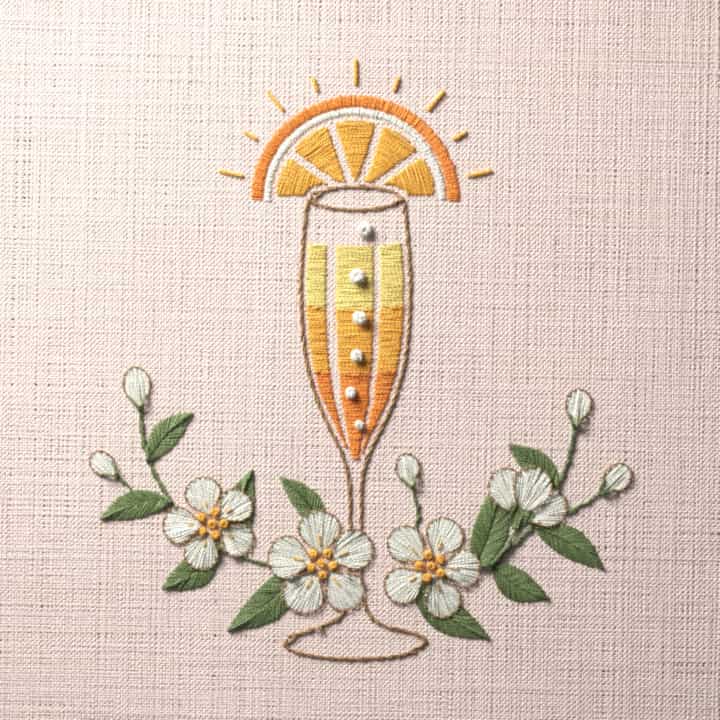
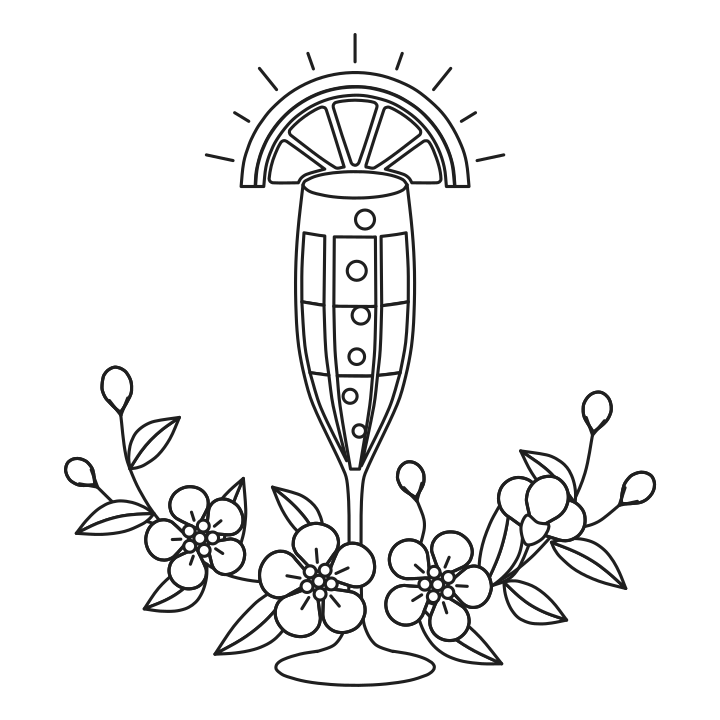
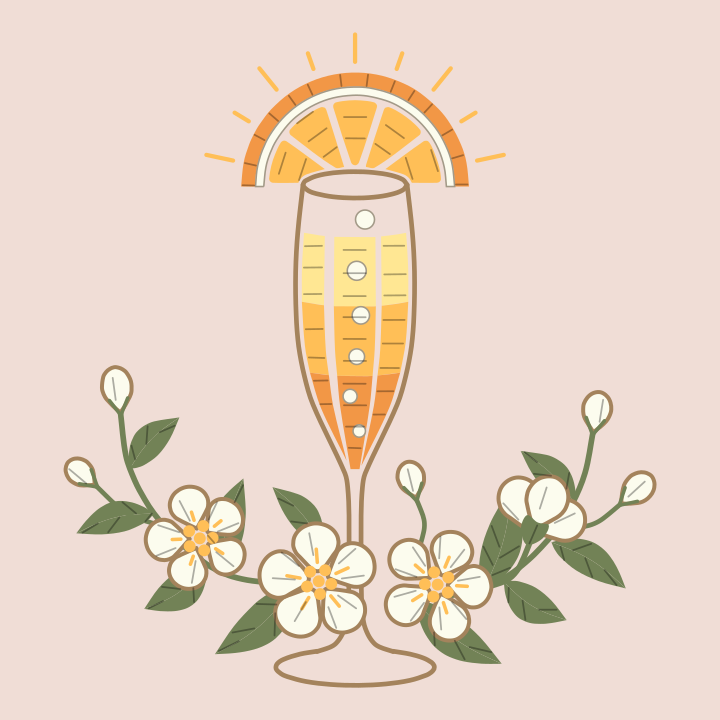
A tulip flute of mimosa stands in a low crescent of orange blossom, with half an orange slice and short gold rays rising behind its rim. The drink is satin stitch in three bands, pale gold to apricot, with narrow streaks of bare cloth for the light and French knot bubbles in one rising line. The petals, buds and slice are satin stitch, the petals edged in back stitch with French knot hearts. The leaves are fishbone stitch, and the glass and sprigs are stem stitch. In the picture of where the colors go, the fine lines show which way the stitches lie.
Size and details
Easy. In a hoop of 6 inches or less: short satin stitches, no shading; in a larger hoop the widest satin stitches are long.
6 colors of floss and 6 kinds of stitch:
| Hoop | Inches | Centimeters | Satin stitch up to |
|---|---|---|---|
| 3 in (8 cm) | 1.5 × 1.6 in | 3.8 × 4.1 cm | 1/8 in (3 mm) |
| 4 in (10 cm) | 2.2 × 2.5 in | 5.6 × 6.4 cm | 3/16 in (5 mm) |
| 5 in (13 cm) | 3 × 3.3 in | 7.6 × 8.4 cm | 1/4 in (6 mm) |
| 6 in (15 cm) | 3.7 × 4.1 in | 9.4 × 10.4 cm | 5/16 in (8 mm) |
| 8 in (20 cm) | 5.2 × 5.7 in | 13.2 × 14.5 cm | 7/16 in (11 mm) |
- In a 3, 4 or 5 inch hoop the French knots are drawn smaller than about 2 mm (a little over 1/16 in). Use one strand of floss for them there, or choose a larger hoop.
The pattern is drawn inside a circle about half an inch (1.3 cm) smaller all around than the hoop.
What you need
- DMC 3853 Dark Autumn GoldOrange slice rind, mimosa (dark)
- DMC 746 Off WhitePetals, buds, orange slice pith and bubbles
- DMC 742 Light TangerineOrange segments, blossom hearts, sunrise rays and petal folds, mimosa (middle)
- DMC 744 Pale YellowMimosa (light)
- DMC 3863 Medium Mocha BeigePetal edges and glass
- DMC 3363 Medium Pine GreenLeaves, sprigs and bud cups
Skeins: one of each color is enough. An estimate for the largest size, the 8 inch hoop: the length of each line and the area of each filled shape, a fifth added for tails and ends, a tenth of every 8 m (8.7 yd) skein kept spare.
The floss is six-strand cotton; the stitch guide says how many strands to use. You also need a hoop, an embroidery needle (a size 7 to 9 suits two or three strands) and plain cotton or linen fabric. To frame the piece in its hoop, cut a square 3 inches (8 cm) wider than the hoop: a 9 inch (23 cm) square for a 6 inch hoop.
When it is stitched, how to finish a hoop shows how to back it for the wall.
Stitch guide
- Put the pattern on the fabric (how to transfer a pattern) and the fabric in the hoop.
- Stitch the filled parts first, what lies behind before what lies in front of it.
- Then stitch the lines: stems, veins and outlines over the edges of the filled parts.
- Keep the knots for the end, so that the hoop and your hand do not flatten them.
Start each thread with a small knot on the back or one of the knotless starts, and end it by running the needle under the backs of a few stitches (starting and ending a thread). Use the strands this list gives, also where a page about a stitch names another number.
- Satin stitch 2 strandsOrange slice rind, orange slice pith, orange segments, mimosa, buds, petals, bud cups
- Straight stitch 1 to 4 strandsSunrise rays, bud cups, petal folds
- Stem stitch 2 to 3 strandsGlass, sprigs
- French knot 2 strands, two wrapsBubbles, blossom hearts
- Fishbone stitch 2 strandsLeaves
- Back stitch 1 strandPetal edges
Getting it onto your fabric
The PDF holds the pattern twice at actual size: once as drawn, and once mirrored for an iron-on transfer pen. Print it at 100% with scaling off and check the one-inch square (25.4 mm) with a ruler before you trace. How to transfer a pattern explains tracing, carbon paper and the other ways. The files are under Downloads.
Downloads
- Download free PDF PDF, US Letter, 3 pages, for a 6 inch (15 cm) hoop
- Download free PDF, A4 PDF, A4, 3 pages, for a 6 inch (15 cm) hoop
More patterns like this
Easy 3–8 in hoop · 7 colors
Easy vintage martini napkin corner
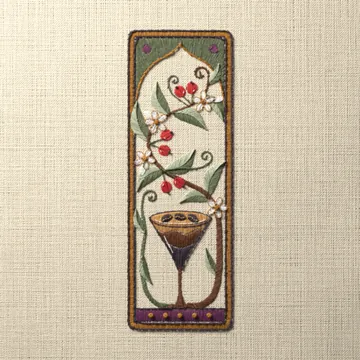
Advanced 3–8 in hoop · 9 colors
Espresso martini bookmark
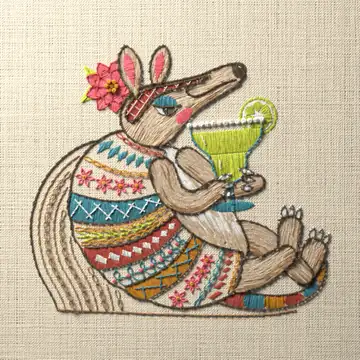
Advanced 3–8 in hoop · 9 colors
Funny armadillo with a margarita
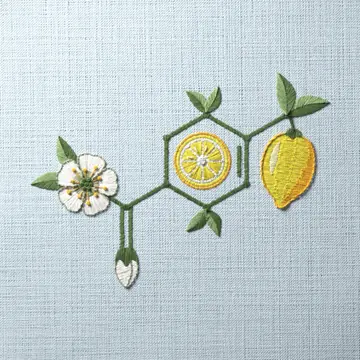
Easy 3–8 in hoop · 7 colors
Lemon molecule towel, small and easy
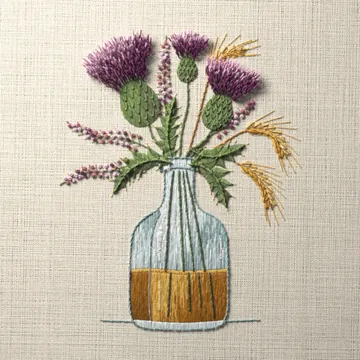
Advanced 3–8 in hoop · 14 colors
Whiskey bottle with thistles
Intermediate 3–8 in hoop · 5 colors
Lemon and blossom ring
Advanced 3–8 in hoop · 5 colors
Wheel of six lemon slices
Advanced 3–8 in hoop · 15 colors
Christmas martini in a mistletoe wreath
New to hand embroidery? Starting hand embroidery, step by step