Letters made of garden things hand embroidery pattern
Intermediate · 10 colors · 26 letters and & · 3.9 in tall
Download letter A (free PDF)PDFPrints on US Letter and A4You may sell what you make from it by hand, in small quantities. The PDF itself is not to be sold or shared. Selling, classes and kits: the rules
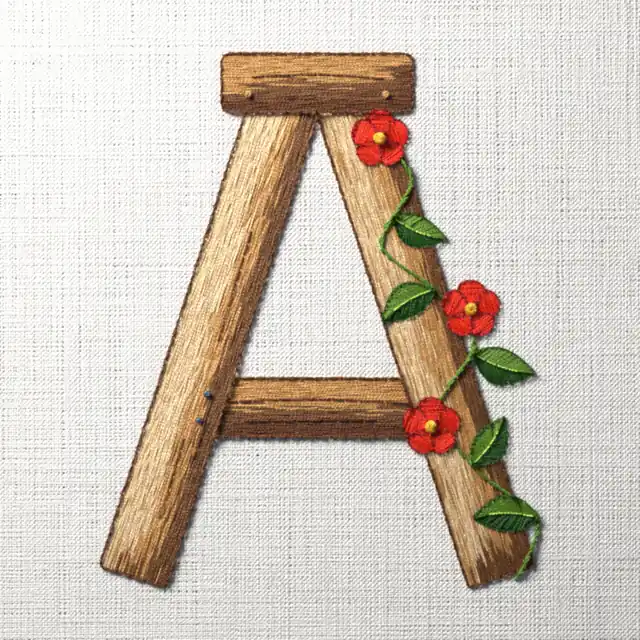
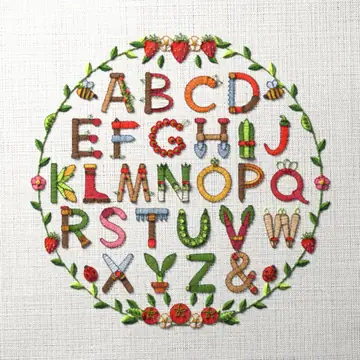
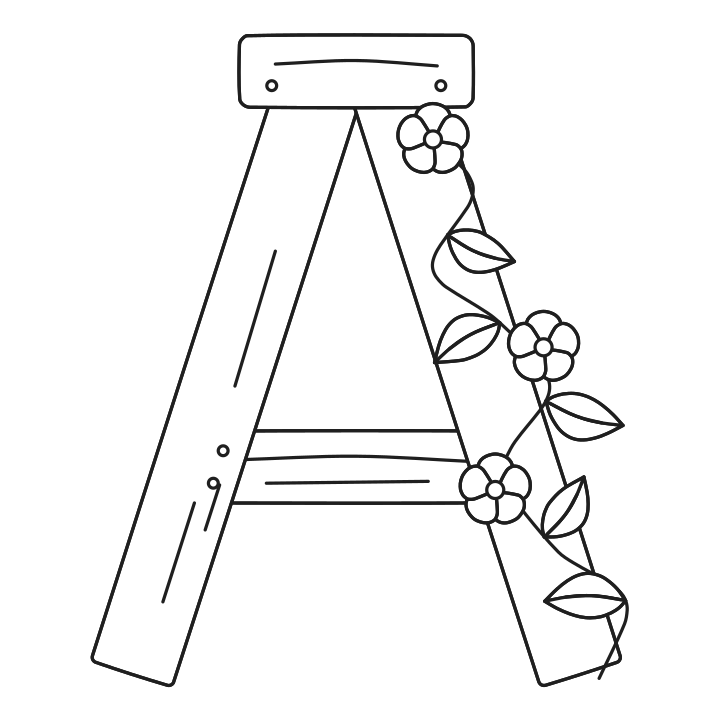
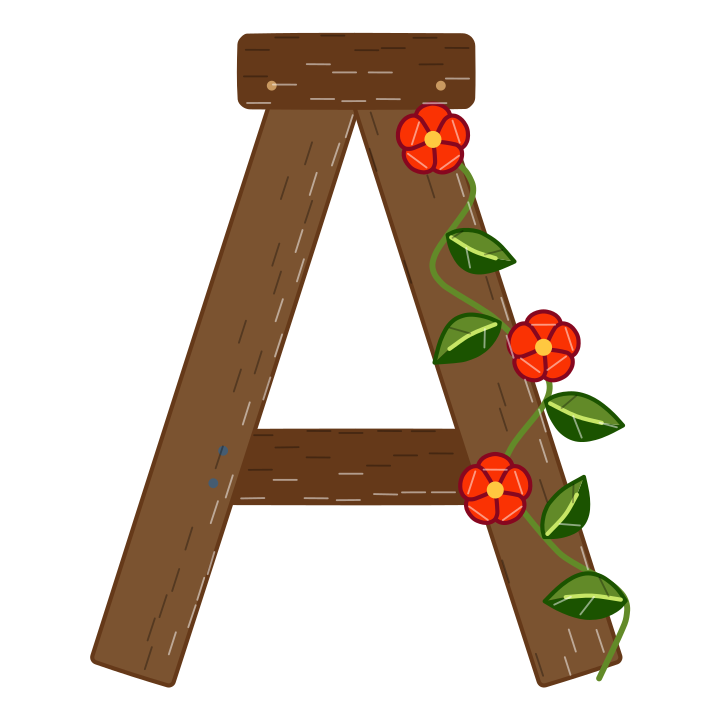
The letter A of the set. Every letter is a garden thing seen from the side, from a ladder A and a carrot C to a hose R, a rake T and a zucchini Z.
Size and details
Intermediate. Uses long and short stitch and ten colors.
Advanced. Uses long and short stitch over much of the design, nine colors and a great deal of stitching.
Intermediate. Uses long and short stitch.
Advanced. Uses long and short stitch over much of the design and a great deal of stitching.
Advanced. Uses long and short stitch over much of the design, twelve colors and a great deal of stitching.
Advanced. Uses long and short stitch over much of the design, eight colors and a great deal of stitching.
Advanced. Uses long and short stitch over much of the design; from a 5 inch hoop up the widest satin stitches are long.
Advanced. Uses long and short stitch, eleven colors and a little satin stitch; from a 6 inch hoop up the satin stitches are long.
Intermediate. Uses long and short stitch and eight colors.
Advanced. Uses long and short stitch over much of the design, eleven colors and a great deal of stitching.
Intermediate. Uses long and short stitch over much of the design.
The wide parts are long and short stitch along the grain, dark on the lower right and light on the upper left; narrow parts are satin stitch and leaves are fishbone stitch. Each part has a back stitch outline in its own darkest thread, with stem stitch for vines and stalks and French knots for nails and flower centers. A letter worked alone fills most of its hoop.
| Hoop | Letter | Inches | Centimeters | Satin stitch up to |
|---|---|---|---|---|
| 3 in (8 cm) | 1.6 in (4.1 cm) | 1.3 × 1.6 in | 3.3 × 4.1 cm | 1/16 in (1.6 mm) |
| 4 in (10 cm) | 2.3 in (5.8 cm) | 1.9 × 2.4 in | 4.8 × 6.1 cm | 1/8 in (3 mm) |
| 5 in (13 cm) | 3.1 in (7.9 cm) | 2.6 × 3.1 in | 6.6 × 7.9 cm | 3/16 in (5 mm) |
| 6 in (15 cm) | 3.9 in (9.9 cm) | 3.2 × 3.9 in | 8.1 × 9.9 cm | 3/16 in (5 mm) |
| 8 in (20 cm) | 5.4 in (13.7 cm) | 4.5 × 5.5 in | 11.4 × 14 cm | 5/16 in (8 mm) |
| Hoop | Letter | Inches | Centimeters |
|---|---|---|---|
| 3 in (8 cm) | 1.6 in (4.1 cm) | 1.2 × 1.6 in | 3 × 4.1 cm |
| 4 in (10 cm) | 2.3 in (5.8 cm) | 1.9 × 2.4 in | 4.8 × 6.1 cm |
| 5 in (13 cm) | 3.1 in (7.9 cm) | 2.5 × 3.2 in | 6.4 × 8.1 cm |
| 6 in (15 cm) | 3.9 in (9.9 cm) | 3.1 × 4 in | 7.9 × 10.2 cm |
| 8 in (20 cm) | 5.4 in (13.7 cm) | 4.3 × 5.6 in | 10.9 × 14.2 cm |
- In a 3 or 4 inch hoop the French knots are drawn smaller than about 2 mm (a little over 1/16 in). Use one strand of floss for them there, or choose a larger hoop.
- In a 3, 4, 5 or 6 inch hoop the French knots are drawn smaller than about 2 mm (a little over 1/16 in). Use one strand of floss for them there, or choose a larger hoop.
- In a 6 or 8 inch hoop the widest satin stitch shape is 1/2 in (13 mm) or more across. Satin stitches longer than about 12 mm (just under 1/2 in) tend to work loose: divide the shape into sections, or work it in long and short stitch.
- In an 8 inch hoop the widest satin stitch shape is 9/16 in (14 mm) across. Satin stitches longer than about 12 mm (just under 1/2 in) tend to work loose: divide the shape into sections, or work it in long and short stitch.
- In a 3, 4 or 5 inch hoop the French knots are drawn smaller than about 2 mm (a little over 1/16 in). Use one strand of floss for them there, or choose a larger hoop.
- In a 3 inch hoop the shortest lazy daisy loops are drawn smaller than about 2 mm (a little over 1/16 in). Use one strand of floss for them there, or choose a larger hoop.
- In a 3, 4 or 5 inch hoop the French knots are drawn smaller than about 2 mm (a little over 1/16 in). Use one strand of floss for them there, or choose a larger hoop.
- In a 3 or 4 inch hoop the French knot is drawn smaller than about 2 mm (a little over 1/16 in). Use one strand of floss for it there, or choose a larger hoop.
On a towel. Wash and dry the towel first. To start with, put the bottom of the design 2 to 3 inches (5 to 7.5 cm) above the hem, in the middle or in a lower corner. Keep the stitches low, and press from the back. How to embroider a towel has every step, and the placement chart has the figures for other towels.
On linens. Wash and press the piece first. A pillowcase takes its design in the middle of the hem band; a napkin or a handkerchief in one corner, set on the diagonal. Keep the stitches short and low, and press face down on soft cloth. How to embroider pillowcases and napkins has the sizes and the places.
What you need
- Fabric
- Plain cotton or linen, cut 9 in (23 cm) square.
- Needle
- Embroidery needle, size 9 for 1 strand, size 7 for 2 or 3 (a lower number is a thicker needle).
- Floss
- 10 colors of six-strand cotton, listed below. DMC is a brand: another brand in a like color will do.
- Marker
- A pen or a sheet that suits the fabric: how to transfer a pattern says which.
Floss
- DMC 801 Dark Coffee BrownOutlines (middle), treads and ladder top, grain (darker)
- DMC 433 Medium BrownLadder, grain (lighter)
- DMC 930 Dark Antique BlueNails (darker)
- DMC 436 TanNails (lighter)
- DMC 905 Dark Parrot GreenLeaves (lighter), vine
- DMC 895 Very Dark Hunter GreenLeaves (darker), outlines (light)
- DMC 907 Light Parrot GreenVeins
- DMC 606 Bright Orange-RedBlossoms
- DMC 815 Medium GarnetOutlines (dark)
- DMC 725 Medium Light TopazBlossom centers
Skeins: one of each color is enough. An estimate for the 6 inch hoop, from the length of each line and the area of each filled shape, with a fifth added for tails.
How to stitch it
- New to hand embroidery? Start here.
- Print at 100%, trace the pattern onto the fabric, and put it in the hoop: inner ring under, drawing up, tight as a drum.
- Floss is six strands. Cut 18 inches (45 cm), pull out the number given one at a time, and lay them together.
- Begin with no knot on the back where it is seen and washed, as on a towel, a napkin or clothes; for a piece in a hoop a small knot is fine. End each thread by whipping it around the backs of four or five stitches, with one small hitch.
- Each small ring is one French knot.
Stitch in this order
Filled parts from the back of the picture forward, then lines and knots. Where a stitch page names another number of strands, use the number here.
- Long and short stitch 1 strandTreads, ladder, ladder top
- Fishbone stitch 2 strandsLeaves
- Satin stitch 2 strandsBlossoms
- Back stitch 1 to 2 strandsOutlines, grain, veins
- Stem stitch 3 strandsVine
- French knot 1 to 2 strands, two wrapsNails, blossom centers
When it is done, take off any lines that still show and finish the hoop. A guide to this kind of work: Stitches for letters, words and names.
More patterns like this
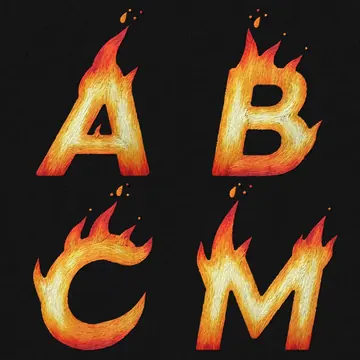
Intermediate 26 letters and & · 9 colors
Flaming letters
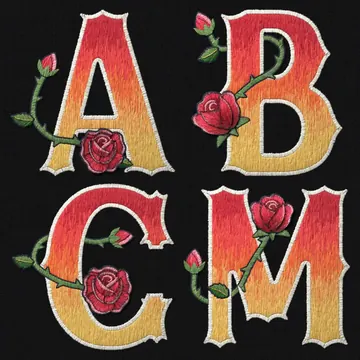
Advanced 26 letters and & · 14 colors
Old school tattoo letters with a rose
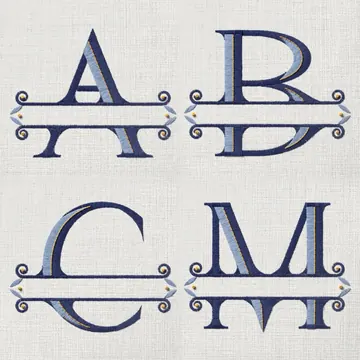
Intermediate 26 letters and & · 4 colors
Split monogram letters with a name bar
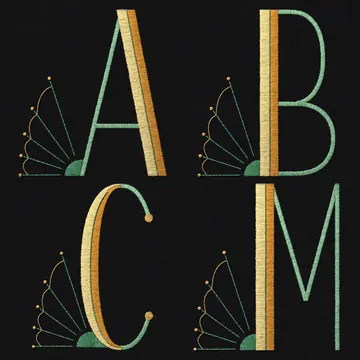
Easy 26 letters and & · 5 colors
Art Deco letters with a fan
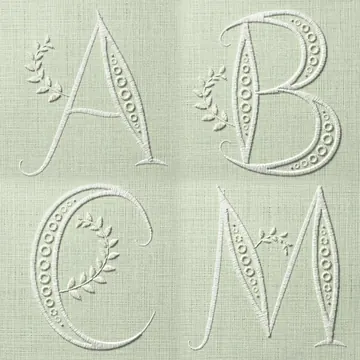
Intermediate 26 letters and & · 2 colors
French laundry letters in white
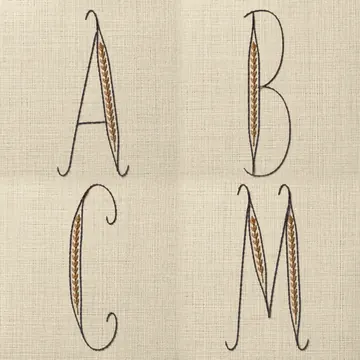
Easy 26 letters and & · 3 colors
Tall skinny farmhouse letters
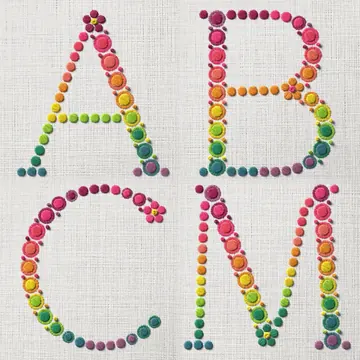
Intermediate 26 letters and & · 10 colors
Dotted letters
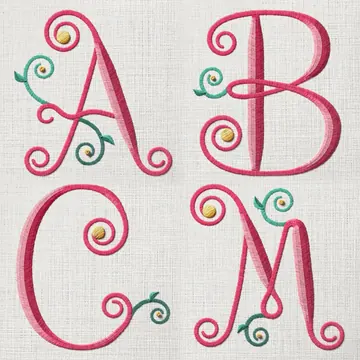
Intermediate 26 letters and & · 10 colors
Playful swirl letters
New to hand embroidery? Starting hand embroidery, step by step