Greek statue with wildflowers hand embroidery pattern
Advanced · 19 colors · 6 kinds of stitch
Download free PDFPDF, US Letter · 213 KBFor your own stitching, gifts and handmade pieces you sell. Do not resell or share this PDF. What you may do, in full
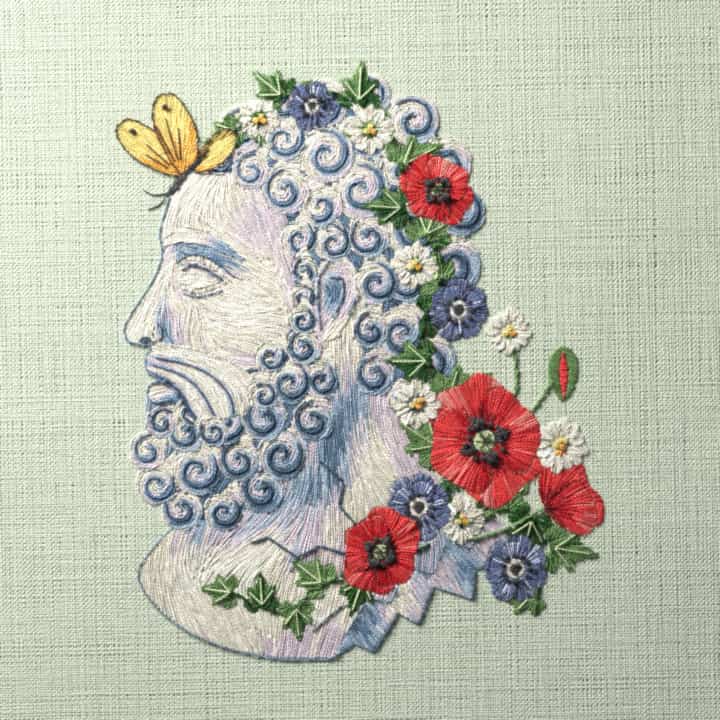
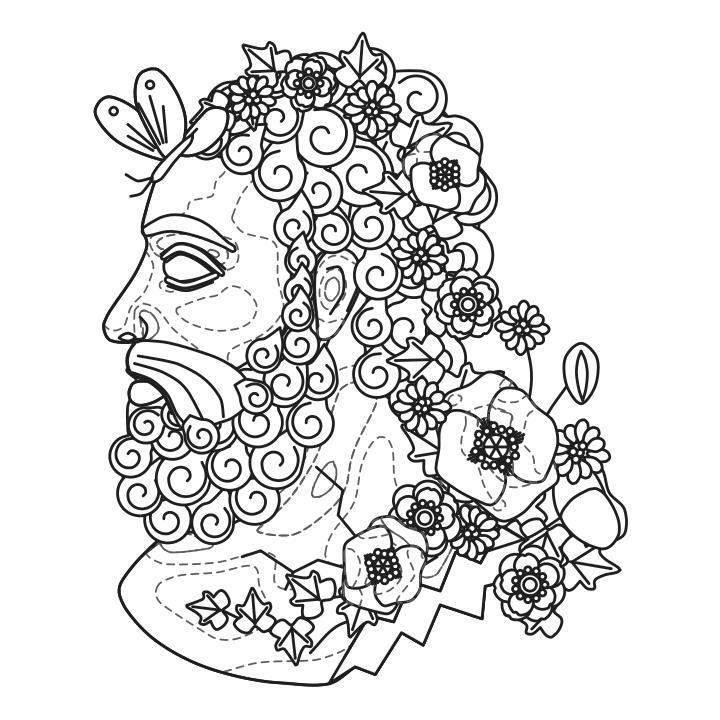
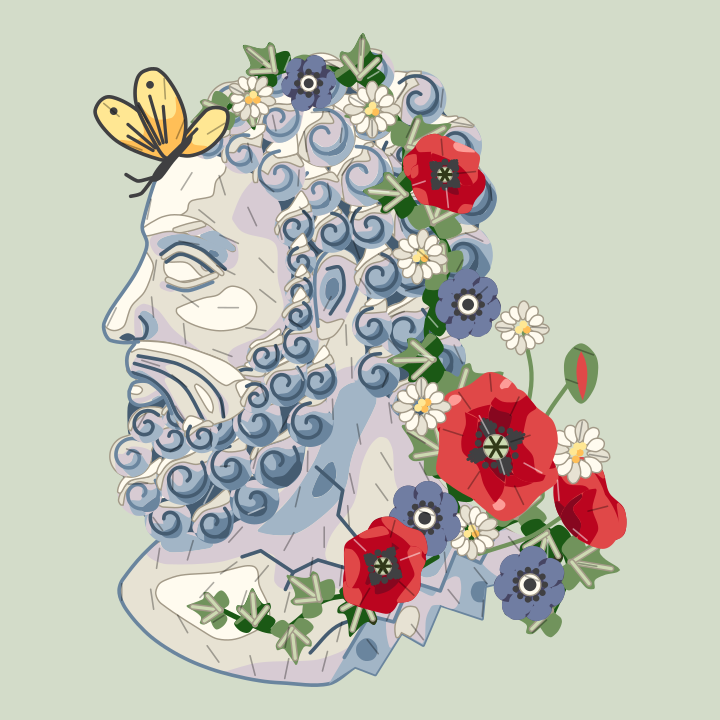
A weathered marble bust of an imagined bearded elder looks left, his shoulder broken away. Red poppies, blue anemones, chamomile and ivy grow out of the break and wind up through his curls, and a yellow butterfly rests on his brow. The stone, the flowers and the leaves are shaded in long and short stitch, from blue shadow to ivory on the marble. The groove of each curl and the cracks are split stitch, the chamomile petals are satin stitch, the stems are stem stitch, and the flower hearts are French knots. It is drawn for sage green linen. In the picture of where the colors go, the fine lines show which way the stitches lie.
Size and details
Advanced. Uses long and short stitch over much of the design, more than a hundred French knots, 19 colors and a great deal of stitching.
19 colors of floss and 6 kinds of stitch:
- Long and short stitch
- Split stitch
- Satin stitch
- Stem stitch
- Straight stitch
- French knot
- Which stitch goes where
| Hoop | Inches | Centimeters | Satin stitch up to |
|---|---|---|---|
| 3 in (8 cm) | 1.5 × 1.8 in | 3.8 × 4.6 cm | 1/16 in (1.6 mm) |
| 4 in (10 cm) | 2.2 × 2.7 in | 5.6 × 6.9 cm | 1/8 in (3 mm) |
| 5 in (13 cm) | 2.9 × 3.6 in | 7.4 × 9.1 cm | 1/8 in (3 mm) |
| 6 in (15 cm) | 3.7 × 4.5 in | 9.4 × 11.4 cm | 3/16 in (5 mm) |
| 8 in (20 cm) | 5.1 × 6.3 in | 13 × 16 cm | 1/4 in (6 mm) |
- In a 3, 4 or 5 inch hoop the French knots are drawn smaller than about 2 mm (a little over 1/16 in). Use one strand of floss for them there, or choose a larger hoop.
The pattern is drawn inside a circle about half an inch (1.3 cm) smaller all around than the hoop.
What you need
- DMC 822 Light Beige GrayNeck and chest, face, beard and curls (light) and 7 more parts
- DMC 931 Medium Antique BlueBeard and curls (dark), carved lines (lighter), outline and 4 more parts
- DMC 932 Light Antique BlueCurls and beard (middle dark), broken edge and neck and chest (dark) and 4 more parts
- DMC 3743 Very Light Antique VioletNeck and chest and face (middle), curls and beard (middle light) and 5 more parts
- DMC 712 CreamCurls, face and neck and chest (lightest), chamomile petals (lighter) and 5 more parts
- DMC 930 Dark Antique BlueCurls and beard (darkest), carved lines (darker), cracks and carved shadow
- DMC 3345 Dark Hunter GreenIvy leaves (middle), ivy stems
- DMC 3347 Medium Yellow GreenIvy leaves (light), flower stems and poppy bud
- DMC 3348 Light Yellow GreenIvy veins, poppy hearts (lighter)
- DMC 934 Black Avocado GreenPoppy hearts (darker), ivy leaves (dark)
- DMC 350 Medium CoralPoppies (light)
- DMC 817 Very Dark Coral RedPoppies (dark)
- DMC 815 Medium GarnetPoppies (darkest)
- DMC 791 Very Dark Cornflower BlueAnemones (darker)
- DMC 793 Medium Cornflower BlueAnemones (lighter)
- DMC 3799 Very Dark Pewter GrayButterfly edge, poppy blotches, poppy stamens and anemone stamens and 2 more parts
- DMC 742 Light TangerineButterfly wings and chamomile hearts (darker)
- DMC 744 Pale YellowButterfly wings and chamomile hearts (lighter)
- DMC 352 Light CoralPoppies (lightest)
Skeins: 2 for neck and chest, face, beard and curls (light) and 7 more parts, 2 for neck and chest and face (middle), curls and beard (middle light) and 5 more parts and 2 for curls and beard (darkest), carved lines (darker), cracks and carved shadow; one of each other color. An estimate for the largest size, the 8 inch hoop: the length of each line and the area of each filled shape, a fifth added for tails and ends, a tenth of every 8 m (8.7 yd) skein kept spare.
The floss is six-strand cotton; the stitch guide says how many strands to use. You also need a hoop, an embroidery needle (a size 7 to 9 suits two or three strands) and plain cotton or linen fabric. To frame the piece in its hoop, cut a square 3 inches (8 cm) wider than the hoop: a 9 inch (23 cm) square for a 6 inch hoop.
When it is stitched, how to finish a hoop shows how to back it for the wall.
Stitch guide
- Put the pattern on the fabric (how to transfer a pattern) and the fabric in the hoop.
- Stitch the filled parts first, what lies behind before what lies in front of it.
- Then stitch the lines: stems, veins and outlines over the edges of the filled parts.
- Keep the knots for the end, so that the hoop and your hand do not flatten them.
Start each thread with a small knot on the back or one of the knotless starts, and end it by running the needle under the backs of a few stitches (starting and ending a thread). Use the strands this list gives, also where a page about a stitch names another number.
- Long and short stitch 1 strandNeck and chest, broken edge, face, ear, eye, brow, curls, beard, lips, ivy leaves, poppies, anemones, butterfly wings
- Split stitch 1 to 2 strandsOutline, carved lines, cracks, butterfly edge
- Satin stitch 2 strandsEyelids, carved shadow, poppy bud, poppies, anemone hearts, chamomile petals, poppy hearts, butterfly body
- Stem stitch 2 to 3 strandsIvy stems, flower stems
- Straight stitch 1 to 2 strandsIvy veins, poppy blotches, poppy hearts, butterfly edge
- French knot 1 strand, two wrapsAnemone stamens, chamomile hearts, poppy stamens, butterfly edge
Getting it onto your fabric
The PDF holds the pattern twice at actual size: once as drawn, and once mirrored for an iron-on transfer pen. Print it at 100% with scaling off and check the one-inch square (25.4 mm) with a ruler before you trace. How to transfer a pattern explains tracing, carbon paper and the other ways. The files are under Downloads.
Downloads
- Download free PDF PDF, US Letter, 3 pages, for a 6 inch (15 cm) hoop
- Download free PDF, A4 PDF, A4, 3 pages, for a 6 inch (15 cm) hoop
More patterns like this
Advanced 3–8 in hoop · 23 colors
Persephone brings the spring flowers
Advanced 3–8 in hoop · 19 colors
Olive crown with room for a letter
Advanced 3–8 in hoop · 18 colors
Greek island village and blue sea
Advanced 3–8 in hoop · 16 colors
Small Roman helmet with a red crest
Advanced 3–8 in hoop · 16 colors
Small Medusa in tattoo style
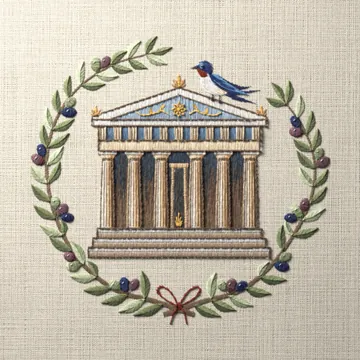
Advanced 3–8 in hoop · 23 colors
Greek temple with olive sprays
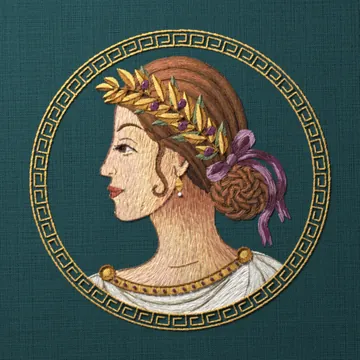
Advanced 3–8 in hoop · 24 colors
Woman in a Grecian olive crown
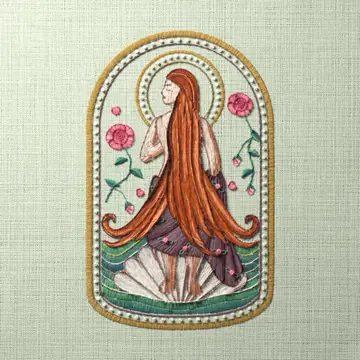
Advanced 3–8 in hoop · 24 colors
Birth of Venus on a scallop shell
New to hand embroidery? Starting hand embroidery, step by step