Hummingbird and honeysuckle block hand embroidery pattern
Advanced · 15 colors · 4.8 × 4.8 in · 6 kinds of stitch
Download free PDFPDFPrints on US Letter and A4You may sell what you make from it by hand, in small quantities. The PDF itself is not to be sold or shared. Selling, classes and kits: the rules
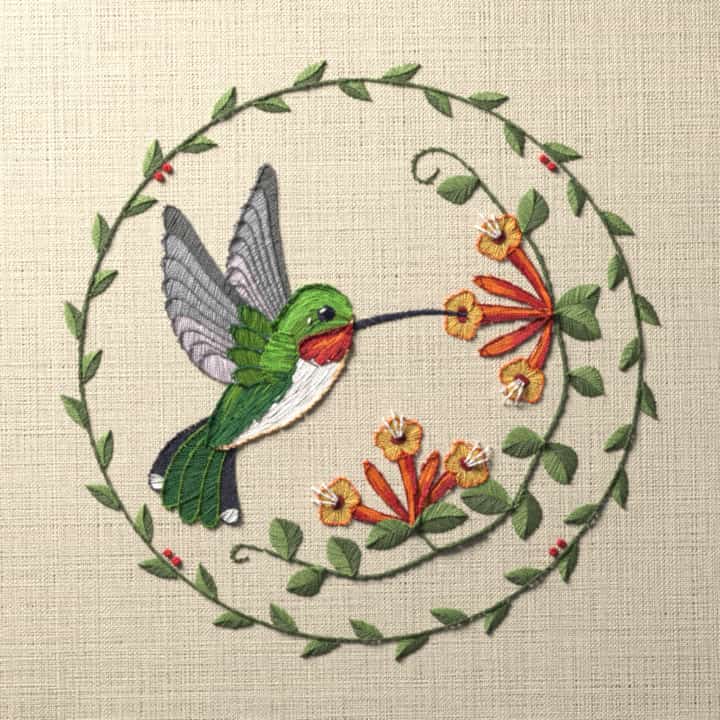
A hummingbird hangs in the air with its bill in the mouth of a honeysuckle trumpet, while the vine curves under it and up the right side.
Size and details
Advanced. Uses long and short stitch, 15 colors and a great deal of stitching.
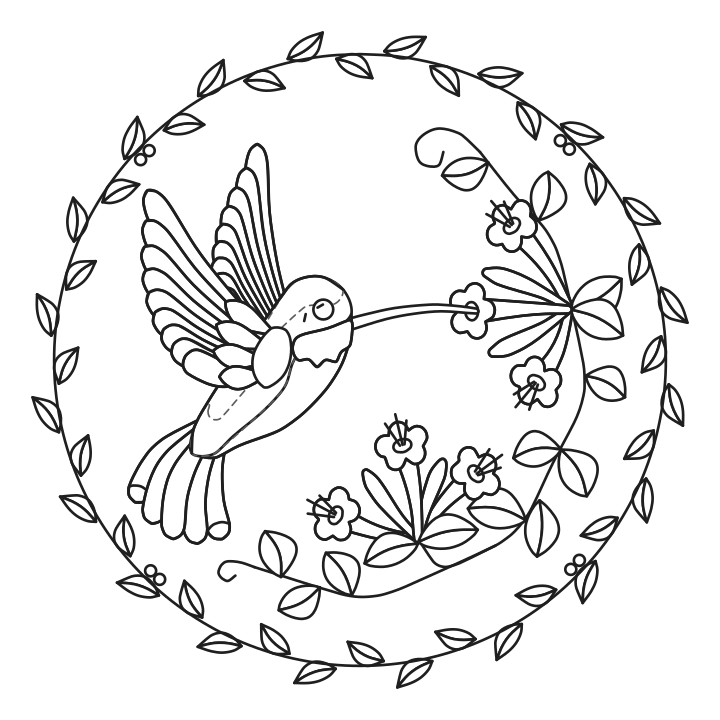
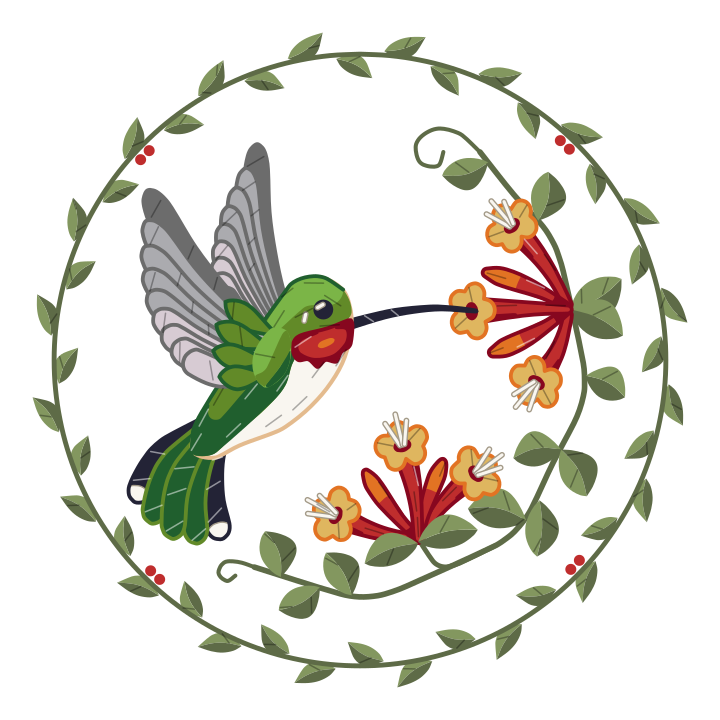
The wings and tail are overlapping satin stitch feathers with stem stitch edges; the green back, red throat and white breast are long and short stitch. The trumpets and buds are long and short stitch from garnet to copper, with golden satin stitch lips and a few straight stitch stamens, and the rounded leaves are fishbone stitch. The round frame is stem stitch with fishbone leaves and French knot berries, the same in every block of the set, so the blocks sew together into one quilt. In the picture of where the colors go, the fine lines show which way the stitches lie.
| Hoop | Inches | Centimeters | Satin stitch up to |
|---|---|---|---|
| 3 in (8 cm) | 1.9 × 1.9 in | 4.8 × 4.8 cm | 1/16 in (1.6 mm) |
| 4 in (10 cm) | 2.9 × 2.9 in | 7.4 × 7.4 cm | 1/8 in (3 mm) |
| 5 in (13 cm) | 3.8 × 3.8 in | 9.7 × 9.7 cm | 3/16 in (5 mm) |
| 6 in (15 cm) | 4.8 × 4.8 in | 12.2 × 12.2 cm | 1/4 in (6 mm) |
| 8 in (20 cm) | 6.7 × 6.7 in | 17 × 17 cm | 5/16 in (8 mm) |
- In a 3, 4 or 5 inch hoop the French knots are drawn smaller than about 2 mm (a little over 1/16 in). Use one strand of floss for them there, or choose a larger hoop.
On a quilt. Wash and press the cloth first, and stitch the block before the blocks are joined. Choose the finished size of the block under Options, the same for every block of the quilt: the design stands half an inch (1.3 cm) inside it on every side. Trim the stitched block half an inch (1.3 cm) larger than its finished size, for a seam of 1/4 inch (6 mm) on each side. How to embroider quilts has every step.
What you need
- Fabric
- Plain cotton or linen, cut 9 in (23 cm) square.
- Needle
- Embroidery needle, size 9 for 1 strand, size 7 for 2 or 3, size 5 for 4 (a lower number is a thicker needle).
- Floss
- 15 colors of six-strand cotton, listed below. DMC is a brand: another brand in a like color will do.
- Marker
- A pen or a sheet that suits the fabric: how to transfer a pattern says which.
Floss
- 1DMC 3364 Pine GreenFrame leaves and leaves (lighter)
- 2DMC 3362 Dark Pine GreenFrame leaves and leaves (darker), frame ring, vine and tendrils
- 3DMC 347 Very Dark SalmonTrumpets (lighter), buds and throat (middle), frame berries
- 4DMC 815 Medium GarnetTrumpet edges, trumpet mouths and throat edge, trumpets (darker), throat and buds (dark)
- 5DMC 3820 Dark StrawTrumpet lips
- 6DMC 922 Light CopperLip edges, buds and throat (light)
- 7DMC 3865 Winter WhiteBreast, stamens, tail tips and eye light
- 8DMC 310 BlackTail and tail edges (darker), bill and eye
- 9DMC 317 Pewter GrayNear wing edges and far wing edges, near wing and far wing (dark)
- 10DMC 318 Light Steel GrayNear wing and far wing (middle)
- 11DMC 3743 Very Light Antique VioletNear wing and far wing (light)
- 12DMC 319 Very Dark Pistachio GreenTail (lighter), back and wing coverts (dark), back edge
- 13DMC 905 Dark Parrot GreenBack and wing coverts (middle), tail edges (lighter)
- 14DMC 437 Light TanBody edge
- 15DMC 703 ChartreuseBack and wing coverts (light)
Skeins: one of each color is enough. An estimate for the 6 inch hoop, from the length of each line and the area of each filled shape, with a fifth added for tails.
How to stitch it
- New to hand embroidery? Start here.
- Print at 100%, trace the pattern onto the fabric, and put it in the hoop: inner ring under, drawing up, tight as a drum.
- Floss is six strands. Cut 18 inches (45 cm), pull out the number given one at a time, and lay them together.
- Inside a filled shape start with two or three tiny stitches, which the filling covers. Start a line with a small knot on the back. End each thread by running the needle under the backs of a few stitches.
- Each small ring is one French knot. A fine broken line inside a shape is where two shades meet: trace it, do not stitch it.
- A number under “Where colors go” is a color of the list. The fine lines on the colors show which way the stitches lie.
Stitch in this order
Filled parts from the back of the picture forward, then lines and knots. Where a stitch page names another number of strands, use the number here.
- Fishbone stitch 3 strandsFrame leaves, leaves
- Long and short stitch 2 strandsTrumpets, buds, breast, back, throat, wing coverts
- Satin stitch3 strands: trumpet lips, far wing, tail, tail tips, near wing, wing coverts2 strands: trumpet mouths, bill, eye
- Stem stitch3 or 4 strands: vine3 strands: frame ring2 strands: tendrils, body edge1 strand: trumpet edges, lip edges, far wing edges, tail edges, back edge, throat edge, near wing edges, wing coverts
- Straight stitch3 strands: eye light2 strands: stamens
- French knot 2 strands, two wrapsFrame berries
When it is done, take off any lines that still show and finish the hoop. A guide to this kind of work: Stitches for fur, hair and feathers.
More patterns like this
Advanced prints 3–14 in · 19 colors
Chickadee and apple blossom block
Advanced prints 3–14 in · 20 colors
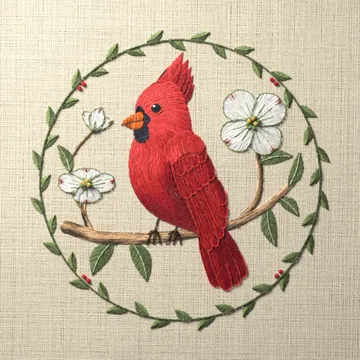
Cardinal and dogwood block
Advanced prints 3–14 in · 21 colors
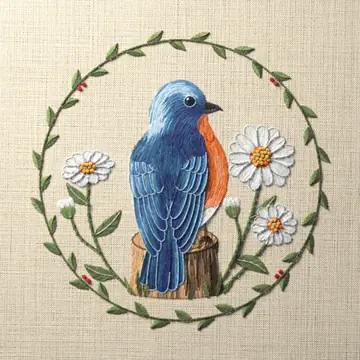
Bluebird and daisies block
Advanced prints 3–14 in · 23 colors
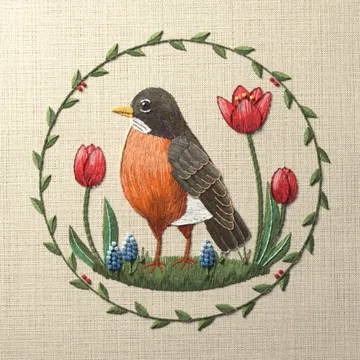
Robin and tulips block
Advanced prints 3–14 in · 16 colors
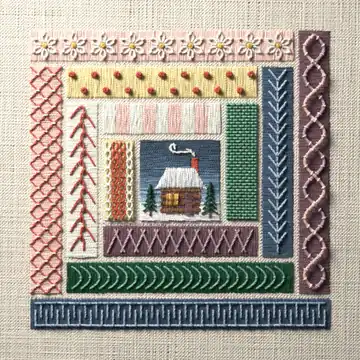
Log cabin quilt block
Intermediate prints 3–14 in · 13 colors
Goldfinch and coneflower block
Advanced prints 3–14 in · 14 colors
I’d rather be quilting, block garland
Advanced 3–8 in hoop · 20 colors
Hummingbird at a gingham lattice
New to hand embroidery? Starting hand embroidery, step by step