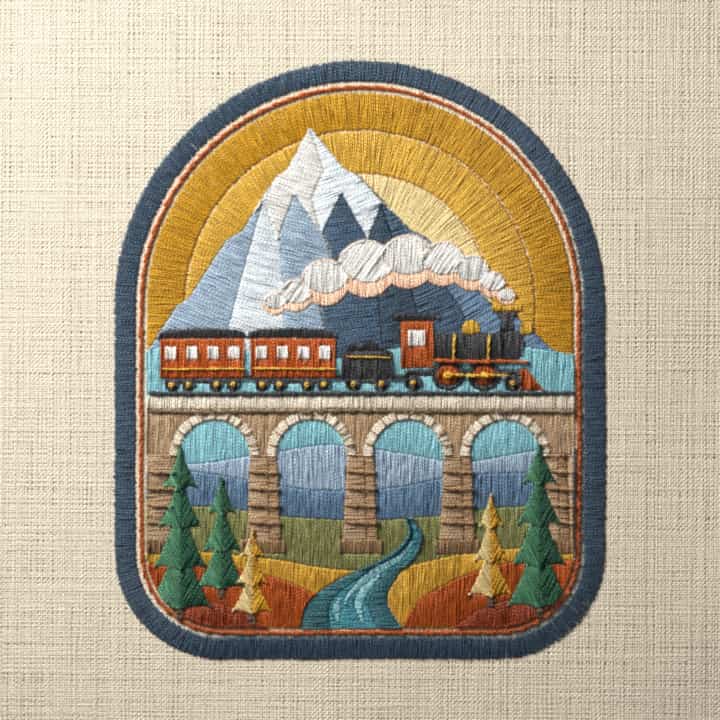
Railroad mountain with a stone viaduct hand embroidery pattern
Advanced · 23 colors · 4 kinds of stitch
Download free PDFPDF, US Letter · 55 KBFor your own stitching, gifts and handmade pieces you sell. Do not resell or share this PDF. What you may do, in full
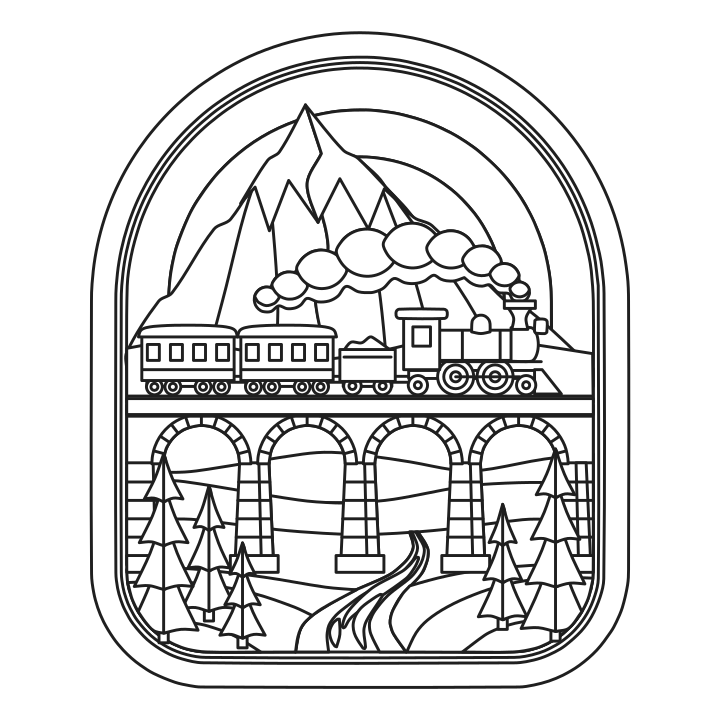
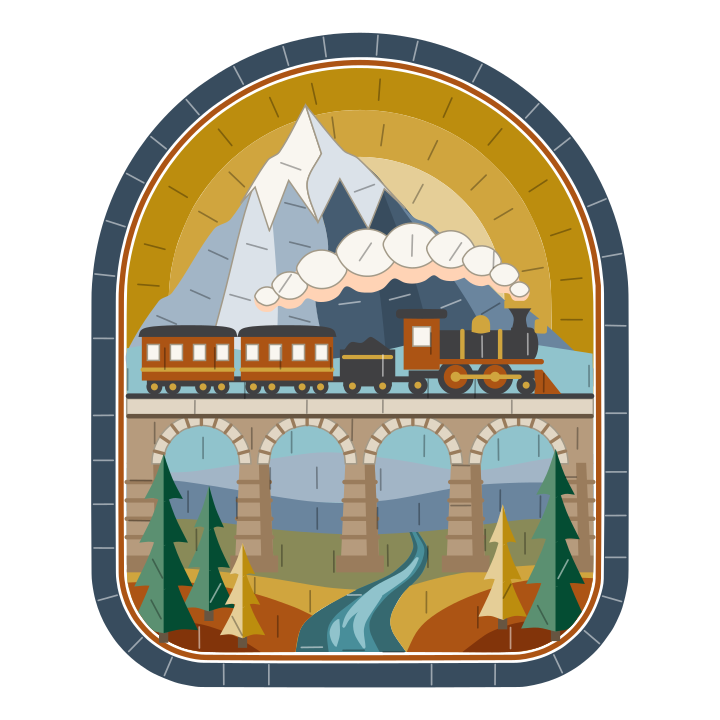
Each plane of the mountain, each band of the sky, the stone viaduct, the train, the river and the navy frame is flat satin stitch, laid in its own direction. The smoke is white puffs of satin with a peach underside. Stem stitch makes the rail, the engine’s gold bands and rod, the stone courses, and the copper line inside the frame. Straight stitches part the arch stones, and French knots are the hubs of the wheels. In the picture of where the colors go, the fine lines show which way the stitches lie.
Size and details
Advanced. Satin stitch over more than half of the cloth in a 6 inch hoop, 23 colors and a great deal of stitching; from a 6 inch hoop up some of the satin stitches are long.
23 colors of floss and 4 kinds of stitch:
| Hoop | Inches | Centimeters | Satin stitch up to |
|---|---|---|---|
| 3 in (8 cm) | 1.4 × 1.7 in | 3.6 × 4.3 cm | 3/16 in (5 mm) |
| 4 in (10 cm) | 2.1 × 2.6 in | 5.3 × 6.6 cm | 1/4 in (6 mm) |
| 5 in (13 cm) | 2.8 × 3.5 in | 7.1 × 8.9 cm | 5/16 in (8 mm) |
| 6 in (15 cm) | 3.6 × 4.3 in | 9.1 × 10.9 cm | 7/16 in (11 mm) |
| 8 in (20 cm) | 5 × 6.1 in | 12.7 × 15.5 cm | 9/16 in (14 mm) |
- In an 8 inch hoop the widest satin stitch shape is 9/16 in (14 mm) across. Satin stitches longer than about 12 mm (just under 1/2 in) tend to work loose: divide the shape into sections, or work it in long and short stitch.
- In a 3, 4 or 5 inch hoop the French knots are drawn smaller than about 2 mm (a little over 1/16 in). Use one strand of floss for them there, or choose a larger hoop.
The pattern is drawn inside a circle about half an inch (1.3 cm) smaller all around than the hoop.
What you need
- DMC 3750 Very Dark Antique BlueFrame, mountain (darkest)
- DMC 920 Medium CopperBanks (middle), frame line, carriages, cab, driving wheels, running board and cowcatcher
- DMC 680 Dark Old GoldSky (dark), larches (darker)
- DMC 729 Medium Old GoldSky (middle), banks (light), gold bands, hubs, rod, dome and lamp
- DMC 676 Light Old GoldSky (light), larches (lighter)
- DMC 932 Light Antique BlueMountain (light), valley hills (lighter)
- DMC 3753 Ultra Very Light Antique BlueMountain (lightest), snow (darker)
- DMC 930 Dark Antique BlueMountain (dark)
- DMC 931 Medium Antique BlueValley hills (darker), mountain (middle)
- DMC 3865 Winter WhiteSmoke and windows, snow (lighter)
- DMC 598 Light TurquoiseValley mist and river light
- DMC 3011 Dark Khaki GreenValley floor
- DMC 3810 Dark TurquoiseRiver (lighter)
- DMC 3808 Ultra Very Dark TurquoiseRiver (darker)
- DMC 918 Dark Red CopperBanks (dark)
- DMC 841 Light Beige BrownViaduct (lighter)
- DMC 840 Medium Beige BrownViaduct shade, stone courses and arch joints, viaduct (darker)
- DMC 3033 Very Light Mocha BrownParapet and arch stones
- DMC 839 Dark Beige BrownParapet line and trunks
- DMC 3799 Very Dark Pewter GrayWheels, engine, roofs and rail
- DMC 3856 Ultra Very Light MahoganySmoke shade
- DMC 502 Blue GreenFirs (lighter)
- DMC 500 Very Dark Blue GreenFirs (darker)
Skeins: 6 for frame, mountain (darkest), 3 for sky (dark), larches (darker) and 3 for sky (middle), banks (light), gold bands, hubs, rod, dome and lamp; one of each other color. An estimate for the largest size, the 8 inch hoop: the length of each line and the area of each filled shape, a fifth added for tails and ends, a tenth of every 8 m (8.7 yd) skein kept spare.
The floss is six-strand cotton; the stitch guide says how many strands to use. You also need a hoop, an embroidery needle (a size 7 to 9 suits two or three strands) and plain cotton or linen fabric. To frame the piece in its hoop, cut a square 3 inches (8 cm) wider than the hoop: a 9 inch (23 cm) square for a 6 inch hoop.
When it is stitched, how to finish a hoop shows how to back it for the wall.
Stitch guide
- Put the pattern on the fabric (how to transfer a pattern) and the fabric in the hoop.
- Stitch the filled parts first, what lies behind before what lies in front of it.
- Then stitch the lines: stems, veins and outlines over the edges of the filled parts.
- Keep the knots for the end, so that the hoop and your hand do not flatten them.
Start each thread with a small knot on the back or one of the knotless starts, and end it by running the needle under the backs of a few stitches (starting and ending a thread). Use the strands this list gives, also where a page about a stitch names another number.
- Satin stitch 2 strandsFrame, sky, mountain, snow, valley mist, valley hills, valley floor, river, river light, banks, viaduct, viaduct shade, arch stones, and 17 more
- Stem stitch 1 to 3 strandsFrame line, stone courses, parapet line, rail, gold bands, running board, rod
- Straight stitch 1 strandArch joints
- French knot 1 to 2 strands, two wrapsHubs
Getting it onto your fabric
The PDF holds the pattern twice at actual size: once as drawn, and once mirrored for an iron-on transfer pen. Print it at 100% with scaling off and check the one-inch square (25.4 mm) with a ruler before you trace. How to transfer a pattern explains tracing, carbon paper and the other ways. The files are under Downloads.
Downloads
- Download free PDF PDF, US Letter, 3 pages, for a 6 inch (15 cm) hoop
- Download free PDF, A4 PDF, A4, 3 pages, for a 6 inch (15 cm) hoop
More patterns like this
Advanced 3–8 in hoop · 17 colors
Cry a river, build a bridge, get over it
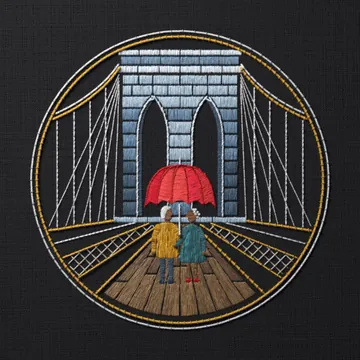
Advanced 3–8 in hoop · 16 colors
Brooklyn Bridge
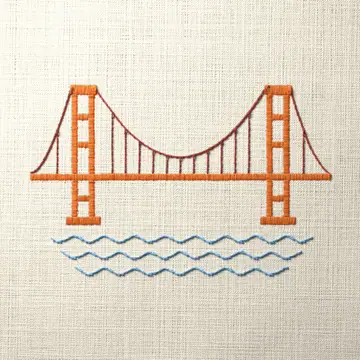
Easy 3–8 in hoop · 3 colors
Golden Gate Bridge
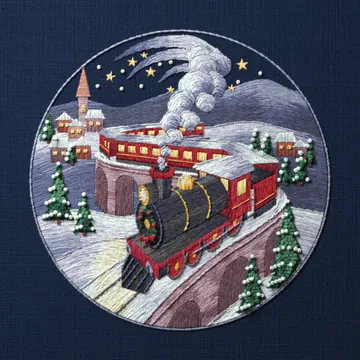
Advanced 3–8 in hoop · 23 colors
Christmas train in a snowy village
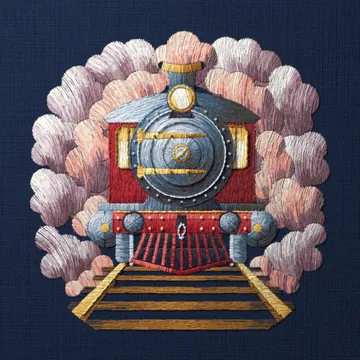
Advanced 3–8 in hoop · 24 colors
Steam engine
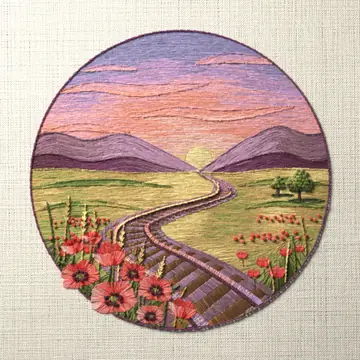
Advanced 3–8 in hoop · 24 colors
Train tracks through poppies at sunset
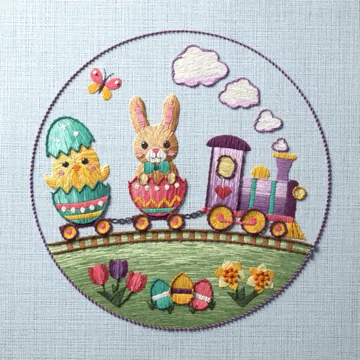
Advanced 3–8 in hoop · 24 colors
Small Easter train with egg cars
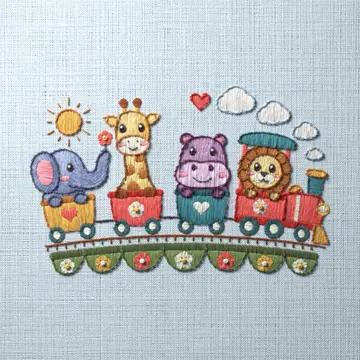
Advanced 3–8 in hoop · 24 colors
Baby safari train border
New to hand embroidery? Starting hand embroidery, step by step