Christmas train in a snowy village hand embroidery pattern
Advanced · 23 colors · 6 kinds of stitch
Download free PDFPDF, US Letter · 146 KBFor your own stitching, gifts and handmade pieces you sell. Do not resell or share this PDF. What you may do, in full
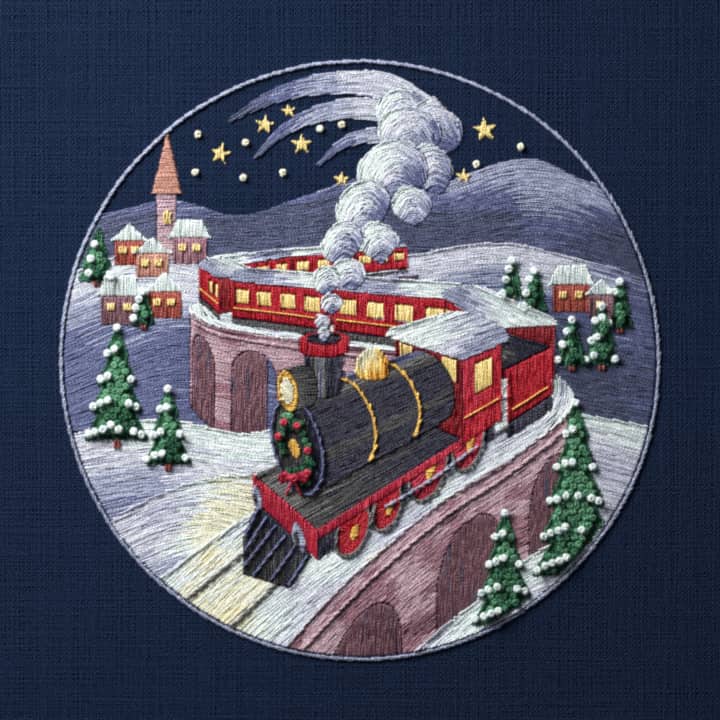
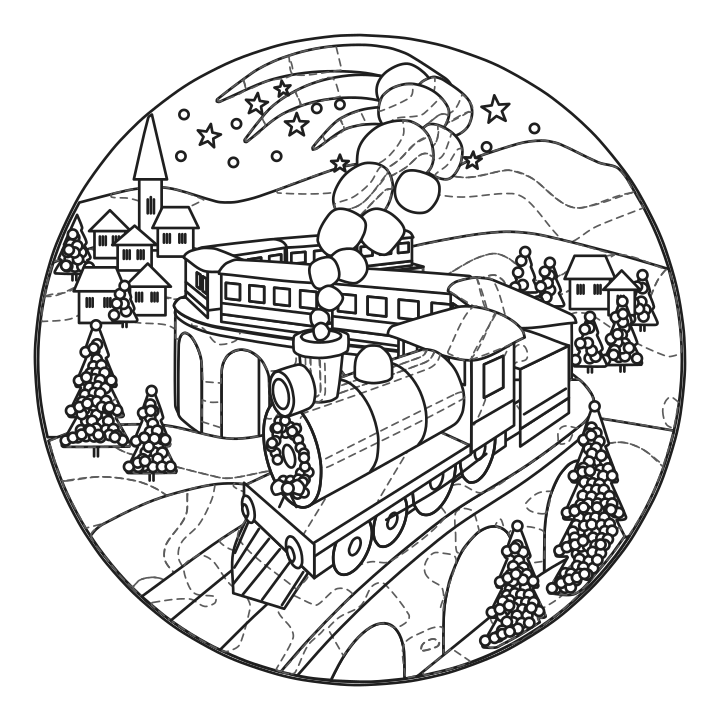
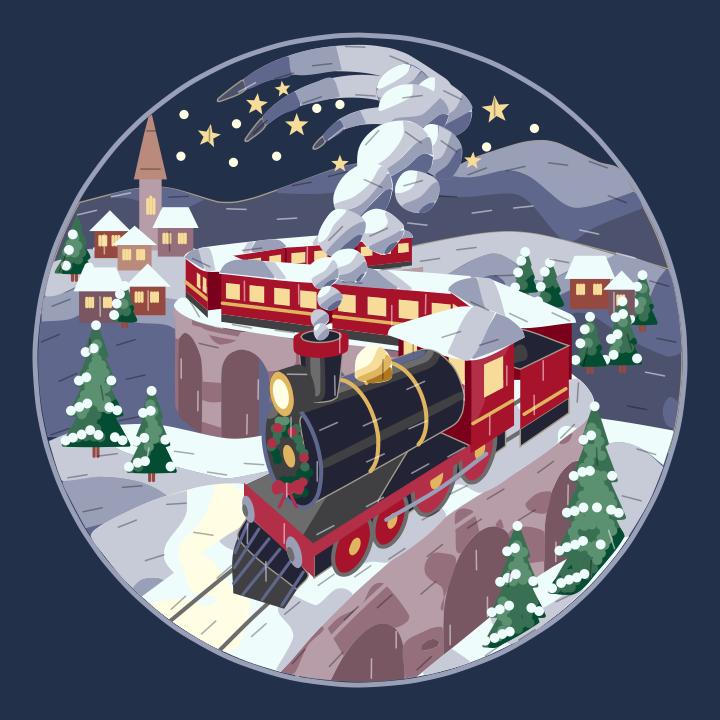
A steam engine with a wreath on its front leads lit red carriages round an S of stone viaduct, past snow hills, firs and a small village with a steeple. The snow, the viaduct, the boiler and the plume are long and short stitch. Houses, windows, wheels and stars are satin stitch; firs and their snow are French knots. Rails, rims and the ring round the scene are stem stitch. The night sky is left as bare navy cloth. In the picture of where the colors go, the fine lines show which way the stitches lie.
Size and details
Advanced. Uses long and short stitch over much of the design, more than a hundred French knots, 23 colors and a great deal of stitching; from a 6 inch hoop up the widest satin stitches are long.
23 colors of floss and 6 kinds of stitch:
- Long and short stitch
- Straight stitch
- French knot
- Satin stitch
- Stem stitch
- Split stitch
- Which stitch goes where
| Hoop | Inches | Centimeters | Satin stitch up to |
|---|---|---|---|
| 3 in (8 cm) | 1.9 × 1.9 in | 4.8 × 4.8 cm | 3/16 in (5 mm) |
| 4 in (10 cm) | 2.8 × 2.8 in | 7.1 × 7.1 cm | 1/4 in (6 mm) |
| 5 in (13 cm) | 3.8 × 3.8 in | 9.7 × 9.7 cm | 5/16 in (8 mm) |
| 6 in (15 cm) | 4.7 × 4.7 in | 11.9 × 11.9 cm | 7/16 in (11 mm) |
| 8 in (20 cm) | 6.6 × 6.6 in | 16.8 × 16.8 cm | 9/16 in (14 mm) |
- In an 8 inch hoop the widest satin stitch shape is 9/16 in (14 mm) across. Satin stitches longer than about 12 mm (just under 1/2 in) tend to work loose: divide the shape into sections, or work it in long and short stitch.
- In a 3, 4 or 5 inch hoop the French knots are drawn smaller than about 2 mm (a little over 1/16 in). Use one strand of floss for them there, or choose a larger hoop.
The pattern is drawn inside a circle about half an inch (1.3 cm) smaller all around than the hoop.
What you need
- DMC 158 Medium Very Dark Cornflower BlueFar hills (dark), right hills and plume wisps (darkest)
- DMC 3807 Cornflower BlueSnowfield and village hill (darkest), right hills (dark) and 6 more parts
- DMC 160 Medium Gray BlueSnowfield (dark), right hills (light), ring and 8 more parts
- DMC 159 Light Gray BlueSnowfield and plume (light), snow on the track (dark) and 6 more parts
- DMC 3756 Ultra Very Light Baby BlueSnow on the track (middle), snowfield (lightest) and 7 more parts
- DMC 3858 Medium RosewoodVillage houses (dark), fir trunks
- DMC 501 Dark Blue GreenFirs (lighter), fir needles and wreath (middle)
- DMC 500 Very Dark Blue GreenFirs (darker), fir needles and wreath (dark)
- DMC 502 Blue GreenFir needles and wreath (light)
- DMC 3822 Light StrawLit windows, village windows and stars, dome (light)
- DMC 3042 Light Antique VioletViaduct (light), viaduct edges, steeple (lighter)
- DMC 3859 Light RosewoodSteeple (darker), village houses (lightest)
- DMC 3041 Medium Antique VioletViaduct (middle), village houses (light)
- DMC 3740 Dark Antique VioletViaduct arches, viaduct (dark), village houses (darkest)
- DMC 3799 Very Dark Pewter GrayRunning board (dark), smokebox (middle) and 6 more parts
- DMC 498 Dark RedCarriages, tender and chimney cap (lighter), cab and wheels (darker)
- DMC 814 Dark GarnetCarriage ends and cab front
- DMC 3820 Dark StrawEngine bands and carriage bands, lamp (lighter) and 3 more parts
- DMC 3823 Ultra Pale YellowLamplight on the snow (lightest) and 4 more parts
- DMC 317 Pewter GrayRunning board (lightest), rails and wheel rims and 5 more parts
- DMC 310 BlackBoiler (darkest), engine frame, coal (dark) and 6 more parts
- DMC 3831 Dark RaspberryWheels (lighter), buffer beam, running board (light) and 3 more parts
- DMC 782 Dark TopazDome (darkest)
Skeins: 2 for far hills (dark), right hills and plume wisps (darkest), 3 for snowfield and village hill (darkest), right hills (dark) and 6 more parts, 2 for snowfield (dark), right hills (light), ring and 8 more parts, 2 for snowfield and plume (light), snow on the track (dark) and 6 more parts and 2 for snow on the track (middle), snowfield (lightest) and 7 more parts; one of each other color. An estimate for the largest size, the 8 inch hoop: the length of each line and the area of each filled shape, a fifth added for tails and ends, a tenth of every 8 m (8.7 yd) skein kept spare.
The floss is six-strand cotton; the stitch guide says how many strands to use. You also need a hoop, an embroidery needle (a size 7 to 9 suits two or three strands) and plain cotton or linen fabric. To frame the piece in its hoop, cut a square 3 inches (8 cm) wider than the hoop: a 9 inch (23 cm) square for a 6 inch hoop.
When it is stitched, how to finish a hoop shows how to back it for the wall.
Stitch guide
- Put the pattern on the fabric (how to transfer a pattern) and the fabric in the hoop.
- Stitch the filled parts first, what lies behind before what lies in front of it.
- Then stitch the lines: stems, veins and outlines over the edges of the filled parts.
- Keep the knots for the end, so that the hoop and your hand do not flatten them.
Start each thread with a small knot on the back or one of the knotless starts, and end it by running the needle under the backs of a few stitches (starting and ending a thread). Use the strands this list gives, also where a page about a stitch names another number.
- Long and short stitch 1 strandFar hills, village hill, right hills, firs, viaduct arches, viaduct, snow on the track, carriages, and 16 more
- Straight stitch 2 to 3 strandsFir trunks, village windows, wreath bow, cowcatcher bars
- French knot 2 strands, two wrapsFir needles, snow on the firs, wreath, wreath berries, wreath bow, small stars
- Satin stitch 2 strandsVillage houses, village roofs, steeple, carriages, lit windows, carriage ends, tender, and 12 more
- Stem stitch 2 to 3 strandsViaduct edges, rails, wheel rims, rods, engine bands, smokebox rim, ring
- Split stitch 1 strandCarriage bands, engine bands
Getting it onto your fabric
The PDF holds the pattern twice at actual size: once as drawn, and once mirrored for an iron-on transfer pen. Print it at 100% with scaling off and check the one-inch square (25.4 mm) with a ruler before you trace. How to transfer a pattern explains tracing, carbon paper and the other ways. The files are under Downloads.
Downloads
- Download free PDF PDF, US Letter, 3 pages, for a 6 inch (15 cm) hoop
- Download free PDF, A4 PDF, A4, 3 pages, for a 6 inch (15 cm) hoop
More patterns like this
Advanced 3–8 in hoop · 15 colors
Retro Christmas train with a tree
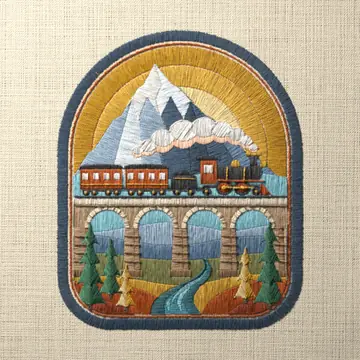
Advanced 3–8 in hoop · 23 colors
Railroad mountain with a stone viaduct
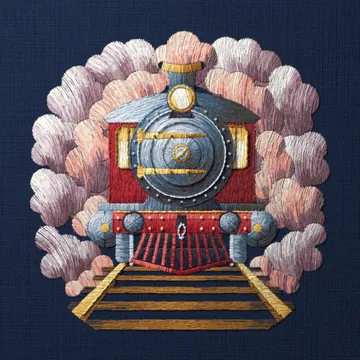
Advanced 3–8 in hoop · 24 colors
Steam engine
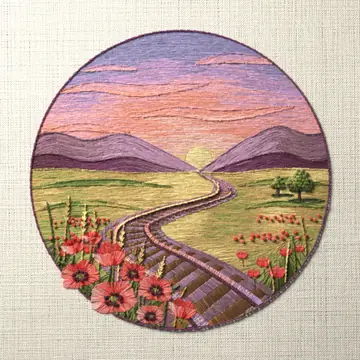
Advanced 3–8 in hoop · 24 colors
Train tracks through poppies at sunset
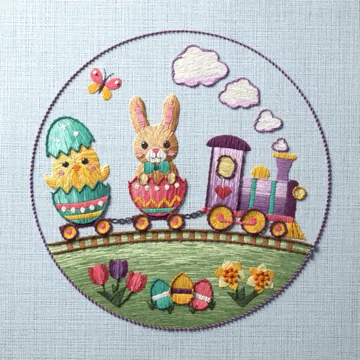
Advanced 3–8 in hoop · 24 colors
Small Easter train with egg cars
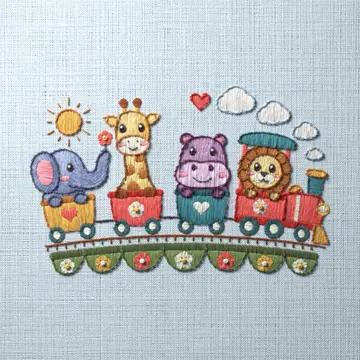
Advanced 3–8 in hoop · 24 colors
Baby safari train border
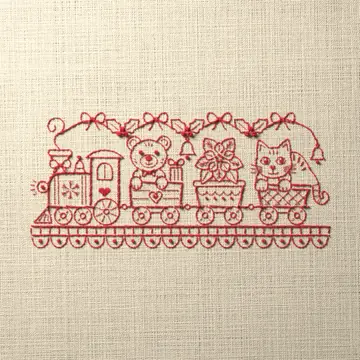
Intermediate 3–8 in hoop · 1 color
Redwork Christmas toy train border
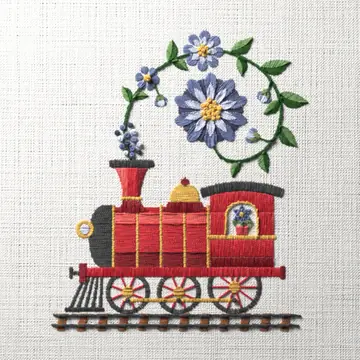
Advanced 3–8 in hoop · 11 colors
Little red train with flower steam
New to hand embroidery? Starting hand embroidery, step by step