Seashell letters hand embroidery pattern
Advanced · 20 colors · 27 letters
Download letter A (free PDF)PDF, US Letter · 34 KBFor your own stitching, gifts and handmade pieces you sell. Do not resell or share this PDF or copies of it. Selling, classes and kits: the rules
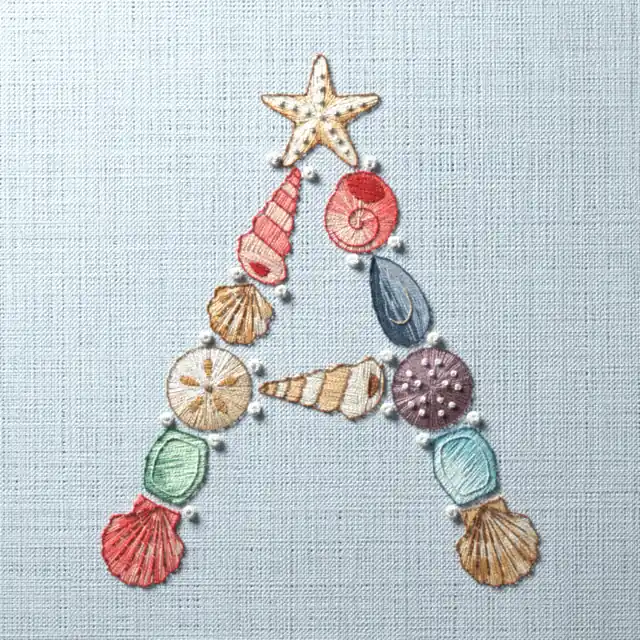
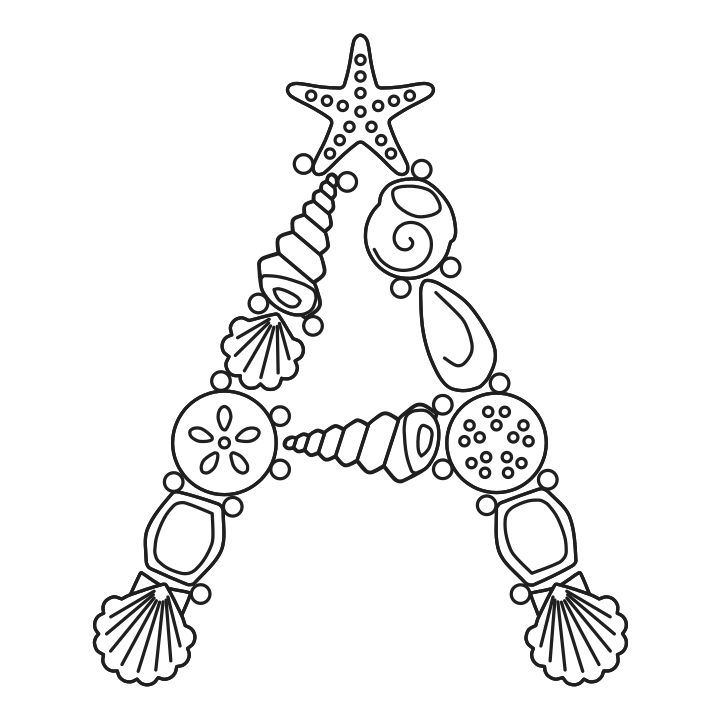
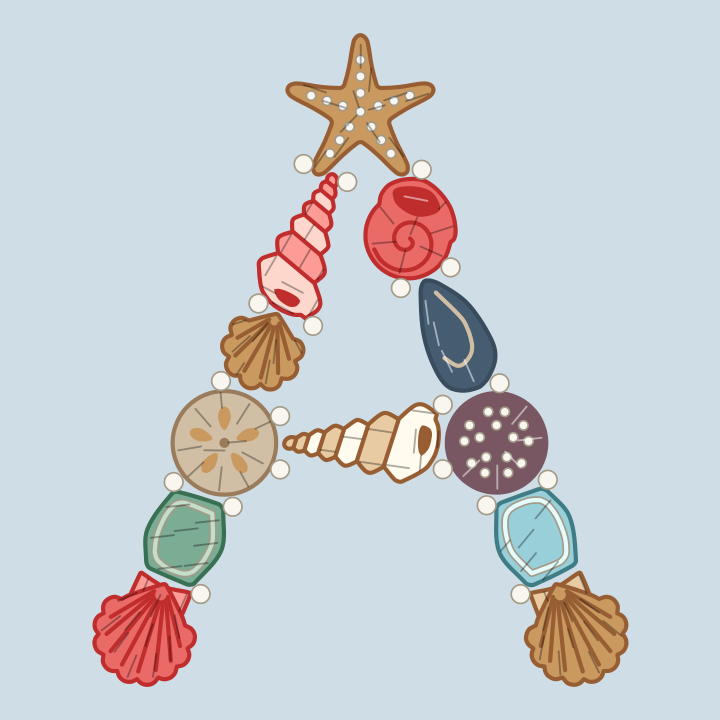
The letter A of the set. Every stroke is a row of beach finds laid end to end: a scallop shell at each free end, a starfish, sand dollar or sea urchin at most joins, long shells and coral on the straights, small shells and sea glass round the curves. The finds are shaded in one strand of long and short stitch and edged in split stitch; the auger shells and the mouths of the shells are satin stitch, and the ribs of the scallops are back stitch. French knots make the pearls in the notches and the bumps on the starfish and urchins. A letter fills a hoop alone, about two thirds of the hoop’s height. It is drawn for pale blue linen.
Size and details
Advanced. Uses long and short stitch, dozens of French knots and 20 colors; from a 6 inch hoop up the widest satin stitches are long.
Advanced. Uses long and short stitch, dozens of French knots, 18 colors and a great deal of stitching.
Advanced. Uses long and short stitch, 15 colors and a great deal of stitching.
Advanced. Uses long and short stitch, dozens of French knots, 17 colors and a great deal of stitching; from a 6 inch hoop up the widest satin stitches are long.
Advanced. Uses long and short stitch, dozens of French knots, 14 colors and a great deal of stitching; from a 6 inch hoop up the widest satin stitches are long.
Advanced. Uses long and short stitch and 16 colors; from a 6 inch hoop up the widest satin stitches are long.
Advanced. Uses long and short stitch, 17 colors and a great deal of stitching.
Advanced. Uses long and short stitch, dozens of French knots, eleven colors and a great deal of stitching; from a 6 inch hoop up the widest satin stitches are long.
Advanced. Uses long and short stitch and 14 colors; from a 6 inch hoop up the widest satin stitches are long.
Advanced. Uses long and short stitch and 17 colors; from a 6 inch hoop up the widest satin stitches are long.
Advanced. Uses long and short stitch, 18 colors and a great deal of stitching.
Intermediate. Uses long and short stitch and eleven colors.
Advanced. Uses long and short stitch, dozens of French knots, 19 colors and a great deal of stitching.
Advanced. Uses long and short stitch, dozens of French knots, 15 colors and a great deal of stitching; from a 6 inch hoop up the widest satin stitches are long.
Advanced. Uses long and short stitch, dozens of French knots and 15 colors.
Advanced. Uses long and short stitch, dozens of French knots, 19 colors and a great deal of stitching; from a 6 inch hoop up the widest satin stitches are long.
Advanced. Uses long and short stitch, 17 colors and a great deal of stitching; from a 6 inch hoop up the widest satin stitches are long.
Intermediate. Uses long and short stitch and 17 colors.
Intermediate. Uses long and short stitch and 14 colors.
Advanced. Uses long and short stitch, 16 colors and a great deal of stitching; from a 6 inch hoop up the widest satin stitches are long.
20 colors of floss and 5 kinds of stitch:
18 colors of floss and 6 kinds of stitch:
15 colors of floss and 5 kinds of stitch:
17 colors of floss and 6 kinds of stitch:
14 colors of floss and 6 kinds of stitch:
16 colors of floss and 5 kinds of stitch:
17 colors of floss and 5 kinds of stitch:
11 colors of floss and 6 kinds of stitch:
14 colors of floss and 5 kinds of stitch:
18 colors of floss and 5 kinds of stitch:
19 colors of floss and 6 kinds of stitch:
15 colors of floss and 6 kinds of stitch:
19 colors of floss and 5 kinds of stitch:
16 colors of floss and 6 kinds of stitch:
- Long and short stitch
- Split stitch
- French knot
- Satin stitch
- Back stitch
- Straight stitch
- Which stitch goes where
- Long and short stitch
- Split stitch
- Satin stitch
- French knot
- Back stitch
- Straight stitch
- Which stitch goes where
- Long and short stitch
- Split stitch
- Satin stitch
- French knot
- Straight stitch
- Back stitch
- Which stitch goes where
| Hoop | Letter | Inches | Centimeters | Satin stitch up to |
|---|---|---|---|---|
| 3 in (8 cm) | 1.6 in (4.1 cm) | 1.3 × 1.6 in | 3.3 × 4.1 cm | 1/8 in (3 mm) |
| 4 in (10 cm) | 2.3 in (5.8 cm) | 1.9 × 2.3 in | 4.8 × 5.8 cm | 1/4 in (6 mm) |
| 5 in (13 cm) | 3.1 in (7.9 cm) | 2.6 × 3.1 in | 6.6 × 7.9 cm | 5/16 in (8 mm) |
| 6 in (15 cm) | 3.9 in (9.9 cm) | 3.2 × 3.9 in | 8.1 × 9.9 cm | 3/8 in (10 mm) |
| 8 in (20 cm) | 5.4 in (13.7 cm) | 4.5 × 5.5 in | 11.4 × 14 cm | 1/2 in (13 mm) |
- In an 8 inch hoop the widest satin stitch shape is 1/2 in (13 mm) across. Satin stitches longer than about 12 mm (just under 1/2 in) tend to work loose: divide the shape into sections, or work it in long and short stitch.
- In a 3 or 4 inch hoop the French knots are drawn smaller than about 2 mm (a little over 1/16 in). Use one strand of floss for them there, or choose a larger hoop.
- In a 3 or 4 inch hoop the French knots are drawn smaller than about 2 mm (a little over 1/16 in). Use one strand of floss for them there, or choose a larger hoop.
- In an 8 inch hoop the widest satin stitch shape is 9/16 in (14 mm) across. Satin stitches longer than about 12 mm (just under 1/2 in) tend to work loose: divide the shape into sections, or work it in long and short stitch.
- In a 3 or 4 inch hoop the French knots are drawn smaller than about 2 mm (a little over 1/16 in). Use one strand of floss for them there, or choose a larger hoop.
The pattern is drawn inside a circle about half an inch (1.3 cm) smaller all around than the hoop.
What you need
- DMC 842 Very Light Beige BrownSand dollars (lighter), mussel shells (light)
- DMC 840 Medium Beige BrownSand dollars (darker), sand dollar hearts
- DMC 436 TanStarfish and cockle shells (lighter), scallop shells (middle light), sand dollar petals
- DMC 3740 Dark Antique VioletSea urchins
- DMC 3865 Winter WhitePearls, starfish bumps and urchin bumps
- DMC 434 Light BrownScallop shells and auger shells (dark), starfish (darker) and 2 more parts
- DMC 352 Light CoralAuger shells (middle dark), scallop shells (light)
- DMC 347 Very Dark SalmonScallop shells and auger shells (darkest), moon snails and shell mouths (darker)
- DMC 351 CoralScallop shells (middle dark), moon snails (lighter)
- DMC 738 Very Light TanAuger shells (middle light), scallop shells (lightest)
- DMC 503 Medium Blue GreenSea glass (light)
- DMC 501 Dark Blue GreenSea glass (darkest)
- DMC 504 Very Light Blue GreenLight on the glass (darker)
- DMC 3766 Light Peacock BlueSea glass (lightest)
- DMC 3809 Very Dark TurquoiseSea glass (dark)
- DMC 747 Very Light Sky BlueLight on the glass (lighter)
- DMC 712 CreamAuger shells (lightest)
- DMC 353 PeachAuger shells (light)
- DMC 930 Dark Antique BlueMussel shells (middle)
- DMC 3750 Very Dark Antique BlueMussel shells (dark)
Skeins: one of each color is enough. An estimate for the largest size, the 8 inch hoop: the length of each line and the area of each filled shape, a fifth added for tails and ends, a tenth of every 8 m (8.7 yd) skein kept spare.
On linens. Wash and press the piece first. A pillowcase takes its design in the middle of the hem band; a napkin or a handkerchief in one corner, set on the diagonal. Keep the stitches short and low, and press face down on soft cloth. How to embroider pillowcases and napkins has the sizes and the places.
In a hoop. The floss is six-strand cotton; the stitch guide says how many strands to use. You also need a hoop, an embroidery needle (a size 9 or 10 for one strand, 7 to 9 for two or three) and plain cotton or linen fabric. To frame the piece in its hoop, cut a square 3 inches (8 cm) wider than the hoop: a 9 inch (23 cm) square for a 6 inch hoop.
When it is stitched, how to finish a hoop shows how to back it for the wall.
Stitch guide
- Put the pattern on the fabric (how to transfer a pattern) and the fabric in the hoop.
- Stitch the filled parts first, what lies behind before what lies in front of it.
- Then stitch the lines: the fine strokes and the outlines over the edges of the filled parts.
- Keep the knots for the end, so that the hoop and your hand do not flatten them.
Begin with no knot on the back where it is seen and washed, as on a towel, a napkin or clothes; for a piece in a hoop a small knot is fine. End each thread by running the needle under the backs of a few stitches. (Starting and ending a thread shows how.) Use the strands this list gives, and begin as it says, also where a page about a stitch names another number or begins with a knot.
- Long and short stitch 1 strandSand dollars, sea urchins, starfish, scallop shells, sea glass, cockle shells, moon snails, mussel shells
- Split stitch 1 strandSand dollars, sea urchins, starfish, scallop shells, sea glass, light on the glass, auger shells, cockle shells, moon snails, mussel shells
- Satin stitch 2 strandsSand dollar petals, scallop shells, auger shells, shell mouths
- French knot 1 to 2 strands, two wrapsSand dollar hearts, urchin bumps, starfish bumps, pearls
- Back stitch 1 strandScallop shells, auger shells, cockle shells
Getting it onto your fabric
The PDF holds the pattern twice at actual size: once as drawn, and once mirrored for an iron-on transfer pen. Print it at 100% with scaling off and check the one-inch square (25.4 mm) with a ruler before you trace. How to transfer a pattern explains tracing, carbon paper, the sticky wash-away sheet for knits, denim and dark cloth, and the other ways. The files are under Downloads.
Downloads
- Download letter A (free PDF) A, PDF, US Letter, 3 pages, for a 6 inch (15 cm) hoop
- Download letter A, A4 (free PDF) A, PDF, A4, 3 pages, for a 6 inch (15 cm) hoop
More patterns like this
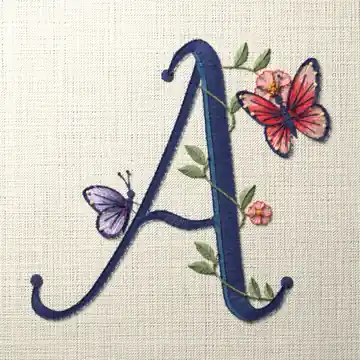
Advanced 27 letters · 15 colors
Letters with butterflies
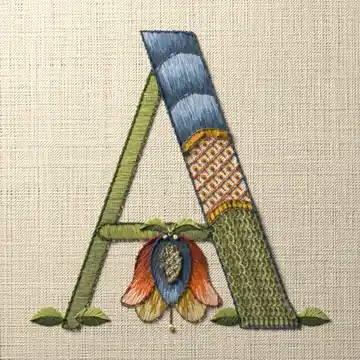
Advanced 27 letters · 15 colors
Crewel letters
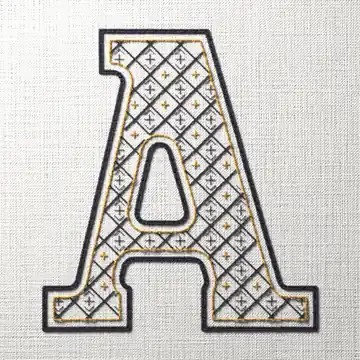
Easy 27 letters · 2 colors
Blackwork letters
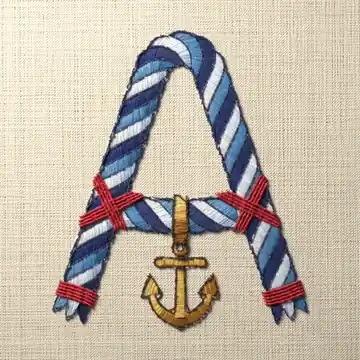
Intermediate 27 letters · 16 colors
Nautical rope letters
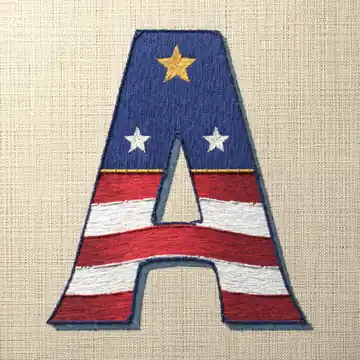
Advanced 27 letters · 10 colors
Stars and stripes letters
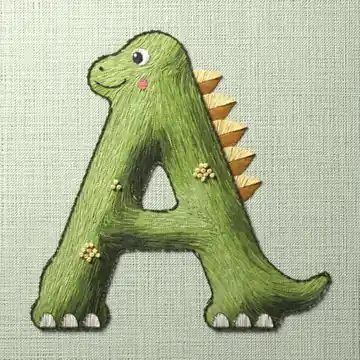
Advanced 27 letters · 9 colors
Dinosaur letters
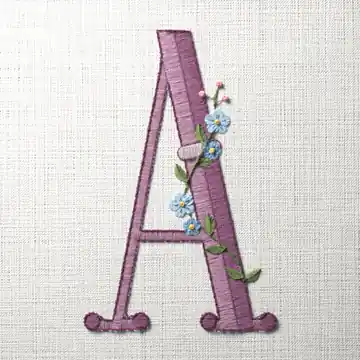
Intermediate 27 letters · 11 colors
Tall Victorian letters
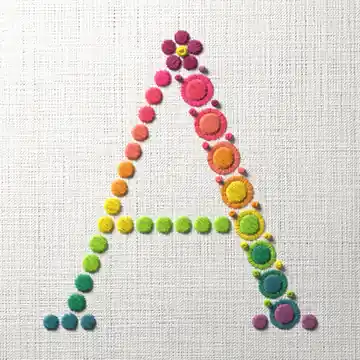
Intermediate 27 letters · 10 colors
Dotted letters
New to hand embroidery? Starting hand embroidery, step by step