Small easy Noah’s ark, rainbow and dove hand embroidery pattern
Easy · 7 colors · 5 kinds of stitch
Download free PDFPDF, US Letter · 73 KBFor your own stitching, gifts and handmade pieces you sell. Do not resell or share this PDF or copies of it. Selling, classes and kits: the rules
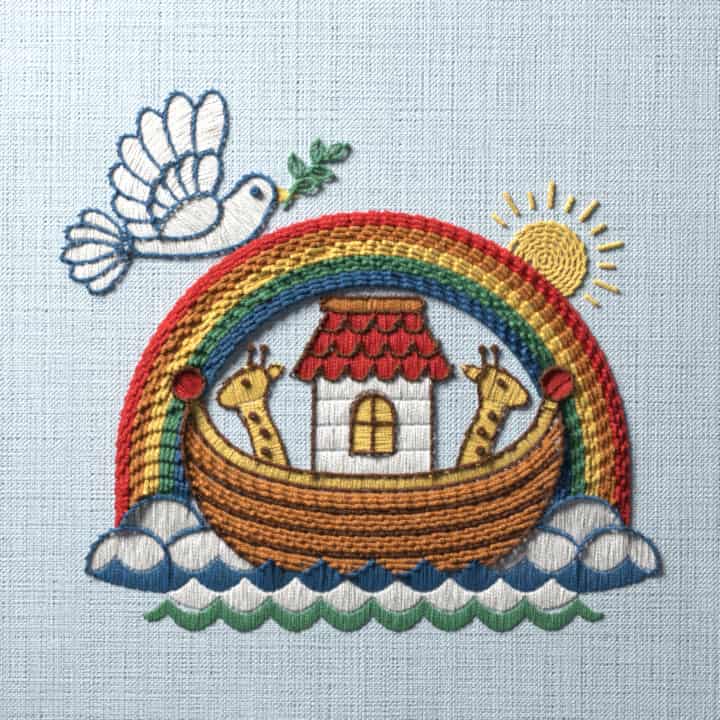
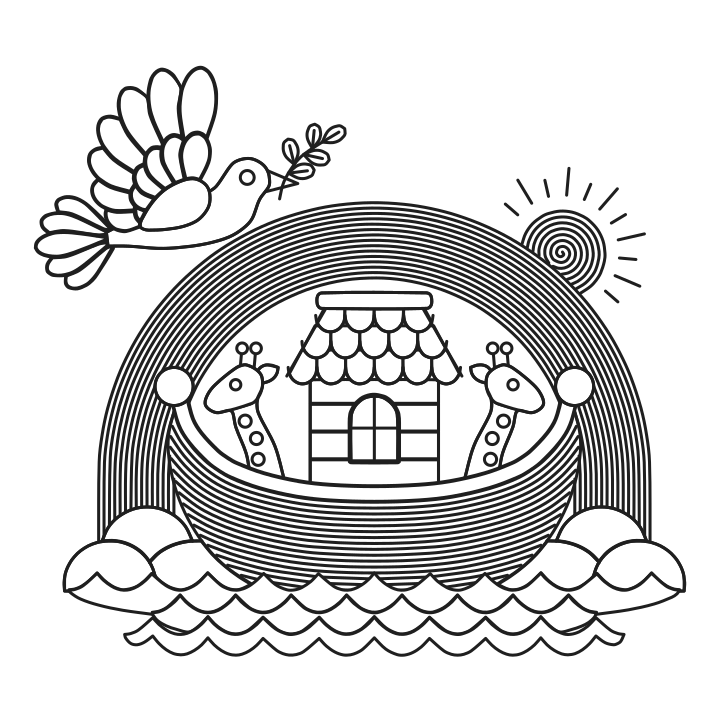
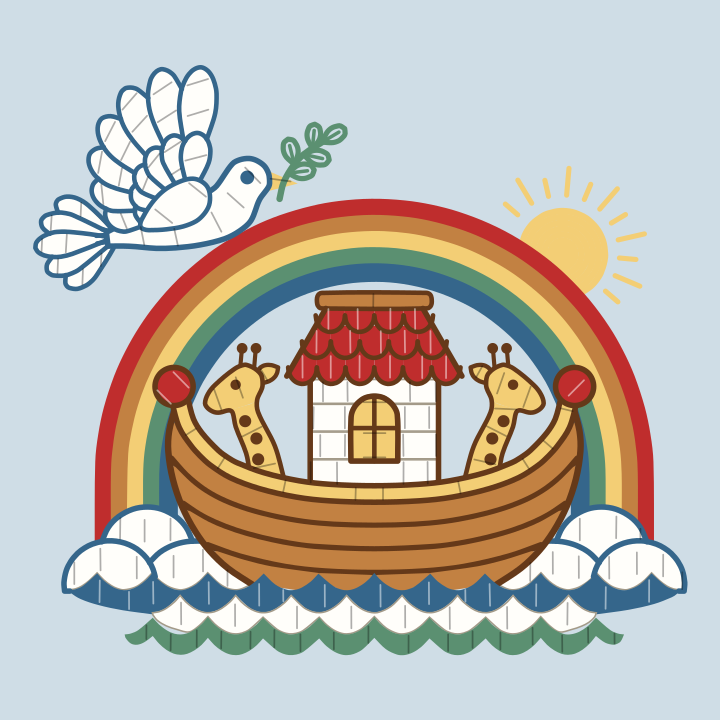
A round ark floats square on under a whole rainbow, with two giraffes looking out over the rail, and a white dove flies in with an olive sprig. The rainbow is five colors, each three close rows of stem stitch, and more rows of stem stitch make the planks and wind round and round to make the sun. The dove, clouds, giraffes, cabin, roof shingles and waves are short satin stitch, with fine stem stitch round all but the waves. The olive leaves are lazy daisy stitch, the sun’s rays are straight stitch, and the eyes and the giraffes’ spots are French knots. It is drawn for pale blue linen. In the picture of where the colors go, the fine lines show which way the stitches lie.
Size and details
Easy. In a hoop of 6 inches or less: short satin stitches, no shading; in a larger hoop the widest satin stitches are long.
7 colors of floss and 5 kinds of stitch:
| Hoop | Inches | Centimeters | Satin stitch up to |
|---|---|---|---|
| 3 in (8 cm) | 1.7 × 1.5 in | 4.3 × 3.8 cm | 1/8 in (3 mm) |
| 4 in (10 cm) | 2.5 × 2.3 in | 6.4 × 5.8 cm | 3/16 in (5 mm) |
| 5 in (13 cm) | 3.4 × 3 in | 8.6 × 7.6 cm | 1/4 in (6 mm) |
| 6 in (15 cm) | 4.2 × 3.8 in | 10.7 × 9.7 cm | 5/16 in (8 mm) |
| 8 in (20 cm) | 5.9 × 5.3 in | 15 × 13.5 cm | 7/16 in (11 mm) |
- In a 3, 4 or 5 inch hoop the French knots are drawn smaller than about 2 mm (a little over 1/16 in). Use one strand of floss for them there, or choose a larger hoop.
- In a 3 inch hoop the shortest lazy daisy loops are drawn smaller than about 2 mm (a little over 1/16 in). Use one strand of floss for them there, or choose a larger hoop.
The pattern is drawn inside a circle about half an inch (1.3 cm) smaller all around than the hoop.
What you need
- DMC 3821 StrawRainbow (lightest), giraffes, rail, sun, window, sun rays, giraffe ears and bill
- DMC 347 Very Dark SalmonRainbow (dark), roof shingles and post tops
- DMC 976 Medium Golden BrownPlanks and roof ridge (lighter), rainbow (light)
- DMC 502 Blue GreenRainbow and waves (middle), olive leaves and olive sprig
- DMC 312 Very Dark Baby BlueWaves (dark), dove outline, cloud edges and dove eye, rainbow (darkest)
- DMC BLANC WhiteClouds, wing feathers, cabin walls, dove body, tail and wing shoulder, waves (light)
- DMC 801 Dark Coffee BrownPlanks (darker), rail edges, shingle edges and giraffe outline and 8 more parts
All it stitches
Planks and roof ridge (darker), rail edges, shingle edges, giraffe outline, hull outline, window frame, cabin, roof edges, giraffe horns, giraffe spots and giraffe eyes
Skeins: one of each color is enough. An estimate for the 8 inch hoop, from the length of each line and the area of each filled shape, with a fifth added for tails.
On a soft blanket. Fleece and plush swallow fine stitches and stretch: lay a wash-away film on top, hoop a backing and baste the blanket to it, and take four to six strands. Do not iron fleece; most of it melts. On a knit, use a sticky wash-away sheet. How to embroider fleece and plush has the steps.
In a hoop. The floss is six-strand cotton; the stitch guide says how many strands to use. You also need a hoop, an embroidery needle (a size 9 or 10 for one strand, 7 to 9 for two or three, and 3 to 5 for four or more) and plain cotton or linen fabric, in pale blue, the color it is drawn for. To frame the piece in its hoop, cut a square 3 inches (8 cm) wider than the hoop: a 9 inch (23 cm) square for a 6 inch hoop.
When it is stitched, how to finish a hoop shows how to back it for the wall.
Stitch guide
- Put the pattern on the fabric (how to transfer a pattern) and the fabric in the hoop.
- Stitch the filled parts first, what lies behind before what lies in front of it.
- Then stitch the lines: stems, veins and outlines over the edges of the filled parts.
- Keep the knots for the end, so that the hoop and your hand do not flatten them.
Begin with no knot on the back where it is seen and washed, as on a towel, a napkin or clothes; for a piece in a hoop a small knot is fine. End each thread by running the needle under the backs of a few stitches. (Starting and ending a thread shows how.) Use the strands this list gives, and begin as it says, also where a page about a stitch names another number or begins with a knot.
- Stem stitch 1 to 6 strands6 strands: rainbow4 or 6 strands: planks4 strands: sun, hull outline, olive sprig3 strands: cloud edges, cabin, roof edges, rail edges2 or 3 strands: window frame, dove outline2 strands: shingle edges, roof ridge1 or 2 strands: giraffe outline
- Straight stitch 3 to 6 strands6 strands: sun rays4 strands: giraffe horns3 strands: olive leaves
- Satin stitch 2 to 3 strands3 strands: clouds, giraffes, cabin walls, window, roof shingles, roof ridge, rail, post tops, waves, tail, bill, dove body, wing feathers, wing shoulder2 strands: giraffe ears
- French knot 2 strands, two wrapsGiraffe horns, giraffe spots, giraffe eyes, dove eye
- Lazy daisy stitch 4 strandsOlive leaves
Getting it onto your fabric
The PDF holds the pattern twice at actual size: once as drawn, and once mirrored for an iron-on transfer pen. Print it at 100% with scaling off and check the one-inch square (25.4 mm) with a ruler before you trace. How to transfer a pattern explains tracing, carbon paper, the sticky wash-away sheet for knits, denim and dark cloth, and the other ways. The files are under Downloads.
Downloads
- Download free PDF PDF, US Letter, 3 pages, for a 6 inch (15 cm) hoop
- Download free PDF, A4 PDF, A4, 3 pages, for a 6 inch (15 cm) hoop
More patterns like this
Advanced 3–8 in hoop · 15 colors
Noah’s ark animal border for a hem
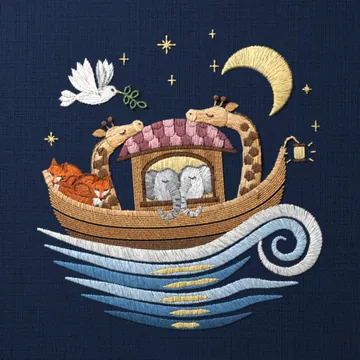
Advanced prints 3–14 in · 24 colors
Noah’s ark under the stars
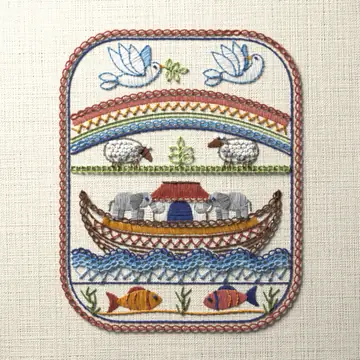
Advanced 3–8 in hoop · 12 colors
Noah’s ark stitch sampler
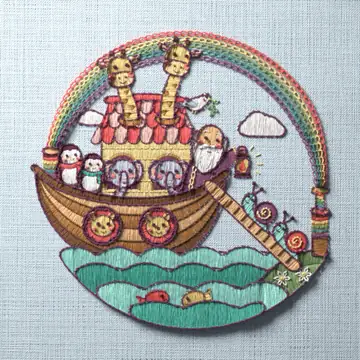
Advanced prints 3–14 in · 17 colors
Noah’s ark with two late snails
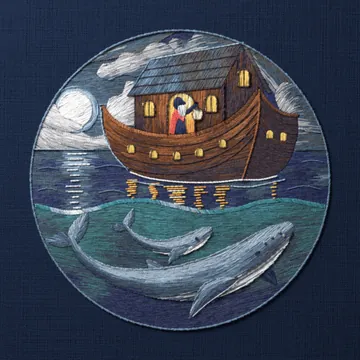
Advanced prints 3–14 in · 20 colors
Large Noah’s ark at sea by moonlight
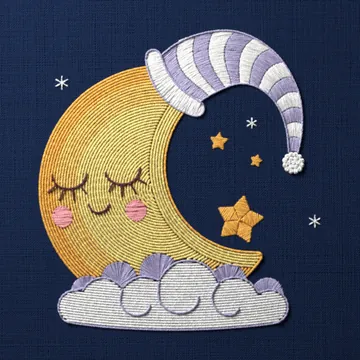
Easy prints 3–14 in · 7 colors
Easy sleepy moon with eyelashes
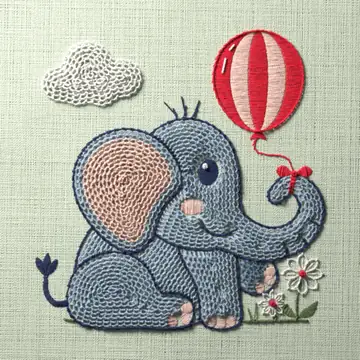
Easy prints 3–14 in · 7 colors
Easy baby elephant with a balloon
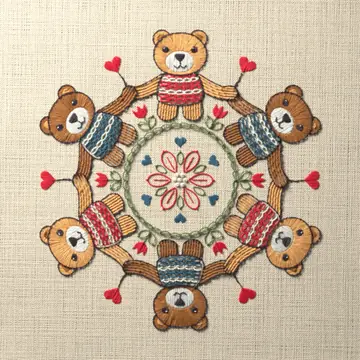
Easy prints 3–14 in · 7 colors
Teddy bears holding hands, easy border
New to hand embroidery? Starting hand embroidery, step by step