Noah’s ark animal border for a hem hand embroidery pattern
Advanced · 15 colors · 9 kinds of stitch
Download free PDFPDF, US Letter · 81 KBFor your own stitching, gifts and handmade pieces you sell. Do not resell or share this PDF. What you may do, in full
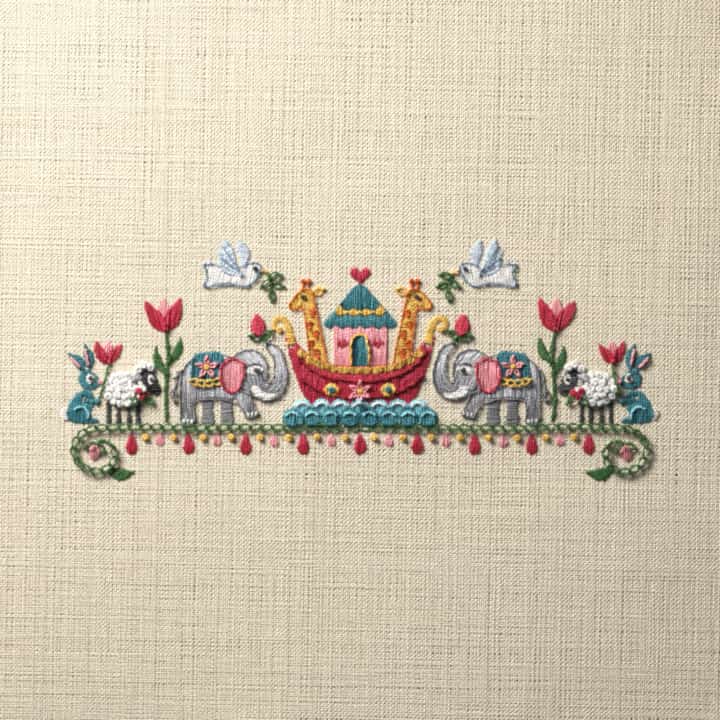
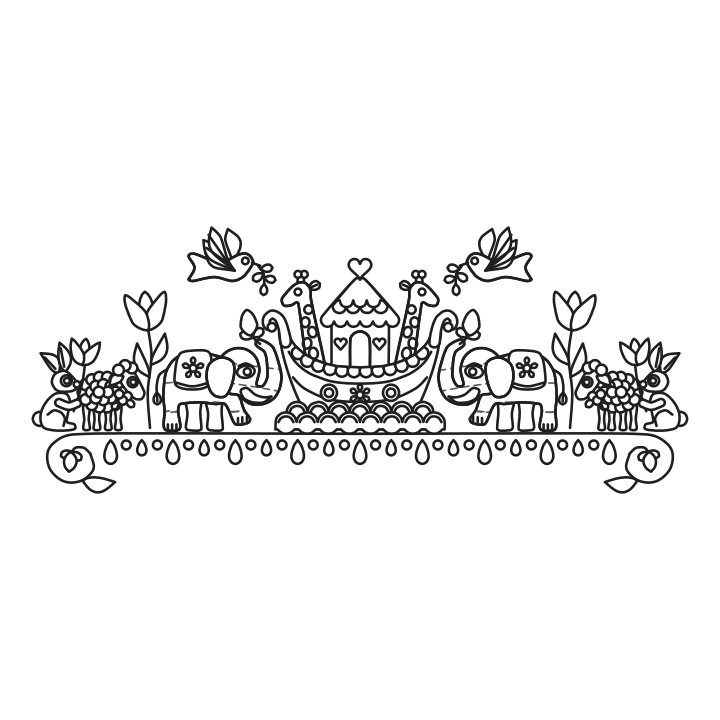
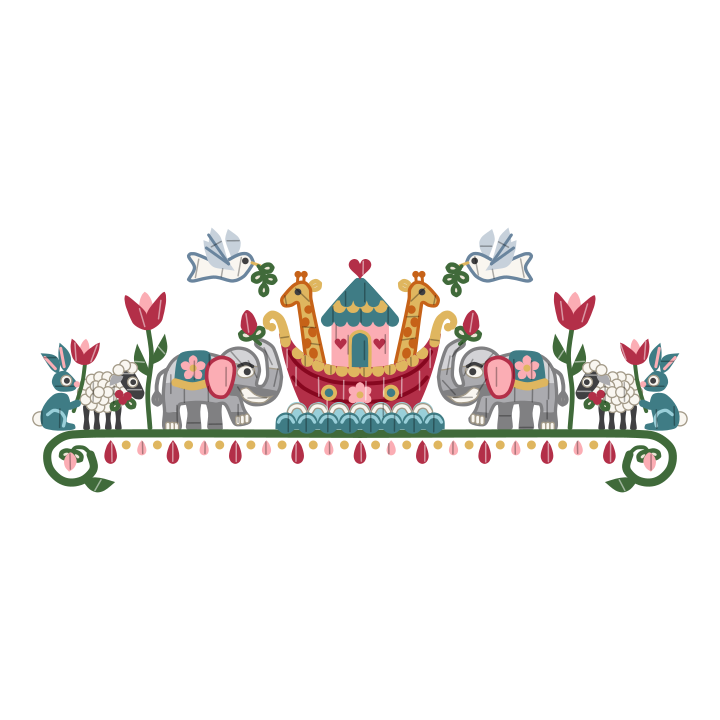
A planked ark with gold curled ends floats on two rows of scalloped waves at the center of the band, with a giraffe at each rail and a heart on the ridge of its roof. An elephant, a woolly sheep and a rabbit come in from each side; every elephant carries a tulip bud in its trunk and every rabbit holds a tulip, while a dove flies in from each side with an olive sprig. The ark, the rabbits, the tulips and the hanging drops are satin stitch, the elephants are long and short stitch, and the sheep’s wool is French knots. The ground line with its scrolled ends and the trim of each saddle are chain stitch, with lazy daisy flowers and sprigs. Stem and split stitch make the outlines and fine stems, with a little back stitch and straight stitch on the elephants’ brows, toenails and the rabbits’ ears. In the picture of where the colors go, the fine lines show which way the stitches lie.
Size and details
Advanced. Uses long and short stitch, dozens of French knots and 15 colors; from a 6 inch hoop up the widest satin stitches are long.
15 colors of floss and 9 kinds of stitch:
- Stem stitch
- Satin stitch
- Long and short stitch
- Split stitch
- Lazy daisy stitch
- Straight stitch
- Chain stitch
- French knot
- Back stitch
- Which stitch goes where
| Hoop | Inches | Centimeters | Satin stitch up to |
|---|---|---|---|
| 3 in (8 cm) | 2 × 0.8 in | 5.1 × 2 cm | 1/8 in (3 mm) |
| 4 in (10 cm) | 2.9 × 1.2 in | 7.4 × 3 cm | 3/16 in (5 mm) |
| 5 in (13 cm) | 3.9 × 1.6 in | 9.9 × 4.1 cm | 5/16 in (8 mm) |
| 6 in (15 cm) | 4.9 × 2 in | 12.4 × 5.1 cm | 3/8 in (10 mm) |
| 8 in (20 cm) | 6.9 × 2.8 in | 17.5 × 7.1 cm | 1/2 in (13 mm) |
- In an 8 inch hoop the widest satin stitch shape is 1/2 in (13 mm) across. Satin stitches longer than about 12 mm (just under 1/2 in) tend to work loose: divide the shape into sections, or work it in long and short stitch.
- In a 3, 4, 5 or 6 inch hoop the French knots and the shortest lazy daisy loops are drawn smaller than about 2 mm (a little over 1/16 in). Use one strand of floss for them there, or choose a larger hoop.
The pattern is drawn inside a circle about half an inch (1.3 cm) smaller all around than the hoop.
What you need
- DMC 3346 Hunter GreenGround line, tulip stems, tulip leaves, olive sprigs and scroll leaves and 4 more parts
- DMC 3326 Light RoseCabin, elephant ears, tulip hearts and scroll buds, fringe (lighter) and 4 more parts
- DMC 3831 Dark RaspberryHull, tulips, ear outlines and garland berries, fringe (darker) and 2 more parts
- DMC 414 Dark Steel GrayElephant outlines, elephant far legs, elephant tails and tail tufts, elephants (dark)
- DMC 415 Pearl GrayElephants (light)
- DMC 318 Light Steel GrayElephants (middle), sheep ears
- DMC 3865 Winter WhiteWool curls, doves, sheep wool and eye whites, wave crests (lighter) and 3 more parts
- DMC 3809 Very Dark TurquoiseRabbits, roof, elephant saddles, door and porthole glass, waves (darker)
- DMC 3820 Dark StrawGiraffes, rail scallops, fringe knots, gold curls and roof scallops and 7 more parts
- DMC 3799 Very Dark Pewter GraySheep legs, sheep faces, eyes and lashes
- DMC 3766 Light Peacock BlueWaves (lighter), wave crests (darker), haunch lines
- DMC 3752 Very Light Antique BlueDove wings
- DMC 931 Medium Antique BlueDove outlines and wing feathers
- DMC 921 CopperGiraffe outlines, giraffe patches, giraffe horns and horn tips
- DMC 815 Medium GarnetPlanks
Skeins: one of each color is enough. An estimate for the largest size, the 8 inch hoop: the length of each line and the area of each filled shape, a fifth added for tails and ends, a tenth of every 8 m (8.7 yd) skein kept spare.
On clothes. Wash and dry the garment first. Denim and twill need no backing and take a sharp needle, embroidery or chenille; T-shirts, sweatshirts and other knits need a stabilizer that sticks or irons on. How to embroider on clothes has every step, and the placement chart says where a design goes.
In a hoop. The floss is six-strand cotton; the stitch guide says how many strands to use. You also need a hoop, an embroidery needle (a size 7 to 9 suits two or three strands) and plain cotton or linen fabric. To frame the piece in its hoop, cut a square 3 inches (8 cm) wider than the hoop: a 9 inch (23 cm) square for a 6 inch hoop.
When it is stitched, how to finish a hoop shows how to back it for the wall.
Stitch guide
- Put the pattern on the fabric (how to transfer a pattern) and the fabric in the hoop.
- Stitch the filled parts first, what lies behind before what lies in front of it.
- Then stitch the lines: stems, veins and outlines over the edges of the filled parts.
- Keep the knots for the end, so that the hoop and your hand do not flatten them.
Start each thread with a small knot on the back or one of the knotless starts, and end it by running the needle under the backs of a few stitches (starting and ending a thread). Use the strands this list gives, also where a page about a stitch names another number.
- Stem stitch 1 to 3 strandsTulip stems, elephant tails, ear outlines, bud stems, olive sprigs, scroll stems, planks
- Satin stitch 2 strandsTulip leaves, tulip hearts, tulips, elephant far legs, elephant saddles, tusks, elephant ears, eye whites, sheep legs, sheep wool, and 22 more
- Long and short stitch 1 strandElephants
- Split stitch 1 to 2 strandsElephant outlines, haunch lines, dove outlines, giraffe outlines, door frame, wave crests
- Lazy daisy stitch 2 strandsTail tufts, saddle daisies, bud leaves, garland leaves, olive sprigs, giraffe ears, hull daisy
- Straight stitch 1 to 3 strandsTail tufts, toenails, ear linings, wing feathers, dove bills, giraffe ears, giraffe horns
- Chain stitch 2 strandsSaddle edges, ground line
- French knot 1 to 2 strands, two wrapsDaisy hearts, eyes, wool curls, garland berries, noses, fringe knots, horn tips, curl tips, porthole glass
- Back stitch 1 strandLashes
Getting it onto your fabric
The PDF holds the pattern twice at actual size: once as drawn, and once mirrored for an iron-on transfer pen. Print it at 100% with scaling off and check the one-inch square (25.4 mm) with a ruler before you trace. How to transfer a pattern explains tracing, carbon paper and the other ways. The files are under Downloads.
Downloads
- Download free PDF PDF, US Letter, 3 pages, for a 6 inch (15 cm) hoop
- Download free PDF, A4 PDF, A4, 3 pages, for a 6 inch (15 cm) hoop
More patterns like this
Advanced 3–8 in hoop · 24 colors
Noah’s ark under the stars
Advanced 3–8 in hoop · 17 colors
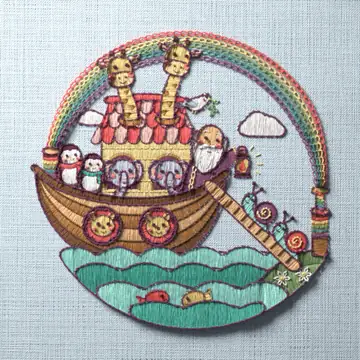
Noah’s ark with two late snails
Advanced 3–8 in hoop · 12 colors
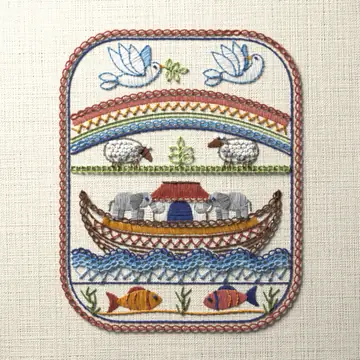
Noah’s ark stitch sampler
Advanced 3–8 in hoop · 20 colors
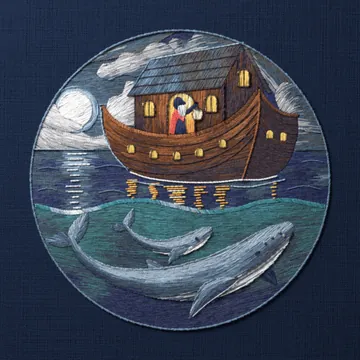
Large Noah’s ark at sea by moonlight
Advanced 3–8 in hoop · 15 colors
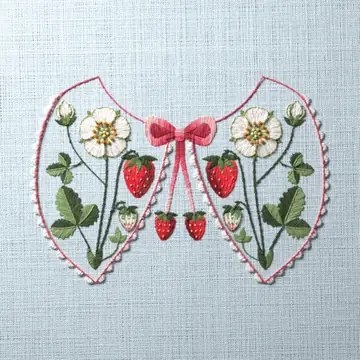
Wild strawberry collar corners
Advanced 3–8 in hoop · 15 colors
Christening gown with lily of the valley
Advanced 3–8 in hoop · 12 colors
Mirror work skirt border
Advanced 3–8 in hoop · 16 colors
Little goat for a kids’ dress
New to hand embroidery? Starting hand embroidery, step by step