Walrus in a bathtub hand embroidery pattern
Advanced · 16 colors · 4.4 × 4.3 in · 7 kinds of stitch

Download free PDFPDFPrints on US Letter and A4You may sell what you make from it by hand, in small quantities. The PDF itself is not to be sold or shared. Selling, classes and kits: the rules
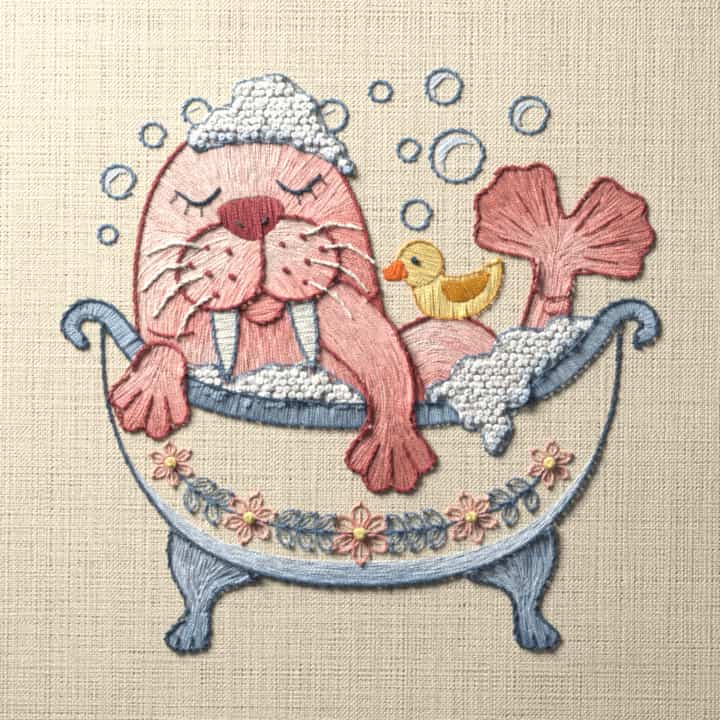
A portly walrus sits back in a clawfoot tub with his eyes shut and a cap of suds on his head. One flipper hangs over the near rim, the other over the left end, and his tail rises at the right behind a toy duck.
Size and details
Advanced. Uses long and short stitch over much of the design, more than a hundred French knots, 16 colors and a great deal of stitching; from a 6 inch hoop up the widest satin stitches are long.
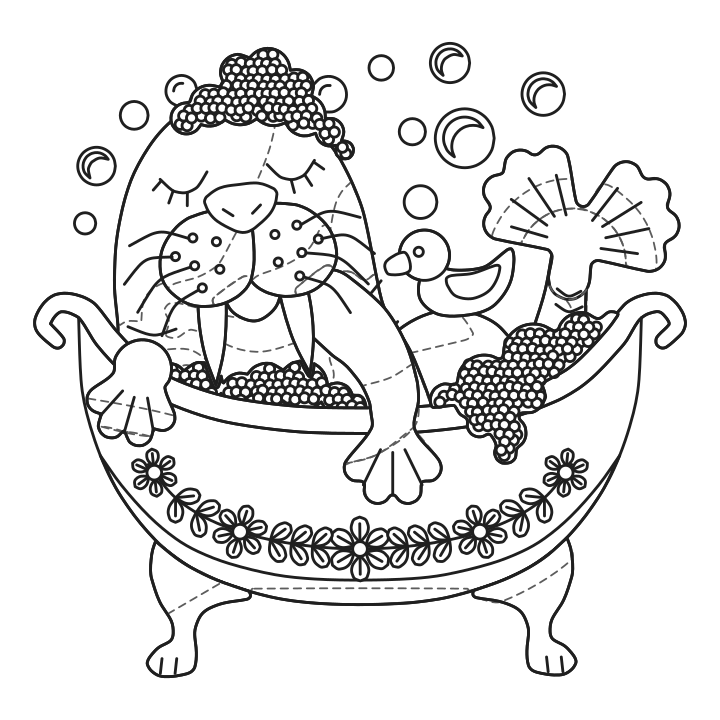
He is worked in long and short stitch in faded shell pinks with a stem stitch outline, and his whiskers are stem stitch in ivory. The rim, tusks, nose and duck are satin stitch, and the suds are French knots in white and pale blue. The daisies and leaves on the tub are lazy daisy stitch, and the bubbles are rings of stem stitch with satin stitch lights. In the picture of where the colors go, the fine lines show which way the stitches lie.
| Hoop | Inches | Centimeters | Satin stitch up to |
|---|---|---|---|
| 3 in (8 cm) | 1.8 × 1.7 in | 4.6 × 4.3 cm | 1/8 in (3 mm) |
| 4 in (10 cm) | 2.7 × 2.6 in | 6.9 × 6.6 cm | 3/16 in (5 mm) |
| 5 in (13 cm) | 3.6 × 3.5 in | 9.1 × 8.9 cm | 5/16 in (8 mm) |
| 6 in (15 cm) | 4.4 × 4.3 in | 11.2 × 10.9 cm | 3/8 in (10 mm) |
| 8 in (20 cm) | 6.2 × 6.1 in | 15.7 × 15.5 cm | 1/2 in (13 mm) |
- In an 8 inch hoop the widest satin stitch shape is 1/2 in (13 mm) across. Satin stitches longer than about 12 mm (just under 1/2 in) tend to work loose: divide the shape into sections, or work it in long and short stitch.
- In a 3, 4 or 5 inch hoop the French knots are drawn smaller than about 2 mm (a little over 1/16 in). Use one strand of floss for them there, or choose a larger hoop.
- In a 3 inch hoop the shortest lazy daisy loops are drawn smaller than about 2 mm (a little over 1/16 in). Use one strand of floss for them there, or choose a larger hoop.
On a towel. Wash and dry the towel first. To start with, put the bottom of the design 2 to 3 inches (5 to 7.5 cm) above the hem, in the middle or in a lower corner. Keep the stitches low, and press from the back. How to embroider a towel has every step, and the placement chart has the figures for other towels.
What you need
- Fabric
- Plain cotton or linen, cut 9 in (23 cm) square.
- Needle
- Embroidery needle, size 9 for 1 strand, size 7 for 2 or 3 (a lower number is a thicker needle).
- Floss
- 16 colors of six-strand cotton, listed below. DMC is a brand: another brand in a like color will do.
- Marker
- A pen or a sheet that suits the fabric: how to transfer a pattern says which.
Floss
- 1DMC 224 Very Light Shell PinkHead and chest and front flippers (light), belly (middle) and 3 more parts
- 2DMC 152 Medium Light Shell PinkHead and chest (dark), tail flippers and front flippers (middle) and 4 more parts
- 3DMC 225 Ultra Very Light Shell PinkHead and chest (lightest), whisker pads and belly (light)
- 4DMC 3721 Dark Shell PinkWalrus outline, flipper lines, nose, neck folds and whisker dots
- 5DMC 223 Light Shell PinkTail flippers and front flippers (dark), head and chest (darkest)
- 6DMC BLANC WhiteSuds, suds knots (lighter)
- 7DMC 3752 Very Light Antique BlueTub shadow and tub feet (lighter), suds knots (darker), bubble lights
- 8DMC 931 Medium Antique BlueSuds edge, soap bubbles, tusk outline and garland stem, garland leaves (darker)
- 9DMC 932 Light Antique BlueTub rim, tub feet and tub shadow (darker), garland leaves (lighter)
- 10DMC 930 Dark Antique BlueTub outline
- 11DMC 3822 Light StrawToy duck and daisy hearts
- 12DMC 3750 Very Dark Antique BlueClosed eyes, eyelashes, claws, nostrils and duck eye
- 13DMC 712 CreamTusks (lighter), whiskers
- 14DMC 3047 Light Yellow BeigeTusks (darker)
- 15DMC 783 Medium TopazDuck outline and duck wing
- 16DMC 922 Light CopperDuck bill
Skeins: one of each color is enough. An estimate for the 6 inch hoop, from the length of each line and the area of each filled shape, with a fifth added for tails.
How to stitch it
- New to hand embroidery? Start here.
- Print at 100%, trace the pattern onto the fabric, and put it in the hoop: inner ring under, drawing up, tight as a drum.
- Floss is six strands. Cut 18 inches (45 cm), pull out the number given one at a time, and lay them together.
- Begin with no knot on the back where it is seen and washed, as on a towel, a napkin or clothes; for a piece in a hoop a small knot is fine. End each thread by whipping it around the backs of four or five stitches, with one small hitch.
- Each small ring is one French knot. Each small loop is one lazy daisy: come up at its point. A fine broken line inside a shape is where two shades meet: trace it, do not stitch it.
- A number under “Where colors go” is a color of the list. The fine lines on the colors show which way the stitches lie.
Stitch in this order
Filled parts from the back of the picture forward, then lines, loops and knots. Where a stitch page names another number of strands, use the number here.
- Long and short stitch 1 strandBelly, tail flippers, head and chest, suds, tub shadow, tub feet, front flippers, whisker pads
- Satin stitch 2 strandsTub rim, lower lip, tusks, nose, toy duck, duck wing, duck bill, bubble lights
- Stem stitch3 strands: closed eyes2 or 3 strands: walrus outline, tub outline2 strands: neck folds, garland stem, claws, tusk outline, whiskers, soap bubbles1 or 2 strands: flipper lines1 strand: suds edge, bubble lights
- Straight stitch2 strands: nostrils1 strand: garland daisies, garland leaves, eyelashes
- Split stitch 1 strandDuck outline
- Lazy daisy stitch 2 strandsGarland daisies, garland leaves
- French knot two wraps2 strands: suds knots, daisy hearts1 strand: whisker dots, duck eye
When it is done, take off any lines that still show and finish the hoop.
More patterns like this
Advanced prints 3–14 in · 20 colors
Seal diving through golden kelp
Advanced prints 3–14 in · 24 colors
Walrus and calf in arctic snow
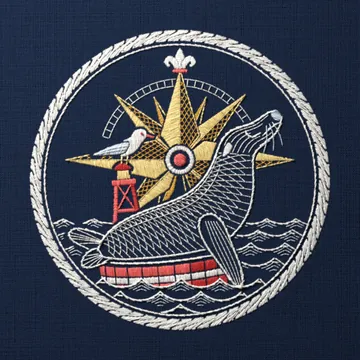
Intermediate 3–8 in hoop · 6 colors
San Francisco sea lion with a compass
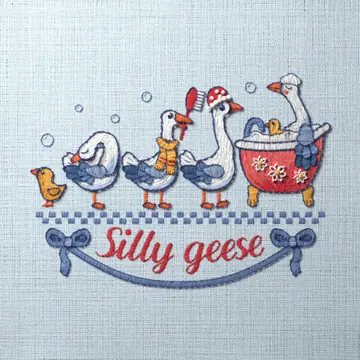
Advanced prints 3–14 in · 12 colors
Silly geese bath towel border
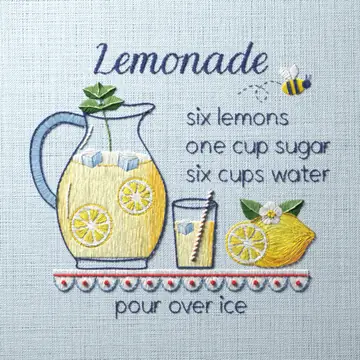
Advanced prints 3–14 in · 16 colors
Lemonade recipe kitchen towel
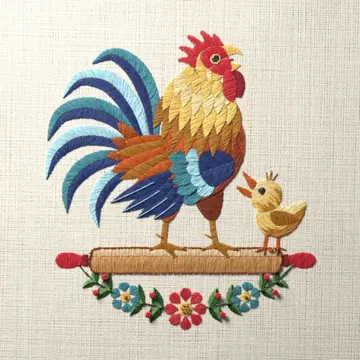
Advanced prints 3–14 in · 16 colors
Rooster tea towel topper
Advanced prints 3–14 in · 16 colors
Triceratops peeker with a flower frill
Advanced prints 3–14 in · 17 colors
Cry a river, build a bridge, get over it
New to hand embroidery? Starting hand embroidery, step by step