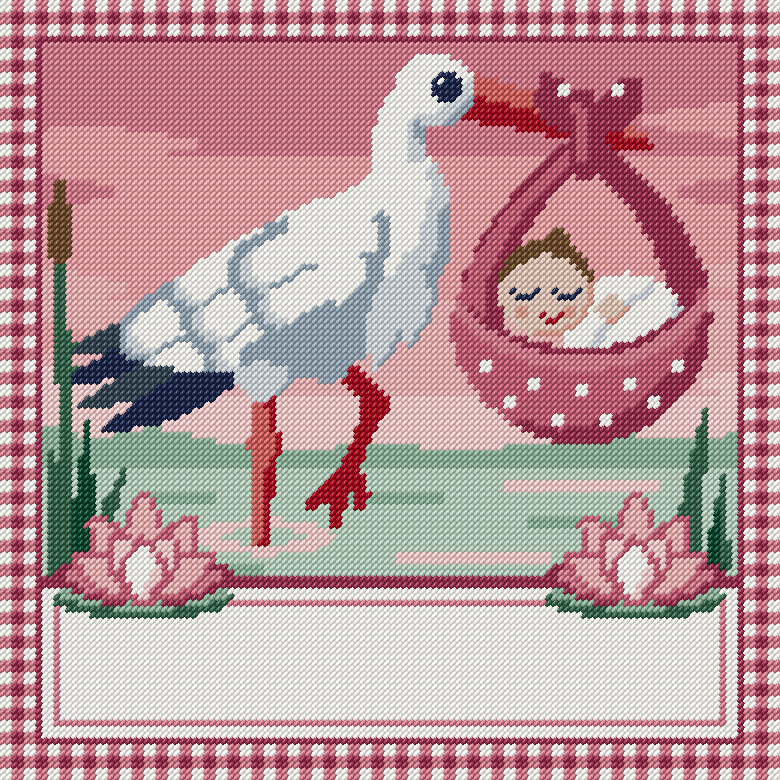
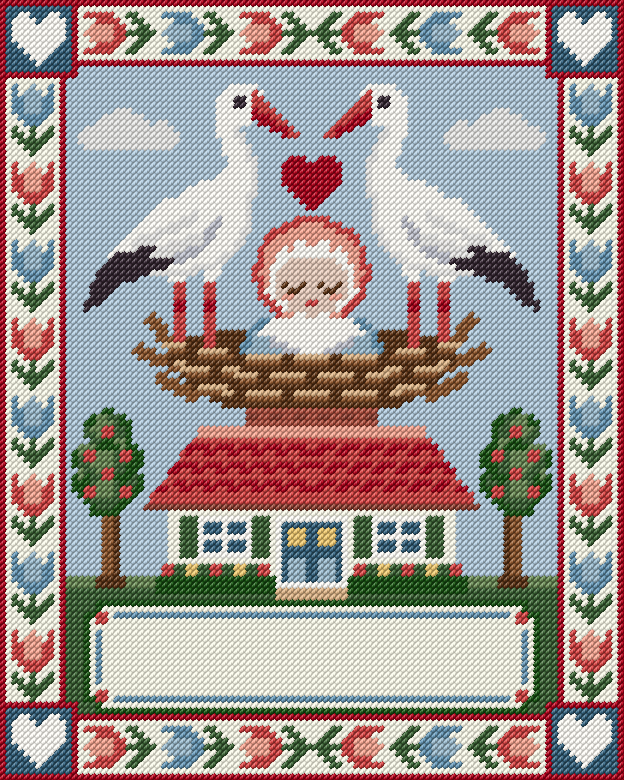
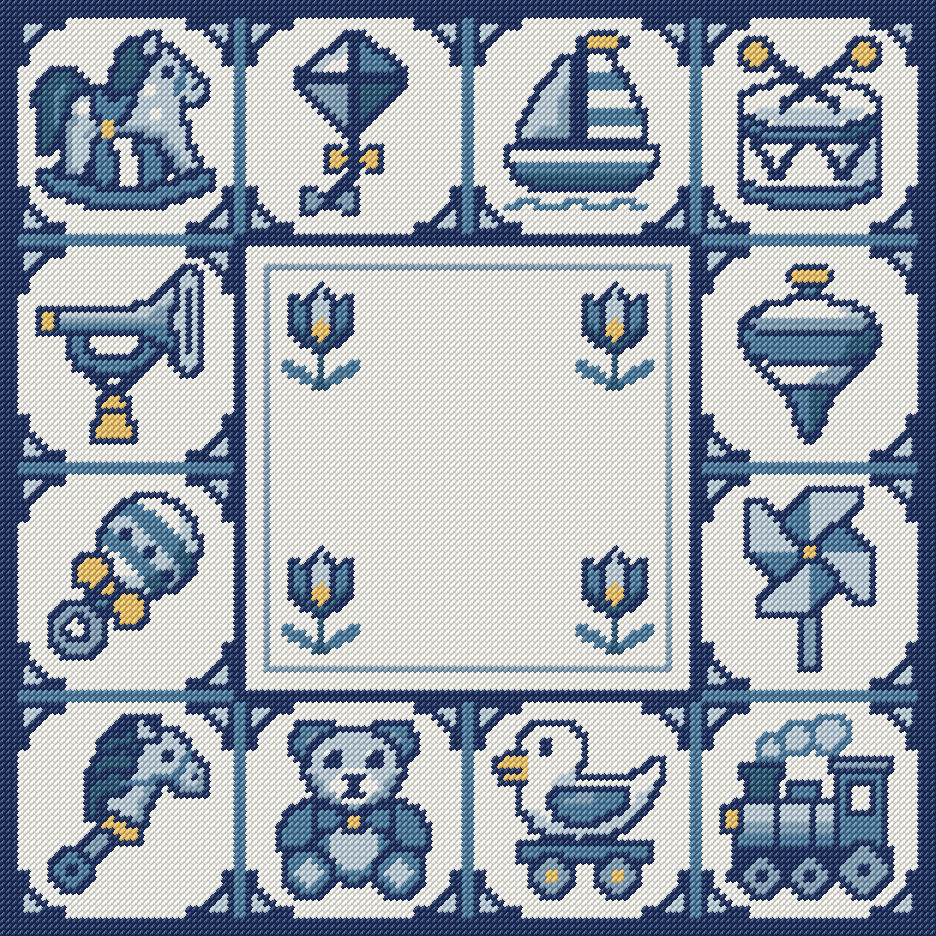
How to make a needlepoint birth announcement
Stitch the design before the birth and leave a plain panel of canvas bare in it. When the name, the day and the weight are known, chart them line by line, center them in the panel, stitch them, and fill in the ground, the plain background, round them last. A pillow 10 inches (25 cm) square on 13 mesh, canvas with 13 holes to the inch (2.5 cm), has room for a name of six letters an inch (2.5 cm) tall and two lines below it.
On this page
- What to do first
- What goes on a personalized birth announcement
- A birth announcement pillow or picture: three layouts
- Before the birth: everything but the panel
- After the birth: the words, step by step
- Dates, weights and fractions
- Twins, a second child, an adoption, a new name
- Colors, thread and stitches
- Finish it
- What goes wrong
- Questions people ask
What to do first
- Choose a design with a plain panel. The birth announcement patterns have one. So do the personalized pillows. On the page of a pattern with one panel, type a name to see it there and have it in the chart you print.
- Or lay out your own. Open a blank canvas of one of the sizes below in the pattern maker, keep the panel free, and draw above it. Many nursery designs are 72 stitches square. One of them fits above the panel of layout A below, with 16 stitches at each side of it, 4 rows above and 2 rows under it.
- Choose a pillow or a framed piece now, because it decides how far the letters stay from the edge.
- Stitch everything but the panel before the birth: the steps.
- Put the words in when you have them: the steps.
On this page the design is what is drawn, such as a stork or a moon. The ground is the plain background round it.
What goes on a personalized birth announcement
The name and the day are enough. The hour, the weight, the length and the place are extra, and a family may want none of them. The earliest dated British sampler that survives, of 1598, records a birth two years before: the name, the day of the month, the day of the week, the afternoon and the year.
Stitches across, in the three charted alphabets. A name is counted by its number of letters, the rest as they stand, without what is in brackets. The empty stitches are in the figures: in letters 5 high, 1 between two letters and 3 between two words; 10 high, 2 and 6; 13 high, 2 and 8.
| Line | For example | Characters | 5 high | 10 high | 13 high | Best height |
|---|---|---|---|---|---|---|
| First name | 4 letters | 4 | 18 | 36 | 52 | 13, or 18 in a script |
| First name | 6 letters | 6 | 28 | 55 | 79 | 13 |
| First name | 8 letters | 8 | 37 | 74 | 106 | 10 or 13 |
| Day | JUNE 8 2026 | 11 | 41 | 82 | 112 | 5 in a frame, 10 on a pillow |
| Day, the longest | SEPTEMBER 23 2026 | 17 | 69 | 138 | 192 | 5, or SEP |
| Hour | 7:42 AM | 7 | 26 | 52 | 72 | 5 or 10 |
| Weight | 7 LB 6 OZ | 9 | 32 | 64 | 88 | 5 or 10 |
| Weight in grams | 3345 G | 6 | 22 | 44 | 59 | 5 or 10 |
| Length | 20 IN (51 cm) | 5 | 16 | 32 | 46 | 5 or 10 |
| Weight and length together | 7 LB 6 OZ 20 IN (51 cm) | 15 | 51 | 102 | 142 | 5 or 10 |
| Place | 6 letters | 6 | 28 | 55 | 79 | 5 |
Capitals 5 stitches high are 3/8 inch (1 cm) on 13 mesh, for a framed piece read close by. From 6 feet (1.8 m) letters have to be 5/8 inch (1.6 cm) high, which is 9 stitches on 13 mesh, so on a pillow take 10. Alphabet charts have a script and other letters 10 to 18 high.
A birth announcement pillow or picture: three layouts
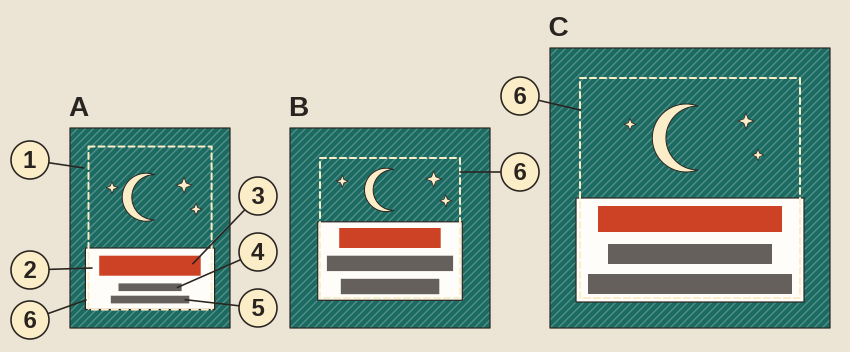
| A. Framed, 13 mesh | B. Pillow, 13 mesh | C. Pillow, 10 mesh | |
|---|---|---|---|
| Size | 8 x 10 inches (20 x 25 cm) | 10 x 10 inches (25 x 25 cm) | 14 x 14 inches (36 x 36 cm) |
| Stitches | 104 x 130 | 130 x 130, and two rows all round for the seam | 140 x 140, and two rows all round for the seam |
| Canvas to cut | 12 x 14 inches (30 x 36 cm) | 14 1/2 x 14 1/2 inches (37 x 37 cm) | 18 1/2 x 18 1/2 inches (47 x 47 cm) |
| Letters stay inside | 12 stitches from the edge, clear of the lip of the frame, the rim that laps over it | 1 1/2 inches (4 cm) inside the seam, 20 stitches | 1 1/2 inches (4 cm) inside the seam, 15 stitches |
| Panel | 84 x 40 | 94 x 51 | 114 x 52 |
| Stitches from the side of the piece to the panel | 10 | 18 | 13 |
| Rows above the panel, rows below it | 78, 12 | 61, 18 | 75, 13 |
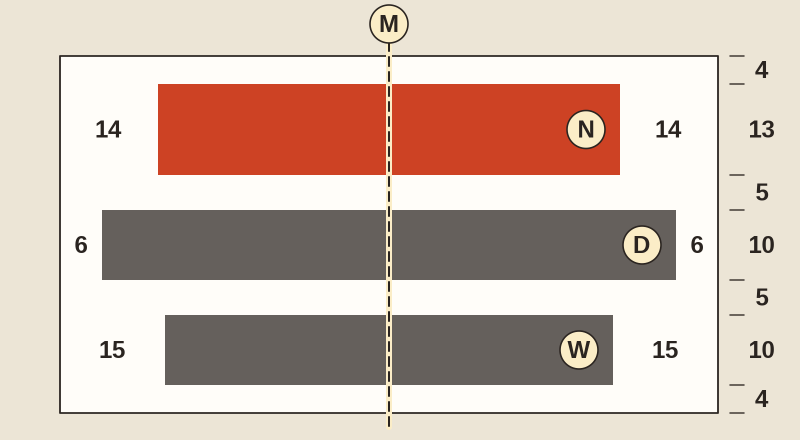
| Rows in the panel | 5, name 13, 5, day 5, 3, weight 5, 4 | 4, name 13, 5, day 10, 5, weight 10, 4 | 4, name 13, 6, day 10, 5, weight and length 10, 4 |
| Letters of a name that fit on a line, 5, 10 or 13 high | 16, 8 or 5 | 18, 9 or 6 | 22, 11 or 8 |
A name is counted by the last row, with two stitches free at each end of the line. A space between two names counts as a letter. It is for a plan, and the count on paper decides.
A day, an hour or a weight goes by its width in the table above and not by that row, because its figures and spaces are narrow. It fits when it is at least 4 stitches narrower than the panel: JUNE 8 2026 at 10 high is 82 wide, and fits the 94 of B.
In A a name of 6 to 8 letters goes in the capitals 10 high, with 6 rows above, 5 below it and 6 at the foot: 6 + 10 + 5 + 5 + 3 + 5 + 6 = 40.
A script 18 high has room for 7 letters on B and 8 on C. It is 5 rows taller than the capitals 13 high, and a letter such as g or y hangs 7 rows below the line. If you may want one, leave the panel 12 rows deeper from the start and the design above it 12 rows shorter. What is not used becomes ground.
Thread, as estimates, in tent stitch, the small slanted stitch over one crossing of the canvas, all colors together and measured as it goes in the needle: A takes about 128 yards (117 m), B 170 yards (156 m) and C 255 yards (233 m), the rows for the seam among them.
What fits in a panel that is drawn already
Count the panel's rows on the chart. These leave two rows free above and below, three between two lines of 5, four under a name, five between two lines of 10.
| Rows deep | Lines it holds |
|---|---|
| 9 | One line 5 high |
| 14 | One line 10 high |
| 17 | One line 13 high, or two lines 5 high |
| 23 | A name 10 high and one line 5 high |
| 26 | A name 13 high and one line 5 high |
| 29 | Two lines 10 high |
| 31 | A name 10 high and two lines 5 high |
| 34 | A name 13 high and two lines 5 high |
| 46 | A name 13 high and two lines 10 high |
What does not fit goes on the back: a cloth label has room for all of it.
Birth announcement charts in a book or a leaflet
Look for three things in a chart for a birth announcement: its size in stitches, a blank panel or room to make one, and an alphabet with the figures 0 to 9, which may come from somewhere else. Cross stitch charts of birth samplers and baby records serve as well: one square is one tent stitch, and the cloth they leave bare becomes ground to stitch.
| Look for | If it is there | If it is not there |
|---|---|---|
| The size in stitches | Work out the ground round the chart, as below | Count the squares. Most charts have a heavier line every ten squares: count the squares between two of them once, and then count the heavy lines |
| A panel | Count its rows and see what fits. A name 13 high and two lines 5 high take 34 rows | Leave out a part of the design, or add a panel below it, as below |
| An alphabet with figures | Count how many squares high a capital is, and write your longest line on squared paper to see how wide it comes | Take one from alphabet charts |
| Lines for name, day and weight | See that their middles lie one under another | Lay them out by the steps |
The ground round the chart. Subtract the width of the chart from the width of the piece, in stitches, and halve what is left. Do the same with the height. For a chart of 98 by 126:
| Framed, 13 mesh | Stitches | Ground at each side | Ground above and below | Canvas to cut |
|---|---|---|---|---|
| 8 x 10 inches (20 x 25 cm), layout A | 104 x 130 | (104 - 98) ÷ 2 = 3 | (130 - 126) ÷ 2 = 2 | 12 x 14 inches (30 x 36 cm) |
| 11 x 14 inches (28 x 36 cm) | 143 x 182 | (143 - 98) ÷ 2 = 22 1/2, so 22 and 23 | (182 - 126) ÷ 2 = 28 | 15 x 18 inches (38 x 46 cm) |
The first is too narrow, because the lip of a frame hides 3 or 4 stitches. Take the second. The drawing wants at least the 10 stitches that layout A has beside its panel, and any letters in it 12.
A panel added below. In a frame, add the 34 rows and 10 rows of ground under them, which keeps the letters 12 rows from the edge. That is 44 rows, so on 13 mesh cut the canvas 3 1/2 inches (9 cm) longer. On a pillow, with two lines 10 high, it is 46 rows and 18 of ground, 64 in all: 5 inches (13 cm) longer. Choose the frame or the insert, the cushion inside the pillow, after that.
Letters drawn as thin lines on the chart are backstitch. Work them over the finished ground.
A leaflet seldom has a year, and its color numbers may be gone: stitching from a leaflet. What a pattern book has to tell you is in needlepoint books.
Before the birth: everything but the panel
- Cut the canvas to the size in the table, or on the pattern's page, and tape its edges: how to prepare canvas. Thread and needle are in the table below.
- Mark the middle both ways with long stitches in sewing thread.
- Mark the outline of the piece, half its stitches to each side of the middle. For B that is 65 to the left and right, and 65 up and down.
- Mark the panel. For B count 61 rows down from the top of the outline and 18 stitches in from its sides, and run sewing thread round the 94 by 51 stitches there. The table has the counts for A and C. On a pattern, count them on its chart.
- Stitch the design, then its ground, up to that thread. Leave the panel bare, its own ground too.
- On a pillow add two rows of tent stitch all round, in the color of the stitches beside them. The seam takes them.
- Put thread by for the panel, with its color numbers, all of one color from one dye lot, which is one batch of dyeing. As estimates, measured as it goes in the needle, the ground of the panel takes 32 yards (29 m) on A, 46 yards (42 m) on B and 73 yards (67 m) on C, and all the letters together 7 yards (6 m), 15 yards (14 m) and 19 yards (17 m).
- Keep the canvas rolled in a clean cloth. Do not block it yet. To block is to dampen a piece, pin it out square and let it dry, and it is done when the words are in.
After the birth: the words, step by step
- Get it in writing from the family: each name with its spelling, the day, the hour, the weight, the length.
- Decide what goes on, and measure it against the panel.
- Chart each line on its own strip of squared paper, one square to a stitch, letters and figures from one alphabet. Not every alphabet has figures: look first. Letters 5 high have 1 empty square between them and 3 between two words, letters 10 high 2 and 6, letters 13 high 2 and 8. Write the width at the end of the strip, and rule its middle.
- Choose the gaps between the lines, and add up the rows. For layout B: 4 + 13 + 5 + 10 + 5 + 10 + 4 = 51, the depth of the panel. If the sum is larger, take a smaller alphabet before you close a gap.
- Send the drawing to the family and have every word and figure read. Read it yourself from the last word to the first.
- Baste two middle lines across the panel in sewing thread, upright and level. To baste is to sew with long stitches that come out later.
- Find the ends of each line. Take its width from the panel's and halve what is left: 94 - 66 = 28, so 14 at each end. With an odd number left, put the odd stitch on the same side in every line. Mark both ends with a stitch of thread.
- Mark the first and last row of each line with a thread.
- Find where to begin: with the letter that lies on the middle of the strip, or nearest to it. Count on the strip how many squares lie between the middle and the left edge of that letter, and count as many stitches on the canvas from the basted line.
- Stitch that letter in tent stitch. Start with a knot on the front, 3 inches (8 cm) off to the side: the away knot. When the letter is done, cut off the knot and run both ends under the backs of the letter's own stitches. Nothing dark then lies behind the pale ground.
- Go on outward, letter by letter to one end and then to the other, each letter begun and ended by itself. The last stitch should come out at the mark of the end. If it does not, recount before you go on.
- Stitch the other lines the same way.
- Read it all once more, from across the room.
- Fill the ground of the panel: one row of tent stitch round the letters, then basketweave. Pull the basting out as you reach it. On a pillow see that the two rows for the seam are there.
- Block the whole piece: dampen it, pin it out square and let it dry.
Small letters in backstitch, four threads high
A panel too small for letters 5 high is filled with ground, and the day is worked on top of it in backstitch, a thin line from hole to hole. A name in tent stitch with the day in backstitch under it is a usual pair.
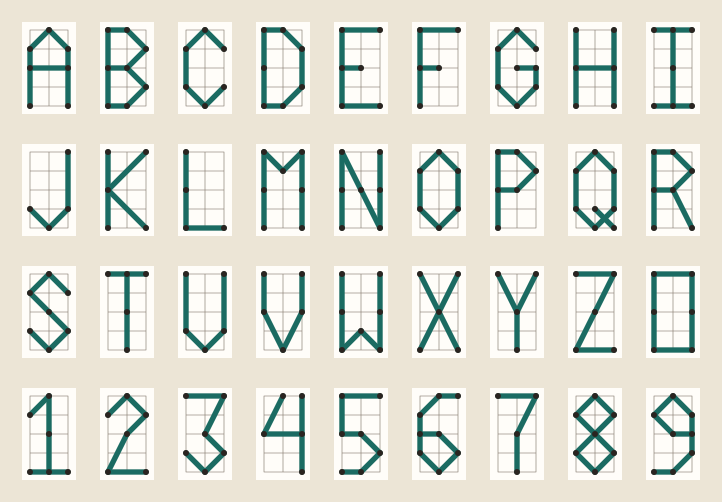
- Copy the line onto squared paper from the picture. Every letter and figure is 2 squares wide and 4 high. Leave 2 squares between two letters and 4 between two words.
- Count it: 4 for each letter or figure, 2 more for each space, and take away 2 at the end. JUNE 8 2026 is 9 x 4 + 2 x 2 - 2 = 38 threads, 2 7/8 inches (7.4 cm) on 13 mesh, and 5/16 inch (8 mm) tall.
- Work it from dot to dot with a blunt needle, through the holes between the stitches and never through a thread. Take one to three strands of floss on 13 mesh, size 3 pearl cotton on 10.
Dates, weights and fractions
Write the month as a word and the year in four figures. A day all in figures is read in two ways: 6-8-2026 is June 8 to one reader and August 6 to another.
| Way to write it | 5 high | 10 high | 13 high |
|---|---|---|---|
| JUNE 8 2026, or 8 JUNE 2026 | 41 | 82 | 112 |
| JUN 8 2026 | 37 | 74 | 100 |
| 6-8-2026 | 31 | 62 | 75 |
| 2026 | 15 | 30 | 41 |
| MMXXVI, the same year | 29 | 58 | 81 |
- Figures. Every figure is 3 stitches wide at 5 high and 6 at 10 high. At 13 high they are 5 to 9. With the gap beside it a figure takes 4, 8 and about 10 at the three heights.
- Plain numbers. Write JUNE 8, not JUNE 8TH.
- The comma is not in these alphabets. Leave it out, or put one stitch level with the lowest row of the letters and one below it, to the left.
- The colon in an hour is two dots: single stitches at 5 high, blocks of 2 by 2 at 10 and 13 (C and D in the picture below).
- Twelve o'clock. Noon and midnight are neither AM nor PM. Stitch NOON or MIDNIGHT, with the day the family gives you.
- Pounds and ounces. 16 ounces are a pound and an ounce is 28.35 grams, so 7 lb 6 oz is 7 x 16 + 6 = 118 ounces, and 118 x 28.35 = 3,345 grams. The comma is left out on the canvas.
- Length. 20 inches is 51 cm. A half is easiest as 20.5.
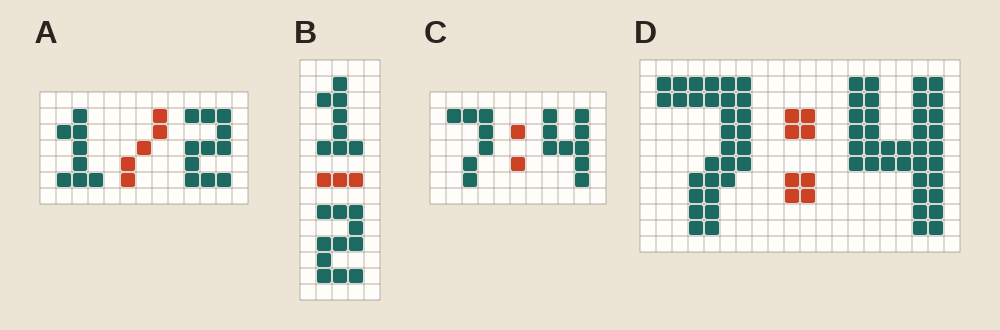
A fraction on one line is 11 stitches wide, where a figure is 3 (A in the picture). One over the other is 13 rows deep (B). The slanted stroke leans to the right, as a tent stitch does, so its stitches meet end to end and look like one line. Leaning left it would look like steps. Rounding to the ounce saves both.
Twins, a second child, an adoption, a new name
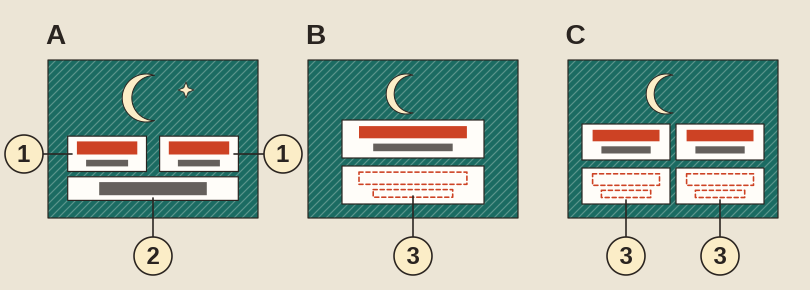
| For | How to leave room |
|---|---|
| Twins | Two panels of one size (A). On a pillow 16 by 12 inches (41 by 30 cm) on 10 mesh, 160 by 120 stitches, two panels of 60 with 10 between are 130, which is what lies inside the line that letters stay inside. Each takes a name of 5 letters 10 high and the weight 5 high under it. The day goes once, in a strip of its own below both |
| A second child | A second panel filled with plain tent stitch, which is picked out when it is wanted (B), or a pillow of the same size later. Write down the alphabet, the thread and the rows |
| More children | Four panels or more, small and alike, with a first name and a year in each (C) |
| An adoption | Ask the family: the day of birth, the day the child came home, or both, as two lines 5 high. The weight may give way to a place |
| A name that may change | First name alone, or an initial, with no family name. Letters begun and ended one by one come out one by one: ripping out stitches |
Colors, thread and stitches
Blue and pink are a habit, not a rule. Before the birth you need no guess at all: take the darkest thread of the design for the letters and the palest for the panel.
| Panel | Letters | Goes with |
|---|---|---|
| Cream | Navy | Storks, hares, boats |
| Pale gray | Coral | Elephants, clouds |
| Butter yellow | Forest green | Ducks, bears, gardens |
| White | Brick red | Folk borders, toys |
| Pale aqua | Chocolate brown | Foxes, whales, swans |
The two have to stand well apart in depth of color, or the words fade from across the room.
| Pillow, 10 mesh (C) | Pillow, 13 mesh (B) | Framed, 13 mesh (A) | |
|---|---|---|---|
| Thread | Three strands of Persian wool, or one of tapestry wool | Two strands of Persian, one of tapestry wool, or one of size 3 pearl cotton | Any of those, 7 or 8 strands of floss, or 6 or 7 of stranded silk, and a little metallic |
| Tapestry needle | Size 16 or 18 | Size 20 | Size 20 |
| Small letters | A thread that just covers. One that is too thin shows canvas first in the letters, and one that is too thick closes the openings of A, B and R | The same | The same |
| Ground | Basketweave | Basketweave | Basketweave, or a small pattern that stops at the panel |
| Leave out | Beads, loops, long stitches | Beads, loops, long stitches | Nothing |
Persian is a wool of three strands that pull apart, tapestry wool is one thick strand, pearl cotton is a shiny twisted thread, and floss and silk part into fine strands. Other meshes are in the thread and needle chart.
Finish it
- As a pillow. The two rows for the seam are stitched already. Choose the insert, and sew it up as in how to finish a needlepoint pillow. It belongs on the nursery chair or on a shelf: the safest crib has nothing in it but a fitted sheet. The steps for any pillow with words are in a name or a date on a pillow. Two more things for a first year are a first stocking for a baby and baby shoes.
- In a frame. Lace it to a board and frame it: how to frame needlepoint. The lip of the frame hides about 1/4 inch (6 mm), 3 or 4 stitches on 13 mesh.
- Sign it on the back with your name and the year.
What goes wrong
| What you see | Why | Cure |
|---|---|---|
| The name runs past the panel | Letters were guessed at one width | Count it on paper. Take the next smaller alphabet, two lines, or the first name alone |
| A line sits to one side | It was begun at its first letter | Take it out. Work from the middle, and put the odd stitch on one side in every line |
| There is no room for the weight | The gaps were added last | Add the rows before the first stitch, or put it on the label |
| The day is wrong | It was copied from a message | Have the family read the drawing. Figures are single letters to take out: snip on the front, pull from the back |
| Pale ground shows gray round the letters | A dark thread was carried behind | End it under its own letter, and start again |
| The panel is a different shade from the rest | Its thread was bought later, from another dye lot | Set it aside at the start. A panel in its own color never shows this |
| The letters are lost at the edge | The panel was too near the seam | Keep to 1 1/2 inches (4 cm) |
Questions people ask
Can I stitch it before the baby is born? Yes, all but the panel. Nothing in the design needs the name or the day.
How big is a birth announcement pillow? 8 to 14 inches (20 to 36 cm) square. Below 10 inches (25 cm) there is room for a name and one line.
What is the difference from a birth sampler? A sampler or birth record is a framed piece with the same facts, often with a border and an alphabet. The layouts are the same.
The ground of the panel is stitched already. What now? Work a short line on top of it in backstitch, or take out the rows you need.
First name only, or the whole name? Whatever the panel holds at a height that can be read. A first name 13 high with the rest of the name 5 high under it is a good pair.
Can a canvas be ordered with the name in it? Yes, after the birth. Send the words as they are to stand, ask for a proof, and read it: custom canvas.
What if the baby comes late or early? Nothing changes: the words go in last.