Needlepoint books: how to choose one
Choose by what you want to do: a handbook to learn, a stitch dictionary to find a stitch, a pattern book for a design to copy. Then open it and look at five things: the diagrams, the size of each stitch, a stitched picture, the index and the spine.
On this page
- What to look at before you buy or borrow
- The kinds of needlepoint book
- How to judge a stitch book
- A first book
- A stitch dictionary: what the number on the cover means
- A pattern book: what comes out, and how large
- Needlepoint pattern books of one subject: ocean, landscape, Gothic, Asian
- Bargello books: how to choose one
- Finishing books: what to look for
- Old needlepoint books, decade by decade
- Before you take a used copy
- Where to find needlepoint books
- Needlepoint magazines, newsletters and other publications
- How to use an old book today
- Needlepoint books for millennials
- Needlepoint books for men
- Do you need a book?
- What goes wrong
- The best needlepoint book for a beginner, and the best for stitches
- Questions people ask
What to look at before you buy or borrow
Open the book in the middle, at any stitch.
- The diagrams. Are the stitches numbered where the needle comes up and where it goes down, and does the book say what a line of its grid stands for?
- The size. Does it say over how many canvas threads each stitch goes, and which thread covers on which mesh (holes to the inch of canvas)?
- A stitched picture beside the diagram, large enough to see how the stitches sit.
- The index. Can a stitch be found by its name, and by what it is good for?
- The spine. Does the book stay open by itself? Both your hands will be busy.
The first two make a book you can stitch from. Without them it is a book to look at.
Which one do I get? Never stitched: an instruction book for beginners. You can work tent stitch, the plain slanted one, and want more: a stitch dictionary. You own a painted canvas, one with the design painted on it: a book of stitches for its subject. You want designs to count: a pattern book. No title is given on this page, since a book is good when you can follow its diagrams, and only the open book shows that. To begin with no book at all, go to how to needlepoint.
The kinds of needlepoint book
| Kind | What is in it | Who it suits | Look for | Leave it when |
|---|---|---|---|---|
| Instruction book for beginners | Tent stitch, starting and ending a thread, canvas, needles, a few small pieces | The first year | Every step drawn; a table of canvas, needle and thread; blocking, which squares the finished piece | It opens with fancy stitches |
| Stitch dictionary | Stitches in families or by use, a diagram for each | Anyone who can stitch tent stitch | Numbers, an index by name and one by use, stitched pictures | Nothing is numbered |
| Stitches for one subject, such as birds, buildings or backgrounds | Stitches, and where to put them on a painted canvas | Owners of such a canvas | Eyes, edges and small parts shown too | It is meant as your only stitch book |
| Pattern or chart book | Designs on squares, with color keys | People who count from a chart | A stitch count for each design, and how to sew or frame the stitched piece | It has photographs and no charts |
| Bargello book | Zigzag patterns, as charts, drawings or photographs | Lovers of color | How long each stitch is, and how far each one steps up or down | Neither is given |
| Finishing book | Blocking, backing, sewing, pillows, boxes | People who sew up their own pieces | Measurements, and pictures of the inside and the back | It only tells you to find a finisher, a person who does it for you |
| Children's book | Coarse canvas, two or three stitches, small pieces | A child and a grown-up together | Large drawings | The pieces are large |
| History or museum book | Old pieces, with dates and what they are made of | Readers, collectors | Close pictures of the stitches | You want instructions |
More about: one subject, such as the ocean, Chinese rugs or a dollhouse; modern pattern books; needlepoint and crochet in one; small stitches; shadow stitching; decorating.
How to judge a stitch book
With the book in your hand, in a shop or a library, take all nine steps. With only sample pages on a screen, take steps 2 to 6.
- Look up basketweave, tent stitch in diagonal rows. It is the one plain stitch that cannot be copied from a picture, because the order matters.
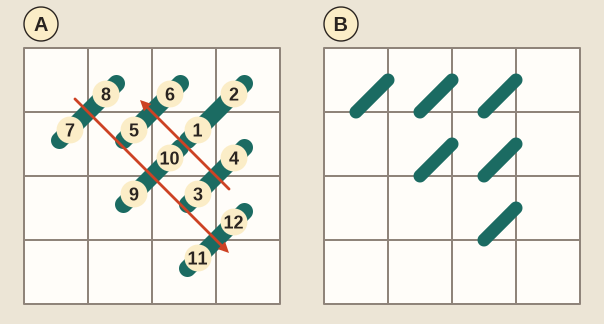
- Follow the numbers with a finger. Up at 1, down at 2, up at 3. There should be a row that climbs and a row that comes down, as in A below.
- See where a stitch ends. In a space, as in A below: the lines are canvas threads, so count the lines it crosses. Where lines cross: those points are holes, so count the squares it crosses. In neither, as in B: leave the book.
- Count a longer stitch, such as Scotch, a small square of slants, or Gobelin, over two threads or more. The page should give its size in threads, up and across.
- Find the thread. Somewhere there should be a thread for each mesh: what covers on 18 mesh leaves gaps on 13.
- Find an edge. Look for one shape in which the stitches are cut short to fit its outline (compensation).
- Look up one stitch by two names, such as Scotch and cushion. A good index has both.
- Read the smallest number in a diagram, by ordinary light. Pocket editions shrink the numbers and the index with everything else.
- Lay it on the table and let go. Spiral and comb bindings stay open.
What is a stitch guide? has the marks that diagrams use.
Hardback, paperback or spiral bound
For a stitch book take a spiral or comb binding, which lies open while both hands stitch. For patterns and pictures a hardback lasts best.
| The book | Does it lie open? | How it lasts |
|---|---|---|
| Spiral, a coil through holes | Flat, and it folds right round on itself | Well, with a stiff or plastic cover |
| Comb, a row of plastic rings | Flat, but it does not fold round | The comb comes off and goes back, so pages can be put in again |
| Hardback, pages sewn | Mostly flat | Longest. The boards guard the pages |
| Hardback, pages glued | Like a paperback | The boards are strong, the glue is not |
| Paperback, pages glued | It springs shut | Least. Sheets come loose with much handling |
| A file, which is a book read on a computer, a tablet or a phone | A printed page lies flat. On a small screen the diagrams may be too small to read | As long as you keep it |
Sewn or glued? Look down on the top of the spine. Small folded bundles of pages are sewn, and in the middle of a bundle you see the thread. One flat block of single sheets is glued.
A hardback that will not stay open: set it on a book stand, hold its pages with a clip at each side, or copy the one diagram you need onto graph paper and stitch from that. A screen that enlarges the page is the cure for small print in a file.
A first book
A beginner's book has to hold these, and little more:
- tent stitch worked all three ways (half cross, continental and basketweave), and five to ten other stitches
- how to start and end a thread
- how to read a chart
- a table of canvas, needle and thread
- one or two small pieces, start to finish
- blocking. Many books begin with materials and stop before the finishing, so turn to the last chapter first.
Of no use yet: a dictionary of 300 stitches; small diagrams that number only the first repeat of a stitch (a repeat is the group of stitches that comes again and again to make the pattern); a book made for one kind of painted canvas; a book with no list of contents, which can be read only by leafing. Borrow a first book before you buy one: the first piece you stitch from it tells you what it lacks.
A stitch dictionary: what the number on the cover means
The number counts diagrams, not ideas. Of 266 diagrams in a large one, some are variations and some the same stitch facing the other way. Of 80 small stitches in a book for one subject, about 43 are other drawings of a ray, which fans out from one hole, or of a leaf. In another book one stitch stands in four chapters. So count the families in its list of chapters. The more of these it has, the more kinds of place it can fill:
- straight stitches, slanted stitches, crossed stitches
- boxes, which are squares of slants, as Scotch is
- eyelets, whose stitches all go into one hole in the middle
- darning, running stitches in rows
- laid work, long threads tied down with small stitches
- knots.
Families before the alphabet. A book sorted by kind lets you find a stitch whose name you do not know. One sorted by name needs a pictured index as well.
Open or full? Some books are full of open stitches, which let a painted canvas show. If you stitch on bare canvas, check that enough of them cover it.
One stitch, many names, and the reverse. Scotch is also cushion and flat stitch; Smyrna cross is also double cross and Leviathan. And in a handbook of 1886, Scotch stitch is the one with a small frame round each square, which is framed Scotch now. Trust the drawing over the name.
Small stitches and small books
A book of small stitches holds stitches for small places. A small book is a stitch book of pocket size. The titles sound alike, so look inside.
For small stitches, each diagram should say how many canvas threads one repeat takes across and up. (A repeat is the group of stitches that comes again and again.) Compare that with your space, which should have room for two repeats at the least, and three look better. In a space six threads wide a repeat of two comes three times, and a repeat of four only once. Expect patterns in tent stitch, mosaic, brick, upright cross and small Smyrna cross. Beware of a book that goes by size alone: a stitch may be small and still look wrong in a small place. Stitches for small areas has the room that each one needs.
A small book goes in a bag, and pays for it: smaller figures, an index that is hard to read, and in some nothing but diagrams, with no advice on thread. It is for reminding yourself of stitches you know.
Shadow stitching in books
Shadow stitching on canvas is light stitching over a painted design, with a thin thread or an open stitch, so that the paint shows through. Over bare canvas the canvas itself shows. Books also call it light coverage, lite stitching or open work. Any stitch can be used for it, so a book that has only diagrams leaves out the hard part, how to use them. Look for these:
- How thin. At most half the strands that would cover. Strands are the threads that lie side by side in the needle. Floss is cotton thread that parts into six of them. On 18 mesh, where four strands of floss cover, half is two, and one may do.
- What it lies over: paint in shades, one plain color, or bare canvas.
- The order: which parts are stitched solid, and whether they come first, since a thin thread is fastened under solid stitches.
- The back: where threads start, stop and cross without showing in front, and what cloth goes behind the piece.
- Two light patterns side by side, and how they meet.
In a general stitch book look under open stitches, light coverage, lace and darning patterns. The steps are in open stitches and light coverage, and quiet patterns in background stitches.
A pattern book: what comes out, and how large
A chart is a grid, one square to a tent stitch: how to read a chart. A bargello chart is read another way: bargello books. Prefer charts with symbols, or with symbols and color: two dark blues that are printed alike cannot be told apart. Divide the stitches by the mesh, and you have the size in inches.
| The chart is | On 10 mesh | On 13 mesh | On 18 mesh |
|---|---|---|---|
| 60 stitches wide | 6.0 in (15.2 cm) | 4.6 in (11.7 cm) | 3.3 in (8.5 cm) |
| 100 stitches wide | 10.0 in (25.4 cm) | 7.7 in (19.5 cm) | 5.6 in (14.1 cm) |
| 140 stitches wide | 14.0 in (35.6 cm) | 10.8 in (27.4 cm) | 7.8 in (19.8 cm) |
| 180 stitches wide | 18.0 in (45.7 cm) | 13.8 in (35.2 cm) | 10.0 in (25.4 cm) |
The canvas calculator does it for any chart. Charts for cross stitch serve as well. A single sheet or a leaflet says less than a book: stitching from a leaflet says what to do where it is silent.
More than a chart. A book of belts should say how wide a belt is and how many extra rows the finishing takes; a book of pillows, what the seam takes. Without that you have a picture.
The thread list names threads you cannot find? Keep the key and choose again: write dark, middle or light beside every symbol, pick the darkest and the lightest first, and fit the others between them. The color chart tells how to match by eye, and has rows of shades that step evenly.
Modern needlepoint pattern books
A modern needlepoint pattern book, from about 2000 on, shows its pieces in color and often its charts too, and names threads that are on sale. Often it teaches little, with the stitches together at the back. DMC is a thread maker, and its color numbers are the ones the charts on this site use. If the key, the list of what each symbol stands for, gives DMC numbers, the chart can be used as it stands. Check five things:
- Is it needlepoint at all? Among the titles with the word are novels, blank notebooks and books of cross stitch.
- The map and the close view. One chart of the whole piece tells you where things go. If there are fancy stitches, each needs a numbered diagram too.
- The size of every piece in stitches, and the mesh.
- The key: thread numbers, strands, and how much of each.
- The end. Is there a word on sewing it up, or does it stop at the last stitch?
New, or a reprint? Look on the back of the title page for two years, or the words first published. Old charts in black and white and wool by the name of a vanished maker say reprint. By their titles, at least seven books of 2019 in one open catalog are charts of the 16th to the 19th century. They can still be good charts. For new designs see the modern patterns.
One pattern book for needlepoint and crochet
One book can serve both crafts if its charts are colored squares. It cannot if they are crochet symbols, or rounds in words.
| The book has | In needlepoint | In crochet |
|---|---|---|
| A color chart on squares | One tent stitch to a square | One single crochet, or one tile of corner-to-corner crochet |
| A filet chart, of open and solid squares | One tent stitch to a square, two colors | One open or solid mesh |
| Crochet symbols, or rounds in words | Nothing to copy | The pattern |
| Bargello, or stitches drawn as lines | The pattern | Nothing to copy |
A chart 60 squares each way is 4.6 inches (11.7 cm) square on 13 mesh. In single crochet at 14 stitches and 16 rows to 4 inches (10 cm) it is 60 ÷ 14 × 4 = 17.1 inches (44 cm) wide and 60 ÷ 16 × 4 = 15 inches (38 cm) tall: crochet stitches are not square, so a circle comes out flattened. In tiles 1 inch (2.5 cm) wide it is 5 feet (1.5 m). A good book of both gives a size for each craft and asks for a sample. Crochet charts tells how to mend the shape.
Basketweave in a written pattern
A pattern wants basketweave when it says basketweave or diagonal tent stitch. If it says only tent stitch, or prints a chart of filled squares and leaves the background to you, you may choose, and basketweave is the choice for every area large enough. The front is the same.
Most pattern books draw it once, in a list of stitches at the front or the back. That drawing must have one row that climbs and one that comes down, numbered, as in A above. To put it into a pattern without one:
- Mark on the chart the areas three stitches or more each way. Lines, letters and narrower places stay in continental.
- Begin at the upper right of an area, or with the left hand at its lower left.
- Go by turns, a row down and then a row up, or the reverse. Two rows the same way side by side leave a line that stays.
- On mono canvas, which is woven of single threads, over and under, let the canvas say which comes next. At each crossing one thread lies on top. Where it is the upright one, work that row down; where it is the level one, work it up. With the left hand it is the reverse.
- On interlock or Penelope, whose threads are locked together or run in pairs, the crossings do not tell. Keep to step 3. If you lose your place, turn the work over: a row up leaves level threads on the back, and a row down upright ones.
Basketweave stitch has every step, left-handed needlepoint has them for the left hand, and basketweave or continental what each is for.
Needlepoint pattern books of one subject: ocean, landscape, Gothic, Asian
Books of one subject are mostly old, so take the words in the table to a library's catalog, and add canvas embroidery or needlepoint to each. The ocean is the exception: its row says what to add.
| Subject | What such a book holds | How its charts are read | Words for the catalog | Patterns and pages here |
|---|---|---|---|---|
| Ocean, shells | Seldom a book of its own: see below | Whole picture | Nautical with canvas embroidery; fish, shells or sea with cross-stitch | Ocean, seashells |
| Landscapes | Views to copy, or stitches by part: sky, hills, water | Whole picture, or diagrams with no picture | Landscape, garden, country | Landscapes |
| Gothic, medieval | Beasts, flowered grounds, tiles, church kneelers | Single figures, and repeats | Medieval, Celtic, church, ecclesiastical embroidery | Medieval, Celtic, tiles |
| Asian, Chinese rugs | Rug fields and borders; Chinese and Japanese motifs | Border, corner and one quarter | Oriental rugs, Chinese rugs, Japanese | Asian, ginger jars, Japanese work |
A quarter chart shows one corner of the rug, with the border on two of its sides. Its other two sides are the middle lines of the rug. If it is the upper left quarter:
- Stitch it as it stands.
- Mirror it to the right, as if the upright middle line were a looking glass. The column next to the line comes first, then the one beyond. Only the places of the colors are mirrored: every stitch leans up to the right as before. Now the upper half is done.
- Mirror the upper half downward across the level middle line, in the same way.
- Count. A quarter of 45 squares by 60 makes 90 by 120 if every square is stitched again. It makes 89 by 119 if the last column and the last row of the chart are the middle itself, and are stitched once. On 13 mesh 90 stitches are 6.9 inches (17.6 cm).
A note beside the chart may say which, in words such as center line or repeat. If there is none, copy the last three columns onto graph paper and mirror them in two ways: with the last column drawn again, and with it drawn once. If drawing it again makes a thin stem or a point two stitches wide, the second way is right. Do the same with the last three rows.
A border. Take two corners off a side, then divide by the repeat, the piece of the border that comes again and again. A rug of 240 by 360 stitches, 24 by 36 inches (61 by 91 cm) on 10 mesh, with corners and repeats of 20 stitches has 200 ÷ 20 = 10 repeats on its short sides and 320 ÷ 20 = 16 on its long ones.
Books of landscapes, and stitches for a landscape
Two kinds of book share the name. One has pictures to copy. The other is a stitch book sorted by what you are stitching: clouds, grass, mountains, rock, sand, snow, trees, water. If you own a painted canvas you want the second kind. Its diagrams should be numbered, and each chapter should say what to think of first, such as which part is far away. The same is told in sky and water and grass, leaves and trees.
Books of Chinese rugs and Asian patterns
These came between about 1975 and 2002, most of them charts of rugs. An old Chinese rug has few, narrow borders, often a fret (a line that turns in right angles), and a field with one round medallion or several. So a book charts one border with its corner, the medallions, and small figures to set between them. Many have oriental in the title, so type that too. The rugs are the tradition of the people who wove them, and a chart is a drawing after one: look at old rugs in a museum's pictures before you choose colors. For a rug, choose a mesh in how to make a rug.
Gothic needlepoint designs in books
Books seldom say Gothic: they say medieval, church or Celtic. Church books, of kneelers and cushions, are of the 1970s and 1980s, books of medieval and Celtic design of 1992 to 2002. Look for the pattern of church windows, with trefoils and quatrefoils (rings of three and four lobes), inlaid floor tiles, which are square and repeat, beasts and letters, and grounds strewn with small flowers, as in hangings of about 1400 to 1550. A good one says where each design comes from. If you mean Gothic in the sense of dark and spooky, see skulls and bats.
Ocean patterns in books
A book of ocean patterns in needlepoint is hard to find. Of about 1,100 titles in an open catalog under canvas embroidery or with needlepoint in their name, none names the ocean, the sea, shells or whales. One of 1989 says nautical, and the three that name a beach are not pattern books. So look inside books of animals, of pillows and of borders, and in cross stitch books of the sea, whose charts serve on canvas. For stitches look up water in a book sorted by use.
Dollhouse and miniature rug books
These books hold rugs, carpets and stair runners for a house at 1 inch (2.5 cm) to the foot, and some have chair seats, bell pulls and wall hangings too. They came mostly between 1976 and 2002. One may have two dozen charts or more. To see whether a chart fits, measure the place in inches and multiply by the mesh.
Congress cloth is a fine cotton canvas. Gauze is silk gauze, a stiff and very fine canvas of silk whose threads are locked where they cross. Ask for them by these names where needlepoint canvas is sold: silk gauze and very fine counts.
| Canvas or gauze | A rug 4 by 6 inches (10 by 15 cm) takes | A chart of 100 by 150 comes out |
|---|---|---|
| 18 mesh canvas | 72 by 108 stitches | 5.6 by 8.3 in (14.1 by 21.2 cm) |
| 24 mesh congress cloth | 96 by 144 | 4.2 by 6.3 in (10.6 by 15.9 cm) |
| 32 mesh gauze | 128 by 192 | 3.1 by 4.7 in (7.9 by 11.9 cm) |
| 40 mesh gauze | 160 by 240 | 2.5 by 3.8 in (6.4 by 9.5 cm) |
Look for the stitch count of each chart, the mesh it was drawn for, a hem and a fringe shown in steps, and a page on drawing your own. If the threads on its list are gone, choose a thread that fits the mesh of your canvas, and the colors by eye. How to make a miniature has sizes, thread and a first rug, petit point the finer needles, and there are dollhouse rug patterns.
Bargello books: how to choose one
Choose a bargello book from whose charts you can count three things: how long each stitch is, how far it steps up or down from the one beside it, and where one whole repeat begins and ends. A repeat is the group of stitches that comes again and again.
- Find the length and the step, written 4-2 or 4:2: over four threads, up or down two.
- Count one repeat along the first line, from a peak to just before the next peak. It should be there whole.
- See what kind of pattern it is. The table below says what each kind has to show.
- Look at the shades. They should be given from light to dark. Thread names alone go out of date.
- Read the darkest chart by your own lamp. In gray charts the darkest gray and black run together.
| Kind of pattern | What it looks like | What the book must show |
|---|---|---|
| Line | One zigzag or wave from side to side, repeated above and below in other colors | The first row |
| Closed, such as a medallion | A shape like a diamond or a lens, made by one line above and the same line upside down below, and filled with rings of color | One whole repeat, with all that is inside it |
| Four-way | Four triangles that meet in the middle of the canvas, with upright stitches in two of them and level ones in the other two | The center, and the diagonals, which are the slanting lines where the triangles meet |
Then see in what form the book gives it:
| The pattern is | Can it be worked? | How |
|---|---|---|
| A chart with symbols or colors on a grid | Yes | A square is one canvas thread here, and not one stitch. Four squares of one symbol, one above another, are one stitch over four threads. The next column is the next line of holes |
| A chart with a line for each stitch | Yes | Each line is a stitch. Draw it again if it tires the eye |
| A drawing without a grid | Yes, if length and step are told | Draw it on graph paper |
| A photograph alone | A line pattern, yes; a closed one, hardly | Count the stitches at each height from the close view, and draw the first line |
Old and new. A charted pattern of the 1970s needs only new colors. One that is drawn without a grid or only photographed has to be drawn again first, as in the table. Of the needlepoint titles since 2020 more than half are on bargello, most with nearly the same name: look inside first. The first row of a line pattern begins in the middle of the canvas, and a four-way pattern in its center. To learn it without a book, go to what is bargello, draw your own in how to design bargello, or take one of the bargello patterns.
Finishing books: what to look for
A good needlepoint finishing book gives measurements at every step: how many rows the seam takes, what size to cut, and in what order to sew. Take one that has a whole chapter on the thing you want to make, since one book seldom does all.
| You want to make | The chapter must give | Here |
|---|---|---|
| Pillows | Rows for the seam, the size of the cloth back and of the insert (the cushion that goes inside), and the cording, a cord sewn round the edge | Pillows |
| Ornaments, and stand-ups, which stand on a shelf | The margin to leave, paper or card shapes, how curves are clipped, cord and loop, a base that stands | Ornaments, stand-ups |
| Boxes | Board sizes, the lining, the hinge, a picture of the inside | Boxes |
| Belts and straps | How wide, how many rows more at the edges, how the end is joined to the buckle | Belts |
| Framed pieces | Lacing (thread run to and fro across the back of a board, to hold the canvas on it), and how glass is kept off the stitches | Frames |
| Chairs and stools | A paper pattern, the margin for tacks, the padding | Upholstery |
Check five things:
- Blocking comes first, with a test of the colors before any water.
- The order. Which seam is sewn first, and what is left open for turning?
- The inside and the back are shown, not only the front.
- The cord. Does the book say how to make or choose it, and is there a picture of how its two ends are hidden?
- What to do by hand if you have no sewing machine.
What goes out of date. The sewing does not age, but the materials do. Foam crumbles long before the stitching wears out, so where an old book says foam, sew the cover so that it can be opened again. Old rubber cement was acid: take an acid-free glue, or sew. Of the four dated books in an open catalog whose titles say finishing or blocking, three are of 1973 to 1979.
The books of one year, such as 2018, are listed by a library's open catalog: type the subject, needlework or canvas embroidery, the word finishing, and the year. No list is given here, because it would be of titles. In one open catalog a search for needlepoint in the title brings six records of 2018, and none of them is about finishing by its title. Teachers' own books are often in no catalog: ask in a needlepoint shop. Needlepoint finishing has the rest.
Books about decorating with needlepoint
Books about decorating with needlepoint show whole rooms with the pieces in their places, and few charts. They are good for scale and place: how large a rug is beside a chair, how many pillows a sofa bears, how high a picture hangs. Most are of the 1970s to the 1990s, and they date fast. Librarians are told to clear general decorating books after five years, and any with outdated colors and patterns. To use one:
- Pick the place, such as a bench or the wall over a sofa.
- Work out the size from a thing in the picture that you have at home. If a pillow there is half as wide as the chair seat, measure your own seat and halve it.
- Choose the colors from your own room, and not from the book.
- Turn inches into stitches: multiply by the mesh. A pillow 12 inches (30 cm) wide is 12 x 13 = 156 stitches on 13 mesh, and 12 x 10 = 120 on 10 mesh.
- Find a chart of that many stitches or fewer, in a pattern book or in the patterns here. What is left over becomes plain background.
In a library, pattern books stand with needlework and not with decorating: where to find needlepoint books.
Decorating with needlepoint has the sizes, room by room.
Old needlepoint books, decade by decade
| When | What there was | Worth finding | What no longer holds |
|---|---|---|---|
| 1880s to 1900s | Thick handbooks of all needlework with a chapter on canvas, called tapestry, canvas work or Berlin work, old names for needlepoint | Stitches told by the thread, such as over two level threads and one upright: they can be worked from the words | Threads of the day. Of 21 color numbers in the keys of a handbook of 1886, nine are on the thread maker's list now |
| 1920 and the 1920s | Stitch handbooks with a canvas chapter; booklets of charts for bags, stools and chairs, called tapestry. Needle-point in a title is mostly lace, or a furniture sale | Charts with a color plate; clear drawings | Wool by its maker's number. Single canvas, 14 to 18 holes to the inch (2.5 cm), is sold as mono now, and double, 9 to 11, woven of pairs of threads, as Penelope |
| 1930s and 1940s | Magazines more than books. American ones say needlepoint by 1935; in Britain the word is still tapestry | Pictures of what was stitched | Canvases to send for |
| 1950s | Few books. Canvases sold with the middle already stitched | What was in fashion | The canvases themselves |
| 1960s and 1970s | Very many: in a large open catalog, 14 books under this subject date from the 1960s and 226 from the 1970s, 21 of them on bargello | Bargello, alphabets, rugs, stitch dictionaries | Colors, and wool by name. Some charts are roughly drawn, some have no grid, and some patterns are only photographed |
| 1980s and 1990s | Pattern books: of every 100 titles of the 1980s 55 are filed as patterns, and of the 1990s 82. Plastic canvas, a stiff plastic grid, in the 1990s | Whole designs, charted | Wool by its color number |
| Since 2000 | Stitch books that teachers publish themselves: spiral bound, about 300 pages, often a diagram a page, some as files | Indexes by use | Little. But of 86 titles since 2020, 56 are on bargello, most with nearly the same name: look inside first |
The numbers in this table count catalog records, so a book printed again counts twice.
What is worth finding in them? Stitches, which have hardly changed, charts, which work on any canvas, and designs that are printed nowhere else now. A manual for librarians clears craft shelves by the same rule: skills last, styles and materials date.
Why people love old needlepoint books
People love old needlepoint books because so much is in one volume that is printed nowhere else now:
- Charts that are large on the page, and easier to see than many new ones.
- Designs that do not age, bargello above all. Only the colors do.
- Stitches told in words, thread by thread, under names that are no longer used.
- Whole sets: rugs, alphabets, church kneelers, rooms, each with its own book.
- Color plates, and pieces laid out to be made.
What to do with one:
- Date it by the table above, so that you know which of its threads and canvases are gone.
- Choose the thread by the mesh of the canvas you can get: thread and needle chart.
- Draw its chart again if it is faint, has no grid, or is too good to mark: how to use an old book today.
Before you take a used copy
Turn every page. If the book has a list of its plates, compare.
- Plates (full-page pictures) and color pages: all there? Some have been cut out and sold, and in old books they loosen and fall out.
- The pocket at the back: folded charts and pull-out sheets are easily lost.
- Pencil on the charts. Rows crossed off in pencil can be rubbed out. Ink cannot.
- Loose leaves, and any page that is missing at the end of a chart.
- The smell. Musty is often the first sign of mold; a velvety or powdery growth is the next. Leave it: paper, cotton and linen are what mold feeds on, and your canvas is cotton.
- The year, usually on the back of the title page. It tells you which row of the table above to read.
A dealer's words. Good means used and worn, with nothing missing. Fair has all its text and pictures, though perhaps not its end papers, the blank leaves inside the covers. A reading copy has the whole text and is otherwise damaged. Ex-library came from a library.
Where to find needlepoint books
- On a library shelf: decimal numbers 746.44 and 746.442, or the letters TT778. Type canvas embroidery into the library's catalog as well as needlepoint, since canvas embroidery is the heading librarians use. Try bargello, tapestry and Berlin work too.
- From another library: ask for a loan between libraries. Yours sends for the book.
- Used: stores for used books, library sales, charity sales, the shelf in a needlepoint shop, and dealers in used needlework books.
- New stitch books: many are published by the people who wrote them, and are sold in needlepoint shops and not in ordinary bookstores.
- Free, on a screen: books old enough to belong to everybody have been scanned, and can be read whole. Search the web for embroidery, canvas work or Berlin work together with the words full text and a year before 1930. Of 398 records on embroidery from 1850 to 1930 in an open catalog, 183 are marked as free to read.
Needlepoint magazines, newsletters and other publications
Besides books, needlepoint is printed in magazines, guild bulletins, leaflets, single pattern sheets, kit booklets, shop newsletters and exhibition catalogs.
| Kind | What is in it | How it is found | What tells its age |
|---|---|---|---|
| Magazine | Projects with charts, articles, new threads | A library's catalog, under needlework or embroidery with the word periodicals. If the library has none, ask for a copy of one article from another library | The month on the cover |
| Magazine or bulletin of a guild, which is a club of stitchers | Projects, designers, a calendar of events | Sent to members, four or six times a year. Recent issues may stand on the guild's site for members | The issue number |
| Shop newsletter | New canvases and threads, a stitch or two | Shop sites, often at the start of a month | Its date |
| Leaflet | One to four pages: a pattern, its directions, the maker's other patterns | Scanned collections, drawers in shops | Seldom a year; a leaflet number, the threads, the clothes in the picture |
| Pattern sheet | One chart. In the 19th century, painted by hand on squares for wool on canvas | Scanned collections, museum sites: search for Berlin woolwork pattern | The publisher's name, the grid |
| Kit booklet | Directions for one kit, and the key | With the kit | A year, if it prints one. Thread numbers that are no longer on the maker's list tell only that it is not new |
| Exhibition catalog | Pictures of old pieces, dates, essays; seldom a chart | Museum libraries and sites | The year of the show |
| Old magazine, scanned | Canvases to send for, small charts, advice | An online library of old books: needlecraft, or embroidery magazine, and a year before 1930 | The month on the cover |
Can I get a needlepoint magazine now? Yes. Guilds bring them out: one on needlepoint comes every two months, and one on all needlework four times a year. To have it sent, join. Search the web for needlework guild: a national guild's page has a place to join and a list of its chapters, which are its local clubs. You can join as a beginner: why people stitch has more on guilds. Past issues may be for sale to anyone.
Guilds may lend books to their members by mail, too. A guild library can hold thousands of them.
How to use an old book today
| In the book | Now |
|---|---|
| Tapestry, tapestry work, canvas work, Berlin work | Needlepoint: see what it was called |
| Needle-point, about 1920 and before | Usually lace made with a needle |
| Petit point, gros point | Tent stitch over one thread each way, and over two: petit point and gros point |
| Plain, single or undivided canvas | Mono |
| Berlin, double or Penelope canvas; 10/20 | Penelope: ten large stitches to the inch (2.5 cm), or twenty small |
| Java canvas | A close cloth whose background was left bare, not needlepoint canvas |
| Single or double Berlin wool | A soft wool no longer made. Choose wool by the mesh: thread and needle chart |
| Ply, strand | Muddled on labels and in books: what ply means |
| Florentine, Irish stitch | Upright stitches in steps or zigzags: bargello |
| Gobelin stitch | Over two level threads and one upright: slanted Gobelin |
| Leviathan stitch | Smyrna cross, often over four threads |
| Plush, raised or velvet stitch | A pile of loops, each held by a cross or a slanting stitch: velvet stitch |
| A thread laid first and stitched over | Tramé |
| Grounding | Background |
- Find the canvas. Divide the stitches across by the inches across: 100 stitches that came out 10 inches (25.4 cm) wide are 10 to the inch, so 10 mesh. If the book gives no size, any mesh will do, and the table of sizes says what each makes of it.
- Choose thread by the mesh, not by the old name.
- Try each stitch on spare canvas before you trust a drawing. Old diagrams are often less clear than new ones.
- Draw it again. A bargello pattern with no grid goes on graph paper: an upright line for each stitch, as many squares long as the stitch goes over threads. (A design in tent stitch is charted the other way, one filled square to a stitch.) A plain zigzag line needs no chart: begin it in the middle of the canvas.
Needlepoint books for millennials
No needlepoint book is for one age, and the open catalog has none with the word millennial. What stitchers in their twenties and thirties ask for is small pieces, words and jokes, food and drink, bright flat color, and things remembered from the 1990s. In the table of kinds that is a pattern book, with a finishing book beside it. Look for four things:
- Pieces under 6 inches (15 cm), with a stitch count for each. Six inches are 78 stitches on 13 mesh, 108 on 18.
- An alphabet, so that the words can be yours.
- Flat color in few threads, charted in color.
- Finishing at home: ornaments, patches, and blanks, ready-made things that hold the stitched piece with no sewing.
Patterns of these kinds here: sayings, funny patterns, cocktails and key fobs. Self-finishing says what each blank takes.
Needlepoint books for men
A book of needlepoint for men came out in 1973 under the name of a former professional football player (who he was). Of 862 titles with needlepoint in their name in an open catalog, it is the only one that says it is for men. The stitches are everybody's, so any book serves. If it is the designs that matter, choose one of geometric, rug or bargello patterns.
Do you need a book?
Not to begin. These pages are free, and do what each kind of book does:
| In place of | Read |
|---|---|
| A beginner's handbook | How to needlepoint |
| A stitch dictionary | The stitch library, and the stitch chart to choose by sight |
| A pattern book | Easy patterns, each with a chart to print |
| A finishing book | Needlepoint finishing |
| A children's book | Needlepoint for kids |
| A book you keep yourself | A stitch notebook |
What goes wrong
| What happens | Cure |
|---|---|
| The stitches lean up to the left | The drawing is a mirror image, or was looked at in a mirror for the left hand. Go by a drawing that leans up to the right, and if you stitch with the left hand turn it upside down |
| Stitches come out one thread too long or too short | Lines were counted where squares should be, or the reverse. Do step 3 of how to judge a stitch book, and count one stitch against the stitched picture |
| The piece comes out half the size | The book counts the pairs of Penelope canvas, and you counted single threads |
| Canvas shows between the stitches | The book was written for another mesh. Add a strand, one more thread side by side in the needle |
The best needlepoint book for a beginner, and the best for stitches
The best needlepoint book is the one whose diagrams you can follow, so no title is named here. Five minutes with the open book tell you which it is.
| You are | The kind of book | The page to open | Leave it when |
|---|---|---|---|
| A beginner | An instruction book: a first book | Basketweave, then the last chapter | Only the first repeat is numbered, or there is no blocking |
| After more stitches | A stitch dictionary: how to judge one | Scotch or Gobelin, and the index | No size in threads, or no index |
| After embroidery and needlepoint in one book | A handbook of all needlework. It gives canvas a chapter, where a needlepoint book gives it all | The canvas chapter: tent stitch, and a table of canvas and thread | Canvas has a page or two |
| After one subject | A pattern book of it, or a book of stitches for it | Its smallest part, such as an eye or a leaf edge | It is to be your only book |
- Borrow two or three of that kind from a library, by the shelf numbers.
- Open each at the page in the table, and put a finger on 1, 2 and 3.
- Take the one in which you never had to guess. The nine steps settle a tie.
Questions people ask
What should a beginner look for in an instruction book? Tent stitch drawn three ways, a table of canvas, needle and thread, a small first piece, and blocking.
Are old needlepoint books still useful? Yes, for stitches, charts and shapes. Choose canvas and thread by today's.
Which needlepoint books came out about 1920? Hardly any under that name. Look for embroidery handbooks with a chapter on canvas stitches, and for booklets called tapestry. A needle-point book of that date is likely to be about lace.
What came out in the 1970s? Nearly everything: handbooks, dictionaries, bargello, rugs, alphabets, church work, and at least seven for children.