Crochet guide
How to crochet a ripple blanket
A ripple is a straight row made to bend. Extra stitches in one place push it up into a peak, and stitches skipped or joined pull it down into a valley. There are as many of one as of the other, with half a peak at each side edge, so the count never changes. Below is one ripple blanket in half double crochet (UK half treble), with the chain for any width.
On this page 16 parts
- How many chains for a ripple blanket
- Before you start
- 1. Work a test piece
- 2. Begin with half a peak
- 3. Down the slope, and skip two
- 4. Up the slope, and three in one
- 5. End with half a peak
- 6. Work row 1 of the blanket
- 7. Change color
- 8. Check after row 8
- 9. Leave the points, or square them off
- 10. Finish
- Which ripple: sharp zigzag or soft wave
- If it goes wrong
- Questions people ask
- Where to go next
How many chains for a ripple blanket
This ripple repeats over 13 stitches. The chain is a multiple of 13, plus 3. Each 13 is one valley and one peak.
| Width, about | Medium yarn, 5.5 mm (I-9) hook: chain | It makes | Bulky yarn, 8 mm (L-11) hook: chain | It makes |
|---|---|---|---|---|
| Baby, 30 inches (76 cm) | 120 (9 valleys) | 30 1/2 inches (77 cm) | 94 (7 valleys) | 30 1/2 inches (78 cm) |
| Baby, 36 inches (91 cm) | 146 (11) | 37 inches (94 cm) | 107 (8) | 35 inches (89 cm) |
| Throw, 54 inches (137 cm) | 211 (16) | 54 inches (137 cm) | 159 (12) | 52 1/2 inches (133 cm) |
| Twin, 68 inches (173 cm) | 263 (20) | 67 1/2 inches (171 cm) | 211 (16) | 69 1/2 inches (177 cm) |
| Queen, 90 inches (229 cm) | 354 (27) | 91 inches (231 cm) | 276 (21) | 91 1/2 inches (232 cm) |
The gauge is 15 1/2 stitches and 10 1/2 rows to 4 in (10 cm) in medium yarn, and 12 stitches and 8 rows in bulky, measured straight across the finished zigzag. A straight chain is longer than that: it draws in as row 1 bends. So never cut the chain to the width. The starting chain calculator does the sum for your own gauge:
- Width in inches × stitches to the inch. For 44 inches: 44 × 15 1/2 ÷ 4 = 170.5.
- Take away 1, divide by 13, round: 169.5 ÷ 13 = 13 valleys.
- 13 × 13 + 3 = 172 chains. They make 170 stitches, about 44 inches.
Before you start
Have: medium yarn (weight 4) in four colors, a 5.5 mm (I-9) hook, a yarn needle, scissors, a tape measure, and markers if you have them.
Know first: the chain and half double crochet. A straight last edge, step 9, also takes slip stitch, single, double, treble and double treble crochet. New to it all? Work a plain blanket first; it is the same stitch, straight.
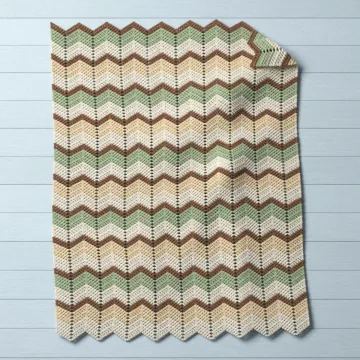
The rows are those of the neutral ripple baby blanket. In the lines ch (chs) is chain, hdc is half double crochet, st (sts) is stitch, sk is skip, RS is the right side, the one meant to show. The number in parentheses at the end is the count. A part in brackets is worked as often as the number after it says.
| Size | Finished | Chain | Stitches in every row | Rows |
|---|---|---|---|---|
| Small | 27 by 30 inches (69 by 76 cm) | 107 | 105 | 79 |
| Standard | 30 1/2 by 38 inches (77 by 97 cm) | 120 | 118 | 100 |
| Large | 37 by 44 inches (94 by 112 cm) | 146 | 144 | 116 |
1. Work a test piece
Chain 29 and work at least four rows; the pattern's own has 16. It has two valleys with one peak between them. It shows every move of the blanket. Work all 16 and you can measure it: about 7 in (18 cm) across and 6 in (15 cm) up. If it is larger, work it again with a smaller hook, and if it is smaller, with a larger one. The blanket takes the hook that comes out right.

In this chart an oval is a chain, and an upright line with a bar on top is a half double crochet.
Foundation: With A, ch 29.
Row 1 (RS): 2 hdc in 3rd ch from hook, hdc in next 5 chs, sk next 2 chs, hdc in next 5 chs, 3 hdc in next ch, hdc in next 5 chs, sk next 2 chs, hdc in next 5 chs, 2 hdc in next ch (27 hdc).
Rows 2 to 16: Ch 2, turn; 2 hdc in first st, hdc in next 5 sts, sk next 2 sts, hdc in next 5 sts, 3 hdc in next st, hdc in next 5 sts, sk next 2 sts, hdc in next 5 sts, 2 hdc in last st (27 hdc).
The next four steps take the row apart.
2. Begin with half a peak
Chain 2 and turn. The chain is not a stitch. Put two half double crochet in the very first stitch. They are half of a peak, and they keep the side edge straight.

3. Down the slope, and skip two
Work one in each of the next five stitches. Then pass over two: they are the bottom of the valley.

4. Up the slope, and three in one
Work one in each of the next five stitches. The next stitch is the peak: work three into it. From row 2 on it is the middle one of the three below.

5. End with half a peak
After the last valley work one in each of the next five stitches. One stitch is left. Work two into it, not three.
Why the count holds: a peak uses one stitch and leaves three. A valley uses two and leaves none. So each pair gives two and takes two, and the two half peaks give one each, which the one valley more takes away.
6. Work row 1 of the blanket
Chain 120 with color A, loosely. Put a marker in the third chain from the hook and in every thirteenth chain after it, to the last chain: ten markers. Each marked chain is a peak, the first and the last half a peak, and one valley lies between every two. Color B comes in on the last pull of row 4: read step 7 before you make it.
Foundation: With A, ch 120.
Row 1 (RS): 2 hdc in 3rd ch from hook, [hdc in next 5 chs, sk next 2 chs, hdc in next 5 chs, 3 hdc in next ch] 8 times, hdc in next 5 chs, sk next 2 chs, hdc in next 5 chs, 2 hdc in next ch (118 hdc).
Rows 2 to 4: Ch 2, turn; 2 hdc in first st, [hdc in next 5 sts, sk next 2 sts, hdc in next 5 sts, 3 hdc in next st] 8 times, hdc in next 5 sts, sk next 2 sts, hdc in next 5 sts, 2 hdc in last st (118 hdc).
The bracket is worked 7 times in the small size (105 stitches) and ten times in the large (144). Any other width: one time fewer than its valleys.
7. Change color
Every row is row 2, so only the color changes. Change on the last pull of the row before, here row 4: in its last stitch stop with three loops on the hook and draw the new yarn through all three.
Row 5: With B, ch 2, turn; 2 hdc in first st, [hdc in next 5 sts, sk next 2 sts, hdc in next 5 sts, 3 hdc in next st] 8 times, hdc in next 5 sts, sk next 2 sts, hdc in next 5 sts, 2 hdc in last st (118 hdc).
Rows 6 to 8: Ch 2, turn; 2 hdc in first st, [hdc in next 5 sts, sk next 2 sts, hdc in next 5 sts, 3 hdc in next st] 8 times, hdc in next 5 sts, sk next 2 sts, hdc in next 5 sts, 2 hdc in last st (118 hdc).
Stop and check after row 8, as step 8 says. Then go on with the set to the top.
The set is twenty rows: A 4, B 4, C 2, A 4, D 4, C 2. The standard size is five sets, 100 rows. The small is four sets less one row, 79. The large is five sets and A 4, B 4, C 2, A 4, D 2, 116.
- Cut or carry? Cut a yarn that rests for long, and leave 6 in (15 cm). In stripes of two rows in two colors, carry the resting yarn up the edge: stripes shows how.
Yarn, by estimate, standard size: A 575 yd (526 m); B, C and D 300 yd (274 m) each. The pattern has the other sizes.
8. Check after row 8
Lay it flat and count one repeat at a time: from the middle of one peak to the middle of the next is 13. Then measure across the middle, not along the chain: about 30 1/2 inches (77 cm). Wider: begin again with a smaller hook. Narrower: with a larger one.
9. Leave the points, or square them off
Many ripples are left as they are, with a zigzag at top and bottom: then go to step 10. For a straight edge do not cut the yarn. One more row, of stitches that get taller toward the bottom of each valley, makes the edge level.
Turn, with no chain. Slip stitch in the first stitch: it is the edge peak. Then work the table from stitch 1 for each valley. A peak inside the row is the middle one of its three stitches; the last peak is the last stitch of the row.

In this chart a dot is a slip stitch and a plus a single crochet. A line with a bar on top is half double, and one slash across it makes it double, two treble, three double treble.
| Stitch of the valley | What goes in it |
|---|---|
| The peak | Slip stitch |
| 1 | Single crochet (UK, or United Kingdom, double crochet) |
| 2 | Half double crochet |
| 3 | Double crochet (UK treble) |
| 4 | Treble crochet (UK double treble) |
| The bottom four, 5 to 8 | Four double trebles (UK triple trebles), one in each, closed together as one |
| 9 to 12 | Treble, double, half double, single |
| The next peak | Slip stitch |
The four at the bottom. For a double treble yarn over three times, put the hook in the stitch, draw up a loop, and pull through two loops three times. Stop there, one pull short. Do the same in each of the next three stitches. Five loops are on the hook: yarn over and pull through all five. Chevron stitch shows it large.
Thirteen stitches become 10, so a row of 118 becomes 91: nine valleys of 10, and the last slip stitch. Lay it flat. If the edge ruffles, close more stitches at the bottom; if it pulls in, close fewer.
The chain edge. Turn the blanket upside down, right side facing. Its peaks are now the gaps over two skipped chains. Its valleys are the chains that hold three stitches, with half a valley at each side.
- Join with a slip stitch in the edge chain and chain 5: they stand for a double treble.
- Pass over a chain. Treble, double, half double and single crochet in the next four, and a slip stitch in the gap.
- In each whole valley: single, half double, double, treble; three double trebles closed together (four loops), the middle one under the three stitches; treble, double, half double, single; a slip stitch in the gap.
- After the last gap: single, half double, double, treble; pass over a chain; a double treble in the edge chain. Count 91.
10. Finish
Fasten off: cut the yarn and draw the end through the last loop. Weave in the ends. Round straight edges you can put a border, or a row of single crochet.
Which ripple: sharp zigzag or soft wave
| Ripple | At the peak and in the valley | Chain | Pattern of ours |
|---|---|---|---|
| Sharp, half double crochet | Three in one; skip two | Multiple of 13, + 3 | Neutral ripple |
| Sharp, single crochet | Three in one; skip two | Multiple of 11, + 2 | Single ripple throw |
| Sharp, double crochet | Three in one; three together | Multiple of 12, + 4 | Baby boy chevron |
| Soft wave, double crochet | Two in each of two; two pairs together | Multiple of 12, + 3 | Rows on chevron stitch |
| Granny groups | Two groups in a space; a space skipped | Multiple of 18, + 4 | Granny ripple |
| Round, like a star | Two pairs in a point; two skipped in a dip | A ring | Twelve point ripple |
What makes it sharp: all the extra stitches in one place. Spread over two or more places they round the crest. What makes it deep: longer slopes. There is no fixed difference between the words ripple and chevron; where one is made, a chevron has points and a ripple rounder waves.
If it goes wrong
| What you see | Why | What to do |
|---|---|---|
| The peaks drift sideways | The three went beside the middle stitch | Mark the middle stitch of every peak, and move the markers up |
| The points flatten | A peak or a valley was missed | Count 13 from peak to peak and find the odd one |
| The sides slant | A stitch added or lost at a row end | Two in the first stitch and two in the last, every row |
| One stitch too many | One stitch skipped in a valley, not two | Pull back to that valley |
| One too few | Three skipped, or two in a peak | The same |
| It puckers | Tight stitches, or a wrong count | Count, then try a larger hook |
Questions people ask
What is the multiple for a ripple? It depends on the length of the slopes: see the table. For this one it is 13 plus 3. Stitch multiples lists others.
How do I make a wider zigzag? Work more stitches on each slope, the same on both. Each stitch more adds 2 to the multiple.
Where to go next
Print the neutral ripple baby blanket, or choose from the ripple blankets and ripple baby blankets. The granny ripple is the next one to learn.