Crochet guide
How to crochet a scrubby
A scrubby is a small round worked from the middle out. The yarn decides what it is for: soft cotton for a face, rough yarn or net for pans. Below are a plain round in one layer, a thick one in two layers, and one from strips of net, with the count for every round.
On this page 8 parts
| For | Use | Hook | Work |
|---|---|---|---|
| A face | Soft cotton, light (weight 3) or medium (weight 4) | 4 mm (G-6) for light, 5 mm (H-8) for medium | The face round |
| Dishes | Medium cotton in a bumpy stitch | 5 mm (H-8) | The two-layer scrubby |
| Pots and stuck food | Rough polyester or nylon yarn sold for scrubbing | 5 to 6 mm (H-8 to J-10) | The face round, in this yarn |
| Pots, rougher and stiffer | Strips of net or tulle | 6 mm (J-10) | The net scrubby |
| In place of a rough yarn | Plain acrylic, or a strand of it held with cotton | 5 mm (H-8) | The face round |
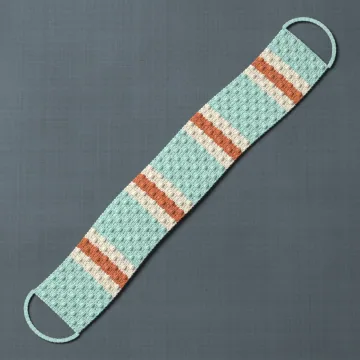
| A back | Cotton in bobbles, on a long strip with handles | 5 mm (H-8) | Our back scrubber |
You also need a yarn needle, scissors, a tape measure and, for net, a stitch marker and a large needle.
| To work | Know first |
|---|---|
| The face round | Magic ring, half double crochet (UK half treble), slip stitch |
| The two-layer scrubby | Magic ring, single crochet (double crochet in United Kingdom patterns), slip stitch. The puff is taught below |
| The net scrubby | Chain, single crochet, slip stitch |
Keep polyester, nylon and acrylic away from a pan that is still hot: they can melt. For a face use cotton: acrylic does not take up water. Yarn for dishcloths compares the fibers.
In the lines sc is single crochet, hdc is half double crochet, ch is chain, st is stitch, sp is space, sk is skip, sl st is slip stitch, rnd is round and RS is the right side. What stands in square brackets is worked as many times as the number after them says.
A round face scrubby, one layer
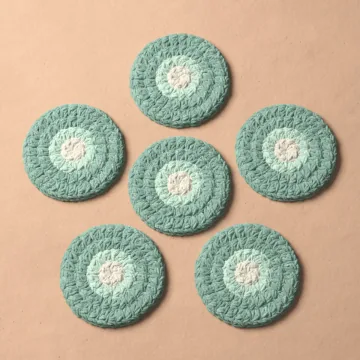
The counts are those of our face scrubbies, worked here in one color. In light cotton on a 4 mm hook it is about 2⅛ in (5.5 cm) across after round 4. One needs 8 yd (7 m), an estimate.
1. Put eight in the ring
Make a magic ring, chain 1, and work 8 half double crochet into it. The chain is not a stitch. Pull the tail to close the hole. Slip stitch in the first stitch to join, and do not turn: the same side always faces you.
2. Double it
Chain 1. Work two in every stitch, the first pair in the stitch you joined in. Count 16, then join.
3. Grow by eight each round
Round 3: two in a stitch, one in the next. Round 4: two in a stitch, one in each of the next two. There are always eight pairs, and one plain stitch more between them.

Foundation: Make a magic ring.
Rnd 1 (RS): Ch 1, 8 hdc in ring, sl st in first hdc to join (8 hdc).
Rnd 2: Ch 1, 2 hdc in each st around, sl st in first hdc to join (16 hdc).
Rnd 3: Ch 1, [2 hdc in next st, hdc in next st] 8 times, sl st in first hdc to join (24 hdc).
Rnd 4: Ch 1, [2 hdc in next st, hdc in next 2 sts] 8 times, sl st in first hdc to join (32 hdc).
4. Larger, or stop
Most are 3 to 4 in (8 to 10 cm), which is two or three rounds more in light cotton and one or two in medium. Round 5: two in a stitch, one in each of the next three. Each round after it has one plain stitch more.
| After round | Stitches | Light cotton, 4 mm hook | Medium cotton, 5 mm hook | Light cotton, an estimate |
|---|---|---|---|---|
| 4 | 32 | 2⅛ in (5.5 cm) | 2⅝ in (6.5 cm) | 8 yd (7 m) |
| 5 | 40 | 2⅝ in (6.5 cm) | 3⅜ in (8.5 cm) | 11 yd (10 m) |
| 6 | 48 | 3¼ in (8 cm) | 4 in (10 cm) | 14 yd (13 m) |
| 7 | 56 | 3¾ in (9.5 cm) | 4⅝ in (12 cm) | 18 yd (16 m) |
Fasten off with a tail of 6 in (15 cm). With the yarn needle run each end under several stitches one way, back, and once more: three directions, because they will be rubbed. Weaving in ends shows the moves.
A thick dish scrubby, two layers
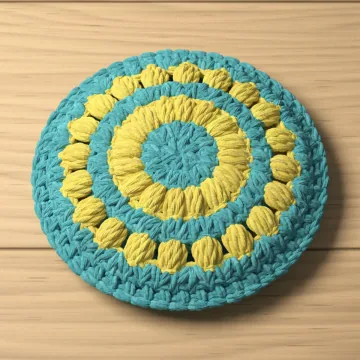
This is our puff dish scrubby, about 4¼ in (11 cm) across: two rounds in rings of puffs, joined at the edge. Medium cotton in two colors, A 25 yd (23 m) and B 20 yd (18 m), estimates, and a 5 mm (H-8) hook.
1. Learn the puff
Yarn over, put the hook in the stitch, yarn over, pull up a long loop, as tall as a double crochet (UK treble). Do this four times in the same stitch: nine loops are on the hook.

2. Close it, and chain 1
Yarn over and pull through all nine. The chain 1 after it belongs to the round: it is the space the next round goes into. Puff stitch has every move.

3. Work one side
Begin with A. To change yarn, make the joining slip stitch with the new yarn: hook in the first stitch, new yarn over, pull through. Cut the old yarn each time, and leave 6 in (15 cm) of both. The chain at the start of a round is not a stitch, and the first stitch goes where you joined.
In rounds 4 and 6 the st is the top of a puff: go under both of its strands, as in any stitch. The ch-1 sp is the gap under the chain beside it. Round 4 waves a little, and round 5 draws it flat.
Foundation: Make a magic ring.
Rnd 1: Ch 1, 8 sc in ring; join with sl st in first sc (8 sc).
Rnd 2: Ch 1, 2 sc in each st around; join with sl st in first sc (16 sc).
Rnd 3: With B, ch 2, [puff in next st, ch 1] 16 times; join with sl st in first puff (16 puff, 16 ch-1 sps).
Rnd 4: With A, ch 1, [sc in next st, sc in next ch-1 sp, sc in next st, 2 sc in next ch-1 sp] 8 times; join with sl st in first sc (40 sc).
Rnd 5: With B, ch 2, [puff in next st, ch 1, sk next st] 20 times; join with sl st in first puff (20 puff, 20 ch-1 sps).
Rnd 6: With A, ch 1, [sc in next st, sc in next ch-1 sp, sc in next st, 2 sc in next ch-1 sp] 10 times; join with sl st in first sc (50 sc).

4. Make the second side, and hide the ends
Fasten off the first side. Work a second the same, but do not cut its yarn. Weave every tail into the wrong sides now. You cannot reach them later.
5. Join the two
Hold them wrong sides together, puffs outward, with the hook in the side that faces you. Chain 1. Put the hook under a stitch of the near side and the stitch that lies against it on the far side, and work a single crochet through both. Go on, stitch for stitch: 50. Slip stitch in the first.
6. Add a loop, and fasten off
For a loop to hang it, chain 10 now and slip stitch in the same place. Then fasten off, with a loop or without, and pull the last ends in between the layers.
A scrubby from net
Net and tulle are cloth. Cut in strips, they are worked as yarn. The rounds below are our own, and no gauge is given, because nets differ: stop by the size.
1. Cut the strips
Fold the net so that it fits your table and cut across the folds, straight, all one width. For net alone one book cuts strips 3 in (7.5 cm) wide and 10 yd (9 m) long, two to a scrubby, and uses a 6 mm (J-10) hook. To hold net along with cotton, cut the strips thin, and use a hook of about 5.5 mm (I-9). The teachers we read name no width for those: the hook must catch strip and yarn in one pull. Either way cut one strip, work ten stitches, and decide before you cut the rest.
2. Join and wind
Knot or sew the strips end to end and wind a ball: fabric strips shows the joins.
3. Begin with chains
Chain 3 and slip stitch in the first chain: a ring. Round 1 goes into that ring, over the starting tail. It needs no chain 1 first.
4. Work by feel
You will not see the stitches. Work in a spiral: at the end of a round do not join and do not chain, but put the next stitch straight into the first stitch of the round before. Put a marker in the first stitch of each round, and say the count as you go. Feel for the top of the next stitch with a finger. If you lose it, put the hook in the gap between two stitches: in a scrubby it makes no difference, if the count is right.
Foundation: Ch 3, sl st in first ch to form a ring.
Rnd 1: 6 sc in ring (6 sc).
Rnd 2: 2 sc in each st around (12 sc).
Rnd 3: [Sc in next st, 2 sc in next st] 6 times (18 sc).
Rnd 4: [Sc in next 2 sts, 2 sc in next st] 6 times (24 sc).
5. Stop at 3 to 4 in (8 to 10 cm)
If it is still small after round 4, go on with six more in each round: 30, then 36. Slip stitch in the next stitch, fasten off with a tail of 6 in (15 cm), and pull it through several stitches with a large needle or the hook. A dome is not a fault here: it fits the hand.
When you cannot see the stitches
The same helps with rough yarn that has bristles.
| What to do | Why |
|---|---|
| Hold a thin, plain strand in the same color along with it | The plain strand shows where the stitches are |
| Use a hook one or two sizes larger | The holes open |
| Say the count aloud, stitch by stitch | The finished round is hard to count |
| Keep to single or half double crochet | Fancy stitches are lost |
| Put cotton in the rounds you must see | For example the first two, and the edge |
Fuzzy and textured yarn has more.
Change it
- Bristles from plain yarn. Loop stitch leaves a long loop on every stitch, on the side away from you. Work a round of it, then a plain round.

- Square. Chain 15 and work 16 rows of 14 single crochet, as a dishcloth is worked. In medium cotton on a 5 mm hook it is about 4 in (10 cm) each way.
- Two sides, two jobs. One round in cotton, one in rough yarn, joined as above.
- A strap for the fingers. Chain 6. Work rows of 5 single crochet, with chain 1 and turn between them, until the strip lies loosely over four fingers. Sew its two ends to opposite edges of the back.
- A bath pouf. Work so many stitches in each stitch that the edge folds up into a ball. In medium cotton, about 40 yd (37 m), an estimate, with a 5.5 mm (I-9) hook: chain 6 and slip stitch into a ring. Chain 3, which stands for a double crochet, work 19 more in the ring, and slip stitch in the top of the chain 3: 20. Next round: chain 3, two in the same place, three in every other stitch, and join: 60. Once more: 180. Chain 30, slip stitch in the same place, fasten off. Hyperbolic crochet shows why it folds.
If it goes wrong
| What you see | Why | What to do |
|---|---|---|
| A hole in the middle | The ring was not pulled shut | Pull the tail, then weave it round the ring |
| The face round cups | Too few stitches, or tight ones | Count back to eight pairs; try a larger hook |
| It ruffles | Too many stitches | Count back |
| The two sides do not match | One has a stitch more | Count each before you join: 50 |
| The edge opens in use | The yarn was cut close, or not woven in | Weave again in three directions |
| Net tears at the hook | Strips too narrow, or pulled tight | Cut wider; use a larger hook |
Questions people ask
How do I wash it? Rinse it, squeeze it out, hang it to dry after use. Wash it as the label of its yarn says, with the towels if it is cotton.
How big should a face scrubby be? About 3 to 4 in (8 to 10 cm). A small pad can be 2 in (5 cm).
Can I use any yarn? For a face, cotton only. For dishes, any yarn that may be washed. A rougher yarn scrubs harder: try it on a corner of the pan first.
Where to go next
Print the puff dish scrubby or the face scrubbies, or look through all the scrubbies. A flat dishcloth is the next thing for the same cotton.