Puff stitch
A puff stitch is a bundle of long loops pulled up in one stitch and closed together at the top. Yarn over, put the hook in and pull up a long loop, several times in the same place, then draw the yarn through every loop on the hook and chain 1 to lock it. The rows on this page also use single crochet (UK double crochet) and double crochet (UK treble): learn those two first.

- Yarn over, hook in, pull up a long loop.
- Same stitch, the same again. Five loops.
- Once more. Seven loops on the hook.
- Yarn over, pull through all seven.
- A soft puff.
How to work it
Never held a hook? How to crochet. Red is what is new. Left-handed? Read each picture as its mirror image.
Pull up a long loop

Yarn over, put the hook into the stitch or space, yarn over again and pull up a loop. Draw that loop up until it is as tall as a double crochet, which is about as tall as three chains. Three loops are on the hook.
Pull up three more in the same place

Yarn over, put the hook into the same place and pull up another loop, as tall as the first: five loops. Do it again: seven loops. Do it once more: nine loops. You have now pulled up four loops, and all of them come from one place.
Pull through all the loops

Yarn over and draw the yarn through all nine loops on the hook in one move. One loop is left on the hook.
Lock it with a chain

Chain 1. This chain closes the top of the puff and holds the loops in place. In the printed rows it is the ch 1 after each puff.
Set the puffs in rows

The rows printed after these steps set a row of single crochet and chains under every row of puffs. Work a puff in the open space under each of those chains (a chain space), not into the chain itself, and end the row with a double crochet. In the row after, the single crochets go into the spaces under the chains that lock the puffs, in the same way. Nothing is worked into the top of a puff.
The stitch pattern, row by row
- Multiple
- Chain a multiple of 2 (8 or more).
- Starting chain
- The rows here are written for a chain of 20, which is 10 times the multiple of 2.
- The ch 4 at the start of a row counts as a dc and a ch-1 sp. The last stitch of the next row is worked into its 3rd ch.
- The ch 1 at the start of a row does not count as a stitch.
- Row 1 is the right side.
- A stitch worked into a chain space passes over any stitches that lie before the space; they are left unworked.
- Foundation. Ch 20.
- Row 1 (RS). Sc in 2nd ch from hook, sc in next ch, [ch 1, sk next ch, sc in next ch] 8 times, sc in next ch (11 sc, 8 ch-1 sps).
- Row 2. Ch 4 (counts as dc and ch-1 sp), turn; [puff in next ch-1 sp, ch 1] 8 times, sk next st, dc in last st (2 dc, 8 puffs, 9 ch-1 sps).
- Row 3. Ch 1, turn; sc in first st, sc in next ch-1 sp, [ch 1, sc in next ch-1 sp] 8 times, sc in 3rd ch of turning ch (11 sc, 8 ch-1 sps).
Repeat rows 2 and 3 for the pattern.
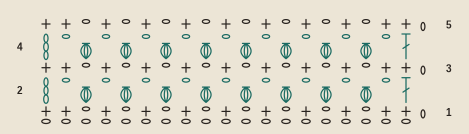
What each symbol meansHow to read a chart
Abbreviations in these rows
- ch
- chain stitch
- sc
- single crochet (UK double crochet)
- dc
- double crochet (UK treble)
- RS
- right side
- sk
- skip
- sp
- space
- st
- stitch
- yo
- yarn over
- puff
- puff stitch: [yo, insert hook in the st or sp, yo, pull up a loop to the height of a dc] 4 times in the same place, yo, pull through all 9 loops on hook.
Patterns do not agree on how many times to pull up a loop. Three, four and five times are all in use, and the more loops, the fatter the puff. The puff on this page is made with four. Read how the pattern describes its own puff, which is usually under its special stitches, and count the loops on the hook before you pull through.
Most patterns lock a puff with one chain, and some leave the chain out. Where there is a chain, the top of the puff and the chain beside it look like two stitches when you come back along the next row. Work into only one of them, the one the pattern names, or the row gains a stitch at every puff. In the rows here it is the chain: sc in next ch-1 sp means under it.
A puff looks much the same on both sides of the fabric, so it can be made on any row. Some patterns still keep all their puffs to wrong-side rows.
Puff stitches use a lot of yarn, so a fabric full of them takes more than a plain fabric of the same size.
The names puff, bobble, cluster and popcorn are not used the same way by everyone, and one pattern's puff is another pattern's bobble. Go by the steps the pattern gives and not by the name alone.
When it goes wrong
- My row has more stitches after a row of puffs.
- You worked into both the top of each puff and the chain that locks it. Work into only one of the two for each puff, the one your pattern names.
- My puffs are different sizes.
- Check that each one has the same number of loops before you pull through (nine, for a puff made with four loops), and that every loop was drawn up as tall as the first.
Left-handed
The pictures show the hook held in the right hand. Press Left-handed, under the moving drawing, and every picture here turns for the left hand. In the words, read left for right.
Patterns that use it
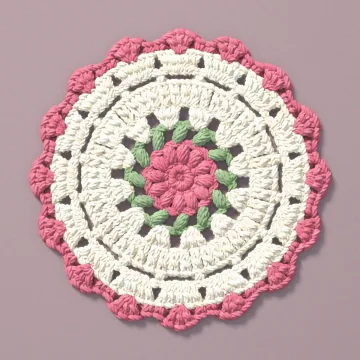
Pink flower doily
Intermediate 5 in across fine yarn
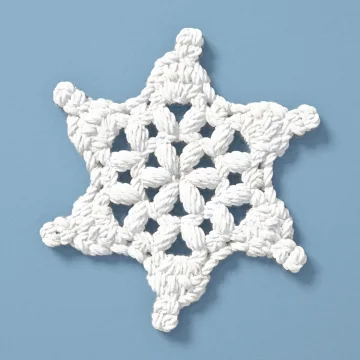
Puff stitch snowflake
Easy 1 3/4 in across lace yarn
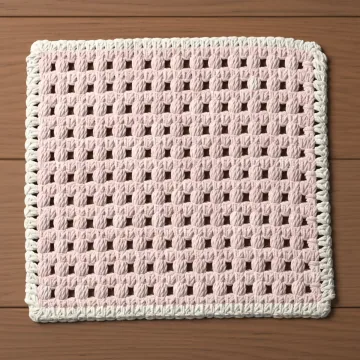
Puff stitch washcloth
Easy 8 3/4 × 8 1/4 in medium yarn
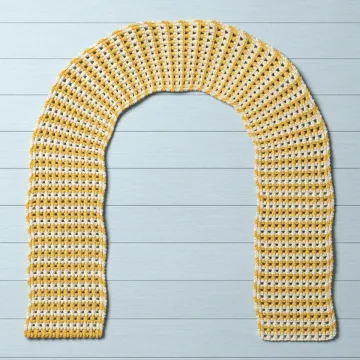
Puff stitch stripe scarf
Easy 7 × 64 in medium yarn
Puff stitch infinity scarfPuff stitch stripe baby blanket
The other 2 patterns that use it
At a glance
- Level
- Easy
- Kind
- Puffs, bobbles and clusters
- Used for
- soft, rounded texture in blankets, scarves and hats; rows of puffs with chains between them; a fabric that looks much the same on both sides
- Abbreviation
- puff or ps. Patterns differ, so read the list at the top of the pattern.
- In UK terms
- puff stitch, the same name
- Loops on the hook
- 7 when the loop is pulled up three times, 9 for four times, 11 for five times
- Multiple
- The chain is a multiple of 2 (8 or more).
- Row repeat
- Rows 2 and 3.
- Sides
- Looks much the same on both sides.
- Edges
- Straight. The second row and every even row begins with chain 4: three chains count as a double crochet and the fourth is the top of a space. The row after it ends in the third of those four chains, counted up from the bottom. The third row and every odd row begins with chain 1, which does not count and is not worked into.
Tips and variations
Tips
- Pull every loop of a puff up to the same height as the first one.
Variations
- Bobble stitch. Several unfinished stitches of double crochet in one stitch, closed together with one pull.
- Cluster stitch. The same closing with fewer stitches, in one place or spread over several.
- Popcorn stitch. Finished stitches of double crochet in one stitch, gathered by taking the hook out of the loop and putting it back through the first of them.
- Smaller and larger puffs. Pull up the loop three times for a small puff (seven loops on the hook) or five times for a large one (eleven loops).
- Puffs between single crochets. Chain an even number and work one row of single crochet (UK double crochet). On the next row, a wrong-side row, work a single crochet in the first stitch, then a puff and a single crochet by turns to the end. Go back with a plain row of single crochet, one in each stitch and one in the top of each puff, not in its chain. Repeat the last two rows.
- Rows of puffs and nothing else. After a first row of puffs with a chain after each, work every puff of the next row into a gap between puffs, with a chain after each. After the turn you come first to the gap between the edge stitch and the nearest puff: leave that one empty. Make one puff in each gap after it, and the last one in the gap between the last puff you come to and the stitch at the far edge. The number of puffs then stays the same. No plain row comes between. One taller stitch at each end, a half double crochet (UK half treble) or a double crochet, keeps the edge up. The puffs of each row sit between those below.
- Puff shells. Three or four puffs side by side with chains among them, so that they spread like a shell, and a single crochet or another stitch at each side to hold the group. Patterns print it with repeats of six, seven and eight stitches. The name is also given to a shell of four double crochets that ends in a puff.
- Crossed and zigzag puffs. Skip a stitch, work a stitch in the next one, then reach back and work a puff in the stitch you skipped. The puff lies across on a slant. Zigzag puff is not always this: patterns also print the name for rows of puffs alone, and for puffs that stand between crossed double crochets.
- Side puffs or leaning puffs. A double crochet with a puff worked round its own post, so that the puff lies on its side. One stitch is skipped after it.
- Puff V-stitch. Two puffs with a chain between, in one place.
- Jasmine stitch. Puffs drawn up in three places and closed together, like small flowers.
- Star stitch. Looks puffed but is not a puff: its loops come from five places along the row, not from one, and are closed together in one pull.
Questions
- How many loops are on the hook for a puff stitch?
- Two for every time you pull up a loop, plus the one you started with: seven loops for three times, nine for four, eleven for five. The pattern says which.
- How is a puff stitch different from a bobble stitch?
- A puff is made of long loops, like half double crochet stitches that are never finished. A bobble is made of unfinished double crochet stitches, each worked off by one pull through two loops before the next is begun. Both are closed with one pull through every loop on the hook.
- Do I have to chain 1 after a puff stitch?
- Only if the pattern says so. Many patterns use the chain to lock the puff, and some close the puff without it.
- Does a puff stitch take more yarn than a plain stitch?
- Yes. A fabric full of puffs takes more yarn than a plain one of the same size.
- Is a puff the same as a bubble stitch?
- Some patterns call a puff a bubble. Others mean a treble crochet (UK double treble) that folds between two short stitches. The bubble stitch page has both.
- Which crochet stitch looks like little balls?
- Puff, bobble and popcorn stitches all make round bumps. For a puff you pull up long loops, for a bobble you leave several double crochets unfinished, and for a popcorn you finish them and gather them. If a pattern names its own ball stitch, look for the line that says how to make it.
- Can I work puffs on every row?
- Yes. After the turn leave the gap beside the edge empty, put a puff in each gap between two puffs of the row below, and the last one in the gap at the far edge, so that none is lost. Work one plain tall stitch at each end. Most patterns put a row of single crochet between two rows of puffs.
- How are puff stitches worked in a doily?
- In rounds, each puff into a space of the round below, with chains after it. Printed doilies and round lace put several chains between puffs, three or five for example. As the round grows it needs more chains between the puffs, or more puffs: the puffs themselves stay the same size. Close the round with a slip stitch in the top of the first puff, and slip stitch into the next space before you begin again. The first puff of a round begins with chains that bring the hook up to its height.