Crochet guide
How to crochet a shawl
The plainest shaped shawl is a triangle that begins with a few stitches in the middle of the long edge. Every row grows at both ends and at the center, and the shawl can stop at any size. Learn rows 1 and 2 from the pictures, and every later row is the same three places with more plain stitches between them.
On this page 15 parts

Before you start
You need: medium yarn (weight 4), a 5.5 mm (I-9) hook, a yarn needle, scissors and a tape measure. A stitch marker helps.
| Shawl | Rows | Size, about | Half the yarn is used after row | Yarn to buy, an estimate |
|---|---|---|---|---|
| Shoulder | 24 | 39 in (99 cm) across, 19½ in (49 cm) deep | 17 | 350 yd (320 m) |
| Full | 32 | 52 in (131 cm) across, 25¾ in (66 cm) deep | 23 | 575 yd (525 m) |
| Large | 40 | 65 in (164 cm) across, 32¼ in (82 cm) deep | 28 | 900 yd (823 m) |
Know first: the chain, the slip stitch and double crochet (UK treble). Never held a hook? Begin with how to crochet, and perhaps a scarf.
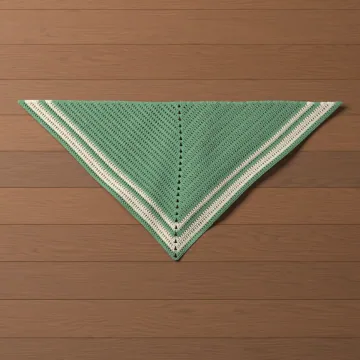
The rows are those of our top down triangle shawl, whose page has every row of the three sizes. It works a few rows in a second color. Leave that out for a shawl in one.
In the picture above A is where you begin, B and B are the ends of the long edge, the wingspan that is worn at the neck, and C is the point at the back. While you work, you hold it the other way up, with the point at the top. The next pictures show it so.
| In the pattern | It means |
|---|---|
| ch, sl st, dc | chain, slip stitch, double crochet |
| (counts as dc) | the chain 3 stands for the first stitch of the row |
| same st | the stitch the chain 3 stands on |
| ch-2 sp | the space under the two chains at the center |
| (2 dc, ch 2, 2 dc) in next ch-2 sp | all of it goes into one space |
| top of turning ch | the third chain of the chain 3 that began the row below |
| ch-1 sp | the space under one chain (granny shawl) |
| [3 dc in next ch-1 sp, ch 1] 2 times | what is in the square brackets is worked twice in all (granny shawl) |
| 3rd ch of turning ch | the third of the chains that began the row below, counted from the bottom (granny shawl) |
| RS, WS | right side, wrong side |
1. Make the ring
Chain 4 and close them into a ring with a slip stitch in the first chain. It sits in the middle of the neck edge. A magic ring does the same and leaves no hole.
2. Work row 1
Chain 3, the first stitch. Work 2 double crochet into the ring, chain 2 for the center, and work 3 more double crochet into the ring. Do not join: you have a half circle, not a round.

Foundation: Ch 4, sl st in first ch to form a ring.
Row 1 (RS): Ch 3 (counts as dc), 2 dc in ring, ch 2, 3 dc in ring (6 dc, 1 ch-2 sp).
3. Turn and start row 2
Chain 3 and turn the work over. Now the shawl grows at this end: put 2 double crochet in the same stitch, the one the chain 3 stands on. With the chain that makes three stitches in one. Then work 1 double crochet in each of the next 2 stitches.

4. Work the center
Put the hook in the space under the two chains. Work 2 double crochet, chain 2, and 2 double crochet, all in that space. The two new chains are the center of the next row. This one space is what bends the rows and makes the point.

Hang a marker on the chain 2 and move it up in every row. Then you always see the middle.
5. End the row
Work 1 double crochet in each of the next 2 stitches. The last place is the top of the chain 3 that began row 1. It is a stitch too. Put 3 double crochet there.

Row 2 (WS): Ch 3 (counts as dc), turn; 2 dc in same st, dc in next 2 sts, (2 dc, ch 2, 2 dc) in next ch-2 sp, dc in next 2 sts, 3 dc in top of turning ch (14 dc, 1 ch-2 sp).
Count: 14 double crochet, 7 on each side of the chain 2.
6. Work row 3, and every row after
Every row is row 2 with more plain stitches: 4 more on each side. So 8 stitches are added in a row, 2 at each end and 4 at the center.
Row 3 (RS): Ch 3 (counts as dc), turn; 2 dc in same st, dc in next 6 sts, (2 dc, ch 2, 2 dc) in next ch-2 sp, dc in next 6 sts, 3 dc in top of turning ch (22 dc, 1 ch-2 sp).
Row 4 (WS): Ch 3 (counts as dc), turn; 2 dc in same st, dc in next 10 sts, (2 dc, ch 2, 2 dc) in next ch-2 sp, dc in next 10 sts, 3 dc in top of turning ch (30 dc, 1 ch-2 sp).
Row 5 (RS): Ch 3 (counts as dc), turn; 2 dc in same st, dc in next 14 sts, (2 dc, ch 2, 2 dc) in next ch-2 sp, dc in next 14 sts, 3 dc in top of turning ch (38 dc, 1 ch-2 sp).
Both sides of the center must have the same number. Count one side of every row: half of the double crochet in the bracket at the end of its line, which is 11 for row 3 and 15 for row 4. If the two sides differ, the fault is at the end of the shorter side, or a stitch was passed over.
Plain stitches on each side, for any row from row 2 on: 4 times the number of the row, less 6. Row 7 has 22 and row 9 has 30.
After row 6 measure the long edge. It should be about 9¾ in (25 cm). A little more or less does no harm: go on, and the shawl is a little larger or smaller. If it is much larger, the yarn in the table will not be enough: begin again with a smaller hook, or buy more. If it is much smaller, begin again with a larger hook, or work more rows.
Shawl diagram

Read it from the ring upward. Row 1 runs from the right to the left, row 2 comes back, and so on. Red stitches are the increases. Two ovals are the center, and three ovals in a line are the chain 3. How to read crochet charts explains the rest.
How many stitches, and how wide
| Row | Double crochet in the row | Plain stitches on each side | Top edge, about |
|---|---|---|---|
| 1 | 6 | none | 1½ in (4 cm) |
| 2 | 14 | 2 | 3¼ in (8 cm) |
| 3 | 22 | 6 | 4¾ in (12 cm) |
| 4 | 30 | 10 | 6½ in (16 cm) |
| 5 | 38 | 14 | 8 in (21 cm) |
| 6 | 46 | 18 | 9¾ in (25 cm) |
| 8 | 62 | 26 | 13 in (33 cm) |
| 10 | 78 | 34 | 16¼ in (41 cm) |
| 12 | 94 | 42 | 19½ in (49 cm) |
| 15 | 118 | 54 | 24¼ in (62 cm) |
| 18 | 142 | 66 | 29 in (74 cm) |
| 20 | 158 | 74 | 32¼ in (82 cm) |
| 24 | 190 | 90 | 38¾ in (99 cm) |
| 27 | 214 | 102 | 43¾ in (111 cm) |
| 30 | 238 | 114 | 48½ in (123 cm) |
| 32 | 254 | 122 | 51¾ in (131 cm) |
| 40 | 318 | 154 | 64½ in (164 cm) |
For a row that is not in the table: its double crochet are 8 times its number, less 2, and its plain stitches on each side 4 times its number, less 6. Each row adds about 1⅝ in (4 cm) to the long edge. The depth is half of the width, because the shawl is half a square. The widths are worked from the pattern's gauge.
7. Decide when to stop
- By size. Hold your arms out: a shawl often runs from wrist to wrist. The shawl size chart has the usual figures, and any row can be the last.
- By yarn. The late rows are the long ones. Half the yarn is gone when seven tenths of the rows are done, after row 17 of 24. When the ball gets small, weigh it before a row and after it. The next row takes a little more than that one did. Stop while there is enough for a row, an edge and the tail.
Join a new ball at the end of a row.
8. Finish
- The last row may be the edge as it is. Or turn and work one row of single crochet (double crochet in United Kingdom patterns). Chain 1, not counted, and put the first stitch into the last one you made. Work one in each stitch and three into the center space. The chain 3 at the far end is a stitch too: the last one goes into its top. The row has 3 more stitches than the row below it, so 193 after row 24.
- Fasten off and weave in the ends.
- Block it: wet it, pin the long edge straight and the point square below its middle, and let it dry. The edges come out straight.
- Fringe or tassels, if you like, go along the two lower edges or on the three points: fringe and tassels.
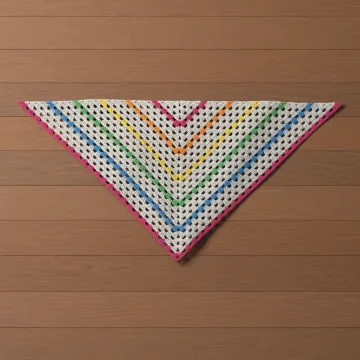
The same shawl in granny groups
Groups of three double crochet stand in spaces, as in a granny square, and this shawl is half of one. There is nothing to count but groups. Each row has one more group on each side.

Foundation: Ch 4, sl st in first ch to form a ring.
Row 1 (RS): Ch 4 (counts as dc and ch-1 sp), 3 dc in ring, ch 2, 3 dc in ring, ch 1, dc in ring (8 dc, 2 ch-1 sp, 1 ch-2 sp).
Row 2 (WS): Ch 4 (counts as dc and ch-1 sp), turn; 3 dc in next ch-1 sp, ch 1, (3 dc, ch 2, 3 dc) in next ch-2 sp, ch 1, 3 dc in next ch-1 sp, ch 1, dc in 3rd ch of turning ch (14 dc, 4 ch-1 sp, 1 ch-2 sp).
Row 3 (RS): Ch 4 (counts as dc and ch-1 sp), turn; [3 dc in next ch-1 sp, ch 1] 2 times, (3 dc, ch 2, 3 dc) in next ch-2 sp, [ch 1, 3 dc in next ch-1 sp] 2 times, ch 1, dc in 3rd ch of turning ch (20 dc, 6 ch-1 sp, 1 ch-2 sp).
Row 4 (WS): Ch 4 (counts as dc and ch-1 sp), turn; [3 dc in next ch-1 sp, ch 1] 3 times, (3 dc, ch 2, 3 dc) in next ch-2 sp, [ch 1, 3 dc in next ch-1 sp] 3 times, ch 1, dc in 3rd ch of turning ch (26 dc, 8 ch-1 sp, 1 ch-2 sp).
From row 3 on, every row is row 3 with a larger number after its square brackets. The number is the row's own less 1: 2 times in row 3, 3 times in row 4, 4 times in row 5. It stands twice in a row, once for each side of the center.
The chain 4 at the start is a double crochet and a chain 1. The row ends with 1 double crochet in the third of those chains. The shawl has as many rows as the plain one and is as wide, with a 6.5 mm (K-10 1/2) hook. The yarn in all is about 320 yd (293 m) for the shoulder size of 24 rows, 530 yd (485 m) for the full size of 32 and 830 yd (759 m) for the large size of 40, all estimates. Pattern: granny stitch triangle shawl. See granny stitch for the groups.
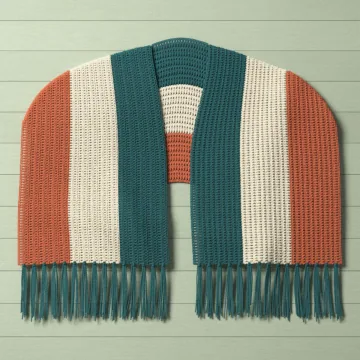
A wrap with no increases
A rectangle needs no shaping. Its stitch is half double crochet (UK half treble). Chain 197 in medium yarn with a 5.5 mm (I-9) hook. For another length, chain 3¼ for every inch (2.5 cm) and 2 more: 60 in (152 cm) is 195 and 2. Work the first stitch in the third chain from the hook and one in each chain: 195. Begin every later row with chain 2, not counted, and turn. After 52 rows the wrap is about 60 by 19 inches (152 by 48 cm). The yarn, fringe and all, is about 1,370 yd (1,253 m), an estimate. The half double prayer shawl is this one with two bands of color, and the simple double wrap is another.
If it goes wrong
| What you see | Why | What to do |
|---|---|---|
| The long edge bends down at the ends | The 3 stitches at an end were missed | Pull back. Two go into the same stitch at the start, and three into the turning chain at the end |
| One end loses a stitch each row | The top of the turning chain was passed over | Pull back. The last 3 stitches go in the third chain |
| There is no point, or the center is round | The center increase was missed | Pull back to it. 2, chain 2, 2 in the space |
| The middle wanders to one side | The hook went between stitches beside the space | Keep the marker in the chain 2 |
| The rows ripple | The center was worked twice in a row, or the ends have 4 | Count one side |
| The end stitches look loose | Three chains are looser than a stitch | Make them firmly, or use a chainless start |
| A corner that is not square | Your rows are taller or shorter than the gauge | Small amounts block out. For your own stitch see shawl shapes |
Where to go next
Work the top down triangle shawl from its page, or choose among the triangle shawls, all shawls and wraps. Shawl shapes has crescents and half circles, and how to wear has ways to put it on.