Granny stitch
Granny stitch is groups of three stitches of double crochet (UK treble), worked in straight rows. Each group goes into the gap between two groups of the row below, not into a stitch. It is the fabric of a granny square made flat. It is also called granny stripe, and it is often worked with a new color every row or two. Double crochet is the one stitch to know first.
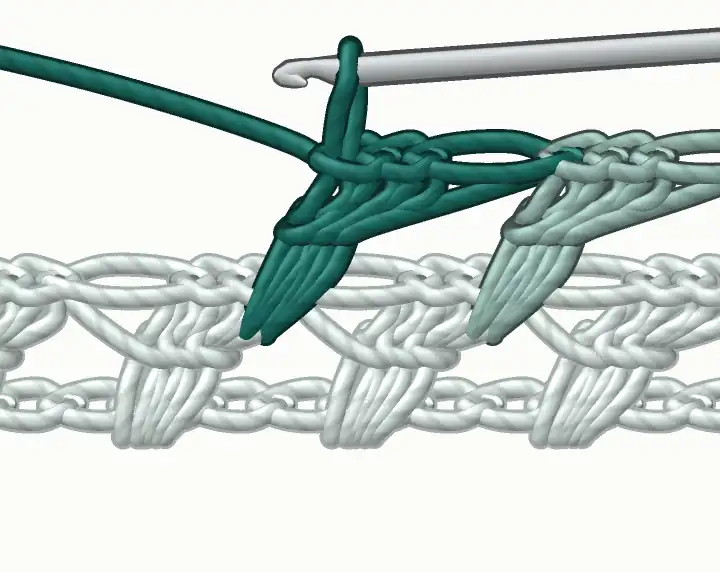
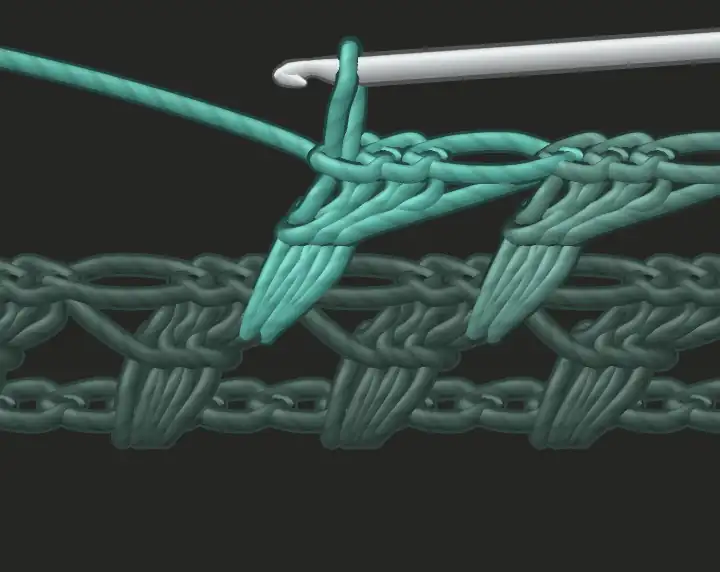
- Find the gap between two groups below.
- Yarn over. Hook into the gap, under the top.
- Finish the double crochet.
- Two more in the same gap: a group of three.
How to work it
Never held a hook? How to crochet. Red is what is new. Left-handed? Press Left-handed, and every picture turns.
Work groups of three into the chain

To try it, chain 22. Skip four chains and work three double crochets into the fifth chain from the hook: that is one group. The four skipped chains stand for a double crochet at the edge: three of them stand up, and one lies flat beside the group. Skip two chains and work three double crochets into the next one, and so on until two chains are left. Skip one of them and work one double crochet into the last. There are six groups, and one stitch alone at each end. In the picture the two skipped chains are brown and the group just made is red.
Work into the gaps

Look along the row below: between each group of three and the next there is a gap. Put the hook into that gap, under the tops of the stitches and between their upright parts (their posts), and work three double crochets there. Do not work into the top of any stitch. Work a group in each gap: five of them.
Begin the third row with whole groups

Chain 3 alone and turn. Work the first group into the gap between the half group and the group beside it, then one in each gap, and the last in the gap before the other half group: six groups. End with one double crochet in the top of the turning chain. From here the second and the third row take turns, which keeps the edges straight. In the picture the single stitches at the edges are brown and the half groups red.
The stitch pattern, row by row
- Multiple
- Chain a multiple of 3 plus 1 (13 or more).
- Starting chain
- The rows here are written for a chain of 22, which is 7 times the multiple of 3, plus 1.
- The ch 3 at the start of a row counts as a dc. The last stitch of the next row is worked into the top of it.
- Row 1 is the right side.
- 3 dc in one place: work all three into the place named after them. Work what stands in square brackets as many times as the number after them says. Parentheses hold a remark, or the count of stitches in the row.
- The sp before next st is the gap between two stitches, under all the loops, not the top of a stitch.
- In row 2 the top of the turning ch is the top of the 4 chs skipped at the start of row 1: the last ch made.
- Foundation. Ch 22.
- Row 1 (RS). 3 dc in 5th ch from hook (skipped chs count as dc), [sk next 2 chs, 3 dc in next ch] 5 times, sk next ch, dc in next ch (20 dc).
- Row 2. Ch 3 (counts as dc), turn; dc in same st, [sk next 3 sts, 3 dc in sp before next st] 5 times, sk next 3 sts, 2 dc in top of turning ch (19 dc).
- Row 3. Ch 3 (counts as dc), turn; sk next st, 3 dc in sp before next st, [sk next 3 sts, 3 dc in sp before next st] 5 times, sk next st, dc in top of turning ch (20 dc).
Repeat rows 2 and 3 for the pattern.
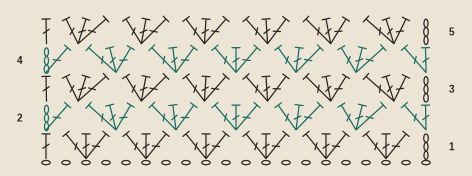
What each symbol meansHow to read a chart
Abbreviations in these rows
- ch
- chain stitch
- dc
- double crochet (UK treble)
- RS
- right side
- sk
- skip
- sp
- space
- st
- stitch
Working into the gaps is what gives the fabric its look: the groups of each row sit between the groups of the row below, like bricks in a wall.
Many patterns begin with one row of single crochet (UK double crochet) into the chain and work the first row of groups into that. The chain for those patterns is a multiple of 3 plus 2. The rows written here work the groups straight into the chain.
For stripes, change color at the end of a row: work the last stitch until two loops are left on the hook, and pull the new color through them. A new color in every row leaves two ends to weave in for each row, so weave them in as you go.
The granny groups patterns on this site are the same stitch with one chain between each group and the next, which opens the fabric a little more.
When it goes wrong
- One side of my work is slanting.
- The two kinds of row have been mixed up. After a row that ended with one double crochet, begin with chain 3 and a double crochet in the same stitch. After a row that ended with two, begin with chain 3 alone and put the first group into the first gap.
- I cannot tell where the gap is.
- Look at the bottom of the stitches, not the top. The three posts of a group come out of one place and lean apart; the gap is the open space between the last post of one group and the first post of the next.
Left-handed
The pictures show the hook held in the right hand. Press Left-handed, under the moving drawing, and every picture here turns for the left hand. In the words, read left for right.
Patterns that use it
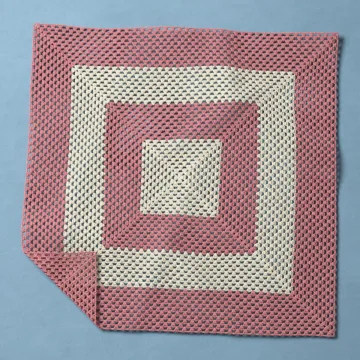
Giant granny square blanket
Easy 50 3/4 × 50 3/4 in
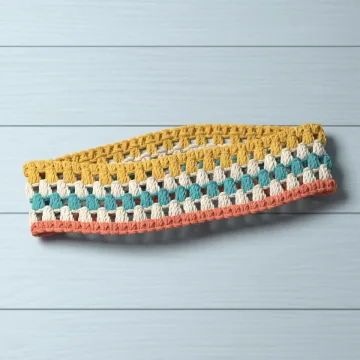
Granny cluster headband
Easy Toddler to adult large
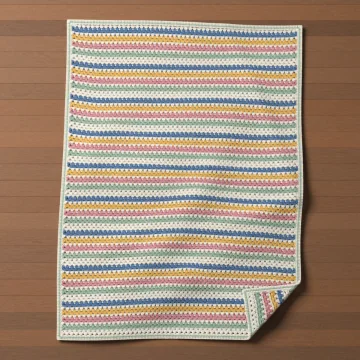
Bed size granny stripe blanket
Easy Twin to king
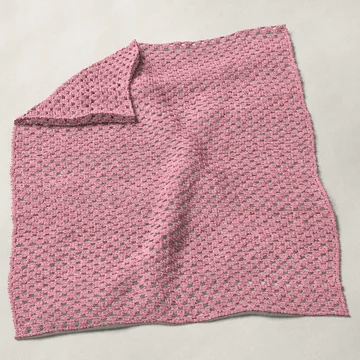
Granny groups and chains baby blanket
Easy 32 1/4 × 40 in
Granny groups and chains throwGranny groups and chains scarf
The other 27 patterns that use it
- Charcoal and scraps granny stripe throw
- Pastel rainbow granny stripe blanket
- Rainbow granny stripe throw
- Winter granny stripe throw
- Vintage scrap granny stripe throw
- Red, white and blue granny stripe throw
- Rainbow granny stripe baby blanket
- Christmas granny stripe throw
- Scrap yarn granny stripe throw
- Harvest granny stripe throw
- Clover field granny stripe throw
- Boho granny stripe scarf
- Kids' granny stripe scarf
- Gingerbread granny stripe throw
- Tropical granny stripe throw
- Christmas granny stripe scarf
- Holly granny stripe throw
- Granny stripe throw
- Halloween granny stripe throw
- Fall granny stripe throw
- Twin size granny stripe blanket
- Maroon and white granny stripe
- Honey bee baby blanket
- Granny stripe cowl
- Granny stripe infinity scarf
- Granny stripe scarf
- Granny stripe baby blanket
At a glance
- Level
- Easy
- Kind
- Shells, fans and V-stitches
- Also called
- granny stripe
- Used for
- striped blankets and throws; scarves and shawls; cardigans and other simple garments
- Multiple
- The chain is a multiple of 3 plus 1 (13 or more).
- Row repeat
- Rows 2 and 3.
- Sides
- Looks much the same on both sides.
- Edges
- Straight. Every row begins with chain 3, which counts as a double crochet, and every row ends in the top of the chain that began the row below.
- A group
- Three double crochets in one place. Some patterns call it a cluster.
- Headband or ear warmer in short rows: chain for the width
- 13, 16 or 19 chains make a band about 3 in (8 cm), 4 in (10 cm) or 4¾ in (12 cm) wide, at 14 double crochet to 4 in (10 cm)
- Headband or ear warmer in short rows: rows for the length
- Toddler 28 rows, 16 in (41 cm). Child 32 rows, 18¼ in (46 cm). Woman 36 rows, 20½ in (52 cm). Man 38 rows, 21¾ in (55 cm). At 7 rows to 4 in (10 cm)
- Headband in a ring: chain
- A multiple of 3. Child 63, woman 72, man 75; for a cowl 24 in (61 cm) around, 84. At 14 double crochet to 4 in (10 cm)
- Giant granny square: rounds for a side of 40, 50 or 60 in (102, 127 or 152 cm)
- At 3 rounds to 4 in (10 cm): 15, 19 or 23. At 5 rounds: 25, 31 or 38. At 7 rounds: 35, 44 or 53
- Worked corner to corner (see Variations), a square of 10, 15 or 20 groups on a side
- 19, 29 or 39 rows and 100, 225 or 400 groups
Tips and variations
Tips
- Count the groups, not the stitches. A row with half a group at each end has one whole group fewer than the row before it.
- Put a stitch marker in the top of the turning chain as you make it, and you can find it at the end of the next row. Some patterns work the last stitches into the space beside the turning chain instead.
Variations
- Granny stitch corner to corner: growing. This is another way of working: the rows run on the slant, from one corner. Begin with one group in a magic ring. Chain 4, which stands for a double crochet and a chain, work 3 double crochets into the ring, chain 1 and one more double crochet. Pull the ring closed. In every row after that, chain 4 and turn, work 3 double crochets in the first space, beside that chain, 3 in each gap across, and in the last space, the one under the chain 4 that began the row below, 3 double crochets, chain 1 and a double crochet. Each row gains one group: row 1 has one, row 2 two, row 3 three. Some patterns put a chain between groups and some do not. Some have no chain at the edges either: they turn with chain 3, work 3 double crochets between the first two stitches, and end with 4 between the last two.
- Granny stitch corner to corner: shrinking. When the edge is as long as you want, leave out the added groups. Chain 3, which counts as a double crochet, turn, pass over the first group, work 3 double crochets in each gap across, and end with one double crochet in the last space. Each row loses one group, until one is left. A square that grows to 10 groups has 19 rows and 100 groups. One that grows to 20 has 39 rows and 400.
- A rectangle, corner to corner. Grow until the short side is long enough. Then work two rows by turns. In one, chain 3 and turn, pass over the first group, work a group in each gap, and end with 3 double crochets, chain 1 and a double crochet in the last space. In the other, chain 4 and turn, work a group in the first space and in each gap, and end with one double crochet in the last space. One edge grows and the other shrinks, so the number of groups stays the same. When the long side is long enough, shrink at both edges.
- Granny spike stitch. Groups of three with one chain between them and three stitches passed over. From the second row on, the middle double crochet of every group goes past the chain, down to what was passed over two rows below, as a long stitch. In row 2 that is the middle one of the three chains skipped in the starting chain. In row 3 and after it is the middle stitch of the group that stands straight below. The two beside it go into the chain space. Chain a multiple of 4 plus 1, and change color every two rows so that the long stitches show.
- Drunken granny stitch. Each group leans: 4 double crochets, chain 3 and one double crochet, all in one place. In the first row skip four chains between groups. Every later group goes into the three chains of a group below. Chain a multiple of 5 plus 4. One row repeats, with a double crochet at each end.
- Granny ripple. The same groups worked up and down in a zigzag.
Questions
- Is granny stripe the same as granny stitch?
- Yes. Granny stripe and granny stitch are two names for the same rows of three-stitch groups worked into the gaps. It is often worked in stripes, with a new color every row or every few rows.
- What is the multiple for granny stitch?
- Each group and its gap take three chains. Worked straight into the chain, as here, the starting chain is a multiple of 3 plus 1. With a first row of single crochet it is a multiple of 3 plus 2. The starting chain calculator works out the number for a width of your own.
- How is it different from a granny square?
- A granny square is worked in rounds. Granny stitch uses the same groups of three, worked into the gaps, but in straight rows that are turned at each end.
- Can I work granny stitch from corner to corner?
- Yes. Start with one group. Work a group in each gap and in the space at each end, and every row has one more. At the width you want, stop working into the end spaces, and every row has one fewer. How both kinds of row begin and end is under Variations.
- Is granny corner to corner the same as C2C?
- Both start at one corner, grow and shrink. In corner to corner crochet each block is chain 3 and 3 double crochets joined to the next block with a slip stitch. In the granny way the groups stand in the gaps of the row below, so the fabric is the open granny fabric on the slant.
- How do I count the rows of a corner to corner granny square?
- Count the groups along one side. While the square grows there is one group for each row.
- How many chains for a granny stripe headband or ear warmer?
- Worked in short rows, the chain is the width of the band: 13 for a headband, 16 or 19 for an ear warmer. Work the rows on this page until the strip is 1 to 2 in (2.5 to 5 cm) shorter than the head, so that it stretches and holds. End after an even number of rows: that row has a half group at each end, so when the ends are sewn the groups still stand between groups. Sew it flat, or turn one end over once before you sew for a twist. For stripes change color at the end of a row. Worked in a ring, chain a multiple of 3, join it without a twist, and work whole groups into every third chain, then into every gap. Close each round with a slip stitch, and slip stitch along to the next gap to begin again with chain 3. The numbers for a size are in the facts above, and the headband chart has the heads.
- How do I work two colors from the center of a granny without cutting the yarn?
- Split the square on its diagonal and turn it after every round. Round 1, in the ring: with color A chain 3 and 2 double crochet for the first group, a corner of 2 chains, a group and 1 chain; pull color B through as the second chain of that corner, and let A hang; with B a group, 2 chains, a group, then 2 chains and a slip stitch in the top of the chain 3 to join. Turn. Slip stitch into the corner space beside the join, chain 3 for the first stitch of a group there, and work back with B over B's half. In the corner where A hangs, work a group, chain 1 in B, pull A through as the second chain and work the group after it in A. Go on in A to the corner you began in, work a group there, chain 2, join and turn: the next round begins in A. Every round comes back to the yarn it left, so nothing is cut and nothing is carried through the open fabric. Round 1 has 2 groups of each color, round 2 has 4, round 3 has 6, and so on: 2 more each time. On a solid square the resting yarn can be worked over instead, without turning.
- How do I make a giant granny blanket, and can I hold strands together?
- A giant granny is one granny square with more rounds. Round 10 has 40 groups, round 30 has 120: four times the number of the round. Holding two or three strands as one makes each round taller, so that fewer are needed. Two strands of medium yarn come out about as thick as a bulky or super bulky one. Take every strand through every loop, choose a hook large enough for the thickness, and measure the first four rounds before you go on. Each round adds its own height at both sides of the square, so rounds = side in inches times the rounds in 4 in (10 cm), divided by 8. The facts above give it for three sizes.