Oversized blanket crochet pattern
Easy · 2 colors · 28,680 stitches in 2 pieces · 3 sizes
Size: Oversized Change size
PDF · US Letter · 4 pages · Change paper
Go to the instructions Row counter
- Size
- About 80 × 89½ in (203 × 227 cm)With its border. The panel alone: about 77¼ × 87 in (196 × 221 cm)
- Skill
- EasyStripes, two stitches in turn, a border
- Yarn
- Bulky (5), about 4,500 yd (4,115 m), an estimate
- Hook
- 9 mm (US M/N-13)
Size 3 choices · Oversized is pictured
Which size? Blanket size chart
Paper for the PDF
For your own crochet, gifts and handmade pieces you sell. Do not resell or share this PDF or copies of it. Selling, classes and kits: the rules
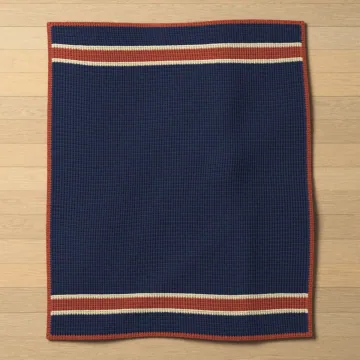
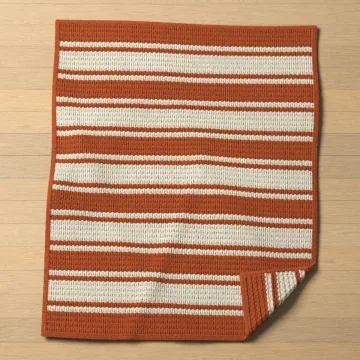
Seed stitch, also called lemon peel stitch, is a single crochet (UK double crochet) and a double crochet (UK treble) in turn, and on the next row a single on every double and a double on every single, so that the face is pebbled on both sides. One piece, as wide as a large bed, with two charcoal stripes at each end and a charcoal edge. A border is worked all the way around.
Sizes
| Size | Finished size, about | Yarn, an estimate |
|---|---|---|
| Lap | 40 × 50½ in (102 × 128 cm) | about 1,325 yd (1,212 m) |
| Oversized | 80 × 89½ in (203 × 227 cm) | about 4,500 yd (4,115 m) |
| Extra large | 89¾ × 99¾ in (228 × 253 cm) | about 5,625 yd (5,144 m) |
Gauge
9 stitches and 7 rows to 4 in (10 cm) in seed stitch.
Use any hook that gives you this. If you count more stitches than this in 4 in (10 cm), change to a larger hook; if you count fewer, to a smaller one.
How to measure it
Along a row, count every stitch and every chain between stitches as one.
To count your gauge in the middle of the test piece: there are no chains between the stitches here, so count the stitches alone: 9 stitches side by side are about 4 in (10 cm) wide, and 7 rows are about 4 in (10 cm) tall.
The pattern also stops you to measure after row 5.
Work a test square first (11 rows)
A test piece to measure and pull out. It is not the start of the pattern.
The test piece is about 6¼ in (16 cm) wide and 6¼ in (16 cm) tall, so that you can count over 4 in (10 cm) in the middle of it.
- Swatch foundationWith A, ch 15.
- Swatch row 1 (RS)Sc in 2nd ch from hook, dc in next ch, repeat: sc in next ch, dc in next ch 6 times(7 sc, 7 dc)
- Swatch rows 2 to 11Ch 1, turn; repeat: sc in next st, dc in next st 7 times(7 sc, 7 dc)
In a thinner or a thicker yarn: how many stitches you need, and how large it comes out.
To make it larger or smaller
For another width, add or take away 2 chains at a time: each 2 chains adds one more repeat of the bracketed group. Measure your own gauge first. The border is worked into whatever the edge has: count your own stitches and row ends for its first round.
The starting chain calculator opens on this pattern's multiple and gauge: type the width you want.
Before you start
How it is worked: Changing colors · Working in the round
Read the 13 notes
- The ch 1 at the start of a row does not count as a stitch: the first stitch of the row goes into the first st of the row below.
- Row 1 is the right side.
- Several of one stitch named together ("3 sc in first st") are all worked into that one place.
- Change yarn in the last yarn over of the last stitch of the row before.
- Cut a yarn when its stripe is done, leaving a tail of about 6 in (15 cm), and work over the tails as you go or weave them in at the end. The estimates include the tails; if you measure your own, add them.
- How to hold the weight: sit at a table or on a wide couch and let the finished part lie there, not in your hands. Turn the work over at the end of a row like the page of a book, one time to the left and the next time to the right, so that the yarn does not twist. When it is too wide to turn, roll the finished part toward you and turn the roll.
- To find out whether you like the stitch, work the lap size first: it is the same pattern.
- Wash and dry it as the label of the yarn says, and dry it flat: wet, it is very heavy.
- Leave a tail of about 6 in (15 cm) when you begin, and weave it in at the end with the others. Join a new ball at the end of a row, with the same tails: each join adds two ends.
- The border is worked in rounds with the right side facing. Rnd 1 begins in the st just joined, which it calls "first st", goes along the last row to the other end, which it calls "last st", then down the left side, along the foundation edge and up the right side.
- Along the foundation edge the ch skipped at the start of row 1 is not counted: the last ch is the one under the first stitch of row 1.
- The chain at the start of a round does not count as a stitch. After rnd 1, the first stitch of a round goes into the stitch that the slip stitch joined: that stitch is the first of the next stitches.
- Where a round names a new yarn, change to it in the slip stitch that joins the round before, and cut the old yarn, leaving a tail of about 6 in (15 cm).
Instructions
Size: Oversized Change sizeUS termsUK terms
First read the 13 notes just above.
- “[ ]” is a repeat.
- The count at the end is what the row leaves.
- Tick a row when it is done. Your place is kept in this browser.
- Left-handed? Work everything as it is written, the other way: rows from left to right, rounds clockwise. Left-handed crochet
How to read these rows
Square brackets “[ ]” hold a repeat: work what is inside as many times as it says. In UK terms sl st is slip stitch, sc is double crochet, hdc is half treble and dc is treble.
Blanket, row 9 in full words: With B, chain 1, turn; [single crochet in next stitch, double crochet in next stitch] 87 times.
Blanket
Yarns in order of use: A, oatmeal; B, charcoal.
- FoundationWith A, ch 175.
- Row 1RSSc in 2nd ch from hook, dc in next ch, repeat: sc in next ch, dc in next ch 86 timesleaves (87 sc, 87 dc)
- Rows 2 to 5Ch 1, turn; repeat: sc in next st, dc in next st 87 timesleaves (87 sc, 87 dc)Next: row 2 of rows 2 to 5
- Stop and measure now, after row 5.Width, across the middle of the rows and not along the chain edge: about 77¼ in (196 cm). If it is wider, start again with a smaller hook; if it is narrower, with a larger one. If only the chain edge is tight, make the chain with a larger hook.
- Rows 6 to 8Ch 1, turn; repeat: sc in next st, dc in next st 87 timesleaves (87 sc, 87 dc)Next: row 6 of rows 6 to 8
- Row 9With B, ch 1, turn; repeat: sc in next st, dc in next st 87 timesleaves (87 sc, 87 dc)
- Rows 10 to 14Ch 1, turn; repeat: sc in next st, dc in next st 87 timesleaves (87 sc, 87 dc)Next: row 10 of rows 10 to 14
- Row 15With A, ch 1, turn; repeat: sc in next st, dc in next st 87 timesleaves (87 sc, 87 dc)
- Rows 16 to 18Ch 1, turn; repeat: sc in next st, dc in next st 87 timesleaves (87 sc, 87 dc)Next: row 16 of rows 16 to 18
- Row 19With B, ch 1, turn; repeat: sc in next st, dc in next st 87 timesleaves (87 sc, 87 dc)
- Rows 20 to 24Ch 1, turn; repeat: sc in next st, dc in next st 87 timesleaves (87 sc, 87 dc)Next: row 20 of rows 20 to 24
- Row 25With A, ch 1, turn; repeat: sc in next st, dc in next st 87 timesleaves (87 sc, 87 dc)
- Rows 26 to 128Ch 1, turn; repeat: sc in next st, dc in next st 87 timesleaves (87 sc, 87 dc)Next: row 26 of rows 26 to 128
- Row 129With B, ch 1, turn; repeat: sc in next st, dc in next st 87 timesleaves (87 sc, 87 dc)
- Rows 130 to 134Ch 1, turn; repeat: sc in next st, dc in next st 87 timesleaves (87 sc, 87 dc)Next: row 130 of rows 130 to 134
- Row 135With A, ch 1, turn; repeat: sc in next st, dc in next st 87 timesleaves (87 sc, 87 dc)
- Rows 136 to 138Ch 1, turn; repeat: sc in next st, dc in next st 87 timesleaves (87 sc, 87 dc)Next: row 136 of rows 136 to 138
- Row 139With B, ch 1, turn; repeat: sc in next st, dc in next st 87 timesleaves (87 sc, 87 dc)
- Rows 140 to 144Ch 1, turn; repeat: sc in next st, dc in next st 87 timesleaves (87 sc, 87 dc)Next: row 140 of rows 140 to 144
- Row 145With A, ch 1, turn; repeat: sc in next st, dc in next st 87 timesleaves (87 sc, 87 dc)
- Rows 146 to 152Ch 1, turn; repeat: sc in next st, dc in next st 87 timesleaves (87 sc, 87 dc)Next: row 146 of rows 146 to 152
- EndFasten off, leaving a 6 in (15 cm) tail.
Border
Yarns in order of use: A, oatmeal; B, charcoal.
- FoundationRight side facing and row 152 at the top, join A with sl st in the stitch that ends row 152, at the top right corner.
- Rnd 1RSCh 1, 3 sc in first st, sc in next 172 sts, 3 sc in last st, repeat: sc in end of each of next 3 rows, 2 sc in end of next row 38 times, 3 sc in first ch of foundation edge, sc in next 172 chs, 3 sc in last ch of foundation edge, repeat: sc in end of each of next 3 rows, 2 sc in end of next row 38 times, sl st in first sc to joinleaves (736 sc)
- Rnd 2RSWith B, ch 2, hdc in next st, 3 hdc in next st, hdc in next 174 sts, 3 hdc in next st, hdc in next 192 sts, 3 hdc in next st, hdc in next 174 sts, 3 hdc in next st, hdc in next 191 sts, sl st in first hdc to joinleaves (744 hdc)
- Rnd 3RSCh 2, hdc in next 2 sts, 3 hdc in next st, hdc in next 176 sts, 3 hdc in next st, hdc in next 194 sts, 3 hdc in next st, hdc in next 176 sts, 3 hdc in next st, hdc in next 192 sts, sl st in first hdc to joinleaves (752 hdc)
- EndFasten off, leaving a 6 in (15 cm) tail.
Finishing
- Weave in the ends.
- Lay the piece flat, pull it gently to its size, dampen it and let it dry.
In all: 28,680 stitches (26,448 in the blanket, 2,232 in the border); 22 ends to weave in.