Recliner cover with pockets crochet pattern
Crochet, 22½ × 62¾ in, 2 colors, intermediate
PDF. Prints on US Letter and A4.
What you need
- Yarn A deep greenabout 2,000 yd (1,829 m), an estimatethe runner, the arm panels and the pockets
- Yarn B camelabout 250 yd (229 m), an estimatethe edges, the tops of the pockets and the buttonholes
- Yarn in all
- About 2,250 yd (2,057 m) or 1,150 g, an estimate
- Weight
- Medium weight, 4 on the label (UK aran), wool blend
- Hook
- 5.5 mm (US I-9), or the size that gives you the gauge
- Also
- 6 buttons, 1 in (25 mm) across, in camel or wood, sewing thread in green and a sewing needle, 6 stitch markers, pins, a yarn needle and scissors
- Gauge
- 14 stitches and 9 rows to 4 in (10 cm) in the waffle stitch. How to check it
Instructions Medium
How to read these rows
US terms · Show UK terms
- ch chain, sl st slip stitch, sc single crochet (UK double crochet), hdc half double crochet (UK half treble), dc double crochet (UK treble).
- FPdc round the stitch below, from the front, sk skip, RS right side, the one that shows.
- 3 sc in next st: all in one stitch. dc in next 74 sts: one in each. ch-3 sp: the gap under three chains; the hook goes in the gap.
- [ ] 24 times: work what is inside 24 times in all.
- (75 sc): the stitches you have when the row is done. How to read a pattern.
- Post stitches. Working in the round.
- In the pocket panels the chain of 2 and the chain of 1 at the start of a row do not count as a stitch. Change to B by drawing it through as the last yarn over of the last stitch in A, and cut A, leaving a tail of 6 in (15 cm).
Go to: Runner · Edge of the runner · Arm panel · Edge of the arm panel · Pocket panel · Assembly
Runner
Yarn A, deep green.
- StartCh 76.
- Row 1RSSc in 2nd ch from hook and in each ch acrossleaves (75 sc)
- Row 2Ch 3 (counts as dc), turn; dc in next 74 stsleaves (75 dc)
Waffle
- Row 3RSCh 3 (counts as dc), turn; repeat: FPdc around next st, dc in next 2 sts 24 times, FPdc around next st, dc in last stleaves (50 dc, 25 FPdc)
- Row 4Ch 3 (counts as dc), turn; dc in next st, repeat: FPdc around next 2 sts, dc in next st 24 times, dc in last stleaves (27 dc, 48 FPdc)
- Rows 5 to 139Repeat rows 3 and 4 in turn: every even-numbered row is worked as row 4, every odd-numbered row as row 3.Row 3: Ch 3 (counts as dc), turn; [FPdc around next st, dc in next 2 sts] 24 times, FPdc around next st, dc in last stRow 4: Ch 3 (counts as dc), turn; dc in next st, [FPdc around next 2 sts, dc in next st] 24 times, dc in last stNext: row 5 of rows 5 to 139, worked as row 3
- EndFasten off, leaving a tail of 6 in (15 cm).
Edge of the runner
Yarn B, camel.
- StartThe piece just worked, 75 stitches and 139 rows; turn it so that the right side faces you, its last row up, and begin at the right end of that row.
- Rnd 1RSJoin B with sl st in first st, ch 1, 3 sc in same st, sc in next 73 sts, 3 sc in next st, repeat: sc in end of next row, 2 sc in end of next row 69 times, sc in end of next row, 3 sc in next ch, sc in next 73 chs, 3 sc in next ch, sc in end of next row, repeat: sc in end of next row, 2 sc in end of next row 69 times, sl st in first sc to joinleaves (574 sc)
- Rnd 2Ch 1, sc in first st, 3 sc in next st, sc in next 75 sts, 3 sc in next st, sc in next 210 sts, 3 sc in next st, sc in next 75 sts, 3 sc in next st, sc in next 209 sts, sl st in first sc to joinleaves (582 sc)
- EndFasten off, leaving a tail of 6 in (15 cm).
Arm panel make 2
Yarn A, deep green.
- StartCh 40.
- Row 1RSSc in 2nd ch from hook and in each ch acrossleaves (39 sc)
- Row 2Ch 3 (counts as dc), turn; dc in next 38 stsleaves (39 dc)
Waffle
- Row 3RSCh 3 (counts as dc), turn; repeat: FPdc around next st, dc in next 2 sts 12 times, FPdc around next st, dc in last stleaves (26 dc, 13 FPdc)
- Row 4Ch 3 (counts as dc), turn; dc in next st, repeat: FPdc around next 2 sts, dc in next st 12 times, dc in last stleaves (15 dc, 24 FPdc)
- Rows 5 to 57Repeat rows 3 and 4 in turn: every even-numbered row is worked as row 4, every odd-numbered row as row 3.Row 3: Ch 3 (counts as dc), turn; [FPdc around next st, dc in next 2 sts] 12 times, FPdc around next st, dc in last stRow 4: Ch 3 (counts as dc), turn; dc in next st, [FPdc around next 2 sts, dc in next st] 12 times, dc in last stNext: row 5 of rows 5 to 57, worked as row 3
- EndFasten off, leaving a tail of 6 in (15 cm).
Edge of the arm panel make 2
Yarn B, camel.
- StartThe arm panel just worked, 39 stitches and 57 rows; turn it so that the right side faces you, its last row up, and begin at the right end of that row.
- Rnd 1RSJoin B with sl st in first st, ch 1, 3 sc in same st, sc in next 37 sts, 3 sc in next st, repeat: sc in end of next row, 2 sc in end of next row 28 times, sc in end of next row, 3 sc in next ch, sc in next 37 chs, 3 sc in next ch, sc in end of next row, repeat: sc in end of next row, 2 sc in end of next row 28 times, sl st in first sc to joinleaves (256 sc)
- Rnd 2Ch 1, sc in first st, 3 sc in next st, sc in next 5 sts, repeat: ch 3, sk next 3 sts, sc in next 10 sts 2 times, ch 3, sk next 3 sts, sc in next 5 sts, 3 sc in next st, sc in next 87 sts, 3 sc in next st, sc in next 39 sts, 3 sc in next st, sc in next 86 sts, sl st in first sc to joinleaves (255 sc, 3 ch-3 sps)
- Rnd 3Ch 1, sc in first st, sc in next st, 3 sc in next st, sc in next 6 sts, repeat: 3 sc in next ch-3 sp, sc in next 10 sts 2 times, 3 sc in next ch-3 sp, sc in next 6 sts, 3 sc in next st, sc in next 89 sts, 3 sc in next st, sc in next 41 sts, 3 sc in next st, sc in next 87 sts, sl st in first sc to joinleaves (272 sc)
- EndFasten off, leaving a tail of 6 in (15 cm).
Pocket panel make 2
Yarns in order of use: A, deep green; B, camel.
- StartCh 41.
- Row 1RSHdc in 3rd ch from hook and in each ch acrossleaves (39 hdc)
- Rows 2 to 13Ch 2, turn; hdc in each st acrossleaves (39 hdc)Next: row 2 of rows 2 to 13
- Row 14With B, ch 2, turn; hdc in each st acrossleaves (39 hdc)
- Rows 15 to 16Ch 1, turn; sc in each st acrossleaves (39 sc)Next: row 15 of rows 15 to 16
- EndFasten off, leaving a tail of 6 in (15 cm).
Assembly
- Weave in all the tails on the wrong side of their pieces. The right side of every piece is the side that shows the waffle squares sunk between raised ribs; on the pockets it is the side that faced you in row 1.
- The pockets. Lay an arm panel with its right side up, its foundation chain toward you. Lay a pocket panel on it, right side up, its foundation chain along the line where the waffle meets the camel edge at that end, its 39 stitches over the 39 stitches of the arm panel and its side edges along the lines where the waffle meets the side edges. Its top edge comes to about row 14 of the arm panel. Pin it.
- Cut a length of A about 84 in (213.5 cm) long. Begin at the top of the side at your right with an end of 6 in (15 cm). Sew the pocket down that side, along its foundation chain and up the other side: bring the needle up through the pocket one stitch in from its edge and down through the arm panel just beside the edge of the pocket, one stitch for each row and one for each chain. Work two stitches over each other at both top corners, fasten off on the back and draw both ends in between the layers. Take the pins out.
- For the seam in the middle put a marker in the 20th of the 39 chains of the pocket and one in the 20th stitch of its last row. Cut a length of A about 36 in (91.5 cm) long and backstitch straight up from the one marker to the other, through both layers, one backstitch for each row of the pocket. Finish with two stitches over the top edge, fasten off on the back of the arm panel and draw both ends in between the layers. Take the markers out. Make the pockets of the second arm panel in the same way.
- The buttons. Lay the runner with its right side up, its foundation chain, the front edge of the seat, toward you. On each side edge count the stitches of round 1 of the edge from the middle one of the 3 sc at the front corner, not counted, toward the back, and put a marker in the 18th, the 31st and the 44th: 6 markers in all. With sewing thread sew a button on the right side at each marker, over the line where the waffle meets the edge: four times through its holes and through the fabric, and fasten off beneath. Take the markers out. Three buttons lie along each side, about 3¾ in (9.5 cm) apart. Where a panel hung from them would cover the lever of the chair, put all three buttons on that side farther back or farther forward by the same number of stitches, so that the panel hangs at least 4 in (10 cm) clear of it.
- Button an arm panel on each side: the end with the buttonholes, right side up, over the side edge of the runner, so that the pockets are at the far end. Both panels are alike and either can go on either side.
Finishing
- Lay the runner over the recliner, its foundation chain at the front of the seat, and the arm panels over the arms. See that nothing hangs over the lever, the hinges or the footrest, and that the front edge of the runner lies on the seat. Put the chair back and up again once by hand and look that nothing is caught.
About
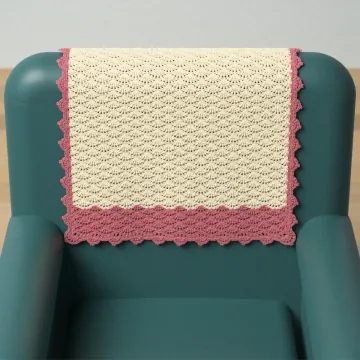
A recliner cover for headrest, back and seat in one piece, in deep green waffle with camel edges, and two arm panels that button on and carry pockets. The long runner goes from behind the headrest down the back and over the seat, and stops at the front edge of the seat, above the footrest. An arm panel buttons to each side of the seat, goes up and over the arm and hangs outside it, with a pocket for a remote control and one for glasses. The panels are not sewn on, so they come off for the wash and can be set forward or back, clear of a lever.