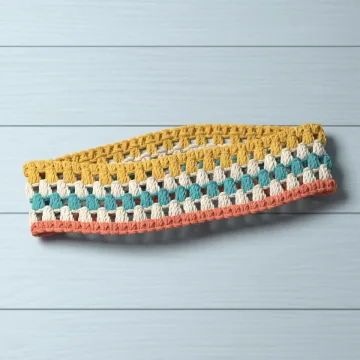
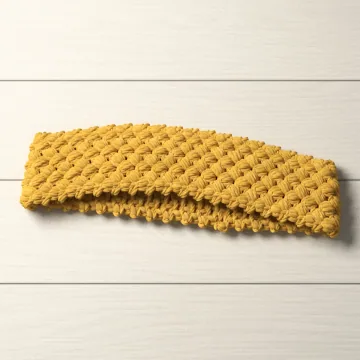
Flower headband crochet pattern
Intermediate · 6 colors · 846 stitches in 4 pieces
PDF · US Letter · 4 pages · Change paper
Go to the instructions Row counter
- Size
- About 19¾ in (50 cm) round and 3½ in (9 cm) wide, with a flower about 4 in (10 cm) across
- Skill
- IntermediateWorked in rows and rounds, with 4 pieces, color changes and 1 special stitch.
- Yarn
- Medium (4), about 105 yd (96 m), an estimate
- Hook
- 5 mm (US H-8)
Paper for the PDF
For your own crochet, gifts and handmade pieces you sell. Do not resell or share this PDF or copies of it. Selling, classes and kits: the rules
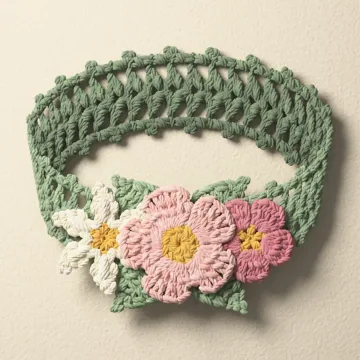
A ribbed headband in half double crochet, worked sideways and sewn to a ring, with a flower in three layers of six petals, blush over rose over dusty rose, and two sage leaves.
Gauge
14 stitches and 15 rows to 4 in (10 cm) in single crochet.
In the ribbed half double crochet of the band, 14 stitches measure 4 in (10 cm) across and 10½ rows measure 4 in (10 cm).
Use any hook that gives you this. If you count more stitches than this in 4 in (10 cm), change to a larger hook; if you count fewer, to a smaller one.
How to measure it
In a thinner or a thicker yarn: how many stitches you need, and how large it comes out.
Before you start
How it is worked: Magic ring · Changing colors · Working in the round
Read the 18 notes
- Rounds are worked with the right side facing; do not turn.
- Where a line says turn, turn the piece over and work back along the stitches just made.
- Magic ring: wrap the yarn round two fingers, work the first round or row into the loop, then pull the tail until the ring is closed. Four chains joined into a ring with a slip stitch may be used instead.
- A chain that counts as a stitch is marked so in its line and is included in the count.
- A chain 1 at the start of a round or a row does not count as a stitch.
- Fasten off the old color, then join the new one with a slip stitch in the place named; the first stitch or chain of the line is worked in that same place.
- Front loop: the strand of the top of a stitch nearest you; back loop: the strand farther from you. Working into one leaves the other free for a later round.
- Where a line names an earlier round, fold what has been worked since toward you and work into the stitches of that round behind it.
- Working along the other side of the chain: turn the piece round, not over, and work into the unused loops of the foundation chain, beginning in the chain next to the one just used.
- A round worked in each st around begins in the st the round before was joined in, or the new color was joined in.
- The figures in brackets at the end of a line count its stitches, its picots and the chain spaces between them; slip stitches are not counted.
- The band is worked sideways: its rows run across the headband, from one long edge to the other. Working in back loops only makes the ribs. Its two sides look alike; call either one the right side.
- Other lengths: work 48 rows in all for a band about 18¼ in (46 cm) round, or 56 rows in all for a band about 21¼ in (54 cm) round. Every 4 rows add or take about 1½ in (3.8 cm). The band stretches.
- Flower, Rnd 3 is worked in the front loops of Rnd 2, the joining sl st too. Each petal stands in one sc and is held down by a sl st in the next sc. The round ends with the sl st in the 12th sc, beside the first petal; it is not joined.
- Flower, Rnds 4 and 6 are worked in the back loops of Rnd 2, the joining sl st too. Rnd 4 goes into the 6 sc that hold the petals of Rnd 3, and Rnd 6 into the 6 sc left between them; the last chain of each passes over the one sc that is left before the join. So the petals of Rnd 5 lie behind the gaps of Rnd 3, and those of Rnd 7 behind the gaps of Rnd 5.
- Leaf: the picot is the tip. The stem end is the other end, where the round began.
- The distances under FINISHING are for the yarn and gauge above; in another yarn make them larger or smaller in the same proportion as the size.
- The same words in another yarn make another size, measured round the ring: fine yarn (2) and a 3.25 mm hook, about 13¼ in (34 cm); light yarn (3) and a 4 mm hook, about 15¼ in (39 cm); bulky yarn (5) and a 6.5 mm hook, about 25 in (64 cm).
Instructions
First read the 18 notes just above.
- “[ ]” is a repeat.
- “( )” goes into one place.
- The count at the end is what the row leaves.
- Tick a row when it is done. Your place is kept in this browser.
- Left-handed? Work everything as it is written, the other way: rows from left to right, rounds clockwise. Left-handed crochet
How to read these rows
Square brackets “[ ]” hold a repeat: work what is inside as many times as it says. Round brackets “( )” inside a line hold stitches that all go into one place. In UK terms sl st is slip stitch, sc is double crochet, hdc is half treble, dc is treble, tr is double treble and dtr is triple treble.
Band
Yarn A, oatmeal.
- FoundationWith A, ch 13.
- Row 1Hdc in 2nd ch from hook, hdc in each rem ch acrossleaves (12 hdc)
- Rows 2 to 52Ch 1, turn, working in back loops only, hdc in each st acrossleaves (12 hdc)Next: row 2 of rows 2 to 52
- EndFasten off, leaving a 20 in (51 cm) tail for sewing.
Flower
Yarns in order of use: B, ochre; C, blush; D, rose; E, dusty rose.
- FoundationWith B, make a magic ring.
- Rnd 1RSCh 1, 6 sc in ring, sl st in first sc to joinleaves (6 sc)
- Rnd 2Ch 1, 2 sc in each st around, sl st in first sc to joinleaves (12 sc)
Fasten off B.
- Rnd 3Join C with sl st in first sc, working in front loops only, ch 3 (counts as dc), 5 dc in same st, sl st in next st, repeat: 6 dc in next st, sl st in next st 5 timesleaves (36 dc)
Fasten off C.
- Rnd 4Join D with sl st in first sc of Rnd 2, working in back loops only, ch 1, sc in same st, ch 4, repeat: sk next sc of Rnd 2, sc in next sc of Rnd 2, ch 4 5 times, sl st in first sc to joinleaves (6 sc, 6 ch-4 sps)
- Rnd 5Ch 1, repeat: (sc, hdc, dc, 3 tr, dc, hdc, sc) in next ch-4 sp 6 times, sl st in first sc to joinleaves (12 sc, 12 hdc, 12 dc, 18 tr)
Fasten off D.
- Rnd 6Join E with sl st in 2nd sc of Rnd 2, working in back loops only, ch 1, sc in same st, ch 5, repeat: sk next sc of Rnd 2, sc in next sc of Rnd 2, ch 5 5 times, sl st in first sc to joinleaves (6 sc, 6 ch-5 sps)
- Rnd 7Ch 1, repeat: (sc, hdc, dc, tr, 3 dtr, tr, dc, hdc, sc) in next ch-5 sp 6 times, sl st in first sc to joinleaves (12 sc, 12 hdc, 12 dc, 12 tr, 18 dtr)
- EndFasten off, leaving a 24 in (61 cm) tail for sewing.
Leaf make 2
Yarn F, sage.
- FoundationWith F, ch 10.
- Rnd 1Sc in 2nd ch from hook, hdc in next ch, dc in next ch, tr in next 2 chs, dc in next ch, hdc in next ch, sc in next ch, (sc, picot, sc) in next ch, working along the other side of the chain, sc in next ch, hdc in next ch, dc in next ch, tr in next 2 chs, dc in next ch, hdc in next ch, sc in next ch, sl st in first sc to joinleaves (6 sc, 4 hdc, 4 dc, 4 tr, 1 picot)
- EndFasten off, leaving a 14 in (36 cm) tail for sewing.
Finishing
- Block: lay the band flat without pulling the ribs apart and pin the petals of the flower and the two leaves to shape on a flat surface, right sides up. Spray the pieces with water and let them dry.
- Band: bring the foundation chain and the last row together, right side outside, so that the band is a ring, and with the tail of the band sew each of the 12 sts of the last row to the chain opposite it. This is the seam.
- Lay the band flat and doubled, with the seam in the middle of the layer underneath. Mark the middle of the upper layer: it is halfway between the two long edges and halfway between the two folds. Lay the flower on it, right side up, with its magic ring halfway between the long edges and 1 in (2.5 cm) to the left of the mark, and pin it.
- Slide the two leaves, right side up, under the back petals of the flower at its right: the tip of one lies 3½ in (8.9 cm) to the right of the magic ring of the flower and 1¼ in (3.2 cm) higher than it, the tip of the other as far to the right and 1¼ in (3.2 cm) lower. About 1¼ in (3.2 cm) of the stem end of each is hidden under the petals, and the two stem ends nearly meet. Sew each leaf to the upper layer with its tail, along the foundation chain in its middle.
- Sew the flower to the upper layer with its tail, all round through the feet of the 6 back petals, close to the middle, and leave the petals free. Sew through the upper layer only.
- Weave in all the ends that are left with the yarn needle.
In all: 4 pieces; 846 stitches (624 in the band, 186 in the flower, 18 in each leaf).